Textile plants rolling out cloud MES, on-premise ERP upgrades and third-party integrations gain production speed but also widen the attack surface across every loom, dye controller and quality gate on the floor. A single unauthenticated API bridge between a scheduling server and a finishing line can expose batch recipes, throughput data and customer order details in minutes. Security frameworks built for office networks do not survive contact with harsh production environments, vibrating cabinets and flat-panel HMIs running outdated firmware. If your plant is scaling digital connectivity without a hardened checklist, the gap between your software ambitions and your actual protection is already wider than you think. For a structured walk-through of every checklist item mapped to your own stack, you can review your textile security posture with our team.
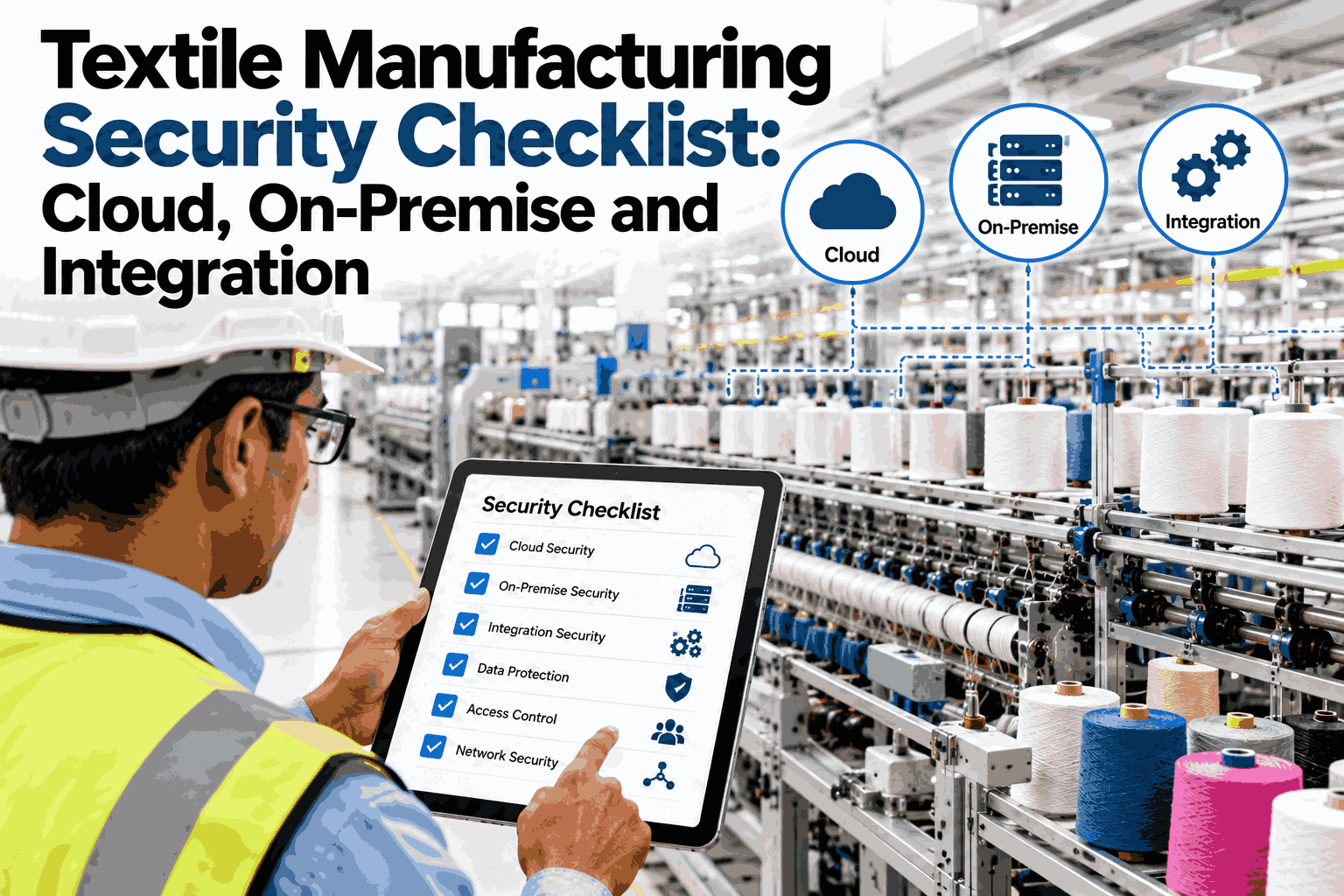
Textile Security Checklist 2026
Cloud, On-Premise and Integration Security Checklist
A practical checklist to lock down cloud MES, on-premise ERP and machine integrations across spinning, weaving, dyeing and finishing lines before a single gap costs you a production shift.
Section A
Cloud MES and SaaS Security Controls
Cloud applications for production scheduling, quality tracking and maintenance planning are the norm in textile plants migrating away from paper. But cloud access from the shop floor introduces risks that standard IT policies miss.
Enforce multi-factor authentication on every cloud MES account, including shared kiosk logins used by shift operators on the weaving floor
Restrict cloud API endpoints to fixed plant IP ranges and deny access from public networks unless a VPN tunnel is active
Enable audit logging for all write operations so recipe changes, order overrides and quality dispositions are traceable to a specific user
Validate that your SaaS vendor encrypts data at rest using AES-256 and in transit using TLS 1.2 or higher for all sub-domains
Confirm the vendor isolates tenants so your production data is never stored on the same logical volume as another textile company
Set automated session timeouts on shop-floor kiosks to prevent idle cloud sessions staying open through shift changes
Section B
On-Premise ERP and Server Hardening
Your ERP holds the crown jewels: customer orders, BOMs, dye recipes, pricing and shipment records. On-premise deployments in textile plants often run on aging server hardware inside cabinets that are physically accessible on the production floor.
Lock server cabinets and log physical access with badge readers, not just a key that any maintenance technician can copy
Apply critical OS patches within 14 days and automate patch scanning weekly so known CVEs cannot be exploited for lateral movement
Separate application service accounts from database admin accounts to stop ransomware encrypting the entire DB via an over-privileged app
Test full database restore quarterly and keep an offline backup copy segmented from the network so ransomware cannot reach it
Place the ERP in a dedicated VLAN with firewalls restricting ingress to known application ports only, blocking all generic traffic
Run This Checklist Against Your Own Plant
Book a session with iFactory AI and we will walk through every cloud, on-premise and integration control for your specific textile environment.
Section C
Integration and API Bridge Security
Integrations are where cloud meets on-premise, where MES meets ERP, and where modern REST APIs meet twenty-year-old OPC DA servers. This is the highest-risk layer because it is the least standardized and the most often custom-built.
Require mutual TLS on every API bridge between cloud MES and on-premise ERP so both sides verify identity before exchanging data
Deploy an API gateway that logs, rate-limits and inspects payloads for any integration touching production order or recipe data
Remove hardcoded credentials from integration config files and use a secrets manager or vault for service account passwords
Validate that OPC UA gateways use signed application certificates and that unsigned Classic DA wrappers are firewalled off
Limit integration service accounts to the minimum data scope needed: read-only for reporting, write-only for specific transaction tables
Schedule quarterly reviews of every active integration endpoint and decommission any bridge that is no longer in production use
Section D
Operational Technology Network Segmentation
Segmentation is the backbone of defense for a connected textile plant. Without it, every device on the floor shares a flat broadcast domain with the ERP, the cloud gateway and the office network.
Define firewall rules between each network level so traffic can only flow one level up or down, never skipping across the DMZ
Place all cloud-facing integration brokers inside the enterprise DMZ with no direct route into the OT control zone
Isolate legacy loom data servers on a separate VLAN and pull data through a diode or unidirectional gateway into the historian
Block all inbound traffic to Level 1 field devices and allow only outbound poll responses to the historian or OPC server
Deploy network monitoring on the OT DMZ to alert on any unauthorized cross-boundary traffic attempts in real time
Section E
Machine Connectivity and Floor Device Controls
Security checklists often stop at the server room door. On a textile floor, the biggest exposure is the collection of HMIs, PLCs and edge devices that control the actual process and are now connected to plant networks for data collection.
Replace or isolate flat-panel HMIs running unsupported Windows CE or embedded XP and remove shared operator logins on weaving kiosks
Segment legacy dye-house PLCs that lack modern authentication onto isolated network zones with strict firewall ingress rules
Migrate loom data collection from unencrypted FTP to SFTP or MQTT over TLS so production metrics are never transmitted in clear text
Change default credentials on all IoT edge gateways translating serial loom data and add them to the regular firmware patching cycle
Disable unused communication ports on all floor devices and PLCs to reduce the available attack surface for network scanners
Section F
Access Governance and Incident Readiness
Even with strong technical controls, human access and incident response procedures determine whether a breach is contained in minutes or discovered months later.
Implement role-based access control so operators only see their line, shift managers see their department, and plant-wide admin is rare
Revoke access for terminated employees within 24 hours and audit dormant accounts quarterly to close orphaned service logins
Run tabletop incident response exercises annually focused specifically on OT ransomware scenarios hitting dye controllers or loom servers
Document a recovery runbook for each critical system specifying rebuild steps, data restore sources and acceptable downtime windows
Establish a log aggregation pipeline that forwards OT security events to the SIEM so anomalies on the floor trigger alerts, not just IT events
Scoring and Prioritization
How to Score This Checklist for Your Plant
Running a checklist is only useful if you can measure progress and prioritize the gaps that carry the most production risk. A simple scoring model helps your team focus on the controls that stop real attacks rather than chasing compliance points.
| Checklist section | Typical risk level | Weight if incomplete | Review frequency |
|---|
| Section A: Cloud MES | High | Critical for SaaS plants | Quarterly |
| Section B: On-Premise ERP | High | Critical for ERP plants | Quarterly |
| Section C: API Bridges | Critical | Highest exploit path | Monthly |
| Section D: OT Segmentation | Critical | Highest lateral movement | Annually |
| Section E: Floor Devices | High | Often overlooked | Quarterly |
| Section F: Access and Incidents | Medium to High | Governance gap | Annually |
API bridges and OT segmentation consistently rank as critical because they are the paths an attacker actually uses to move from a compromised HMI to the ERP database. Score your own environment and build a quarterly remediation roadmap. Build your remediation roadmap on a call with iFactory AI.
Frequently asked questions
What Textile Plants Ask Before Running This Checklist
Can we apply this checklist if we only use cloud MES and have no on-premise ERP?
Yes, you would focus on sections A and C for cloud controls and API bridges, while using section D for OT segmentation of your floor network. Skip section B or use it to validate any on-premise historian or data collector.
Ask support about cloud-only deployments for your plant.
How do we secure loom HMIs that cannot be upgraded or patched?
Unpatchable HMIs must be network-segmented into the Level 2 control zone with strict firewall rules blocking lateral movement, and should access plant systems only through a jump host or published application.
Review HMI isolation designs with our team.
Our integrator built custom API bridges; how do we audit them?
Start by inventorying every bridge, then demand documentation for authentication method, data scope and logging. Validate each item against section C of this checklist.
Book an integration audit to walk through them together.
Does network segmentation slow down data collection from the floor?
Properly designed segmentation using a DMZ and OPC UA gateways adds milliseconds of latency, which is irrelevant for production monitoring and quality tracking.
Discuss performance architecture with our support team.
How often should we re-run this checklist?
Run a full review annually or whenever you add a new integration, upgrade a major ERP module or connect a new line to the cloud MES. Quarterly spot-checks on the critical items in sections C and D are recommended.
Set up a recurring review cadence with iFactory AI.
Secure your digital plant
Get This Checklist Applied to Your Textile Environment
Book a free session with iFactory AI to walk through every cloud, on-premise and integration control for your spinning, weaving, dyeing and finishing lines.