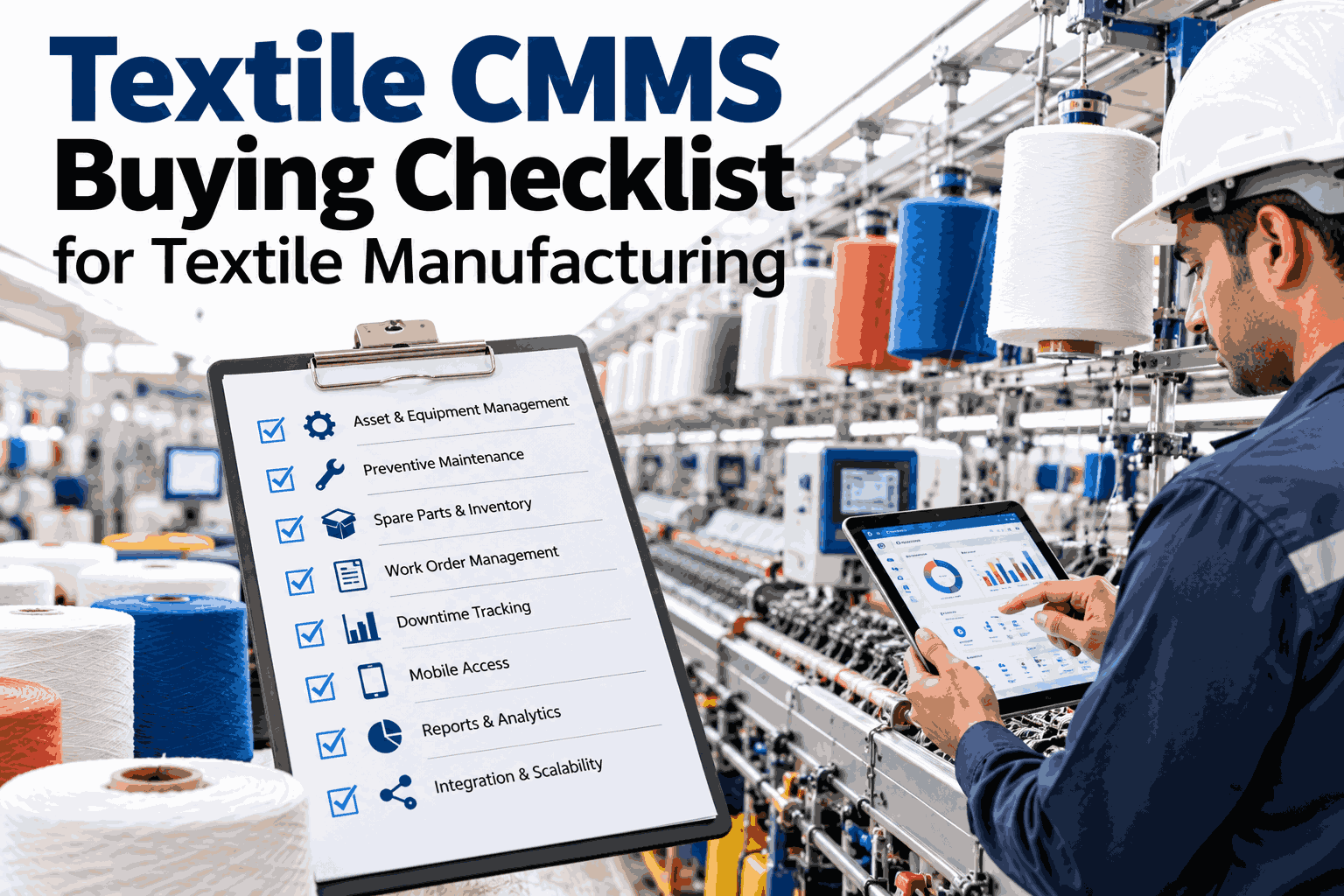
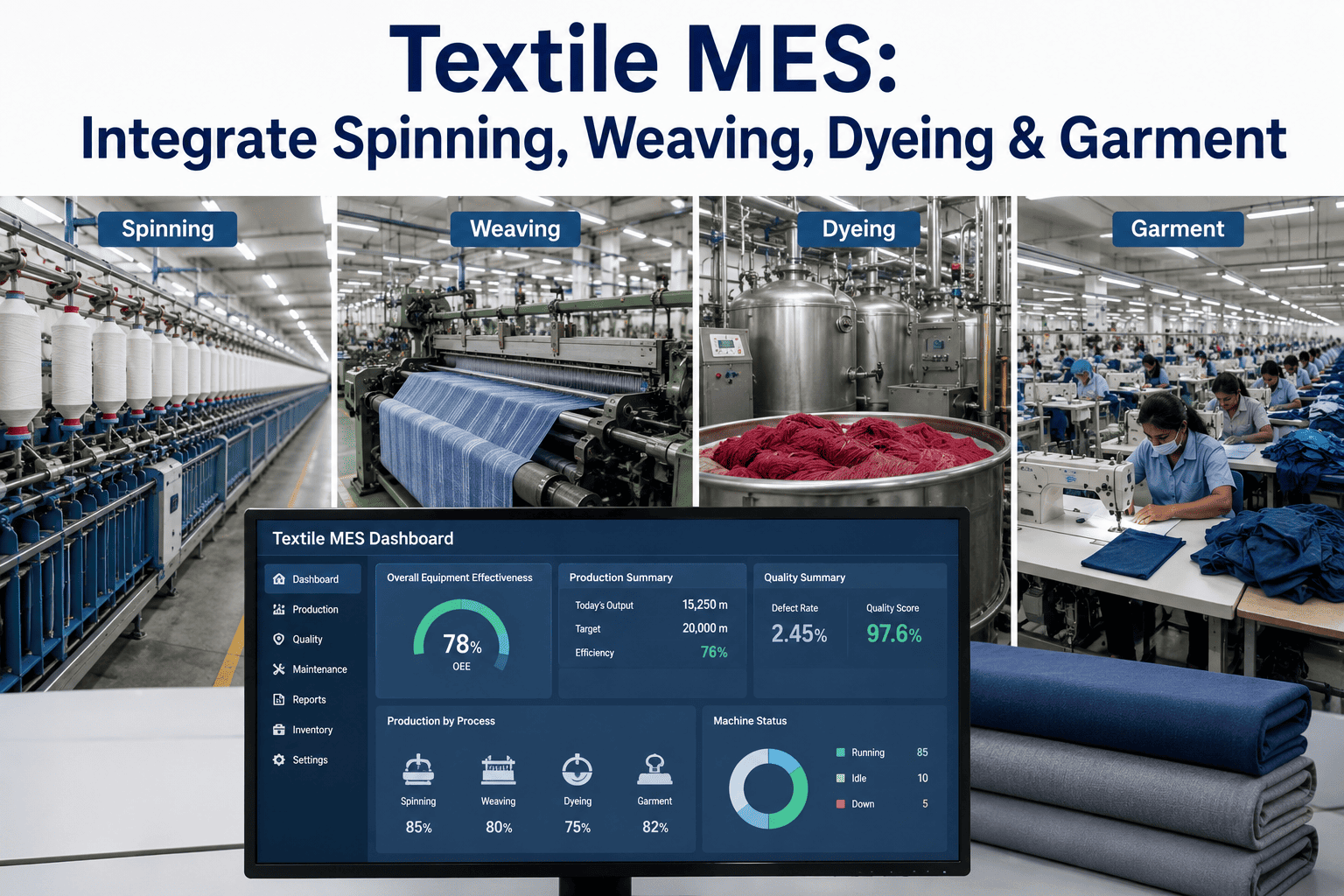
A generic CMMS checklist asks whether a system can log a work order and send a notification, which almost every vendor can do. It rarely asks whether the system can handle a ring frame spindle change, a loom beam replacement, or a dye jet's descaling cycle, which is where a textile maintenance team actually lives day to day. This checklist is built around those three floors specifically, and you can walk through it against your own equipment list with our team.
CMMS buying checklist
A CMMS Checklist Built for Spinning, Weaving, and Dyeing Floors
Go beyond generic maintenance software questions and check a vendor against what actually keeps a textile plant's machines running.
A sample of what you are about to check
Tracks spindle-level maintenance history on ring frames
Schedules loom beam and reed replacement by run hours
Logs dye jet descaling and chemical dosing checks
Why generic falls short
Why a Generic Maintenance Checklist Misses the Point
Most CMMS checklists are written for discrete manufacturing, where a machine either runs or does not. Textile equipment fails in more specific, process-dependent ways.
It ignores process-specific wear. A spindle wearing unevenly or a dye jet losing pressure does not always trigger a hard stop, so generic alerting misses it.
It treats all machines the same. A ring frame, a loom, and a dye jet fail differently and need different maintenance checklists, not one generic template.
It skips run-hour based scheduling. Many textile maintenance tasks are tied to spindle hours or meters run, not calendar days, which generic systems rarely handle well.
It is not built for humid, dusty floors. Mobile maintenance tools built for clean environments often struggle on a lint-heavy spinning or weaving floor.
Spinning floor
Spinning Floor Checklist: Ring Frames and Spindles
Spinning equipment runs continuously for long stretches, so maintenance here is mostly about catching gradual wear before it turns into a quality defect.
Tracks maintenance history at individual spindle level, not just machine level
Schedules preventive tasks by run hours, not only by calendar date
Flags bearing and belt wear trends before a breakdown stops the frame
Links a yarn quality defect back to the spindle that produced it
Supports lint and dust-tolerant mobile checklists for floor technicians
Logs spare part usage per frame to track recurring part failures
Weaving and knitting floor
Weaving and Knitting Floor Checklist: Looms and Beams
Weaving and knitting equipment maintenance is driven heavily by mechanical wear on moving parts and by beam and reed replacement cycles.
Schedules beam and reed replacement based on meters woven, not only time
Tracks shuttle, heddle, and picker stick wear across looms
Links fabric defects to a specific loom and the maintenance done on it
Supports both shuttle and shuttleless loom maintenance profiles
Records knitting needle breakage patterns to catch a recurring issue
Prioritizes work orders by production impact, not just request order
Dyeing and finishing floor
Dyeing and Finishing Floor Checklist: Jets, Jigs, and Finishing Lines
Dyeing equipment failures often show up as a shade or finish defect before they show up as a hard machine stop, which makes early signals especially valuable here.
Logs descaling and chemical dosing checks against a set schedule
Tracks pump and valve wear that can cause shade inconsistency
Schedules boiler and steam line maintenance tied to finishing equipment
Links a shade variation complaint back to the dye jet and recipe used
Supports calibration checks for temperature and dosing sensors
Records water treatment and effluent system maintenance separately
Run This Checklist Against Your Shortlist
Bring your current vendor options and we will help you score each one against the spinning, weaving, and dyeing checklist above.
Across every floor
Enterprise-Level Checklist: What Should Tie Every Floor Together
Beyond floor-specific items, a handful of checklist points determine whether the system works as one plant-wide tool instead of three disconnected ones.
One shared asset register across spinning, weaving, and dyeing equipment
Mobile access for technicians that works offline on low-signal floors
Integration with production data so maintenance and output are visible together
Spare parts inventory tracked against actual consumption per machine type
Reporting that rolls maintenance cost up by floor and by machine type
Vendor support response commitments specific to production-stopping failures
Scoring your checklist
What Your Checklist Score Actually Tells You
Add up how many boxes a vendor genuinely checks, not how many they claim to support, and use the bands below as a rough reading of fit.
0 to 7 checked
Early stage fit
The system covers basic maintenance logging but will need heavy configuration for textile-specific needs.
8 to 15 checked
Developing fit
Core textile capabilities exist, worth a scored pilot on one floor before deciding further.
16 or more checked
Strong fit
The system is built with textile-specific maintenance in mind and is worth prioritizing in your shortlist.
Frequently asked questions
What Plants Ask Before Buying a Textile CMMS
Does a single CMMS really need to cover spinning, weaving, and dyeing at once?
It does not have to launch on all three floors at once, but it should be capable of covering all three eventually, since running separate systems per floor recreates the same reporting gaps a unified plant is trying to remove.
Ask support about a phased rollout across your floors.
How important is offline mobile access on a textile floor specifically?
It matters more than on a typical factory floor, since spinning and weaving areas often have weaker signal coverage due to building layout and equipment density, and a technician without offline access will fall back to paper.
See the mobile experience on a live call.
Can run-hour based scheduling work if our machines are not fully sensor-connected?
Yes, run hours can be logged manually against a shift log as a starting point, though connecting machines directly produces more accurate scheduling over time and removes the manual logging step entirely.
Discuss your current connectivity with our team.
Should spare parts inventory be part of the CMMS or a separate system?
Keeping spare parts inside the same system as maintenance work orders is usually preferable, since it lets a plant see which parts are consumed fastest per machine type without reconciling two separate systems.
Review your parts tracking setup with our specialists.
How do we use this checklist fairly across vendors who demo differently?
Score every vendor against the exact same checklist items during their demo rather than relying on their own presentation order, and only check an item once you have actually seen it work, not just heard it described.
Get a scoring template from our support team.
Score every vendor the same way
Put Your Shortlist Through This Floor-by-Floor Checklist
Book a session with iFactory AI to walk through this checklist against your own spinning, weaving, and dyeing equipment.