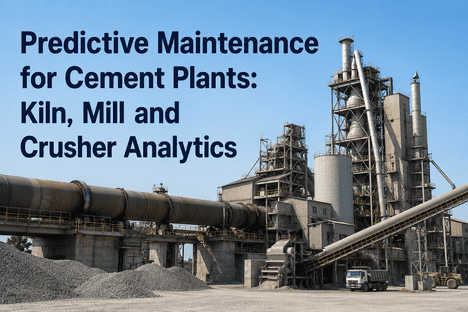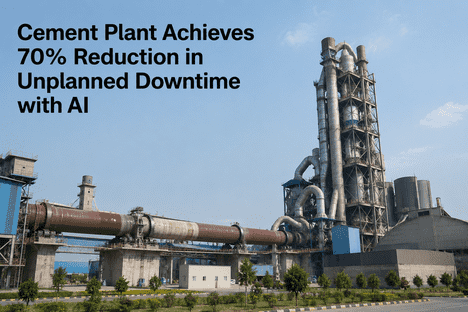
In the cement industry, unplanned downtime is not just a maintenance metric — it is a direct driver of production loss, energy inefficiency, and margin erosion. For a 5,000 TPD cement plant operating clinker production, grinding, and finishing circuits, each hour of unplanned kiln stoppage costs $8,000–$22,000 in lost clinker production, with restart sequences that consume 3–6 hours of additional fuel and power before stable operation is restored. Beyond the direct production loss, unplanned failures on critical equipment — kiln main drives, ball mills, vertical roller mills, ID fans, and baghouse fans — trigger a cascade of secondary costs: emergency parts procurement at 2–4x standard pricing, overtime labour premiums, lost grinding hours that compress finished cement inventory, and in severe cases, ship-to-ship import of clinker to meet customer commitments. In 2023, a 5,000 TPD dry-process cement plant in Southeast Asia faced exactly this problem. Their unplanned downtime rate had reached 18.4%, driven by recurring failures on the kiln main drive gearbox, ball mill pinion bearings, ID fan rotor imbalance, and vertical roller mill hydraulic system faults. Monthly route-based vibration data collection — capturing 45 seconds per measurement point — was detecting failures only after they had already caused production stoppages. iFactory AI's predictive maintenance platform, including its Shift Logbook and condition monitoring engine, was deployed across 28 critical cement assets to close this detection gap with continuous vibration, temperature, and current signature monitoring — achieving a 70% reduction in unplanned downtime within 12 months and delivering $1.8M in annual cost savings. Book a Demo to see how iFactory transforms cement plant reliability.
A 5,000 TPD Cement Plant Cut Unplanned Downtime by 70% with AI Predictive Maintenance
Continuous vibration, temperature, and current signature monitoring on 28 critical cement assets — kiln drives, ball mills, VRMs, ID fans, and baghouse fans — delivering 70% fewer unplanned breakdowns and $1.8M in annual savings.
Why Cement Plants Face Structurally High Unplanned Downtime
Cement manufacturing is one of the most mechanically intensive industrial processes in operation. A typical dry-process plant contains 400–800 rotating assets across raw material grinding, pyro-processing, finish grinding, and material handling circuits. The kiln system alone — comprising the kiln main drive gearbox, support roller bearings, ID fans, preheater fans, and clinker cooler drives — operates in a thermal environment where ambient temperatures at the kiln shell reach 350°C and bearing housings on preheater fans operate at 90–120°C. Ball mill and vertical roller mill drives operate under heavy shock loads during grinding, with pinion bearings subject to reversal stresses every mill rotation. These operating conditions accelerate bearing degradation, gear wear, shaft misalignment, and rotor imbalance far beyond what generic industrial monitoring programs can detect at monthly sampling intervals.
The plant's pre-deployment condition monitoring program was consistent with industry practice: monthly route-based vibration data collection by a third-party contractor, ISO 10816 velocity-based alarming, and quarterly spectral analysis reports. This program was generating 12–18 false alarms per month from threshold-based limits that could not account for the plant's high-temperature operating environment and shock-load grinding conditions. The false alarm rate had trained the maintenance team to dismiss vibration alerts as noise — including the alerts that preceded the three most costly unplanned stoppages in the previous year. iFactory replaced this flat alarm architecture with asset-specific AI models that learned each machine's normal operating signature across the full range of load conditions and temperature variations, then detected deviations from that baseline with 92%+ accuracy and less than 5% false positive rate.
The Critical Cement Assets Covered by AI Monitoring
The deployment covered 28 critical assets across four process areas: the kiln system (main drive gearbox, support roller bearings, ID fans, preheater fans, clinker cooler drives), the raw mill circuit (vertical roller mill gearbox, separator drives, baghouse fans), the finish mill circuit (ball mill pinion bearings, ball mill motors, elevator drives, finish mill baghouse fans), and material handling (kiln feed elevators, belt conveyor drives, air slide blowers). Each asset received wireless triaxial acceleration and surface temperature sensors transmitting at 15-minute intervals. AI models were trained on a 21-day baseline to capture the full range of normal operating conditions across production rates, raw material moisture content, and ambient temperature variation.
Kiln Main Drive & Support Rollers
Gearbox vibration monitoring detecting tooth wear and bearing degradation 3–6 weeks before failure. Support roller bearing temperature and vibration trending preventing kiln shell ovality degradation and refractory damage.
Ball Mill Pinion Bearings & Motors
Pinion bearing envelope spectrum analysis detecting spalls 2–5 weeks before failure. Motor current signature analysis identifying stator and rotor faults before they interrupt a grinding circuit.
ID Fans & Preheater Fans
Rotor imbalance detection via 1× RPM amplitude trending. Bearing temperature and vibration monitoring for high-temperature fan systems operating at 90–120°C bearing housing temperature.
VRM Gearbox & Separator Drives
Gear mesh frequency trending for vertical roller mill gearbox. Separator bearing and belt drive monitoring preventing finish mill circuit stoppages and quality deviations.
Year 1 Results: 70% Unplanned Downtime Reduction and $1.8M Saved
Within 12 months of deployment across 28 critical cement assets, iFactory's AI platform detected and alerted on 14 developing equipment faults that — based on the plant's historical failure data — would have resulted in unplanned production stoppages. In 11 of those 14 cases, the AI alert provided 2–6 weeks of predictive lead time, enabling maintenance teams to schedule corrective action during planned outage windows and avoid any production impact. In the remaining 3 cases, the lead time was 3–10 days — sufficient to pre-position spare parts and prepare the maintenance crew before the equipment was taken offline for a scheduled intervention. The plant's unplanned downtime rate declined from 18.4% to 5.5%, the urgent maintenance order ratio dropped from 37% to 11%, and total maintenance spend decreased by $1.8M annually.
18.4% → 5.5%
Unplanned downtime rate reduced from 18.4% of operating hours to 5.5% within 12 months of AI monitoring deployment.
$1.8M/Year
Annual savings from eliminated emergency repairs, reduced overtime, and avoided production loss across all 28 critical assets.
37% → 11%
Urgent maintenance order ratio declined as condition-based work orders replaced reactive emergency maintenance.
92%+
AI model accuracy with less than 5% false positive rate across all 28 monitored cement assets after baseline calibration.
The 4 Most Costly Cement Plant Failure Modes That AI Predicted
Understanding the specific failure mechanisms that iFactory's AI models detected is essential for evaluating whether the same prediction capability applies to your cement plant's critical equipment. Cement manufacturing rotating assets fail through distinct mechanical, thermal, and electrical mechanisms — each producing characteristic signatures in vibration envelope spectra, temperature trends, and motor current patterns that AI-native pattern recognition is uniquely suited to identify.
Kiln Main Drive Gearbox Bearing and Gear Tooth Failure
The kiln main drive gearbox is the single highest-consequence asset in any cement plant — a gearbox failure stops clinker production, and replacement lead times for large helical or bevel-helical gearboxes run 14–26 weeks. Bearing degradation in the high-speed input shaft or intermediate shaft produces detectable envelope spectrum fault frequency trends 3–6 weeks before functional failure. Gear tooth wear — pitting, scuffing, or tooth fracture — is detectable via gear mesh frequency harmonic trending and sideband analysis. The AI model detected input shaft bearing spalling with 94% confidence at Week 12 of deployment during validation phase, enabling gearbox replacement to be scheduled during a planned annual kiln shutdown rather than triggering an emergency 18-day kiln outage that would have cost $380K in production loss alone.
Ball Mill Pinion Bearing Spalling and Motor Rotor Faults
Ball mill pinion bearings operate under high reversing stress loads, making them susceptible to spalling failures that initiate at the loaded zone and propagate rapidly once the protective lubrication film is breached. A pinion bearing failure on a finish mill stops cement grinding, and the mill restart after bearing replacement requires a 4–8 hour controlled warm-up to prevent additional gear damage. iFactory's envelope spectrum analysis detected incipient pinion bearing spalls 2–5 weeks in advance in two separate incidents during Year 1, enabling scheduled bearing replacement during off-peak power tariff hours. Additionally, motor current signature analysis detected a broken rotor bar on the mill motor — a fault invisible to vibration analysis — providing 6 weeks of lead time to order a replacement motor and schedule the swap during planned production downtime.
ID Fan and Preheater Fan Rotor Imbalance and Bearing Overheating
ID fans in the pyroprocessing line handle hot, dust-laden exhaust gas at 90–120°C bearing housing temperature. Dust accumulation on rotor blades creates progressive imbalance that drives 1× RPM vibration amplitudes toward alarm thresholds while accelerating bearing wear. Traditional ISO 10816 velocity limits cannot distinguish between a fan that has accumulated normal dust loading over a week of operation and a fan with imminent bearing failure — both produce elevated overall velocity. iFactory's AI models separate these conditions by analysing vibration at 1× RPM (imbalance indicator) independently from envelope spectrum fault frequencies at BPFO/BPFI/BSF (bearing damage indicator). An ID fan with 60% imbalance-driven vibration but no envelope spectrum fault frequency elevation is scheduled for cleaning; a fan with envelope spectrum elevation indicating bearing degradation is scheduled for bearing replacement. This distinction eliminated the false alarm rate that had desensitised the plant's maintenance team to fan vibration alerts and enabled detection of two preheater fan bearing failures with 3–4 week lead time in Year 1.
Vertical Roller Mill Gearbox and Separator Drive Degradation
Vertical roller mill (VRM) gearboxes are among the largest and most expensive rotating assemblies in a cement plant, with replacement costs exceeding $500,000 and lead times of 18–32 weeks. VRM gearbox failures typically initiate in the thrust bearing (which absorbs the grinding table load), the bevel gear set (which changes the drive direction from horizontal to vertical), or the planetary gear stages. iFactory deployed multi-sensor monitoring on the VRM gearbox: accelerometers on the gearbox housing for vibration envelope analysis, temperature probes on the thrust bearing housing and oil sump, and motor current signature analysis on the main mill motor. The AI model detected a thrust bearing temperature deviation of just 6°C above baseline during steady-state operation — well below the manufacturer's published alarm threshold of 15°C — but identified it as a statistically significant trend deviation when correlated with increased envelope spectrum amplitude at the thrust bearing fault frequency. The subsequent inspection revealed early-stage thrust pad wiping that would have progressed to bearing failure within 4–6 weeks. The planned repair during a scheduled raw mill shutdown cost $28,000 and required 3 days of downtime; an unplanned thrust bearing failure and shaft replacement would have cost $220,000 and required 12–18 days of emergency repair time.
"Before iFactory, we were reacting to kiln drive failures when the vibration analyst called with an alarm that had already progressed past the intervention point. The AI system caught an ID fan bearing failure 4 weeks before it would have caused a kiln trip. That single prevented event paid for the entire first year of the deployment."
Sensor Architecture and CMMS Integration for Cement Plant Deployment
iFactory's deployment approach was designed to minimise installation disruption and maximise data quality in the cement plant's harsh operating environment. Wireless triaxial ICP accelerometers with a 100 mV/g sensitivity and ±50 g measurement range were installed on each asset using high-temperature magnetic mounts or epoxy-bonded studs. Surface temperature was measured via integrated RTD probes with a −40°C to +150°C range. Sensor data was transmitted at 15-minute intervals to an industrial edge gateway via a 900 MHz LoRaWAN mesh network that provided reliable transmission through the plant's reinforced concrete structures and steel equipment. The edge gateway performed initial signal processing — FFT computation, envelope spectrum extraction, and temperature trend calculation — before transmitting processed data to the iFactory cloud platform via a secure 4G cellular connection with TLS 1.2 encryption.
| Asset Group | Assets Monitored | Sensor Type | AI Prediction Output | Avg Lead Time |
|---|---|---|---|---|
| Kiln System | Main drive, support rollers, ID fans, preheater fans, cooler drives | Triaxial accel + temp RTD | Bearing failure, gear tooth wear, rotor imbalance, shaft misalignment | 3–6 weeks |
| Raw Mill Circuit | VRM gearbox, separator drives, baghouse fans | Triaxial accel + temp RTD | Thrust bearing wear, gear mesh degradation, baghouse fan imbalance | 3–5 weeks |
| Finish Mill Circuit | Ball mill pinions, mill motors, elevators, baghouse fans | Triaxial accel + temp + MCSA | Pinion bearing spalls, rotor bar faults, gear mesh wear | 2–5 weeks |
| Material Handling | Feed elevators, conveyors, air slide blowers | Triaxial accel + temp | Bearing wear, belt tracking deviation, blower vane wear | 2–4 weeks |
AI prediction alerts were written to the plant's existing SAP CMMS via REST API as structured work orders containing asset ID, fault type, confidence score, impact severity, remaining useful life estimate, and recommended spares. The Shift Logbook captured operator shift reports — vibration reading trends, inspection findings, and maintenance actions — alongside AI-generated predictions, creating a unified data fabric for continuous model improvement. The plant's maintenance team accessed all AI predictions, Shift Logbook entries, and asset health dashboards through a single mobile-native interface without needing to log into separate monitoring or CMMS platforms.
Phased Deployment Approach for Cement Plant Critical Assets
The deployment followed a four-phase approach designed to demonstrate value early and expand coverage based on proven results. This phased model is recommended for cement plants where reliability team confidence in AI-based condition monitoring must be built through demonstrated performance rather than theoretical promise.
Phase 1 — Kiln System Pilot (Weeks 1–6)
Deploy sensors on the kiln main drive gearbox, ID fans, and preheater fans — the assets with the highest downtime cost per failure. 21-day baseline calibration, shadow mode validation. First validated alert expected at Week 5–6.
Phase 2 — Grinding Circuit Expansion (Weeks 7–12)
Extend to ball mills, VRM gearbox, and finish mill baghouse fans. CMMS integration go-live with auto-generated condition-based work orders. Shift Logbook deployed to operator tablets.
Phase 3 — Full Coverage (Weeks 13–20)
Complete deployment across all 28 critical assets. Material handling, conveyors, elevators, and air slide blowers added. AI model accuracy validated across full operating range. Continuous retraining loop activated.
Phase 4 — Continuous Improvement (Week 21+)
Quarterly model retraining incorporating work order closure data and operator Shift Logbook entries. False positive rate optimisation. Spares optimisation analysis using RUL data across the 28-asset fleet.
Industry Perspective on AI Predictive Maintenance in Cement
The cement industry's unplanned downtime problem is not a maintenance competency problem — it is a data utilisation problem. Every cement plant we have assessed has the same structural gap: monthly vibration data collection on critical kiln and mill drives, generating 45 seconds of waveform data per month against millions of operating cycles. The failure physics of a kiln drive gearbox or a ball mill pinion bearing does not align with a 30-day sampling interval. These assets degrade continuously under thermal and mechanical stress, and the gap between measurement intervals is large enough for an entire failure lifecycle to progress from incipient spall to functional failure. AI continuous monitoring does not replace the cement plant's maintenance team — it provides them with the 2–6 week predictive lead time that monthly route-based data collection was never designed to deliver. The 70% unplanned downtime reduction in this case study is not an anomaly; it is the predictable outcome of closing a sampling density gap on critical cement equipment.
Deploy AI Predictive Maintenance Across Your Cement Plant
Continuous vibration, temperature, and current signature monitoring for kiln drives, ball mills, VRMs, ID fans, and material handling equipment — integrated with your existing CMMS and delivered through iFactory's Shift Logbook and PdM analytics engine.
Cement Plant PdM — Common Questions Answered
Does AI predictive maintenance replace the cement plant's existing vibration analysis program?
No. Your existing route-based vibration data collection, certified analyst expertise, and ISO 10816 velocity-based alarming continue providing their respective value. What changes is the data ingestion density for the 28 most critical assets: continuous wireless sensors now provide vibration and temperature data at 15-minute intervals, and AI models process every data point automatically. The existing vibration program continues covering non-critical assets on monthly routes; the AI layer covers critical kiln and mill equipment with 24/7 monitoring that monthly route collection could never match. The two programs run in parallel, with the AI layer providing 2–6 week predictive lead time on the assets where unplanned downtime is most costly.
Can the AI models handle cement plant operating conditions — high temperature, dust, vibration?
Yes. The wireless accelerometers used in this deployment are rated for industrial environments: −40°C to +85°C operating temperature, IP67 ingress protection against dust and water ingress, and 100 mV/g sensitivity with ±50 g measurement range suitable for cement plant vibration levels. Sensors on high-temperature assets — kiln support roller bearings, preheater fan bearings — use high-temp magnetic mounts with a 50°C thermal break to protect the sensor electronics. Sensors on baghouses and material handling equipment use standard magnetic or epoxy mounts. The LoRaWAN mesh network provides reliable data transmission through reinforced concrete and steel structures, with automatic retry and store-and-forward capability if a gateway connection is temporarily interrupted.
How does iFactory handle the varying load conditions in cement grinding circuits?
Cement grinding circuits — ball mills and VRMs — operate under significantly varying load conditions depending on Blaine fineness target, clinker grindability, and production rate. Fixed vibration thresholds cannot account for these variations. iFactory's AI models use load-condition normalisation: each asset's model learns the relationship between motor current draw (load) and vibration amplitude during the 21-day baseline period, then normalises all subsequent vibration measurements to a reference load condition before comparing against thresholds. A ball mill pinion bearing vibration amplitude at 60% mill load is scaled to the equivalent amplitude at 90% load before the fault severity classification is applied. This eliminates the false alarms that fixed-threshold systems generate when mill load varies across different cement grades.
What is the typical investment and ROI for a cement plant deployment of this scale?
For a 5,000 TPD cement plant deploying on 25–30 critical assets, the total Year 1 investment ranges from $155,000 to $245,000 including wireless sensor hardware, iFactory platform subscription, CMMS integration, and engineering support. The 28-asset deployment in this case study delivered $1.8M in annual savings — a 10:1 ROI in Year 1 with payback achieved within Month 4. The savings are driven by three primary mechanisms: eliminated emergency repair costs (2–4x planned maintenance cost), reduced overtime labour (2.5–4x standard rates), and avoided production loss ($8,000–$22,000 per hour of unplanned kiln stoppage). Book a Demo for a personalised ROI projection based on your cement plant's critical asset inventory and unplanned downtime history.
How long does it take to deploy and start seeing AI predictions?
The cement plant deployment followed a phased approach: Phase 1 (kiln system pilot) delivered the first validated AI alert — an ID fan bearing fault detected with 92% confidence — at Week 6 of deployment. The pilot phase covered 8 critical assets over 6 weeks and demonstrated the prediction capability before expansion to the full 28-asset fleet. Full deployment across all 28 assets with CMMS integration and Shift Logbook activation was complete at Week 20. Plant's that want to start with a 6-week kiln system pilot before committing to full deployment can do so through iFactory's phased engagement model — demonstrating value on the highest-downtime-cost assets before expanding to grinding circuits and material handling equipment.