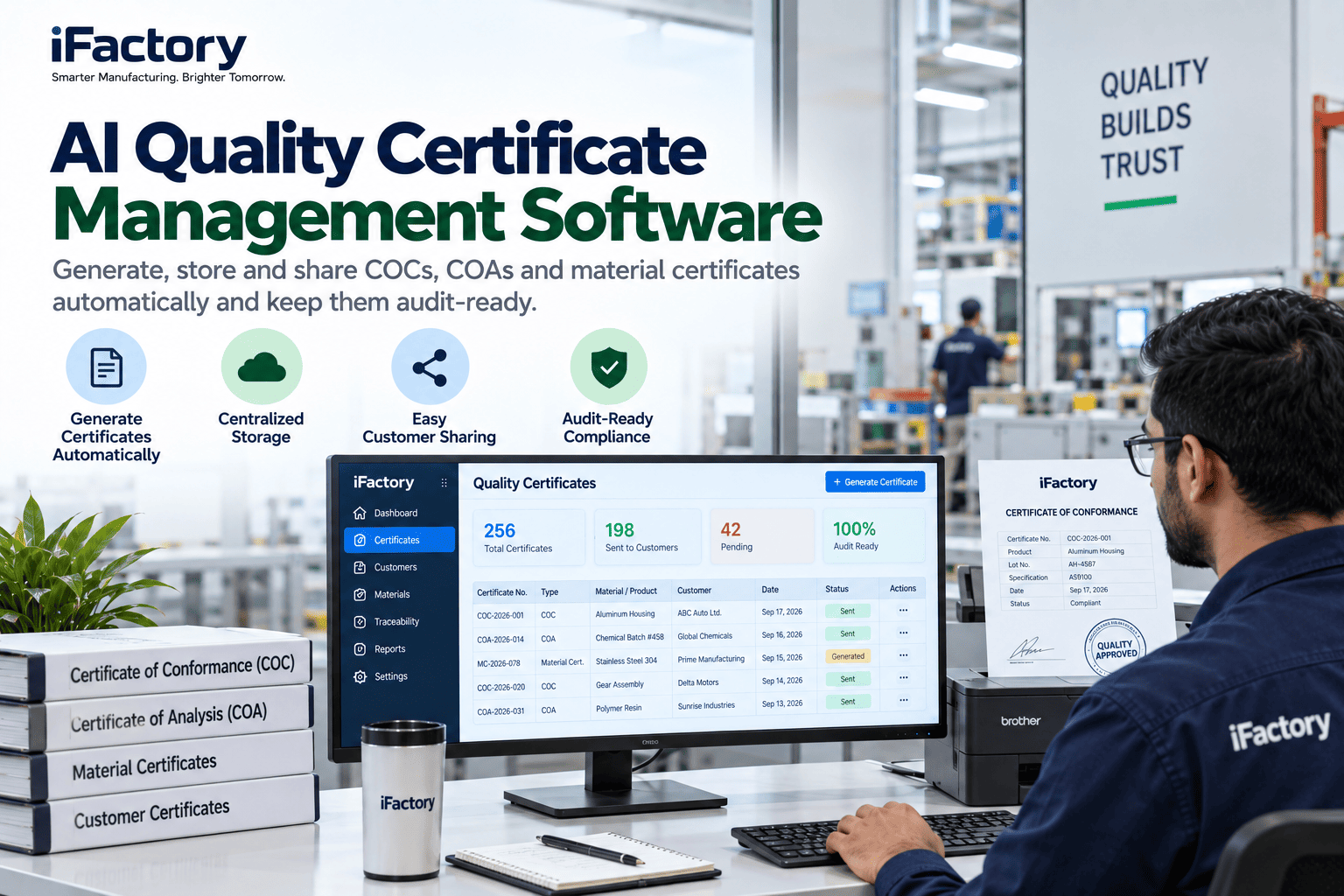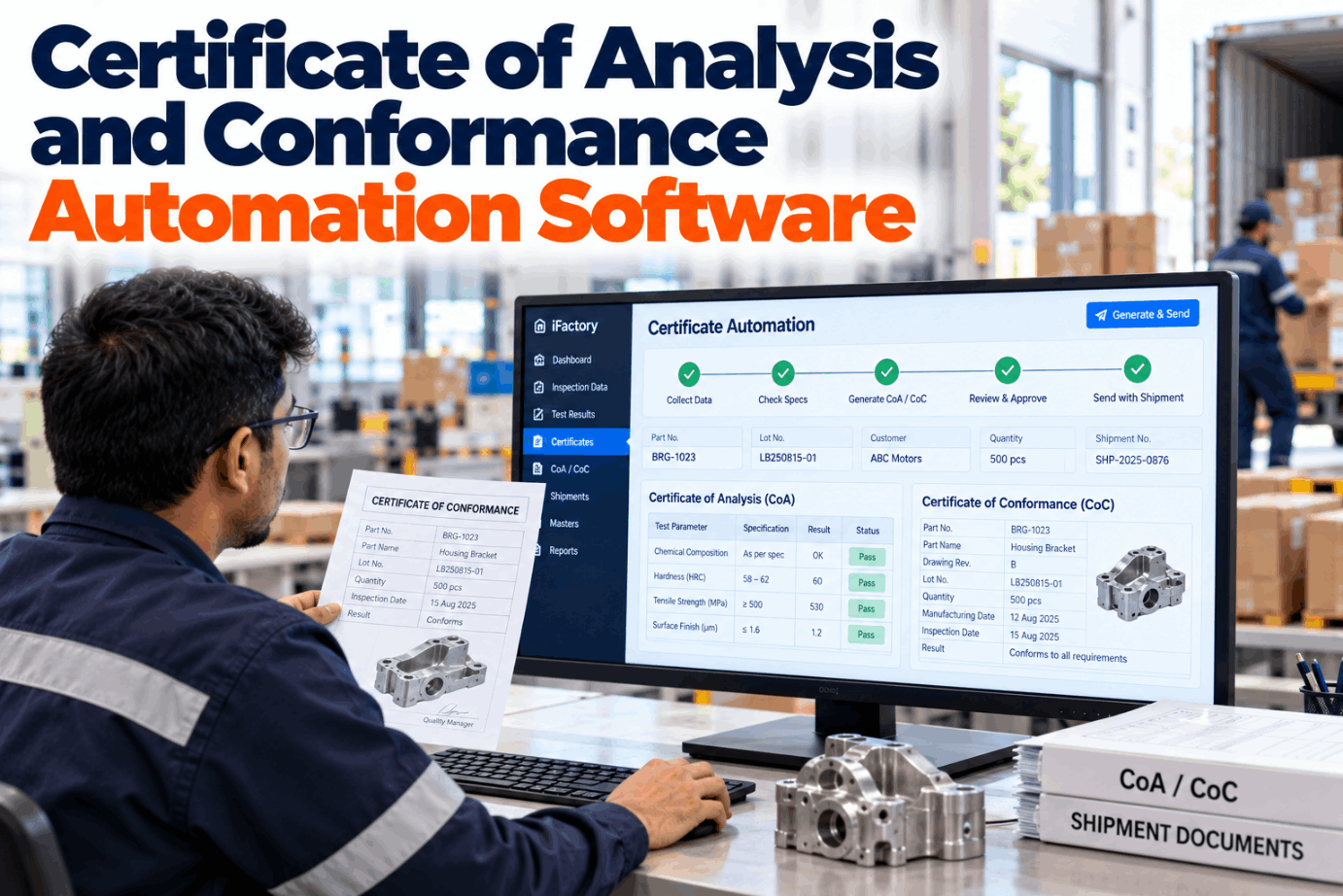
Every shipment leaves with a promise on paper. A certificate of conformance or certificate of analysis tells the customer the lot meets their requirements, and an error on it can stop goods at their receiving dock just as surely as a bad part. Yet most certificates are still typed by hand from spreadsheets and lab printouts at the end of a shift. Certificate of conformance automation builds them from the lot's own data instead, as a short certificate demo shows.
Certificates Built From Lot Data and Checked Before They Ship
iFactory's Certificate Engine pulls inspection and test results for each lot, checks them against every customer's requirements and attaches the signed CoC or CoA to the shipping record automatically. No retyping, and no copying last month's certificate.
Three Certificates That Prove Different Things
The names get used loosely, but the documents are not the same. A CoC states that the lot conforms. A CoA reports measured results for the lot against limits. A mill test report covers the chemistry and mechanical properties of a heat of metal. Mixing them up causes real trouble, because a customer who needs measured values will reject a bare statement of conformity. In Europe, metals certificates often follow EN 10204, where a type 3.1 inspection certificate is validated by an inspector independent of production. Ask our support team which ones your customers expect.
A CoC Template Built on ISO/IEC 17050-1
ISO/IEC 17050-1:2004 sets general requirements for a supplier's declaration of conformity. Its minimum content includes a unique identification, the issuer's name and address, the object of the declaration, a statement of conformity, the list of standards or other specified requirements, the date and place of issue, and the signature, name and function of the authorised person. Most customer CoC formats cover the same ground plus order details. Fill every field from a system record so nobody types the lot number twice. Get the template as a starting file from our certificate specialists.
Where this clause applies and the contract administration office authorises shipment on a certificate instead of source inspection, the certificate states that the supplies conform in all respects with contract requirements, including specifications, drawings, preservation, packaging, packing and marking, and identifies part number and quantity, with a signature, title and date.
One Lot, Three Customers, Three Different Answers
The same lot can pass for one customer and fail for another, because each customer's spec sets its own limits. A certificate engine checks the results against the spec of the customer on the order, not a single internal limit. It also handles the quieter problem of a customer revising its spec: new limits apply from the effective revision, while certificates built earlier keep the old limits on record. The resin lot below is an illustration. Our support team can load your customer specs.
Ask Before You Ship, Not After a Rejection
The Certificate Engine knows every customer's limits and every lot's results. Shipping and quality can ask in plain words whether a lot can go, and get the reason when it can't.
From Closed Lot to Signed Certificate
CoA generation and CoC building follow the same path. The results already exist in your CMM software, lab system and test stands. The work is collecting them for one lot, mapping them to the customer's list and checking them before anyone signs. Where a certificate shows one value, it should also say what that value is: a single test, the mean of several parts or the worst case. See each step run on your own results in a guided demo.
Eight Certificate Errors and the Check That Stops Each One
Certificate errors are rarely dramatic. They are small mismatches that a customer's receiving inspector spots in seconds, and each one can hold a shipment or raise a complaint. Most share one root cause: someone copying values between systems at the end of a busy shift. These are common examples from practice, each paired with an automatic check. Review your own error log with our quality team.
Deliver the Certificate the Way Each Customer Wants It
A certificate does its job only if it arrives with the goods, or before them. Some customers want a PDF in the box, others an upload to their supplier portal or a file with the advance ship notice. Where records fall under FDA rules, electronic signatures also need to meet 21 CFR Part 11. Keep the issued file, not just the data behind it, so you can show exactly what the customer received if a question comes back years later. Set delivery rules per customer with our implementation team.
How Three Industries Use the Same Engine
These are illustrations, not case studies. The engine is the same in each. Only the customer requirements and the source of the results change. In every case, the certificate is only as good as the lot record behind it. Talk through your own customers with our support team.
Count the Hours Spent Typing Certificates
The first measurable return is the time spent assembling certificates by hand. Both inputs are assumed, so treat the result as a method, not a forecast, and use your own certificate counts. Our team can work through it with you.
Add the cost of reissued certificates and held shipments only where your complaint and shipping records show them. Review time does not fall to zero, since an authorised person still signs each certificate. Track how many certificates customers send back for correction before and after, using your own complaint log.
One Delivery: Certificate Engine, Connectors and AI Server
iFactory delivers the Certificate Engine as a turnkey bundle. A pre-configured NVIDIA AI server ships racked and ready with the engine, spec-check rules and customer templates pre-loaded, so quality records stay in the building. You rack it, plug in power and Ethernet, and the AI is live. Our support team can price it for your sites.
- Pre-configured NVIDIA AI server, racked and ready
- Certificate Engine with CoC and CoA templates
- Customer spec library with revision control
- Connectors for CMM, lab, test stand and ERP data
- Electronic signature by authorised role
- Delivery by shipping record, ASN, portal or email
- 24×7 remote monitoring
Server installed, result sources linked, top customers' specs and templates loaded.
Certificates built automatically and compared with the hand-made ones.
Automatic certificates switched on for every shipment, delivery rules active.
A Certificate Engine That Reads the Lot, Not a Spreadsheet
iFactory links each certificate to the lot, the results and the customer spec it was checked against, so any certificate can be traced back in seconds. Book a certificate walkthrough to see the trail.
What Quality and Shipping Teams Ask About Certificate Automation
Ship Every Lot With a Certificate You Can Trust
Pull results per lot, check them against each customer's specs and attach signed certificates to every shipment. The system arrives turnkey and goes live within 6 to 12 weeks.