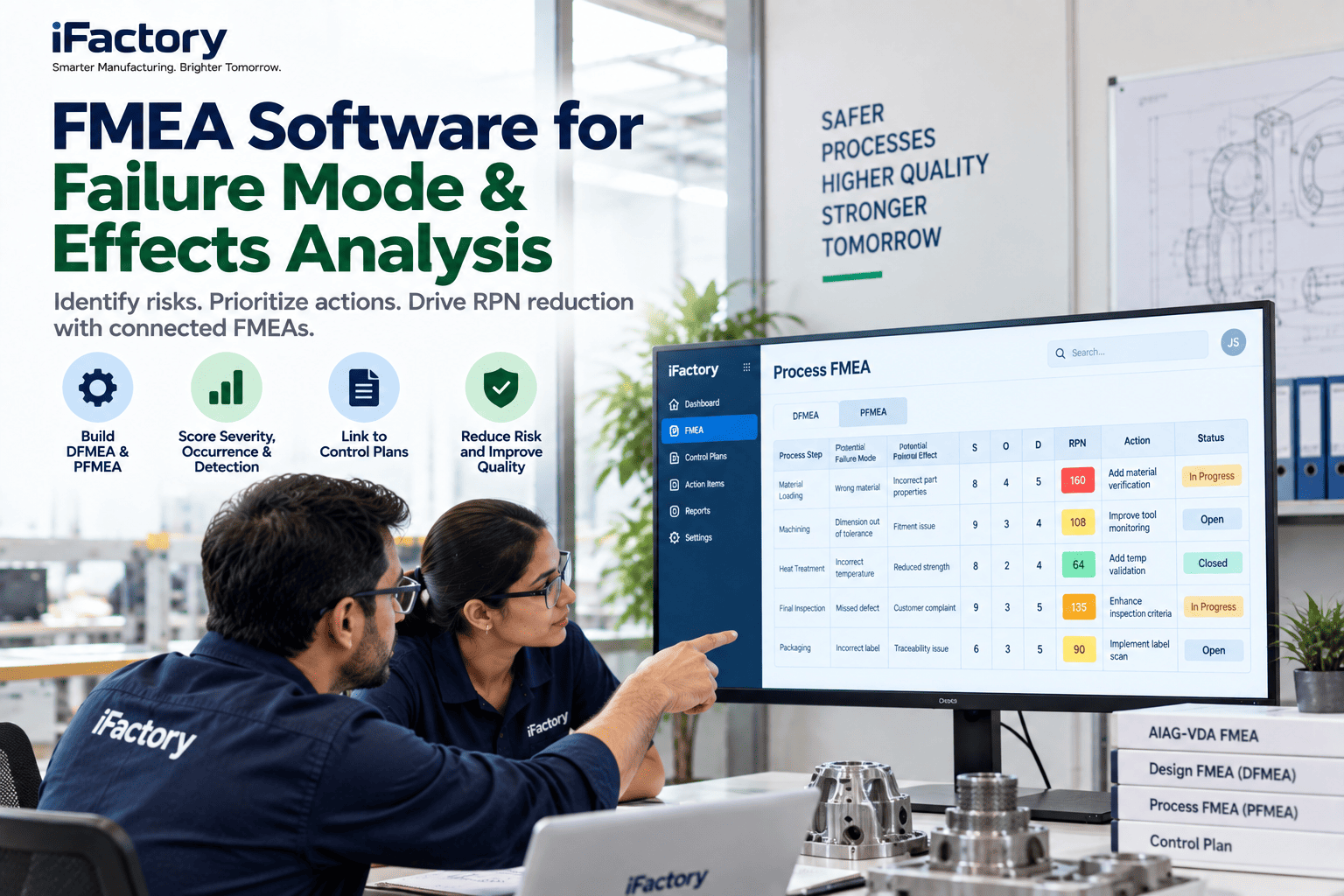
FMEA methodology changed in 2019 and most organisations are still catching up. The AIAG-VDA harmonized FMEA Handbook replaced the traditional Risk Priority Number (RPN = S × O × D) with an Action Priority (AP) system — a lookup table that classifies each failure mode as High, Medium, or Low priority based on the specific combination of Severity, Occurrence, and Detection. The 7-step approach (Plan and Prepare → Structure → Function → Failure → Risk → Optimization → Documentation) replaced the looser prior methodology. IATF 16949 customer-specific requirements increasingly point to the harmonized handbook. FMEA software built for AIAG-VDA 2019 — not a template retrofit — is what current customer audits actually expect.
iFactory / FMEA software
DFMEA and PFMEA on the Current AIAG-VDA 7-Step Method — Not a Template Retrofit
Build DFMEA and PFMEA on the AIAG-VDA 2019 7-step methodology with Action Priority replacing RPN, linked structure/function/failure trees, control plan bridging, and monitoring/system response (FMEA-MSR) support.
AIAG-VDA 2019
7-step method
Action Priority
replaced RPN
The Problem in FMEA Practice
A typical organisation runs FMEA in Excel — templates handed down from a customer or consultant a decade ago, structured for the pre-2019 methodology with RPN scoring, revisited annually because the auditor asks. When a real failure happens in the field, the FMEA rarely explains it — because the analysis was cursory, scoring was inflated, and actions on high-RPN items were closed without evidence of risk reduction. When a customer updates their CSR to require the harmonized AIAG-VDA method, the templates don't cover it: structure and function analysis are missing, Action Priority isn't calculated, FMEA-MSR isn't supported. Most organisations respond by adding tabs to the spreadsheet.
Where FMEA Actually Fails as a Tool
FMEA failure modes are consistent across industries. Each is a specific IATF 16949 or customer-audit finding category.
Structure skipped
7-step method starts with structure analysis (breaking system into elements). Most templates skip straight to failure modes, missing the structural relationships that surface real failure paths.
Score inflation
Severity and Occurrence scored 8-10 on almost every row to avoid arguments about criticality. Every RPN over 100. AP would show most as Medium at worst — but the template doesn't calculate AP.
Actions unclosed
High-RPN items generate action lists that never close. Six months later same items still open. No evidence that risk reduction occurred; RPN unchanged at next review.
FMEA-Control Plan drift
FMEA lives in one Excel file. Control Plan lives in another. Changes to one don't propagate to the other. Audit compares CP against FMEA and finds neither reflects current process.
What Good Looks Like in FMEA
A working FMEA system holds four disciplines together — 7-step AIAG-VDA methodology, Action Priority replacing RPN, control plan bridging, and living FMEA that updates with change.
7-Step Method
Plan and Prepare, Structure Analysis, Function Analysis, Failure Analysis, Risk Analysis, Optimization, Documentation — each step with its required outputs, not shortcuts.
7 steps, no shortcuts
Action Priority
AP calculated from the AIAG-VDA lookup table on Severity × Occurrence × Detection combinations. High/Medium/Low classification drives action, not RPN threshold arguments.
AP, not RPN
Control Plan Bridge
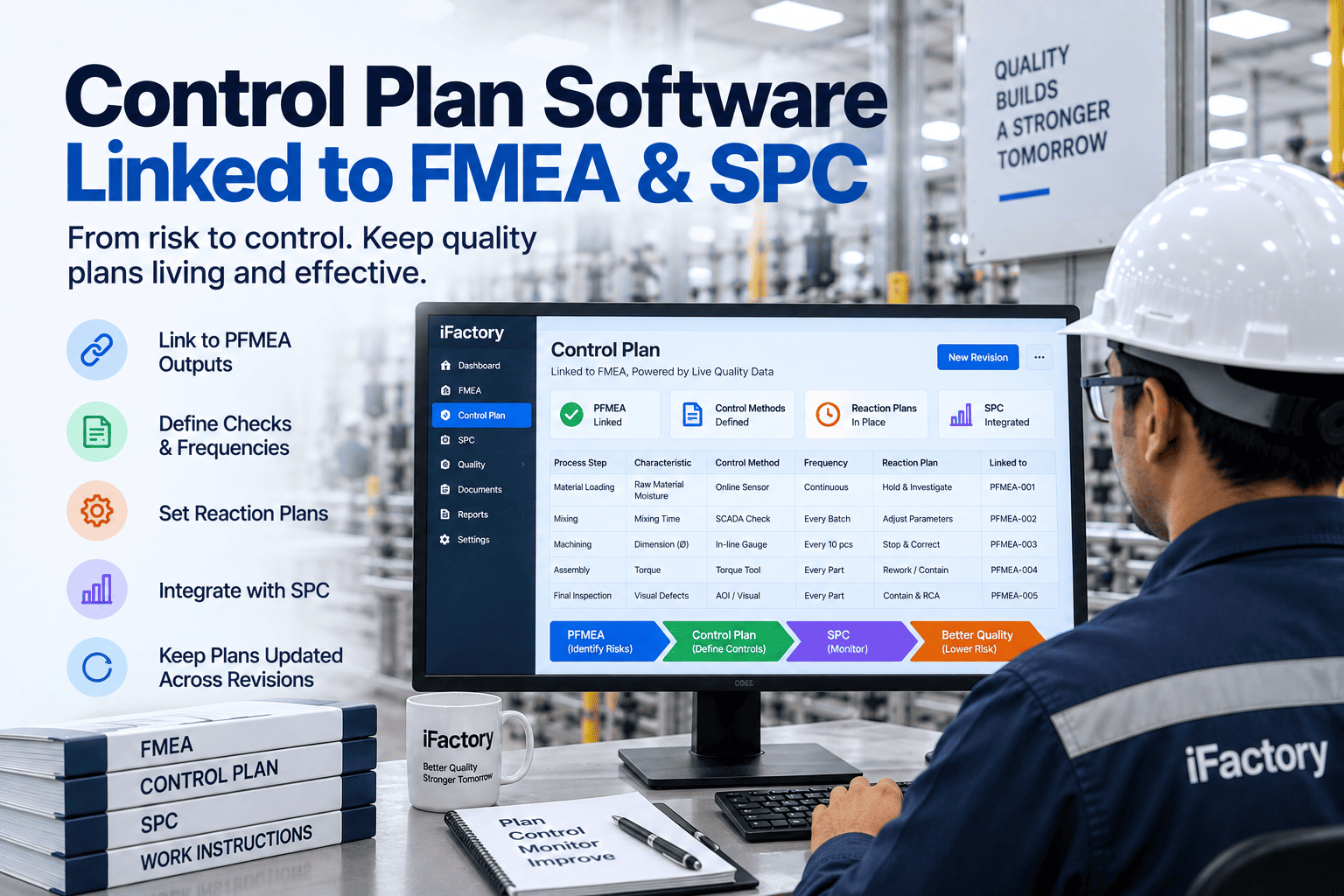
FMEA controls linked to control plan characteristics and reaction plans. Change to FMEA propagates to CP; new CP characteristic prompts FMEA review. One source of truth.
Living linkage
FMEA-MSR Support
Supplemental Method for Monitoring and System Response for safety-related items — diagnostic detection, fault mitigation, in-service response — supported per the 2019 handbook.
Safety-item ready
How iFactory AI Fits
iFactory AI works alongside your PLM, MES, and control-plan systems — supporting DFMEA, PFMEA, and FMEA-MSR per the AIAG-VDA 2019 handbook with control-plan bridging that no Excel template can maintain.
FMEA Workbench
FMEA Layer
7-step guided workflow for DFMEA and PFMEA with structure, function, and failure trees. Action Priority calculated from AIAG-VDA lookup. FMEA-MSR supported.
Score Library
FMEA Layer
AIAG-VDA severity, occurrence, and detection rating tables with worked examples. Consistent scoring across teams and projects.
CP Bridge
FMEA + Control Plan
Bidirectional linkage between FMEA controls and control plan characteristics. Changes propagate; drift caught before audit.
Change Trigger
FMEA + PLM
Product or process change (ECO/ECN) triggers FMEA review for affected items. FMEA stays living instead of annual snapshot.
Ask your quality engineer to produce a PFMEA and its linked control plan for one product family. If they don't match on the current process, the audit finding is queued. And if the FMEA still shows RPN instead of Action Priority, the customer's CSR update is going to catch it. Book an FMEA method review.
12-Week FMEA Pilot on One Product Family
One product family with DFMEA and PFMEA scope, twelve weeks. The pilot rebuilds one FMEA on the AIAG-VDA 7-step method with Action Priority and connects it to the current control plan.
Weeks 1–3
Method Training
Team trained on AIAG-VDA 7-step approach and AP methodology. Scoring calibrated with worked examples. Current-state FMEA reviewed for gaps.
Weeks 4–7
Rebuild
One PFMEA rebuilt on 7-step method with proper structure/function/failure analysis. Action Priority calculated. High-AP items enter optimization step with owned actions.
Weeks 8–10
Control Plan Bridge
Rebuilt FMEA linked to current control plan. Discrepancies surfaced and reconciled. Change-trigger workflow from PLM tested.
Weeks 11–12
Living Discipline
Living update discipline established via ECO/ECN change trigger. Rollout to remaining FMEAs and DFMEA scope scoped based on rebuild time and value.
Who Owns the KPI
FMEA crosses design engineering, process engineering, quality, and program management. Each function owns a specific KPI or the FMEA reverts to annual template refresh.
Design / Process Engineer
FMEA currency vs product/process state
Owns the FMEA freshness — the share of FMEAs reflecting the current product and process state. Aging FMEAs signal the change-trigger discipline is missing.
Quality Engineer
High-AP items with closed actions
Owns the risk reduction — every High Action Priority item with implemented actions and re-scored AP evidencing reduction. Open indefinitely means the method isn't working.
Program Manager
FMEA-CP alignment at gate reviews
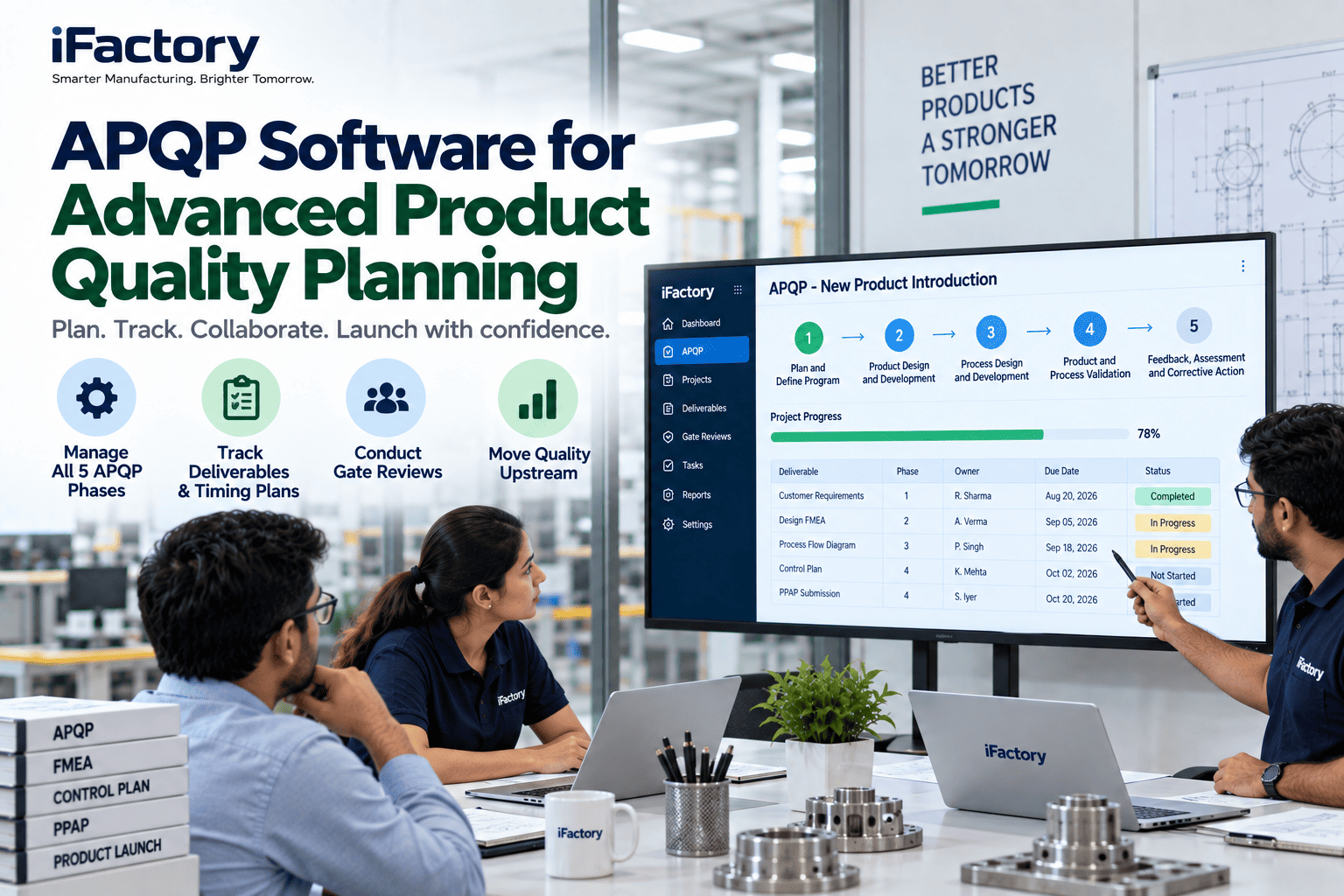
Owns the launch discipline — FMEA and control plan aligned at every APQP gate. Misalignment at Phase 4 validation is where launch escapes happen.
Customer Quality
FMEA audit findings per customer visit
Owns the customer-facing outcome — FMEA-related findings at customer audits. Rising is a signal the method or the discipline is behind current CSR.
FAQ
What if our customer still requires RPN in the FMEA — do we run both?
Yes, and the workflow supports both. Some customers (particularly outside automotive) still require RPN. Others are on the harmonized AIAG-VDA method with Action Priority. Some are in transition. The system calculates both from the same S/O/D inputs so the FMEA can be presented in whichever format each customer requires without maintaining parallel analyses. Where customer CSR explicitly points to the AIAG-VDA 2019 handbook, AP is the primary output; where RPN is still required, both display. Neither requires re-scoring by hand.
How does FMEA-MSR (Monitoring and System Response) fit in — is that only for automotive?
FMEA-MSR was added as a supplemental method in the AIAG-VDA 2019 handbook primarily for automotive safety-related applications — analysing diagnostic detection, fault mitigation, and in-service response for the end user. But the methodology applies to any product where in-service monitoring is part of the safety strategy: medical devices, industrial equipment, consumer electronics with safety-critical firmware. The workflow supports FMEA-MSR as an analysis type when the product's safety strategy calls for it. Where MSR is not applicable (many consumer or non-safety-critical products), it's simply not used.
Book a demo to see FMEA-MSR handling.
How does this integrate with our existing PLM or ALM system?
Bidirectional integration. Product structure and function definitions read from PLM (PTC Windchill, Siemens Teamcenter, Aras Innovator, Dassault ENOVIA) into the FMEA structure and function analysis. Process definitions read from MES or PLM manufacturing modules. Change events (ECO/ECN) trigger FMEA review workflow for affected FMEAs. Where the organisation runs requirements management in an ALM (Polarion, Jama, IBM DOORS), requirement-to-function traceability flows through so DFMEA analysis aligns with requirement structure. What the workflow adds is the analysis discipline — not a replacement for the systems your engineering teams already rely on for design authority.
Stop running FMEAs on templates from 2015.
Rebuild One FMEA on AIAG-VDA 7-Step — Live
Bring one PFMEA and its linked control plan for a product family, plus the customer CSR that references FMEA methodology. We'll walk the 7-step rebuild, calculate Action Priority for high-risk items, and demonstrate the control-plan bridge that keeps them aligned.