A control plan is supposed to be the logical continuation of the PFMEA — every high-risk failure mode the FMEA identifies generates a documented control spelling out what to check, how, how often, and what to do when it fails. In theory it's a closed loop from risk to control. In practice the two documents drift apart: the PFMEA gets revised and the control plan doesn't, or the binder in the quality office says one thing while the operator's sampling on the line does another. A control plan disconnected from its PFMEA is, in an auditor's words, a quality plan with no evidence of risk-based thinking — exactly what IATF 16949 demands you show. The fix is to make the link live: FMEA row to control-plan row to SPC. You can book a demo to see the linked chain on your process.
A Control Plan Is Only as Good as Its Link to the FMEA Behind It
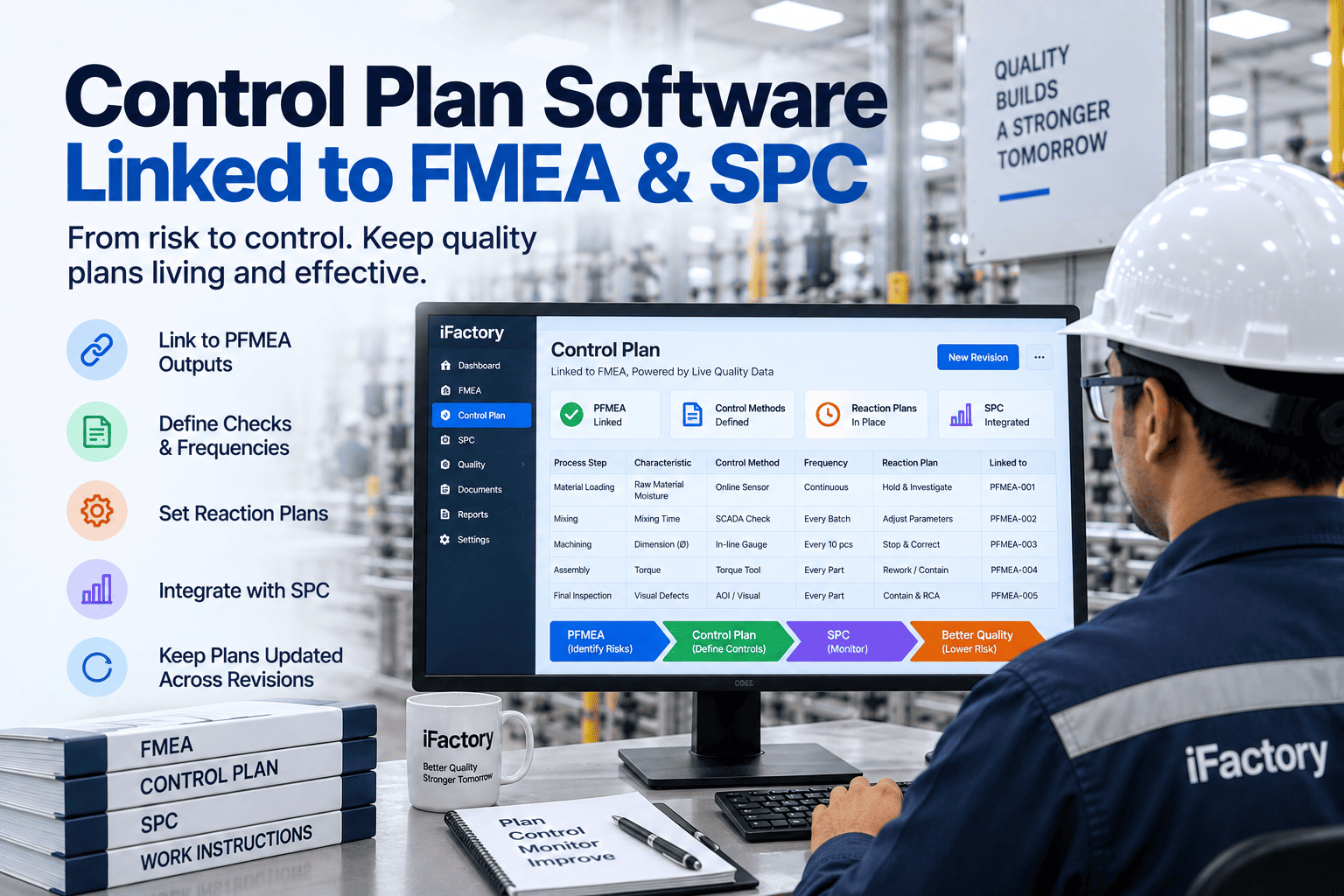
Create dynamic control plans that flow from PFMEA outputs — defining checks, frequencies, and reaction plans — and keep them living across every revision, so the plan the operator follows always matches the risk analysis it came from.
The Document Isn't the Problem — the Disconnection Is
The control plan itself has been refined by industry for thirty years, and every supplier has a polished template. What fails isn't the format; it's that the plan comes unmoored from the risk analysis that's supposed to drive it and from the floor that's supposed to execute it. These are the specific ways a control plan drifts out of alignment — each one a common audit finding.
A PFMEA revision closes an action or changes a control, but the control plan isn't updated to match. Now the risk analysis and the control document disagree — and treating them as independent files is exactly the mistake auditors look for.
A line that just says "visual inspection" with no defined method, sample size, or frequency isn't a control — it's a hope. Generic control text that can't actually be executed the same way twice is one of the most common plan weaknesses.
Every detection method needs a reaction plan — what the operator does when the check fails. It's the column most often left thin or empty, which means when something does fail, nobody knows what to do with the suspect product.
A classic finding: the plant is running production under a pre-launch control plan because nobody moved it to the production phase after PPAP approval. A paper-administration lapse, but it costs points in every surveillance audit.
Every Control Traces Back to a Risk, and Forward to a Check
The value of control plan software isn't a nicer table — it's that the control plan sits in a live chain from risk to monitoring. A characteristic doesn't appear on the plan by habit; it's there because a failure mode in the PFMEA put it there, and it's watched by an SPC chart or a check that reports back. When that chain is connected in software rather than copied across spreadsheets, the plan stays honest. Here's the chain the software maintains.
A failure mode with a high or medium Action Priority — under the AIAG-VDA approach that replaced the old RPN threshold — has to generate a process control. That's the origin of every meaningful control-plan line: a risk the FMEA judged worth controlling.
Each such risk becomes a control-plan line with the full specification: the characteristic, its tolerance, the control method, the sample size, the frequency, and — critically — the reaction plan. The prevention and detection controls transfer from the PFMEA with nothing dropped.
The control isn't just documented; it's live. A measured characteristic feeds an SPC chart, an attribute check reports pass or fail, and the plan's frequency and sample size govern how often — so the control plan is connected to what actually happens on the floor.
When a control fails, the reaction plan fires and the event can re-score the PFMEA — an occurrence that keeps happening raises the risk, which drives a control change. The loop closes: risk drives control, control catches failure, failure updates risk.
Build the Plan From the Risk, Not From a Blank Template
iFactory generates control-plan lines directly from your PFMEA's high-risk failure modes and links each to its SPC chart or check — so every control traces to a risk and nothing is re-keyed across spreadsheets.
The Columns That Turn a Risk Into an Executable Control
A control-plan line only controls something if it's specific enough to be executed the same way by any operator on any shift. Vague entries are where plans fail an audit and fail the process. These are the fields each line has to define, and the reaction plan is the one that most often gets shortchanged.
The specific product or process characteristic being controlled and its tolerance — with special characteristics (safety, regulatory, key fit or function) flagged, because those carry higher-level controls and must be marked to satisfy the standard.
Exactly how the characteristic is checked — the gauge, the SPC chart, the inspection technique — specified concretely rather than as a generic "inspect," so the control means the same thing to everyone who runs it.
How many and how often — every part, one per hour, first and last off. The frequency has to match the risk: a high-severity special characteristic warrants tighter checking than a routine dimension.
What happens when the check fails — contain the suspect product, adjust the process, notify quality, quarantine the lot. The column that's most often thin, and the one that decides whether a caught failure is actually controlled.
The Plan Has to Move Through the Product's Life, Not Freeze at Launch
A control plan isn't written once. It progresses through phases as the product matures, and it has to be revised every time something that affects control changes. The failure mode is a plan that freezes — most visibly the plant still running a pre-launch plan long after production started. Keeping it living is a version-control discipline that software enforces and a binder can't.
The plan advances through its phases, tightening as confidence grows, and the transition to the production plan must happen when PPAP is approved — not whenever someone remembers. The software makes the phase current, so serial parts never run on a pre-launch plan.
An engineering change, a customer complaint, new equipment, a supplier change, an audit finding, or any PFMEA revision triggers a control-plan review. The system ties the plan to those triggers so a change in one place prompts the update in the other.
Every change increments the revision, archives the prior version with its effective dates, and retains it as long as the standard requires. The current plan is unambiguous and the history is intact for any audit that asks how control evolved.
The process-step numbering has to match across the process flow, the PFMEA, and the control plan. When they're linked in software, that alignment is preserved automatically instead of drifting apart every time one document is edited alone.
Auditors Ask One Question: Show Me How These Connect
The single most common demand an IATF 16949 or AIAG-VDA auditor makes of control plans is to show the connection to the PFMEA — the evidence that controls exist because risks were analyzed, not because a template had rows to fill. A linked system answers that question by construction, because the connection is how the plan was built. This is what the linkage delivers at audit.
Every control-plan line points back to the PFMEA failure mode that justifies it, so the risk-based-thinking evidence the standard demands is inherent in the document rather than reconstructed for the auditor.
A characteristic flagged special in the FMEA carries that flag onto the control plan with its higher-level control, so the safety and regulatory items an auditor checks first are provably handled end to end.
For high and medium Action Priority failure modes, the controls, sample sizes, and reaction plans on the plan align exactly with the PFMEA's current controls — the precise alignment auditors verify on critical items.
Because the plan is current and linked, a layered process audit can check control effectiveness against a document that reflects reality, rather than against a binder everyone knows is out of date.
One Linked Chain From PFMEA to Reaction Plan
iFactory holds the PFMEA, control plan, and SPC on one platform so the links between them are real rather than referential: a control plan is generated from the FMEA's risks, executed by live checks, kept current across revisions, and always audit-traceable back to the analysis it came from.
What Quality Teams Ask About Control Plan Software
Make Your Control Plans Living, Linked, and Audit-Proof
iFactory builds control plans from your PFMEA's risks, defines real checks, frequencies, and reaction plans, links them to live SPC, and keeps them current across every revision — so the plan on the floor always matches the risk analysis behind it.