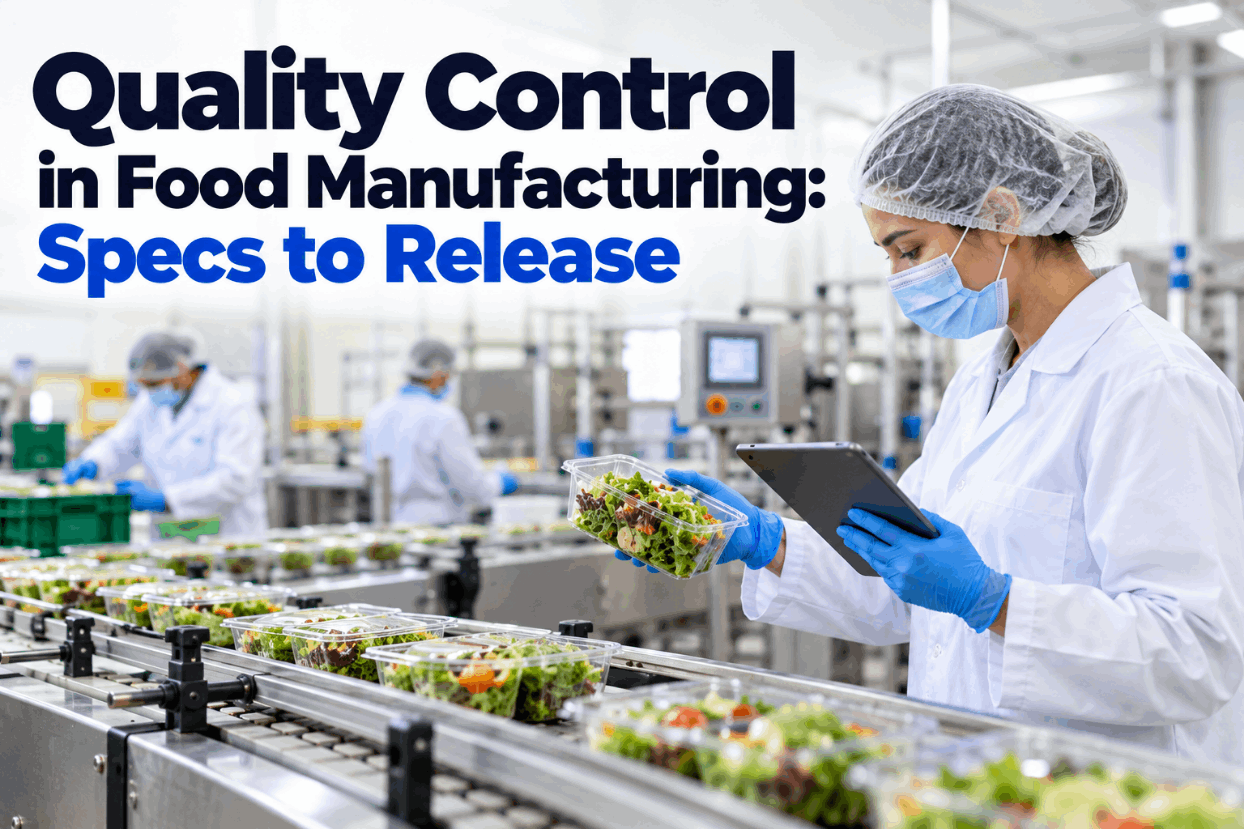
Quality Control in Food Manufacturing: Specs to Release

By James C on October 23, 2026

quality-control-food-manufacturing-specs-release

A food plant can pass every hygiene audit and still ship a lot that is underweight, too salty or slightly off in flavour. Quality control is the chain that stops that: a written spec for every material and product, checks at the dock, checks on the line, tests on the finished lot and a release decision that someone signs. When those links sit on paper, in spreadsheets and in the lab's inbox, release gets slow or blind. See one connected lot record in a short quality release demo.

FOOD QUALITY PACK · SPEC TO RELEASE

Every Check Against the Spec, Every Lot Released on Evidence

iFactory Food Quality Pack keeps specs, voice-logged in-process checks and lab results in one record per lot. Positive release workflows hold each lot until the criteria in your SQF or BRCGS system are met, then route it to QA for sign-off.

Lot 26-296 · Tomato soup 400 gOn hold
Soup line 3 · Spec FG-118 v7
Operator said · 10:42"Line 3 fill weights 404, 406, 403. pH 4.12."
iFactory read backThree weights in spec. pH inside the spec limit. Logged to lot 26-296.
In-process checks46 of 46 in spec
Micro resultsDue 14:00
Sensory vs gold standardGrade 4 of 5, pass
Release when micro is in · QA sign-off required
QUALITY CONTROL FOOD MANUFACTURING

Five Links From Spec to Release

Food safety plans control hazards. Quality control makes sure each lot is what the spec says it is: the right weight, recipe, taste and texture, in the right pack with the right code. The work follows the product through the plant, and each link hands evidence to the next. If one link is missing, the release decision rests on memory. Map your own chain with our food quality team.

1SpecifyRaw material, in-process and finished product limits, approved and versioned
2ReceiveDock checks and COA review before any material is used
3Check the lineWeight, temperature, pH, metal detector and seal checks on schedule
4Test the lotMicro, chemical, physical and sensory tests on finished product
5ReleaseQA confirms every criterion is met and signs the lot out
PRODUCT SPECIFICATIONS

Three Kinds of Spec, One Version Number

Both main GFSI schemes expect written specs. SQF Code Edition 9 covers them in 2.3.2, spanning raw materials, packaging, finished product and contract services, and BRCGS Food Safety Issue 9 sets out specification requirements in clause 3.6. A spec only works if the line and the lab use the same version, so every check should record which version it was measured against. SQF Edition 10 was published in March 2026, with audits expected no earlier than January 2027, so recheck clause numbers when you move over. Build your spec library in a spec setup session.

Raw material
What arrivesIdentity, composition, micro and chemical limits, allergens, packaging, storage, shelf life and what the COA must show
In-process
What the line must hitTargets and limits for fill weight, cook time and temperature, pH, Brix or viscosity, seal settings and detector sensitivity
Finished product
What shipsMicro and chemical limits, physical and sensory attributes, net quantity, label, code format and shelf life
INCOMING CHECKS AND COA

A COA Is a Claim. The Receiving Check Tests It.

A Certificate of Analysis reports the supplier's results for one lot. It is useful evidence, but only as good as the supplier's lab and its match to your spec. Good receiving practice compares every COA field with the current spec, matches the lot number to the delivery, adds quick physical checks at the dock and runs your own verification tests on a risk-based schedule. Materials stay on hold until that review is done. Set up COA review rules with our support team.

Supplier and lotMatches the delivery note and pallet labels
Spec versionCompared with the current spec, not last year's
Results vs limitsEvery parameter inside the spec limit
Method and labMethod stated, lab accredited where required
DatesTest date, make date, remaining shelf life
Dock checksTemperature, seals, damage, pests, allergen labels
Own verificationYour own test on a set share of lots, by risk
DecisionAccept, hold or reject, with who and when
IN PROCESS FOOD CHECKS

What the Line Checks, and Why

In-process checks catch drift while it can still be corrected. Each one needs a target, limits, a frequency, a method and a reaction plan, and each result should be logged against the lot and spec version. In the US, some of these checks also sit in the food safety plan as preventive controls under 21 CFR 117. Keep them in one place, but mark which are food safety controls and which are quality checks, because the response to a failure differs. Walk through your check plan in a line check review.

Check
What it protects
Typical method
Reaction when out
Net contents
Legal quantity, customer trust, giveaway
Checkweigher plus sample weighing against tare
Adjust filler, re-weigh suspect packs
Temperature
Safety, texture and yield in cook, chill and hold
Calibrated probe or logged sensor
Hold, assess against process limits
pH and water activity
Safety, shelf life and taste
Calibrated pH meter, aw meter
Hold, re-test, adjust where allowed
Metal detector verification
Foreign body control
Ferrous, non-ferrous and stainless test pieces at start, set intervals and end
Hold all product since last good check
Seal integrity
Pack protection and shelf life
Visual, squeeze, burst or dye test by pack type
Stop sealer, check since last pass
Code and label
Right product, allergens, dates
Visual or vision check against approved artwork
Stop, segregate, relabel under control
Weight control in context

US packers check fill against NIST Handbook 133: the lot average must at least equal the label, and no pack may fall short by more than the Maximum Allowable Variation. In the EU and UK, the average quantity system sets three packers' rules, and packs from 5 g to 10 kg that meet them may carry the e-mark.

Speak the Check, See It Against the Spec

Operators say the reading. iFactory logs it to the lot, compares it with the current spec version and reads the result back. Anything outside the limits raises a hold before the next case is packed.

Soup line 3 · QA technician and iFactory
QA technicianLine 3 seal check, five packs, all pass. Detector test pieces, all three rejected.
iFactoryLogged to lot 26-296 at 11:05. Seals pass, detector verified. Next check due 12:05.
QA technicianHow is fill weight trending?
iFactoryAverage 404 g on a 400 g label, rising for 40 minutes. Still in spec, but giveaway is climbing on head 4.
FINISHED PRODUCT TESTING

Four Test Families for the Finished Lot

Finished product tests confirm what the line checks suggest. Which tests you run, and how often, should come from the spec and your risk assessment. BRCGS Issue 9 covers this in clause 5.6, product inspection, on-site product testing and laboratory analysis, and expects results and trends to be understood and acted on. SQF Edition 9 covers product sampling, inspection and analysis in 2.4.4. Plan your sampling with our lab specialists.

M
MicrobiologicalIndicator organisms, and pathogens where the risk assessment calls for them, against spec limits
C
ChemicalSalt, sugar, fat, moisture, Brix, pH, allergens or residues, as the spec defines
P
PhysicalWeight, size, colour, viscosity, foreign matter, pack and code checks
S
SensoryAppearance, aroma, flavour and texture against an approved standard
SENSORY EVALUATION

Grade Against a Gold Standard, Prove Differences With a Triangle Test

Routine sensory checks compare each lot with a gold standard: an approved reference sample or description, stored under control and renewed on schedule. Trained assessors grade the lot on a short scale with clear anchors. When an ingredient, supplier or process changes, a triangle test shows whether a difference can be detected. ISO 4120:2021 describes it: each assessor gets three coded samples, two the same and one different, and picks the odd one, so a guess is right one time in three. Set up grading scales in a sensory setup session.

5 · Matches
No detectable difference from the standard. Release.
4 · Minor
Slight difference within agreed tolerance. Release.
3 · Noticeable
Clear difference. QA review before release.
2 · Defect
Off-note or texture fault. Hold and investigate.
1 · Reject
Not acceptable. Reject or rework under control.
FOOD QUALITY RELEASE

Positive Release or Release on Records?

Every lot needs a release decision, and sites make it in two ways. Under positive release, the lot stays on hold until all required results are back and acceptable. SQF Edition 9 clause 2.4.7.2 says that where a site uses positive release based on pathogen or chemical testing, a procedure must ensure product is not released until acceptable results are received. BRCGS Issue 9 sets product release requirements in clause 5.7. Other lots are released once the production records are complete and in spec, with tests run as verification. Choose per product, based on risk, with our food quality team.

POSITIVE RELEASE · TEST AND HOLD
  • Lot held until every required result is in
  • Used for pathogen, allergen or customer-required tests
  • Needs hold space and shelf-life time
  • Clear evidence trail behind every shipped lot
RELEASE ON RECORDS
  • Lot released when records are complete and in spec
  • Tests verify the process over time
  • Faster, with less storage needed
  • A late failing result can mean a withdrawal
QUALITY CONTROL FOOD MANUFACTURING TEMPLATE

A Lot Release Checklist You Can Use Today

Use this as a starting point and tick each item as you confirm it. Adjust the items to your own specs, food safety plan and customer requirements. Get an editable version in a release workflow session.

ARecords complete5 items
BResults and sign-off5 items
QUALITY CONTROL FOOD MANUFACTURING SOFTWARE

Trends Across Lots, Not Just Pass or Fail

A check can pass every time and still drift toward a limit. When every result lives in one record, AI trending shows which checks are moving, on which line and shift, before a lot fails. The chart below is an illustration, not customer data. See trending on sample data with our support team.

Week 42 · Soup line 3Results close to a spec limit
Fill weight giveaway14
pH near upper limit8
Seal re-checks5
Detector re-tests2
HotspotFiller head 4
WhenAfter changeovers
ActionCheck filler calibration
QUALITY CONTROL FOOD MANUFACTURING EXAMPLES

Three Release Decisions, Illustrated

These are illustrations of typical situations, not case studies. Each shows how a connected record changes what happens next. Walk through your own recent holds in a release scenario review.

COA outside spec
Ingredient held at the dockThe moisture result on a flour COA sits above the spec limit. The lot is held and the supplier contacted before any use.
New paste supplier
Triangle test before the switchA grade 3 on the first trial batch triggers a triangle test against the current paste before the change is approved.
Detector check fails mid-run
Product since last good check heldPacks back to the last passed verification are held and re-inspected through a working detector.
QUALITY CONTROL FOOD MANUFACTURING BEST PRACTICES

An Implementation Guide in Five Steps

You don't need to change everything at once. Start with the spec library, because every other link depends on it, then connect checks and results to lots one line at a time. Get help sequencing the work from our quality specialists.

1
Clean up the spec libraryOne approved version per material and product, with an owner and a review date.
2
Write the check planTarget, limits, frequency, method and reaction for every check.
3
Link every result to a lotLot, line, spec version, person and time on each reading.
4
Set release criteria per productPositive release where risk calls for it, records-based release elsewhere.
5
Review trends every weekDrift, giveaway, repeat holds and supplier COA performance.
TURNKEY AI DEPLOYMENT

Food Quality Pack and NVIDIA AI Server, Delivered Ready

iFactory delivers the Food Quality Pack as a turnkey package. A pre-configured NVIDIA AI server ships racked and ready with spec management, voice capture and trending models pre-loaded, so line checks and lab results stay on your own network. You rack it, plug in power and Ethernet, and the AI is live. To scope it for your plant, request a turnkey quote.

What's Included
  • Pre-configured NVIDIA AI edge server, racked and ready
  • Spec library loaded from your current specs
  • Voice capture for line checks on handhelds and headsets
  • Lab result import from your LIMS or instruments
  • Positive release workflows mapped to SQF or BRCGS
  • AI trending of checks, holds and COA results
  • 24×7 remote monitoring of models and hardware
Live in 6–12 weeks
Wk 1–4
Specs and Check Plans

Specs loaded, check plans written, server installed and linked to lines and lab.

Wk 5–8
Pilot One Line

Voice checks and lab results run on one line next to the current paper records.

Wk 9–12
Release Goes Live

Release workflows switched on, QA trained, weekly trend review started.

HOW iFACTORY FITS

One Record From Spec to Signed Release

iFactory connects the links food plants usually keep apart, so QA can release a lot by reviewing one record instead of chasing five. Our support team can walk you through a pilot plan.

1
Manages specs. Raw material, in-process and finished product specs are versioned and approved in one library.
2
Logs checks by voice. Operators speak readings, hear them read back and see them compared with the spec.
3
Brings in lab results. Micro, chemical and sensory results attach to the lot as they arrive.
4
Runs positive release. Lots stay on hold until criteria aligned to SQF and BRCGS are met and QA signs.
1000+
Industrial clients running iFactory
99.9%
Platform uptime for round-the-clock food lines
6-12 wks
From racked server to live lot release
FREQUENTLY ASKED QUESTIONS

What Food QA Leaders Ask About Quality Control

What is quality control in food manufacturing?
It is the set of checks that confirms each lot meets its specification. It runs from written specs through incoming checks and COA review, in-process checks on the line and finished product tests, to a documented release decision. Food safety controls overlap with it, but quality control also covers weight, taste, texture, appearance and pack.
What should a food product specification include?
At minimum: product identity and composition, micro and chemical limits, physical and sensory attributes, allergens, net quantity, packaging and labelling, storage conditions and shelf life. Raw material specs should also state what the supplier's COA must show. Each spec needs an owner, an approval and a version number.
Is a supplier COA enough to accept a raw material?
Usually not on its own. A COA is the supplier's claim for one lot. Compare every field with your current spec, add dock checks such as temperature and pack condition, and run your own verification tests on a schedule set by the material's risk and the supplier's history.
What is the difference between positive release and normal release?
Under positive release, a lot stays on hold until every required test result is back and acceptable. Under records-based release, the lot ships once production records are complete and in spec, and tests verify the process over time. Many plants use positive release for higher-risk products and records-based release for the rest.
When should we use a triangle test?
Use it when you change something and need to know whether the product is still the same to the senses, such as a new supplier, recipe change or process change. ISO 4120:2021 describes the method. For routine lot checks, grading against a gold standard is faster and gives a clear release decision.
How do we get started?
Pick one product family and one line. Clean up its specs, write the check plan, link checks and lab results to each lot and define its release criteria. Once that works, extend it line by line. Our support team can plan that first line with you.

Release Every Lot on Evidence, Not Memory

Keep specs, voice-logged checks and lab results in one lot record, and release only when every criterion is met. The full Food Quality Pack is delivered turnkey and goes live in 6 to 12 weeks.
Example lot release · Soup line 3
Spec versionFG-118 v7
In-process checks46 of 46 in spec
Micro and chemicalReceived, within spec
SensoryGrade 5 against gold standard
Released by QA with name and time

Share This Story, Choose Your Platform!