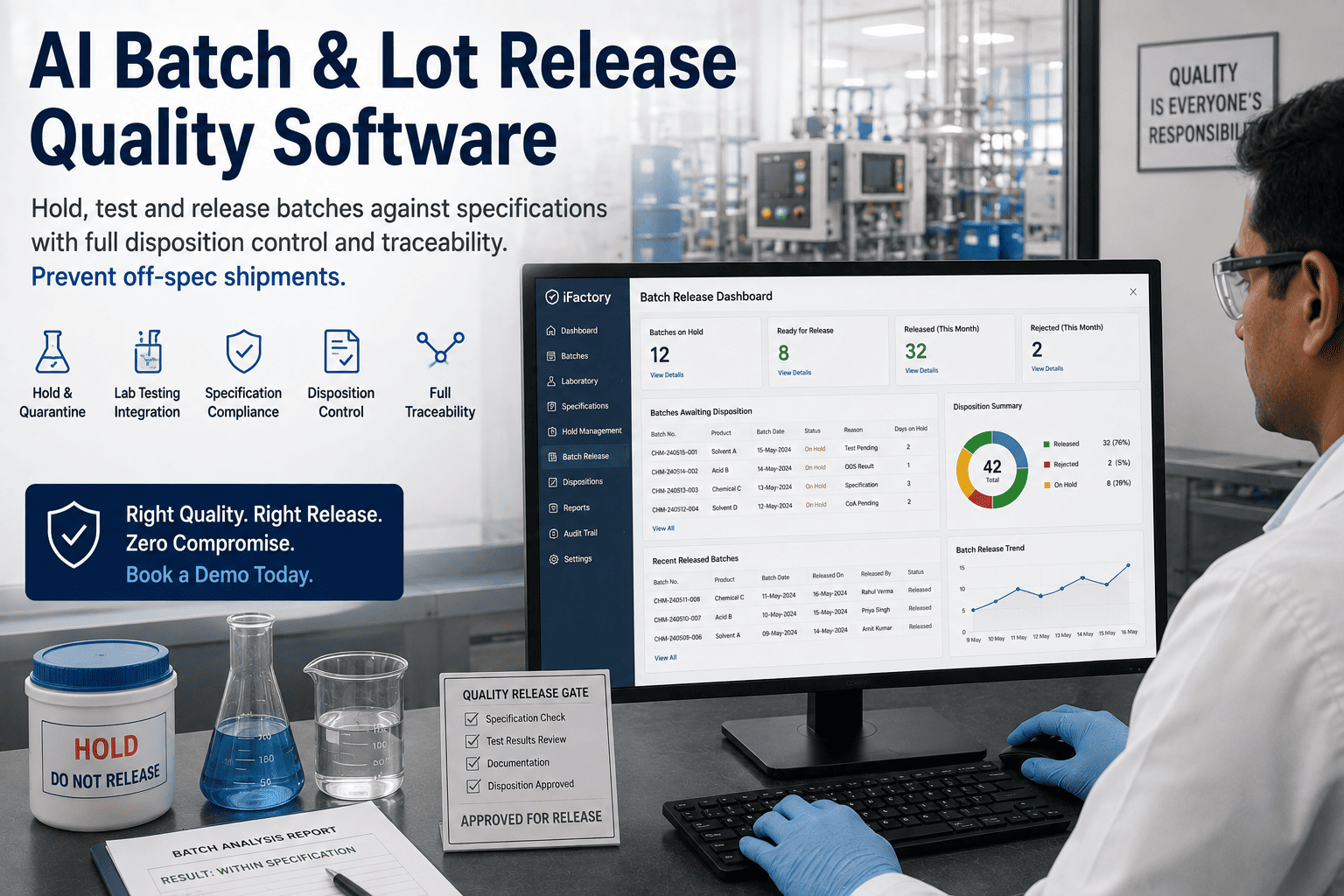
Every batch you make is one signature away from a shipment or a recall. The chemical recall notices filed over the past two years read almost identically — a batch "not manufactured to the required specification," an out-of-spec result caught too late, and every drum of the affected lot needing quarantine and return. The one thing standing between a controlled release and that headline is the disposition gate: the decision that a specific lot met its spec before anyone could ship it. Batch and lot release software makes that gate real — every batch born on hold, tested against spec, and released only by a signed disposition, with genealogy to trace any lot both ways. You can book a demo to see the gate run on your own batches.
No Batch Ships Until the Spec Says It Can — and the Record Proves It
Hold every batch by default, test it against specification, and release it only through a controlled, signed disposition — with full genealogy so any lot is traceable in both directions the moment it matters.
Default to Hold, Not Default to Ship
The single most important design decision in release management is which direction the gate fails. In a controlled system, a newly manufactured or received lot enters quarantine automatically and cannot be picked, packed, or shipped until Quality signs a disposition. The status itself enforces the rule — not a person remembering to check, not a note on a whiteboard. That inversion, from "ship unless someone flags it" to "hold until someone releases it," is what stops an untested or off-spec batch from reaching a customer by default.
It sounds like a small distinction, but it's the entire difference between a system that prevents mistakes and one that merely records them. A release process built on hold tags and human vigilance fails the moment someone is rushed, a tag falls off a drum, or a new hire doesn't know the rule — and the failure is invisible until the off-spec product is already at a customer. A status-driven gate has no such gap: the lot is simply not shippable, as a property of its record, until the disposition exists. The safe outcome is the automatic one, and the burden shifts from remembering to hold onto deliberately choosing to release.
The lot met every release specification, its records are complete, and Quality has signed the disposition. Only now does it become pickable and shippable under controlled inventory rules.
Every batch lands here the moment it's made or received. It's blocked from use and from shipment until a disposition decision moves it — the safe default that protects you from an accidental release.
The lot failed its criteria and is dispositioned out — segregated, unpickable, and recorded, so a rejected batch can never quietly find its way into an order wave.
Disposition Is a Risk Decision Anchored in Evidence, Not a Rubber Stamp
Releasing a lot isn't clerical. It's a judgment that compares a complete set of evidence against the acceptance criteria, and every input has to be present and compliant before the signature is valid. When any piece is missing or out of spec, there is no release. Here's what the gate checks on every batch.
The lot's actual analytical results — purity, potency, physical properties — compared line by line to the release specification, with the margin to each limit visible rather than a bare pass or fail. Out-of-spec or out-of-trend results must be investigated and closed before the gate opens.
The executed batch record with materials consumed, process parameters, in-process results, and any holds or restarts — proof the batch was actually made the way it was supposed to be, not just that it tested acceptable at the end.
Any linked deviation or nonconformance on the batch assessed and resolved, with CAPA where the issue is systemic, so an open investigation can't sit unnoticed under a released lot.
Full traceability from received components to the finished lot, plus confirmation that the correct label template and version were applied — because more recalls start with label drift and traceability gaps than most teams expect.
Make the Release Gate Impossible to Bypass
iFactory holds every batch until its evidence is complete and its spec is met, then records the disposition under a controlled signature — so an off-spec lot can't ship because someone was in a hurry.
The Spec Decides — So the Spec Has to Be Right and Enforced Identically
A release specification is the quality contract for the product, and the gate is only as good as the spec behind it. Set the limits and the system compares every lot to them the same way, every time, removing the judgment drift that creeps in when a person eyeballs results against a number they half-remember.
Specifications set too wide let substandard product through the gate — the lot passes on paper while falling short of what the customer's process actually needs, seeding a complaint or a downstream failure.
Limits set from real product and stability data, applied identically to every lot by the system, so the gate catches genuine problems and passes genuinely good product — the target most operations reach with disciplined specs.
Specifications set too narrow reject sound product and drive unnecessary OOS investigations, burning lab and QA time on batches that were never actually at risk.
A lot that clears every limit by a hair is not the same as one sitting comfortably in the middle of its range, even though both read "pass." Showing the actual result and its margin to each limit turns release into an early-warning system: a series of lots creeping toward a boundary is a process drifting toward an out-of-spec event, and catching that trend before a batch actually fails is far cheaper than investigating the failure after it happens.
Trace Any Lot in Both Directions — Before You Ever Need To
The chemical recalls of the last two years share a pattern: an off-spec batch identified after it shipped, and a scramble to find every drum. Batch genealogy is what turns that scramble into a query. Built during manufacture rather than reconstructed under pressure, it answers the two questions a recall demands, instantly.
The difference between having genealogy and building it after the fact is the difference between a contained incident and a spreading one. When an off-spec result surfaces on a batch that already shipped, every hour spent reconstructing which raw materials it used and which customers received it is an hour that product sits in the field. Worse, a genealogy assembled by hand under deadline pressure is exactly when errors creep in — a missed shipment, a raw material lot left off the list — and those errors are what turn a targeted recall into a broad, expensive, reputation-damaging one. Connected genealogy captured as the batch is made removes both the delay and the doubt.
Every raw material and component lot consumed in a finished batch, linked to the batch record — so if a suspect raw material is found, you know exactly which finished lots it touched, and which are clean.
Every finished lot linked forward to the shipments and customers that received it — so if a batch is later found off-spec, the containment list is a report, not a week of digging through paperwork.
From Manufacture to Signed Release, With No Gap to Slip Through
The lifecycle is the same discipline on every batch, and the software carries each one through it without a manual handoff where a lot could get shipped before it was cleared. Here's the path from made to released.
Wherever a Batch Is Released Against a Spec, the Gate Applies
Batch release is sharpest in chemical manufacturing, where potency, purity, and specification margins decide whether a lot performs in a customer's process — but the same hold-test-release discipline governs any batch-based operation with a quality bar to clear.
Release against purity, impurity, and concentration specs with COA generation, where a lot testing slightly off can still fail a customer's tighter internal tolerance.
Disposition batches on physical properties — viscosity, pH, solids — where the release spec is the difference between a lot that applies right and one that doesn't.
Quality-unit disposition under formal release testing, with deviations, OOS, and genealogy all part of the gate before a batch is certified.
Hold-and-release on finished lots against safety and quality specs, with forward and backward traceability for rapid containment if an issue surfaces.
From Manual Hold Tags to a Governed Release Gate in Weeks
Because release is a discipline you already run, deployment is fast — your specifications, disposition roles, and status rules get configured, not invented. iFactory maps to how you release today and goes live in phases.
Configure your release specifications, the hold-test-release status model, and who holds disposition authority, so the gate enforces exactly your rules.
Run real batches through auto-quarantine, testing, evidence assembly, and signed disposition, and validate the genealogy against your existing lot records.
Link status to your ERP and warehouse so released-only lots are pickable, extend across products and sites, and switch on genealogy and trend reporting.
What Quality Teams Ask About Batch Release Software
Ship Only What the Spec Cleared — and Prove It Every Time
iFactory holds every batch by default, releases it only through a signed disposition against specification, and keeps the genealogy that turns a recall into a query — so an off-spec shipment stops being a risk you carry.