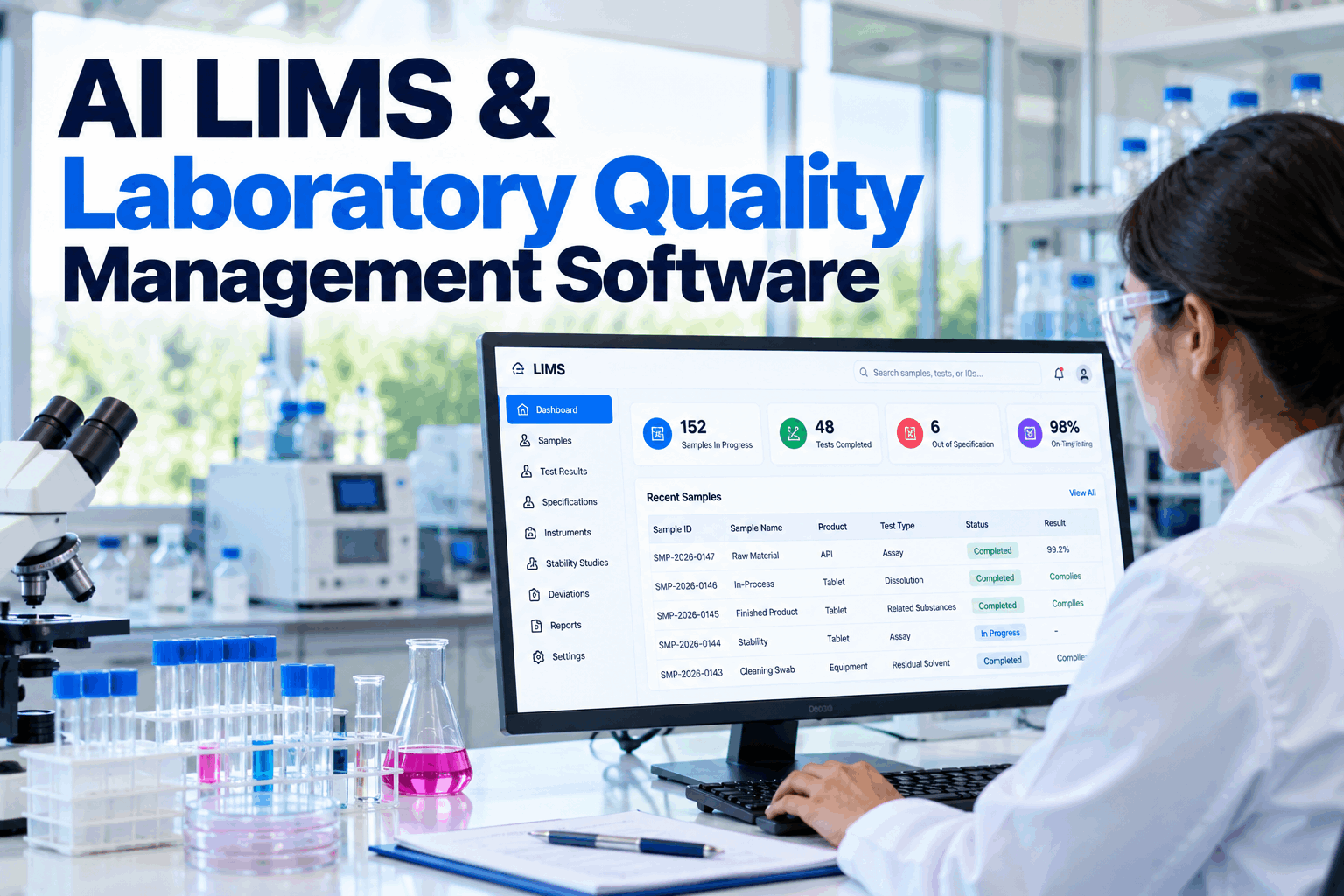
Most quality labs still run on a mix of logbooks, instrument printouts and spreadsheets that one person understands. Samples arrive with handwritten labels, results are typed in twice, and specification checks happen by eye. When an auditor asks how a result was produced, the answer means pulling paper from three places. AI LIMS and laboratory quality management software brings samples, results, specifications and instrument data into one traceable record, checks every result against its specification as it is entered, and supports alignment with ISO/IEC 17025. See it in a lab walkthrough.
AI LIMS and Laboratory Quality Management Software
Sample registration to final report in one system. Instrument data captured directly, specifications checked automatically, and every step traceable for audits and accreditation.
- The full sample lifecycle in one record
- Automatic specification checks and instrument capture
- How the system supports ISO/IEC 17025 alignment
Why Spreadsheets and Logbooks Fall Short
The lab's output is only as trusted as its records.
Labs make decisions that release product, accept raw materials and support customer claims. Every one of those decisions rests on a result that has to be traceable to a sample, a method, an analyst, an instrument and a specification. When that chain lives across paper and spreadsheets, gaps appear: transcription errors, missing calibration links, specifications that changed without anyone noticing and reports that are hard to reproduce. Each gap is small on its own, but together they slow releases, weaken audit answers and make it harder to trust the numbers when a customer complaint arrives. Our lab specialists can review where your gaps are.
Double entry
Results typed from printouts, then typed again into reports.
Spec drift
Old specification versions still used in templates.
Weak links
Results not tied to instrument calibration status.
Slow audits
Hours spent rebuilding the history of one result.
The Sample Lifecycle in One Record
Every step from arrival to report, linked together.
A LIMS follows each sample through its whole life in the lab. At every step the system records who did what, when and with which equipment, so the full history of any result can be shown in seconds. Analysts see their own work list for the day, and supervisors see the whole lab at a glance. See the lifecycle in a product demo.
Register
Sample logged, labelled and linked to its lot.
Assign
Tests set from the product's specification.
Test
Results captured from instruments or entered.
Review
Checked against spec, reviewed and approved.
Report
Certificate or report issued, sample stored or disposed.
A barcode or QR label printed at registration removes most sample mix-ups and makes every later step faster. Scanning the label at each instrument and storage location builds the chain of custody without extra effort from analysts.
Specifications and Automatic Result Checks
Let the system compare every result with the right limits.
Specifications are held in the LIMS as controlled, versioned records. When a sample is registered, the right specification version is attached. If a specification changes, the new version goes through review and approval, and the system records which samples were tested against which version, so there is never doubt about the limits a result was judged by. As each result is entered or captured, it is compared with its limits and flagged at once if it fails or comes close to a limit. Set up specifications with our implementation team.
Instrument Data Without Retyping
Every manual transcription is a chance for an error.
Balances, titrators, pH meters, chromatography systems and spectrometers can send results straight to the LIMS. The result arrives with the instrument ID, method and time, and the system checks the instrument's calibration status before accepting it. Where an instrument cannot connect, results can still be entered by hand with a second-person check, and the record shows which values were typed and which came from the instrument. Ask our integration team which of your instruments can connect.
Balances and meters
Weights and readings captured at the bench.
Chromatography
Results from chromatography data systems.
Spectrometers
Measurements with method and run details.
Calibration check
Out-of-calibration instruments blocked.
One Traceable Record for Every Result
Samples, results, specifications and instrument data in one system, with automatic checks and a history auditors can follow in seconds.
Supporting ISO/IEC 17025 Alignment
The standard asks for competence, consistency and valid results.
ISO/IEC 17025:2017 sets out general requirements for the competence of testing and calibration laboratories. Many of its requirements are easier to meet and show when records are held in one controlled system. Assessors can be shown a result and follow it back through the method, analyst, instrument, calibration and sample handling without anyone searching through binders. The grid below links some of the standard's main clauses to how a LIMS supports them. Accreditation itself remains a matter for your lab and accreditation body. Review your needs with our quality team.
Ensuring the Validity of Results
Watch the lab's own performance, not just the products.
Labs check their own reliability with control samples, replicate tests, reference materials and proficiency testing. The LIMS charts control results over time, so drift in a method, analyst or instrument shows up before it affects product decisions. Proficiency test results are stored alongside, so the lab can show how it compares with other labs on the same tests. The AI looks for patterns across these charts and raises them for review. Set up control charts with our lab quality team.
Lab Workload and Turnaround
Production waits on the lab. Make the queue visible.
Release testing often sits on the critical path for shipping product. A LIMS shows every sample in the queue, its priority, the tests left and the analyst or instrument it is waiting on. The AI estimates when each result will be ready and warns when a priority sample is at risk of missing its due time, so supervisors can move work between analysts or instruments before production is kept waiting. Plan workload views with our operations team.
Samples waiting
By priority, test and due time.
Analyst load
Who has what, and who has capacity.
Instrument bottlenecks
Instruments that hold up the most samples.
Turnaround time
From registration to approved result.
Stability Studies and Retained Samples
Long studies need long memories.
Stability programs and retained sample libraries run for months or years. The LIMS schedules each pull point, reminds analysts when samples are due, tracks storage conditions and links every result to its study and time point. Retained samples are logged with their location and retention period, so they can be found quickly for an investigation or a customer query. Set up stability programs with our stability team.
Stability programs
- Pull points scheduled automatically
- Storage chamber conditions linked
- Results trended against time
- Out-of-trend points flagged for review
Retained samples
- Location and quantity recorded
- Retention period tracked
- Withdrawals logged with reason
- Disposal recorded at end of retention
Moving From Spreadsheets: A Practical Path
Start with the work that matters most, then grow.
Labs that try to move everything at once often stall. A phased approach brings early wins and builds confidence. Plan your path with our implementation team.
Specifications
Clean, version and load the specs in use.
Core samples
Release and raw material testing first.
Instruments
Connect the busiest instruments.
Wider scope
Stability, environmental and special tests.
Built for Labs Across Industries
Different products, same need for trusted results.
The same core LIMS serves quality labs in many sectors, with methods and specifications set up for each. Discuss your sector with our industry team.
Food and beverage
Micro, allergen and composition testing, environmental monitoring.
Chemicals and plastics
Raw material, in-process and release testing with COAs.
Pharma and devices
GMP labs with audit trails and electronic signatures.
Metals and building materials
Mechanical and chemical testing with certificates.
LIMS Mistakes to Avoid
A LIMS reflects the lab's processes, good or bad.
These are common problems when labs move to a LIMS. A short readiness review can avoid them.
What works
- Specifications cleaned and versioned first
- Instruments connected, not retyped
- Barcoded samples from registration
- Review and approval before reports
What fails
- Copying every spreadsheet into the LIMS
- Free-text results with no limits
- Calibration tracked somewhere else
- Shared logins for convenience
How iFactory Runs Laboratory Quality Management
Quality Management System, on your own network.
iFactory manages samples, tests, results, specifications and instrument data with full traceability and supports ISO/IEC 17025 alignment. It runs on an on-prem AI server inside your site and connects to your instruments, ERP and quality system. Fit questions go to our solutions team.
Sample management
Registration, labels and chain of custody.
Spec checks
Every result evaluated automatically.
Instrument capture
Results straight from instruments.
Control charts
Validity of results watched over time.
Reports and COAs
Controlled templates with approval.
Data integrity
Access control and audit trails.
iFactory supports your lab's quality system and accreditation work. Accreditation decisions remain with your accreditation body.
Turnkey AI: Delivered, Connected and Live in 6–12 Weeks
You do not build this. It arrives ready.
iFactory ships as a pre-configured NVIDIA AI server with the software pre-loaded, racked and ready. Rack it, plug in power and Ethernet, and the AI is live on your network. Our team handles cabling, network setup, PLC, SCADA, DCS and CMMS integration, instrument and ERP links, operator training and 24×7 remote monitoring. Data stays on your network. For a scope matched to your plant, request a turnkey quote.
Ship, network and data
Server installed. Instruments, specifications and ERP connected.
Model training and pilot
Sample workflows, tests and reports configured for one lab area.
Go-live and training
LIMS live for the lab. Analysts and reviewers trained. 24×7 monitoring begins.
Frequently Asked Questions
What is LIMS and laboratory quality management software?
Software that manages samples, tests, results, specifications, instruments and reports in one traceable system, supporting the lab's quality and accreditation needs.
Does it support ISO/IEC 17025?
It supports many requirements of ISO/IEC 17025:2017, such as equipment records, technical records, validity of results and data control. Accreditation remains with your lab and accreditation body.
Can results come straight from instruments?
Yes. Many instruments and data systems can send results directly, with the instrument ID, method and time.
How are specifications managed?
As controlled, versioned records. The right version is attached to each sample and every result is checked against it.
What happens when a result fails?
It is flagged at once, the reviewer and QA are notified, the lot can be held and an investigation can be opened.
Can it manage stability studies?
Yes. It schedules pull points, links storage conditions, trends results over time and flags unusual time points for review.
Does it handle certificates of analysis?
Yes. COAs are produced from approved results using controlled templates.
Where is lab data stored?
On the on-prem server inside your site, with access control, audit trails and backups.
How do we start?
Start with one lab area and its most common tests. A 6-week pilot connects key instruments and configures workflows. To plan it, contact our team.
Give Every Result a Traceable History
In thirty minutes we review your lab's current records, instruments and reports, and sketch a LIMS setup for one lab area. You keep the sketch either way.
- 1A sample of your lab spreadsheets
- 2Your specification list
- 3Instrument list and data systems
- 4A recent certificate of analysis
- 5Your last audit or assessment findings