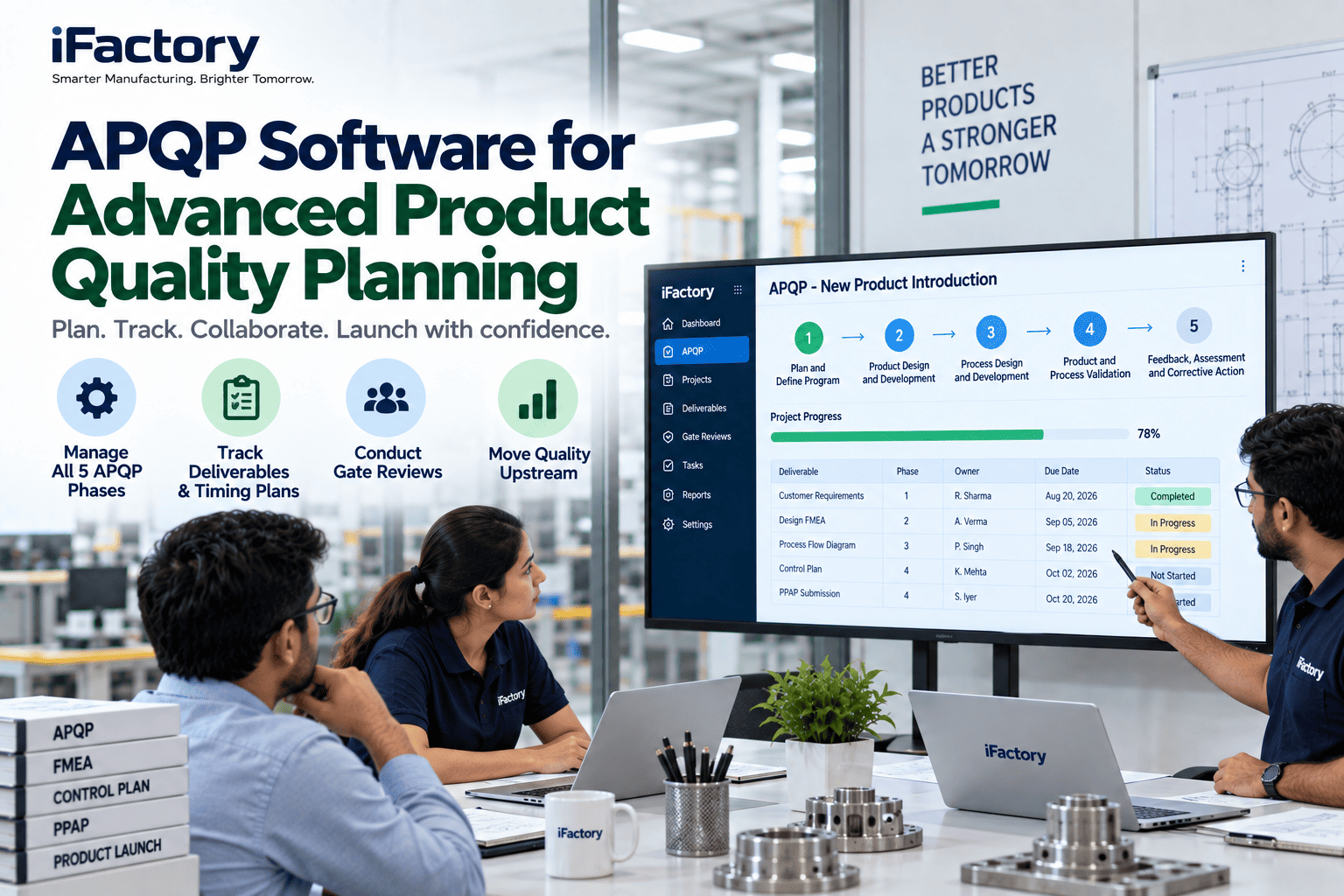
APQP — Advanced Product Quality Planning — is the disciplined phased approach that moves quality thinking upstream into design and process development, so a product launches on-time, at-cost, and to-quality rather than firefighting through PPAP. The five phases (Plan and Define, Product Design and Development, Process Design and Development, Product and Process Validation, Feedback/Assessment/Corrective Action) each have their entry criteria, deliverables, and gate reviews. Under IATF 16949 the discipline is required for new product launches; under AS9100 it manifests as APQP or an equivalent New Product Introduction process. When APQP runs on spreadsheets and shared drives, gates slip and deliverables miss. Software that structures the five phases with gate reviews and deliverable tracking is what makes launches actually land.
iFactory / APQP software
Run All Five APQP Phases with Gate Reviews and Deliverable Tracking
Manage APQP across all five phases with entry/exit criteria per phase, gate readiness reviews, timing plans, deliverable tracking, and PPAP hand-off from Phase 4 — aligned to AIAG APQP 2nd edition and IATF 16949 requirements.
4
Product & Process Validation → PPAP
5
Feedback / Assessment / Corrective
Gate reviews
entry + exit criteria
The Problem in APQP Practice
A typical program manager running APQP today juggles a Gantt chart, an APQP deliverable spreadsheet, an FMEA in Excel, a control plan in another Excel, meeting minutes from cross-functional reviews, and email threads on where each deliverable stands. Gate reviews happen in PowerPoint from screenshots of the spreadsheet. When Phase 3 slips, Phase 4 gets compressed, and PPAP submission arrives at the customer half-baked because deliverables that should have been signed in Phase 3 were closed only after Phase 4 started. When the customer audits the APQP file, missing deliverables and out-of-sequence closures are the finding pattern. When the launch fails to hit SOP quality, the retrospective points to gates that closed without evidence, not to any single missed activity.
Where APQP Actually Slips
APQP execution failure modes are consistent across automotive tier-1/2 suppliers and aerospace NPI programs. Each is a specific IATF 16949 or customer-audit finding.
Gate compression
Phase 3 slips two weeks. Phase 4 window doesn't move because SOP is fixed. Validation activities run in parallel with process design closure that should have preceded them.
Deliverable missing
APQP checklist has 43 deliverables. Twelve show as complete but the evidence attachments are missing or point to obsolete revisions. Customer audit finds it.
Gate closed without review
Phase gate closed because the timeline required it — not because the entry criteria for the next phase were met. Downstream work built on unsigned foundation.
PPAP unsupportable
PPAP submission assembled at end of Phase 4 from disconnected sources. Elements don't fully reference APQP evidence. Customer rejects submission; launch delays.
What Good Looks Like in APQP Execution
A working APQP system holds four disciplines together — 5-phase structure with entry/exit criteria, gate reviews with readiness evidence, timing plan with critical-path visibility, and Phase 4 hand-off to PPAP with linked deliverables.
5-Phase Structure
Every phase with defined entry criteria, deliverables, and exit criteria. Deliverable tracking with owner, due date, and evidence attachment per item.
Phase-gate discipline
Gate Readiness
Gate reviews with readiness rollup — every entry criterion satisfied, every deliverable signed off. Gates don't close on calendar; they close on evidence.
Evidence, not calendar
Timing Plan
APQP timing plan with critical path across phases. Slip on a critical-path deliverable surfaces impact on downstream phases immediately, not at the next status meeting.
Critical-path visible
PPAP Hand-off
Phase 4 deliverables (PSW, process flow, PFMEA, control plan, MSA, dimensional results, initial capability studies) auto-populate PPAP package elements per submission level.
Phase 4 → PPAP linked
How iFactory AI Fits
iFactory AI overlays your PLM, project management (MS Project, Smartsheet, Jira), and existing QMS — providing the APQP-specific 5-phase structure, gate discipline, and PPAP linkage without replacing your program-management tooling.
Phase Manager
APQP Layer
5-phase structure with entry/exit criteria and full AIAG deliverable checklist. Per-project configuration for customer-specific requirements and internal NPI variations.
Gate Review
APQP Layer
Gate review workflow with readiness rollup, cross-functional sign-off, and evidence attachment. Gates that show incomplete cannot be closed without documented exception.
Timing + Critical Path
APQP + Project Mgmt
APQP timing plan integrated with project management tool. Critical path calculated. Slip impact on downstream phases surfaced live.
PPAP Bridge
APQP + PPAP
Phase 4 deliverables auto-populate the AIAG PPAP package per customer submission level (1-5) or VDA PPA scope. Submission-ready without re-keying.
Ask your program manager to produce the gate readiness evidence for the most recent APQP gate review. If the answer is "a PowerPoint from a spreadsheet from meeting minutes," the launch is exposed. Book an APQP launch review.
16-Week APQP Rollout on One Active Program
One active APQP program in Phase 1 or 2, sixteen weeks. The pilot deploys the 5-phase structure on the program and runs at least one gate review through the new discipline.
Weeks 1–3
Program Load
Load program scope. Configure 5-phase structure with customer-specific deliverables and internal NPI requirements. Timing plan imported from current project management tool.
Weeks 4–8
Deliverable Tracking
Current-phase deliverables migrated with owners and evidence. Cross-functional team trained. Weekly cadence with program manager to close known-open items.
Weeks 9–13
Gate Review
First formal gate review through the new discipline. Readiness rollup produced. Cross-functional sign-off captured. Gate close or exception documented.
Weeks 14–16
Method Established
Discipline established for remaining phases of the pilot program. Rollout to remaining active programs and future NPIs scoped.
Who Owns the KPI
APQP crosses program management, design engineering, process engineering, quality, and customer-facing account management. Each function owns a specific KPI or the launch discipline reverts to spreadsheet chaos.
Program Manager
Gates closed on schedule with evidence
Owns the launch cadence — the share of gates closed on schedule with full readiness evidence. Slipped gates or evidence-light closures are the launch-risk signal.
Quality Engineer
Phase 4 deliverables ready for PPAP
Owns the submission readiness — PSW, PFMEA, control plan, MSA, dimensional, capability all ready before PPAP window opens. Rush submissions cause customer rejection.
Engineering Lead
Design deliverables at gate readiness
Owns the engineering flow — DFMEA, design verification, prototype build all signed at their respective gates. Downstream work depends on upstream engineering readiness.
Customer Quality
Customer APQP audit findings
Owns the customer-facing outcome — findings at customer APQP status reviews and pre-PPAP audits. Rising findings are the launch-risk signal.
FAQ
How does this align with IATF 16949 and customer-specific APQP requirements?
IATF 16949 requires a documented product-realisation process aligned with APQP principles — most OEMs then add customer-specific requirements (Ford APQP Status Report, GM GVDP, Stellantis PSO, Toyota GSDB requirements). The 5-phase structure is configurable per customer so that program teams working with Ford see Ford-specific deliverables and gate templates; teams working with GM see GVDP-specific structure. Where a supplier works with multiple OEMs on one program family, the workflow supports parallel customer-specific views on a shared underlying deliverable base. Nothing forces uniformity that customers don't want.
How does this bridge into PPAP — do we run APQP and PPAP as one system?
Yes, and the bridge from Phase 4 to PPAP is where most of the launch value lands. Phase 4 (Product and Process Validation) generates most of the AIAG PPAP 18 elements — process flow, PFMEA, control plan, MSA, dimensional results, initial process studies, PSW. When these are captured in APQP with evidence attachments, the PPAP package assembles from them automatically per customer submission level (Level 1 through Level 5). The alternative — assembling PPAP separately at end of Phase 4 — is where submissions arrive incomplete and get rejected.
Book a demo to see the Phase 4 → PPAP bridge live.
What about VDA PPA — does this handle VDA Volume 2 as well as AIAG PPAP?
Yes. VDA Volume 2 6th edition (2020) replaced fixed submission levels with a negotiated Production Part Approval (PPA) agreement between supplier and customer scoped per part risk; VDA Volume 2 7th edition (2026) further scopes the procedure by product risk. The workflow supports the PPA agreement structure alongside AIAG PPAP levels, so suppliers working with German OEMs use VDA PPA while suppliers working with US OEMs use AIAG PPAP — from the same underlying APQP deliverables. Aerospace suppliers under AS9100 with equivalent NPI processes configure similarly.
Stop running APQP on spreadsheets and gate-review PowerPoints.
Structure One Active Program on the 5-Phase Discipline — Live
Bring one active APQP program at any phase, its current deliverable status, and its customer's specific APQP requirements. We'll load the 5-phase structure, walk gate readiness for the current phase, and demonstrate the PPAP bridge from Phase 4.
Gate readiness
evidence-driven