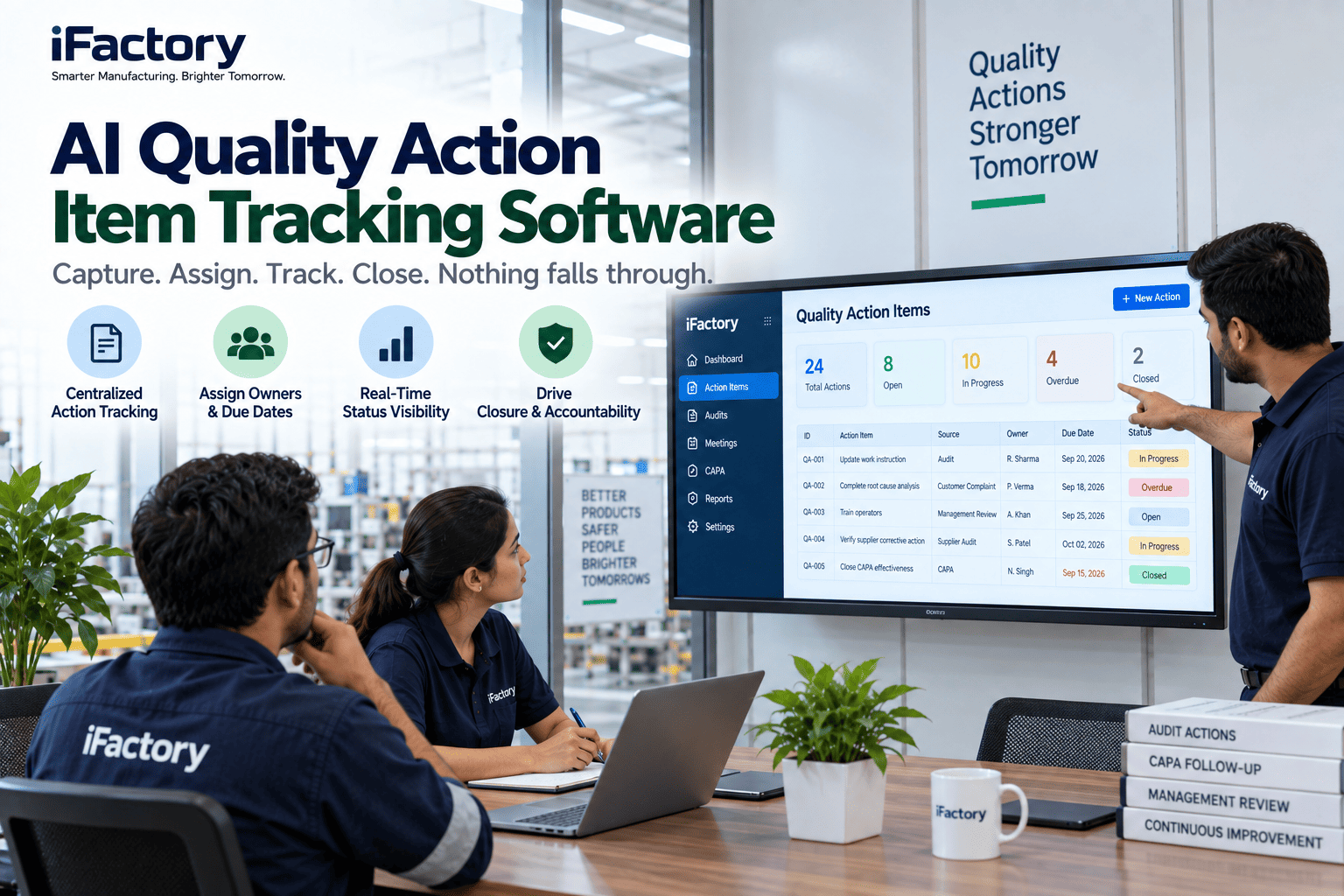
Every audit, review, and quality meeting generates action items. Every CAPA opens sub-actions. Every customer scorecard produces improvement commitments. In most organisations these end up scattered across meeting minutes, email threads, personal task lists, and the memory of the quality manager — and half of them never close. The gap between action-generated and action-closed is where continuous improvement dies quietly. A single quality action register with named owners, tracked due dates, and closure evidence is not project management overhead; it is the discipline that turns every audit finding, every management review commitment, and every complaint into a completed improvement rather than a repeated finding at the next audit.
iFactory / Quality action tracking
Every Action Item, One Register — Owned, Due-Dated, Tracked to Closure
Capture quality actions from internal audits, management reviews, layered process audits, complaints, CAPAs, and customer scorecards into one register — with named owner, due date, escalation on overdue, and closure evidence that stands up to the next audit.
Internal audits
→ Owner · date
Management reviews
→ Owner · date
Complaint / NCR
→ Owner · date
Customer scorecard
→ Owner · date
Layered process audit
→ Owner · date
6+ sources
every action origin
The Problem in Quality Action Follow-Through
A typical quality function generates action items from six or more sources every month — internal audit findings, management review outputs, layered process audit observations, complaints and their CAPAs, customer scorecard commitments, and supplier development activities. Most organisations track these in whichever tool the source function uses: audits in the audit tool, review actions in meeting minutes, LPA observations on paper walking cards, CAPAs in the QMS, scorecard commitments in email replies. When the next surveillance audit asks how the previous audit's findings were closed, the quality manager assembles evidence by hand from six systems and hopes nothing was missed. Half of what looks closed in one place is actually pending in another.
Where Action Items Actually Get Lost
Quality action failure modes are consistent across organisations of any size. Each is a specific ISO 9001 or IATF 16949 finding category.
No named owner
Action captured with 'quality team' or 'operations' as owner. No individual accountable. Deadline arrives; nobody remembers whose responsibility it was.
No due date
Action captured with 'ASAP' or 'this quarter.' No specific deadline. Falls to the bottom of everyone's list. Rediscovered at next audit as still open.
Closed without evidence
Owner marks action complete. No evidence attached. Auditor asks how effectiveness was verified. No answer.
Repeat finding
Previous audit's action never actually closed. Same finding at surveillance audit. Auditor upgrades severity because the finding is systemic — not new.
What Good Looks Like in Action Tracking
A working action tracking system holds four disciplines together — single register from all sources, named ownership with due dates, escalation on approaching or overdue actions, and closure with evidence.
Single Register
Every action from audits, reviews, LPAs, complaints, CAPAs, and customer scorecards captured in one register with source-tagged origin. No parallel lists in six systems.
One register, all sources
Named + Dated
Every action captured with individual owner (not team), specific due date, and success criteria. No 'ASAP', no 'ongoing', no 'team owns it.'
Individual + date
Escalation
Approaching due date prompts owner. Overdue escalates to functional lead. Chronic overdue escalates to quality manager. Nothing falls silent.
Never falls silent
Closure Evidence
Every closure with evidence attached — document, photo, verification record, or effectiveness check. Repeat findings prevented because closure was real.
Real closure, not marked
How iFactory AI Fits
iFactory AI overlays your existing audit tool, QMS, meeting management, and customer scorecard interfaces — consolidating actions from every source into one owned register without replacing the systems that generate them.
Action Register
Tracking Layer
Every action from every source with owner, due date, source reference, success criteria, and status. The single register the quality manager pulls from.
Source Connectors
Tracking + Sources
Native or API-based capture from internal audit tool, LPA workflow, QMS CAPA, meeting management, customer portal — actions land in the register at source.
Escalation Engine
Tracking Layer
Rule-based escalation — approach-due to owner, overdue to functional lead, chronic overdue to quality manager. Configurable per action source or priority.
Evidence Archive
Tracking + Compliance
Closure evidence per action, retained for audit response. Export by audit, by source, by owner, by timeframe. No hunting for evidence at surveillance audit.
Ask your quality manager to produce every open action item from every source, sorted by owner. If the number is over 50, or if the sort takes more than 30 minutes, the discipline is already lost — and the next audit will find it. Book an action tracking review.
8-Week Action Tracking Rollout
One site or one quality function, eight weeks. The pilot loads open actions from all sources, activates escalation, and closes the first surveillance-ready action-history package.
Weeks 1–2
Consolidation
Pull open actions from internal audit, management review, LPA, CAPA, and customer scorecard sources into the register. Baseline the open action count and age.
Weeks 3–4
Owners + Dates
Every action reviewed for named owner and specific due date. Actions without both revised or closed. Success criteria defined per action.
Weeks 5–6
Escalation Live
Escalation rules active. Approach-due and overdue notifications flowing. Weekly review with functional leads on overdue actions.
Weeks 7–8
Audit-Ready
Full action history exportable for surveillance audit. Repeat-finding rate baseline captured. Rollout to remaining functions scoped.
Who Owns the KPI
Action tracking crosses quality, operations, engineering, and functional leadership. Each function owns a specific KPI or the register becomes another parallel list.
Quality Manager
Actions with owner + due date %
Owns the register hygiene — the share of open actions with both individual owner and specific due date. Anything below 100% is a gap in the discipline.
Functional Leads
Actions closed on target %
Owns the closure velocity — the share of actions their function owns that close by the target date. Rising overdue signals capacity or clarity gaps.
Internal Audit
Repeat findings at surveillance audit
Owns the closure integrity — the count of repeat findings at each surveillance audit. Repeat findings mean closures were marked but not real.
Executive Sponsor
Management review action closure
Owns the leadership discipline — actions captured at management review close between reviews. Non-closure is a signal management commitments aren't landing.
FAQ
How is this different from a project management tool like Asana or Monday?
General project management tools handle task tracking well but lack the source-tagged capture and audit-response export that quality actions specifically need. When a surveillance auditor asks 'show me every action from the 2024 internal audit and its closure evidence,' a project tool needs a hand-built filter and manual evidence-hunting. The quality action register is structured for that question — source-tagged at capture, evidence-attached at close, exportable by audit reference in seconds. Where project tools serve broader operational work, the quality register serves the specific compliance and continuous-improvement discipline.
What happens with actions that turn out to need a formal CAPA?
The register captures action items across the full range of severity — simple corrections, minor improvements, and actions that on investigation reveal a systemic root cause requiring CAPA. When an action turns out to need CAPA, the workflow escalates it into your QMS CAPA process (Sparta TrackWise, ETQ, MasterControl, Veeva Vault, or your platform of choice) with the register entry cross-referenced. The CAPA runs its full 5-Why or 8D discipline in the QMS; the register entry closes when the CAPA closes. Registers and CAPAs stay complementary rather than duplicative.
Book a demo to see the CAPA escalation live.
How does this handle layered process audit (LPA) actions specifically?
LPA is a specific audit format under IATF 16949 (and adopted more broadly) with unique dynamics — high volume of observations at daily or shift cadence, mostly minor, needing quick closure by front-line supervisors. LPA observations flow into the register through a lightweight capture path suited to shop-floor use (mobile app, tablet). Escalation rules for LPA are typically shorter (owner in same shift, escalation next shift) than for annual audit findings. What ISO 9001 audit findings and LPA observations share is the register discipline; what they differ on is cadence — and the workflow supports both.
Stop letting action items scatter across six systems.
Consolidate One Function's Open Actions — Live
Bring the last internal audit report, the last management review minutes, and one customer scorecard for one function. We'll consolidate the actions into one register, assign owners and dates, and demonstrate the surveillance-ready export.
Owned + dated
every action