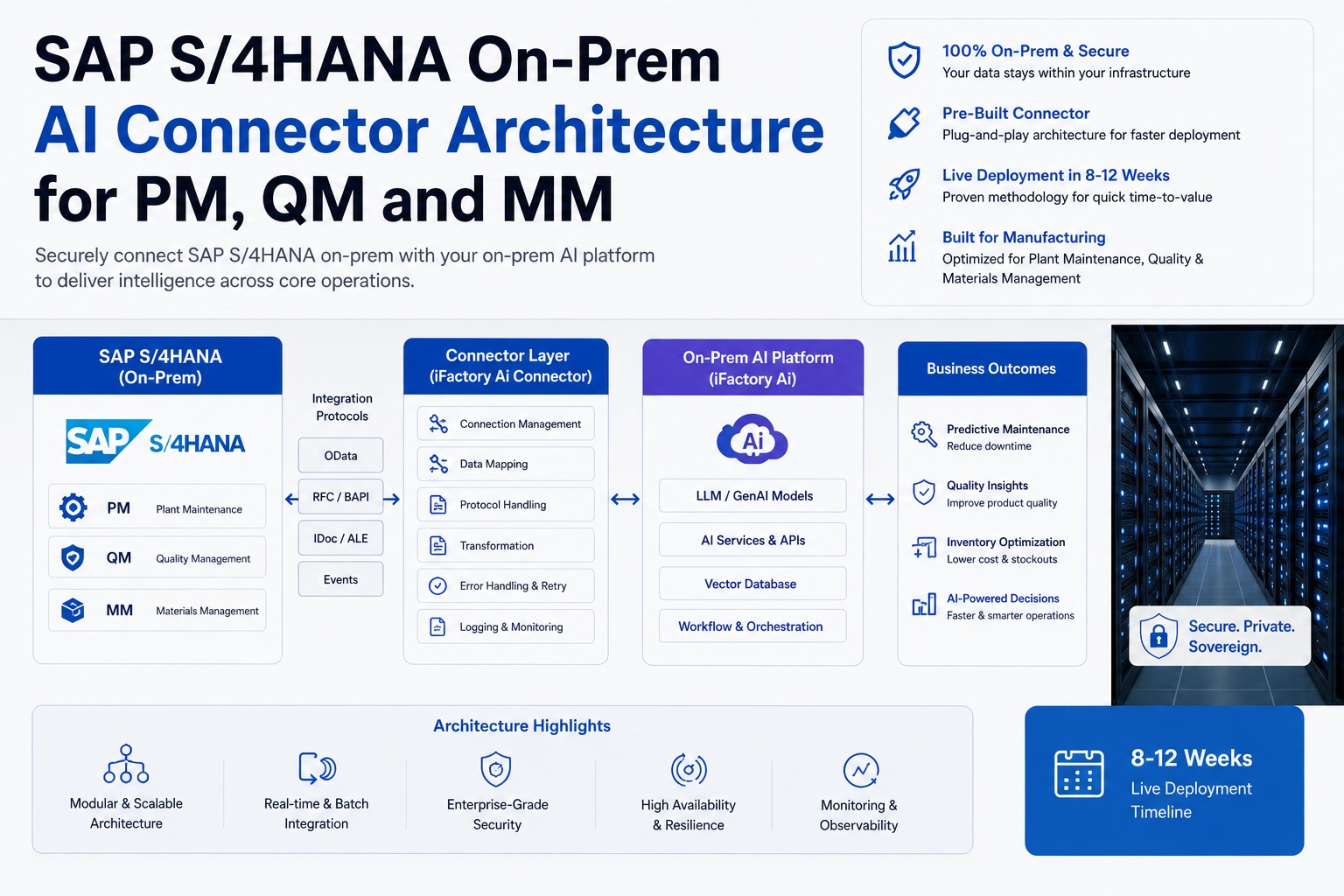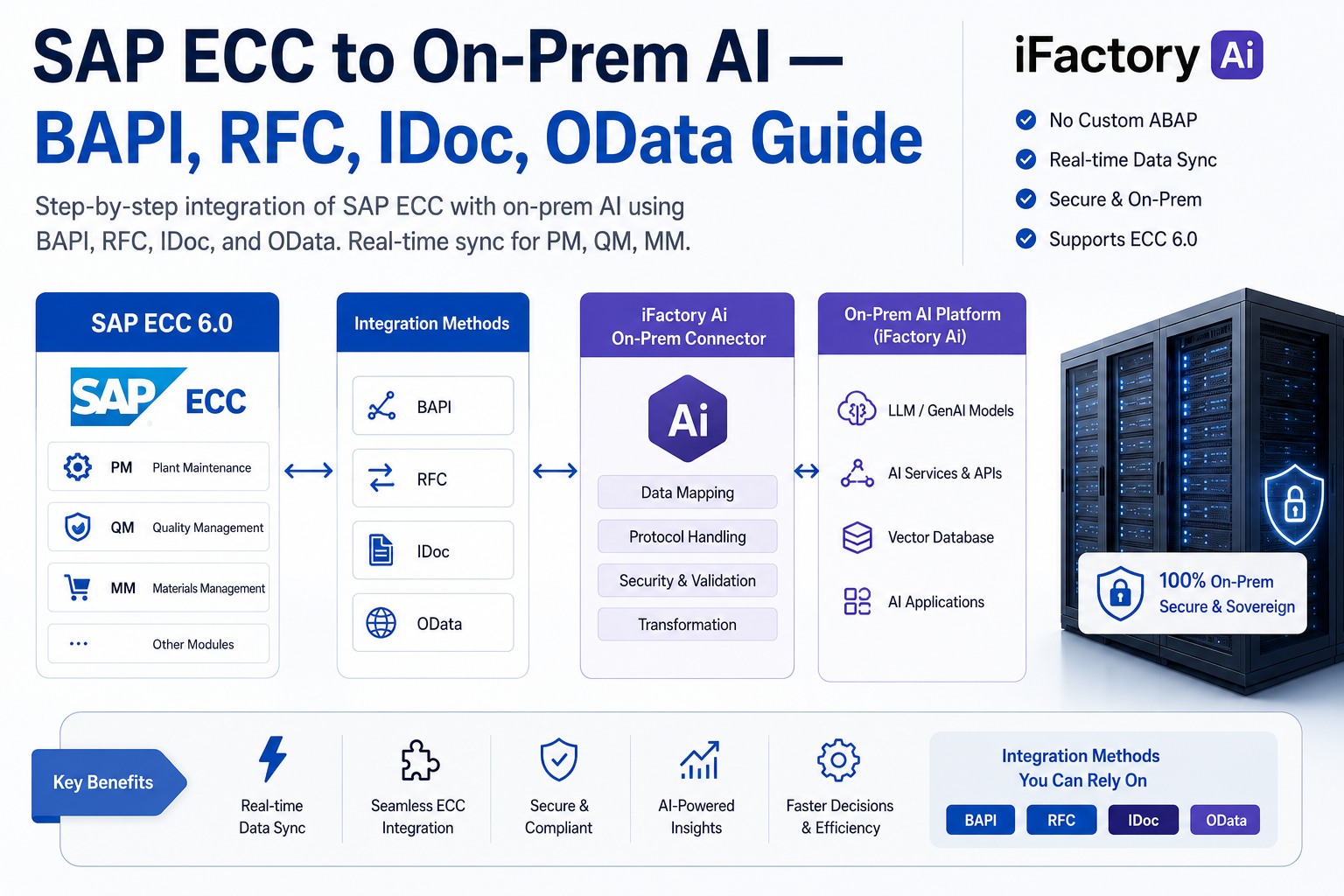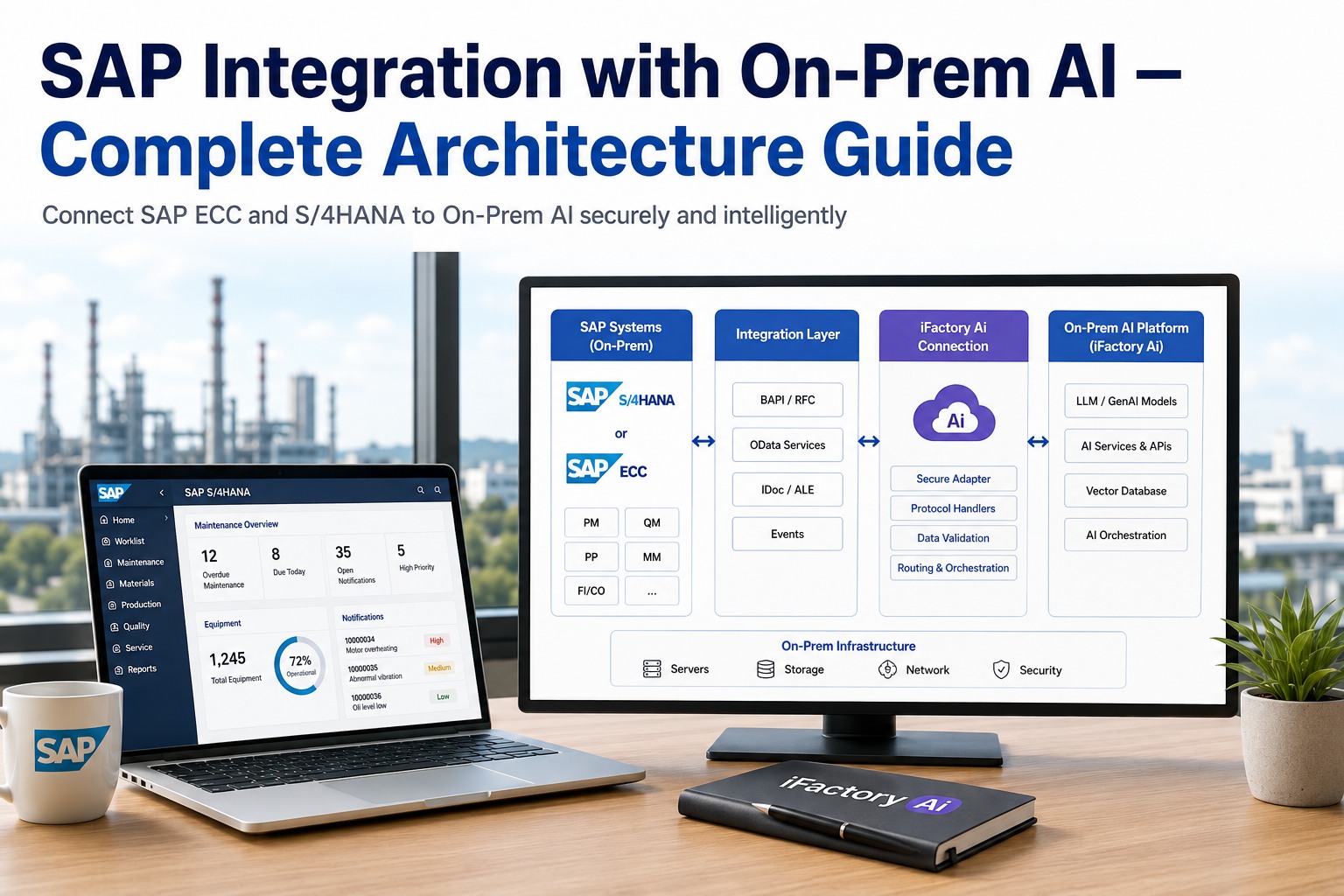
SAP integration with on-prem AI is the architecture that lets manufacturing plants run a sovereign AI brain inside the facility while keeping live SAP ECC or S/4HANA transactions in sync. This guide walks through the full stack — BAPI, RFC, OData, IDoc, and REST integration methods; eight pre-built module connectors for PM, QM, MM, PP, FI/CO, SD, HR, and SRM; air-gapped security; and the 8–12 week deployment plan we use to ship every iFactory on-prem AI system. Whether you run SAP ECC 6.0 today or are mid-migration to S/4HANA ahead of the 2027 mainstream support deadline, the same iFactory connector layer carries through with zero custom ABAP.
SAP Integration with On-Prem AI — The Complete Architecture Guide
Connect SAP ECC or S/4HANA to a sovereign, on-premise AI brain — using BAPI, RFC, OData, IDoc, and REST. Every plant transaction grounded. Every decision audit-ready. Live in 8–12 weeks on NVIDIA DGX, with zero cloud dependency and zero custom ABAP.
What You Get — Turnkey On-Prem AI for SAP
One package. Hardware, software, integration, training, and support — pre-configured and shipped racked. Plug power and Ethernet. Live in weeks, not quarters.
Hardware
NVIDIA DGX Spark, B200, B300, or SuperPOD — pre-racked, pre-cabled, ships ready to plug in.
Software
NeMo, RAPIDS, NIM, Agent Toolkit, and pre-built SAP connectors for PM, QM, MM, PP, FI/CO.
Training
Operator, supervisor, and admin training. Custom playbooks per plant role. Knowledge transfer to your team.
Support
24×7 remote monitoring, model retraining, SAP patch compatibility, and SLA-backed uptime.
The 2027 ECC Deadline Is Forcing a Decision
SAP ends mainstream maintenance for SAP ECC in 2027. Around 30,000 ECC customers worldwide are mid-migration to S/4HANA — and most are being pushed toward cloud-only AI through SAP Joule. For manufacturing plants with sensitive process data, sub-50ms latency requirements, and IT/OT separation rules, cloud-only is the wrong default.
The honest framing
SAP Joule lives in the cloud and requires RISE or GROW contracts. Your machine signals, batch records, recipe IP, and live process variables live on-premise. Bridging those two worlds — without sending sensitive plant data to the cloud — is what iFactory does. Best-in-class AI models, deployed inside your plant, talking natively to SAP.
The Five-Layer SAP-to-On-Prem-AI Stack
Every iFactory SAP integration follows the same five-layer architecture. Each layer is purpose-built for one job — and each layer is replaceable, observable, and auditable on its own.
Layer 1 — System of Record
SAP ECC 6.0, S/4HANA on-prem, or S/4HANA Private Cloud. Source of truth for materials, equipment, work orders, batches.
Layer 2 — Integration Hub
iFactory connector layer. Bi-directional BAPI/RFC/OData/IDoc/REST. Replaces SAP xMII completely.
Layer 3 — Data Fabric
Time-series store, vector database, knowledge graph. Indexes SAP transactions + sensors + SOPs + historian data.
Layer 4 — AI Brain
NVIDIA DGX running best-in-class models: vision (YOLO, ViT), time-series (LSTM, Transformer), foundation LLMs (Llama, Mistral, Nemotron).
Layer 5 — Agent & UI
Role-based copilots — CFO, plant manager, quality director, operator. Voice, chat, smart glasses HUD.
Cross-Cutting — Security
IEC 62443 zoning, IT/OT separation, audit logs, role inheritance from SAP authorization objects. Air-gap optional.
Six Ways iFactory Talks to SAP
Different SAP modules expose different APIs. Different use cases need different latencies. iFactory uses all six standard integration patterns — picking the right one per data flow rather than forcing one method everywhere. Deep-dive into BAPI, RFC, IDoc, and OData here.
Business APIs
Stable, version-safe entry points into SAP business objects. iFactory uses BAPIs to create work orders, post goods movements, and read material master data from PM, MM, and PP modules.
Remote Function Call
SAP's native protocol for high-throughput synchronous calls. iFactory uses tRFC and qRFC for guaranteed-once delivery of sensor-triggered transactions and batch updates.
REST-based Standard
The modern way to talk to S/4HANA. OData services expose CDS views and SAP Fiori entities. iFactory uses OData for read-heavy copilot queries and dashboard refreshes.
Intermediate Document
For high-volume, store-and-forward integration. iFactory uses IDocs for shift-end batch postings, large material movements, and bulk QM result transfers where eventual consistency is acceptable.
Custom APIs & Webhooks
For non-SAP systems and custom ABAP services. iFactory exposes its own REST APIs so SAP can pull AI predictions, scores, and recommendations directly into ABAP code.
Core Data Services
For S/4HANA, CDS views are the fastest path to clean, semantic data. iFactory reads CDS views directly for sub-second copilot answers without round-tripping through application servers.
Eight SAP Modules — Pre-Built Connectors
Every plant runs a different subset of SAP modules. iFactory ships pre-built connectors for the eight most common ones — covering the entire maintain-make-quality-move-pay loop. No custom ABAP. No middleware. See PM, QM, MM module deep-dive.
Plant Maintenance
Equipment master, functional locations, work orders, notifications, PM schedules. AI auto-creates work orders from sensor predictions.
Quality Management
Inspection lots, characteristics, results, usage decisions. AI vision auto-logs defects with annotated images.
Materials Management
Material master, BOMs, purchase orders, goods movements. AI triggers procurement on predictive stock-outs.
Production Planning
Process orders, routings, capacities, MRP. AI optimizes shift schedules and changeover sequences.
Finance & Controlling
GL accounts, cost centers, variance reports. AI posts variances and reconciles three-way matches.
Sales & Distribution
Sales orders, deliveries, billing. AI senses demand from POS and adjusts production plans.
Human Resources
Org structure, qualifications, time. AI matches work orders to technician skills and certification status.
Supplier Relationship
Supplier master, contracts, performance. AI scores supplier risk and predicts delivery delays.
What Changes When You Move From ECC to S/4HANA
iFactory supports both. The architecture is the same — the integration plumbing differs. Here's what your team needs to know about each.
| Dimension | SAP ECC 6.0 | S/4HANA On-Prem |
|---|---|---|
| Database | Oracle, DB2, MSSQL, MaxDB | SAP HANA in-memory only |
| Primary integration | BAPI, RFC, IDoc | OData, CDS views, plus legacy BAPI/RFC |
| UI layer | SAP GUI, NetWeaver Portal | SAP Fiori, OData-backed |
| Built-in AI | None — third-party only | Joule (cloud-only, requires RISE/GROW) |
| Support runway | Mainstream ends 2027 | 2040 mainstream maintenance |
| iFactory connector status | Pre-built & production-tested | Pre-built & production-tested |
| Typical deployment time | 8–12 weeks | 8–12 weeks |
Whether you finish your S/4HANA migration by 2027 or run ECC longer under extended support, the iFactory connector layer is the same code path. The same models. The same copilot. The same agents. You don't rebuild your AI stack just because your ERP version changes. Book a migration architecture review.
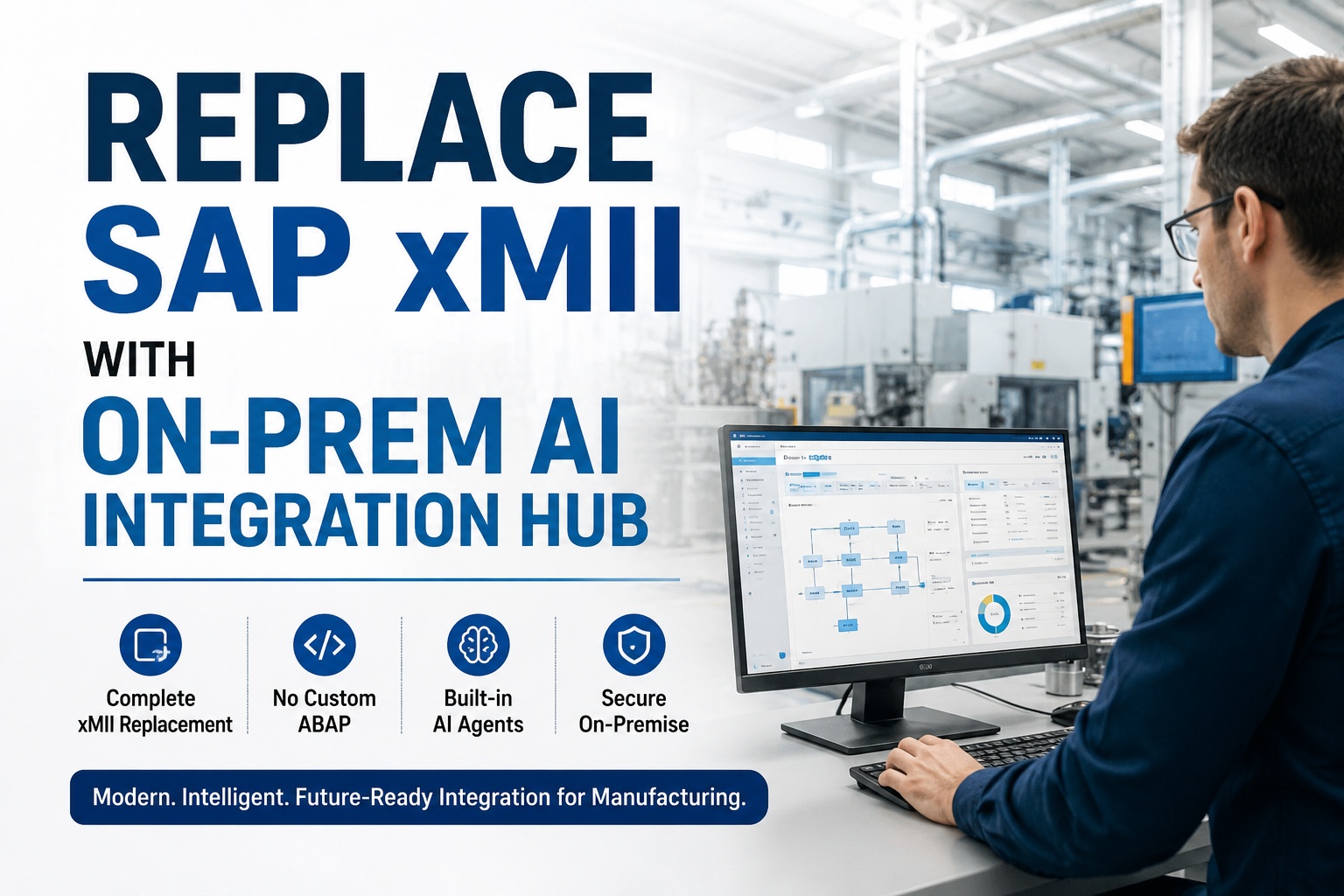
Replacing SAP xMII — End-of-Life Has Arrived
SAP MII (formerly xMII, formerly Lighthammer) was for years the bridge between the shop floor and SAP ECC. SAP's roadmap now points away from MII toward S/4HANA Manufacturing for Production Engineering and Operations (DMC/DM) — but neither carries an AI brain, and both require cloud licensing for the full feature set. iFactory provides a complete xMII replacement on-prem, including legacy logic, dashboards, and PLC connectivity.
What You Lose Staying on xMII
No active feature development. Limited AI/ML integration. Heavy custom logic stuck in obsolete ME runtimes. Security patches slowing. Skills gap widening as MII consultants move on.
What iFactory Replaces It With
Full xMII feature parity — PLC/SCADA connectivity, transaction workbench, dashboards, alerts — plus a native AI brain, modern OData/REST APIs, and zero ABAP customization. Migration in 8–12 weeks. Full xMII migration guide here.
Your Data Never Leaves Your Plant — Unless You Say So
The single biggest reason manufacturers want on-prem AI is data sovereignty. Process recipes, batch genealogy, supplier pricing, equipment failure history — none of it should leave your facility without an explicit policy. iFactory's default posture is fully local. Cloud is opt-in, per data class, with audit.
Air-Gap Optional
Zero external API calls supported. Designed for defense, pharma GxP, and regulated industries.
IEC 62443 Zoning
Purdue Model levels respected. L3 segmentation between OT and IT. Conduit-controlled traffic.
SAP Auth Inheritance
AI agents inherit SAP authorization objects. Users see only what their SAP role permits.
Full Audit Trail
Every AI action — prediction, work order, posting — logged with user, timestamp, and SAP transaction reference.
Your Team Talks. SAP Listens. AI Acts.
Operators don't open dashboards. They ask questions — by voice on the floor, by chat in the office, through smart glasses at the machine. iFactory grounds every answer in live SAP transactions and live sensor data.
· 38 minutes lost to changeover on SKU-204 (vs 22-min standard)
· 17 minutes downtime on capper #3 — vibration alarm at 14:22 (SAP PM auto-created WO #4821)
· Material shortage on closure caps — SAP MM auto-PO'd from supplier 100847 this morning
From Kickoff to Live AI — 8 to 12 Weeks
The same proven three-phase deployment plays out across every iFactory SAP integration. Servers ship pre-racked. Network and PLC integration runs in parallel with model training. Go-live is structured, not hopeful.
- NVIDIA DGX pre-racked and shipped (US + intl)
- Field techs dispatched for cabling and PLC integration
- SAP read-only connectors live; data fabric ingestion starts
- Historian and IoT sensor streams onboarded
- Predictive maintenance and vision models trained on your data
- RAG indexes built for SOPs, work instructions, batch records
- Pilot copilot deployed to one production line
- SAP write-back paths validated in sandbox
- Plant-wide rollout to all lines and shifts
- Operator, supervisor, and admin training delivered
- SAP write-back enabled with role-based approvals
- 24×7 remote monitoring handover; SLA active
Reference deployment
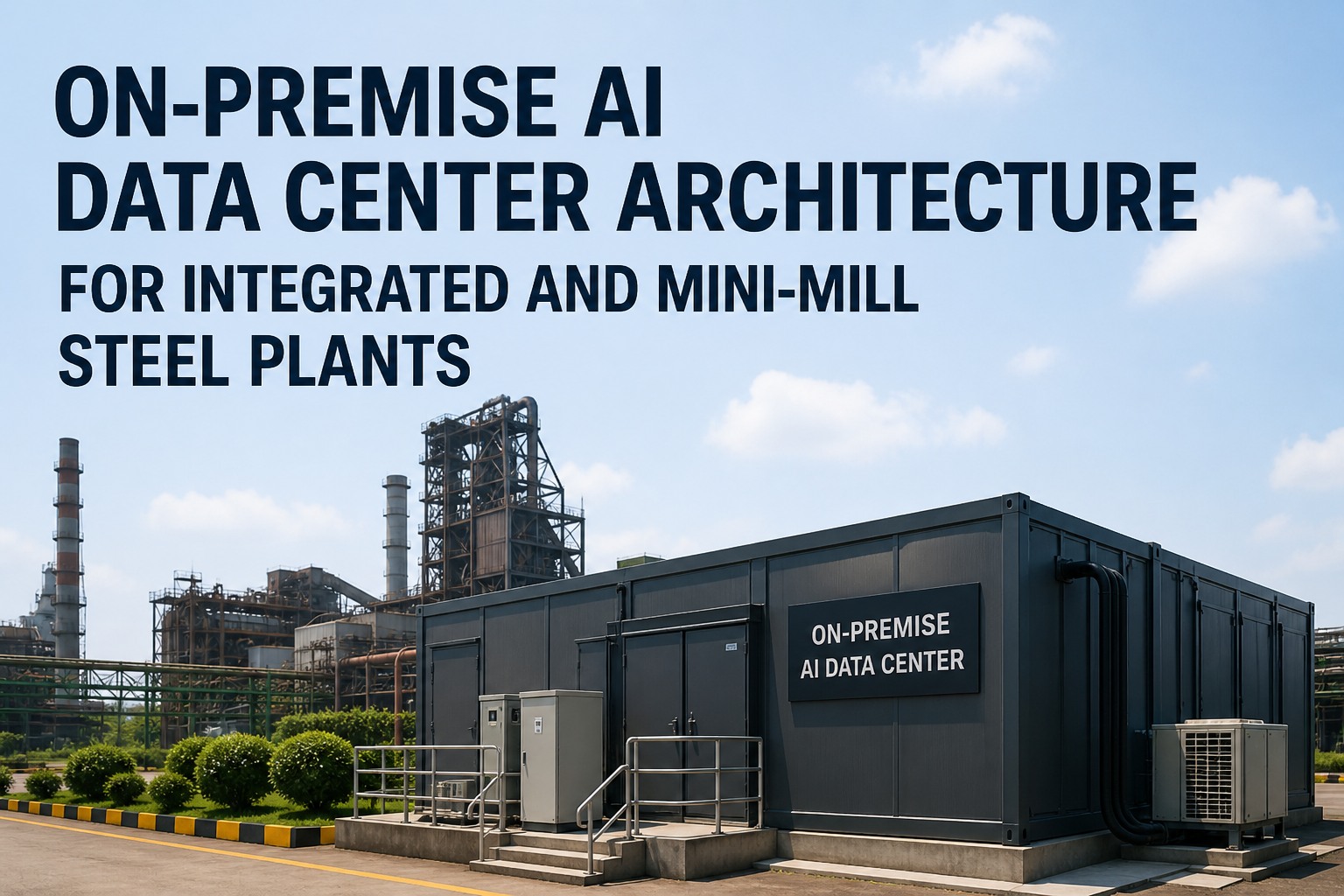
A North American steel mini-mill ran the full 12-week plan in 2025: SAP ECC 6.0 + four AI vision stations on the rolling mill + predictive maintenance on 400 critical assets. First measurable yield gain in week 14. 4% throughput improvement sustained at month six. Zero custom ABAP. Want a similar plan for your plant? Book the architecture review.
What Plants Measure After Go-Live
The numbers below are aggregated from production deployments across cement, steel, pharma, automotive, FMCG, and oil and gas — every one of them running SAP ECC or S/4HANA in parallel with iFactory on-prem AI.
iFactory On-Prem AI vs SAP Joule
Joule is SAP's native AI copilot. It is well-built. It is also cloud-only, locked to RISE or GROW contracts, and missing the manufacturing-specific capabilities — AI vision, digital twin, predictive maintenance, energy optimization — that plants need to justify the project.
SAP Joule
- Cloud-only — requires RISE with SAP or GROW with SAP
- No AI vision · No digital twin · No predictive maintenance
- One-size-fits-all bundled AI models
- Sensor data must travel to SAP BTP
- No air-gap option for defense or regulated workloads
iFactory On-Prem AI
- Works on ECC 6.0, S/4HANA on-prem, S/4HANA Private Cloud
- Vision, digital twin, PdM, energy, smart sensors all in-platform
- Best-in-class models per function — vision, time-series, LLM
- All data stays in your plant — sensor, recipe, batch, IP
- Air-gap supported · Zero external API calls when required
Meet iFactory at SAP Sapphire 2026
Live demo of on-prem AI talking to SAP S/4HANA — across cement, steel, power, pharma, oil & gas, and FMCG. Book a 20-minute floor walkthrough before slots close.
Related Architecture Guides
Three companion deep-dives covering the most technical sides of SAP integration with on-prem AI. Together with this page they make up the SAP Integration cluster on the iFactory on-prem AI hub.
Frequently Asked Questions
Do I need to buy NVIDIA servers separately?
No. Fully-loaded NVIDIA DGX AI servers are supplied and installed as part of the iFactory package. They ship pre-racked, pre-cabled, with all NeMo, RAPIDS, NIM, and Agent Toolkit components pre-installed. You provide power and Ethernet. We provide the rest.
Does this work with my SAP ECC 6.0 environment or do I need to migrate to S/4HANA first?
It works on both. iFactory connectors are production-tested on SAP ECC 6.0, S/4HANA on-prem, and S/4HANA Private Cloud. If you are mid-migration to S/4HANA, the same connector layer carries through — your AI investment is not orphaned by the ERP move.
How is this different from SAP Joule?
SAP Joule is cloud-only and requires RISE with SAP or GROW with SAP licensing. It does not cover AI vision, digital twin, predictive maintenance, or energy optimization. iFactory runs on-prem, supports ECC and S/4HANA equally, and ships those manufacturing-specific capabilities in the same platform. The two can coexist if needed.
How much custom ABAP does my team need to write?
None. All five integration methods — BAPI, RFC, OData, IDoc, REST — use standard SAP-released objects. iFactory's connector library is pre-configured for PM, QM, MM, PP, FI/CO, HR, SD, and SRM modules. Your Basis team approves transport requests; no developer hours required.
Can this run fully air-gapped with no internet access?
Yes. The full stack — DGX hardware, NeMo models, RAPIDS analytics, NIM inference, SAP connectors — runs entirely offline with zero external API calls. This is the required posture for defense customers, pharma GxP environments, and regulated industries that mandate complete network isolation.
What happens to AI access controls if a user's SAP role changes?
Access is synchronized. iFactory AI agents inherit SAP authorization objects in real time — when a user's SAP role is changed or revoked, their AI access reflects that change on the next session. There is no parallel access list to maintain. This is enforced via SAP-issued tokens, not a side-channel directory.
What deployment options do you offer if I cannot host on-prem?
The same iFactory copilot runs on AWS, Azure, and GCP inside your VPC — useful for offices, pre-production tenants, or hybrid scenarios. AWS Outposts and AI Factories also let you run the cloud APIs locally inside your data center. The recommended posture for plant-floor workloads remains on-prem DGX for latency and sovereignty reasons.
How long until measurable ROI?
First measurable wins typically appear in weeks 10–14 — usually unplanned downtime avoidance or defect reduction on the pilot line. Sustained ROI across the plant settles by month six. Average three-year savings across customer deployments is $2.3M per plant, with a payback period under 14 months on most SKUs.
Bring AI to Your SAP — Without the Cloud
Every plant that runs SAP can run iFactory on-prem AI alongside it — vision, predictive maintenance, digital twin, smart sensors, energy, copilots. All grounded in your live SAP data. All in 8–12 weeks. All sovereign.