On a line running 200 parts per minute, the total window from image capture to a pass or reject signal reaching the PLC is roughly 300 milliseconds — and inference is only one slice of that budget. Camera exposure, image transfer, preprocessing, model prediction, post-processing, and the fieldbus write all have to fit inside the takt time cycle, every cycle, without a single miss. Miss the window and the defective part has already passed the reject actuator, or the good part gets kicked because the decision arrived late. Most vision projects that stall in pilot phase stall here: the accuracy demo looked great in the lab, but the deployed system cannot hit the deterministic latency the line actually needs. iFactory ships turnkey NVIDIA edge inference hardware pre-configured for your takt time, with 95th-percentile tail latency measured, published, and guaranteed against your cycle budget. Book a demo to see inference profiled against your own line speed.
DETERMINISTIC INFERENCE · TAKT TIME BUDGETS · REAL-TIME VISION
Every Inference Decision Fits Inside Your Cycle — Every Time, Not On Average
iFactory delivers pre-configured NVIDIA edge AI hardware with published tail latency, giving your line a defect-detection decision that lands in the PLC before the part reaches the reject actuator.
END-TO-END LATENCY BUDGET AT 200 PARTS PER MINUTE (300 MS PER PART)
Image Capture and Exposure
~15 ms
Image Transfer to Edge GPU
~20 ms
Model Inference on Edge GPU
~35 ms
Post-Process and PLC Write
~18 ms
Headroom for Variance
~212 ms
THE PROBLEM
Average Latency Lies — Tail Latency Is What Breaks a Line
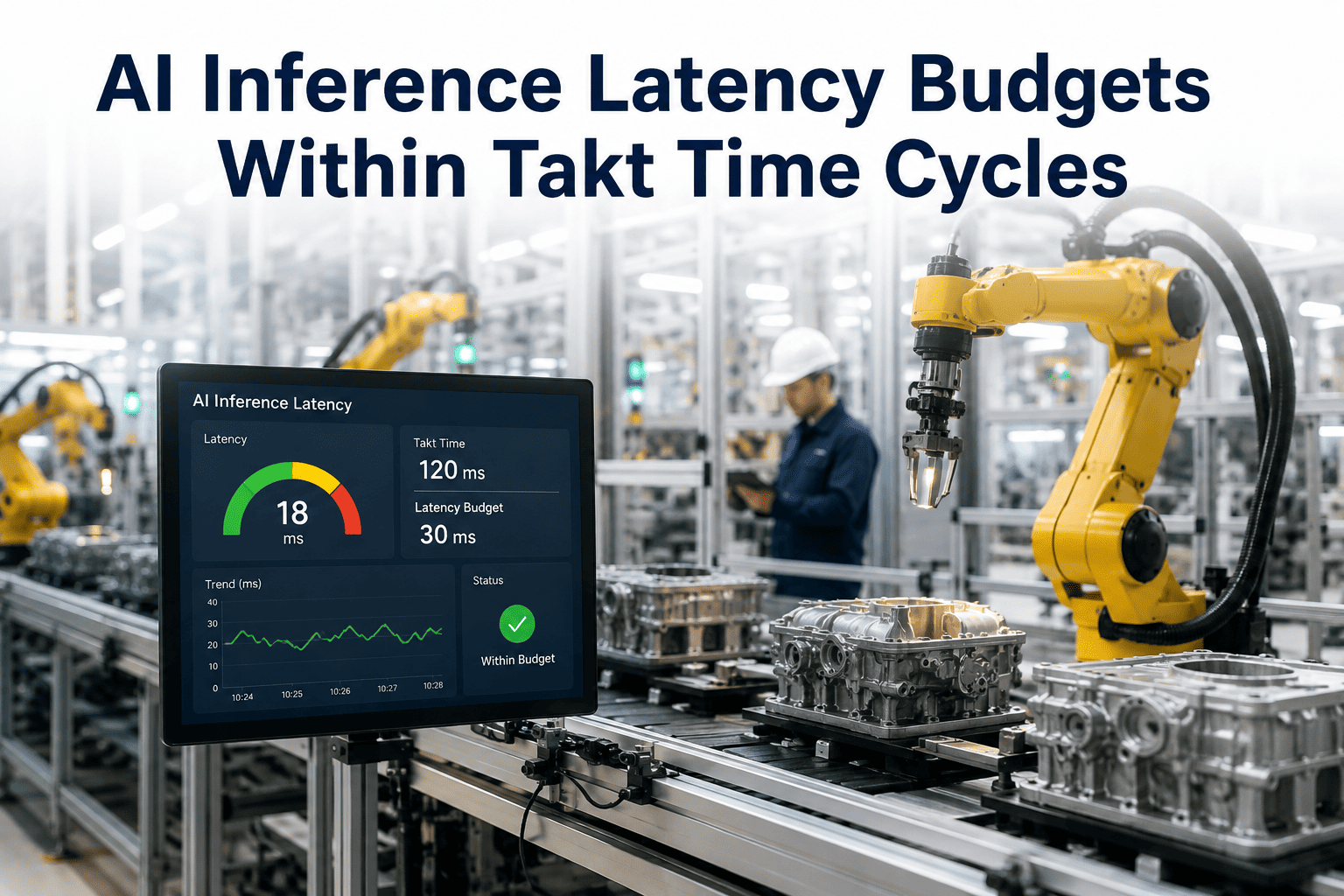
A vendor slide that says the model runs at 25 milliseconds is describing average or best-case inference, which is not the number your production line lives or dies by. What matters is the 95th and 99th percentile — the worst decision out of every hundred, and every thousand — because a line running one part every 300 milliseconds cannot tolerate a single occasional 700-millisecond spike. That one late decision is a defect passed through to a customer, or a good part rejected because the accept signal arrived after the diverter fired. Deterministic latency, meaning a tight bound between best case and worst case, is the property that separates a working inspection system from a lab demo.
300 ms
Total decision budget available per part on a line running 200 parts per minute end to end
1–2 sec
Typical round-trip latency for a cloud-inferenced vision decision, blowing past the takt budget entirely
10–50 ms
Model inference time achievable on an NVIDIA Jetson AGX Orin edge GPU for a typical classification model
HOW TAKT TIME SETS THE BUDGET
The Number You Have to Fit Inside Comes From the Customer, Not the Camera
Takt time is the pace at which a finished part must come off the line to meet customer demand, calculated as available production time divided by required units, and it sets the outer envelope every inspection cycle must fit inside. Cycle time — how long the process actually takes for one part — has to sit at or below takt, and every step in the vision pipeline is one component of that cycle. The inference latency budget is not something engineering picks; it is whatever remains after you subtract the mechanical, transport, and control times from the takt window.
30 ppm
Slow discrete line
~2000 ms per part budget
Cloud inference feasible in principle, but network variability still risks tail latency violations
60 ppm
Standard assembly cell
~1000 ms per part budget
Edge inference strongly preferred, comfortable headroom for larger model architectures
200 ppm
High-speed inspection
~300 ms per part budget
Edge inference mandatory, model size and preprocessing must be actively engineered to fit
600 ppm
FMCG packaging line
~100 ms per part budget
On-camera inference or dedicated GPU per station, sub-50ms model inference required
THE FULL PIPELINE
Inference Time Is One Slice — The Other Slices Also Have to Fit
Vendors love to quote model inference latency in isolation because it is the shortest number in the pipeline. The end-to-end budget your line actually cares about starts when the trigger fires the camera and ends when the reject or accept signal lands in the PLC. Every stage in between consumes milliseconds and adds variance, and each one has to be measured, budgeted, and held to a bound. A model that runs in 25 milliseconds attached to a camera pipeline that adds 400 milliseconds of transfer, preprocessing, and PLC-write overhead has not solved the problem — it has just moved the failure mode into stages nobody was watching. Real deployment engineering treats the pipeline as a single latency contract, profiles each stage separately, and sizes the compute so the sum of worst cases still fits inside takt with meaningful headroom for the variance production always introduces.
01
Trigger and Camera Exposure
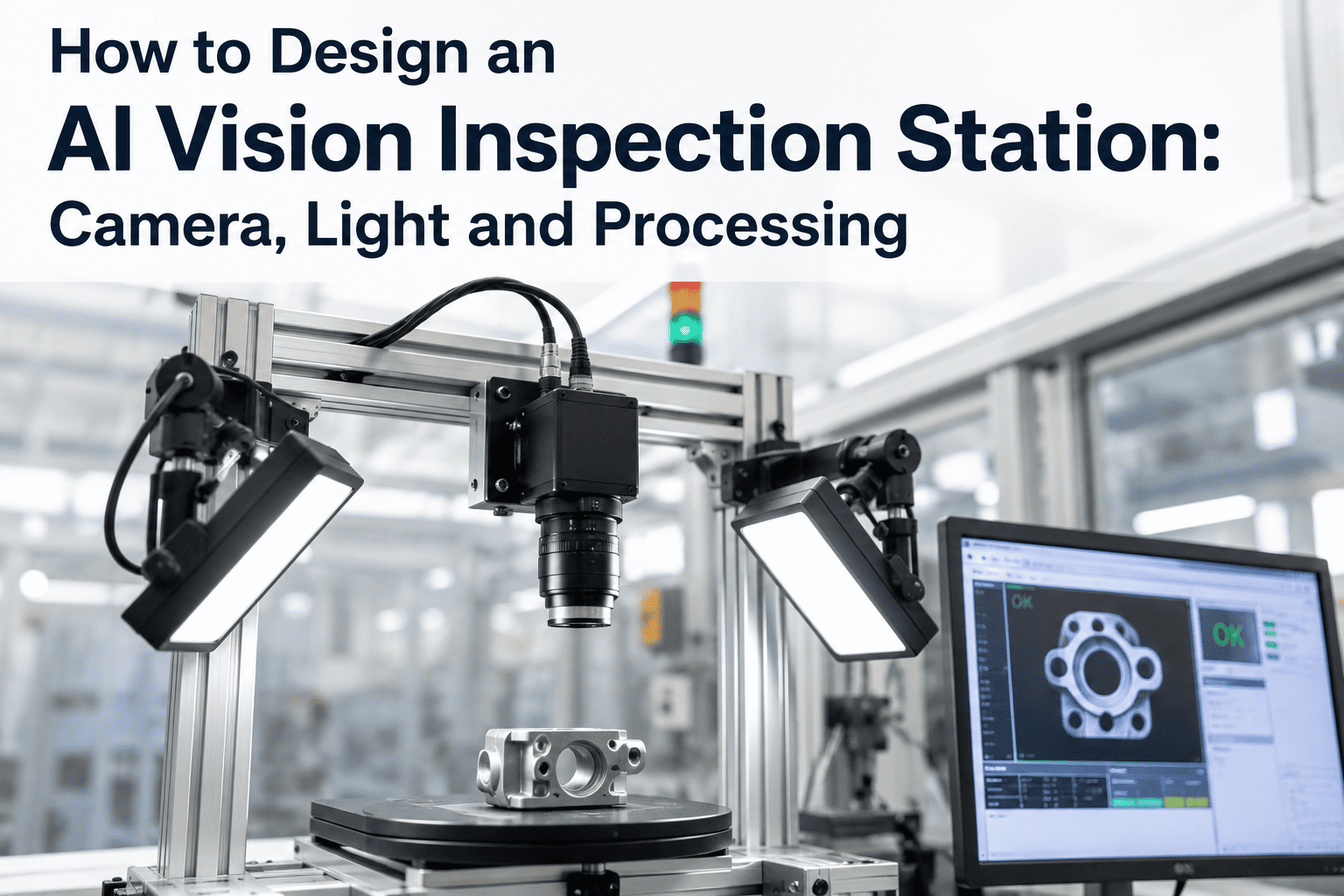
The PLC or sensor fires the camera as the part enters the field of view, exposure completes, and the sensor reads out. Typical budget: 5–20 ms depending on shutter type and light level.
02
Image Transfer to Compute
Frame moves from camera buffer to edge GPU memory, over GigE Vision, USB3, or MIPI CSI. Typical budget: 5–30 ms depending on resolution, bit depth, and interface bandwidth.
03
Preprocessing and Normalization
Debayering, resizing, color normalization, and tensor conversion before the model sees the frame. Typical budget: 3–15 ms, GPU-accelerated where possible to avoid CPU bottlenecks.
04
Model Inference
The neural network produces a classification, detection, or segmentation output. Typical budget: 10–50 ms on Jetson AGX Orin class hardware, single-digit ms on smaller on-camera accelerators.
05
Post-Processing and Decision Logic
Threshold application, multi-model voting, and business rule evaluation converts raw model output to a discrete pass, fail, or rework code. Typical budget: 2–10 ms.
06
PLC Write and Actuator Trigger
Decision written to PLC over EtherNet/IP, PROFINET, or OPC-UA, actuator receives command in time to divert or accept the part. Typical budget: 5–20 ms depending on protocol scan rate.
See Your Line's Latency Budget Profiled End to End
Bring us your takt time, part geometry, and defect classes. We'll return a full pipeline latency budget — capture, transfer, inference, PLC write — and the edge hardware configuration that fits inside it with headroom.
EDGE VS CLOUD INFERENCE
Why the Decision Has to Live on the Factory Floor
The single biggest architectural mistake in first-attempt vision deployments is trying to run inference in the cloud because it seemed simpler to provision. Cloud inference works for offline analytics or overnight batch model training, but a round trip from the plant to a remote server and back consumes 200 milliseconds to 2 seconds of variable latency, which either blows the takt budget entirely or introduces variance that guarantees intermittent misses. Edge inference is not a nice-to-have optimization for real-time control loops — it is the only architecture that can deliver bounded tail latency at production line speeds.
| Architecture Factor |
Cloud Inference |
Edge Inference on iFactory |
| Typical Round-Trip Latency |
200 ms to 2 seconds, highly variable |
10–50 ms model inference, bounded end to end |
| Tail Latency Behavior |
Dependent on network conditions, no guarantee |
95th-percentile bounded within tight window |
| Line Speed Ceiling |
Practical limit ~30 parts per minute |
600+ parts per minute achievable |
| Network Dependency |
Inspection stops if link degrades |
Air-gap ready, continues without external network |
| Bandwidth Requirement |
Every frame uploaded, high egress cost |
Only decisions and sampled frames leave the plant |
| Data Sovereignty |
Production imagery leaves the facility |
All raw imagery stays on premise |
THE HARDWARE THAT MAKES THE BUDGET
Compute Sized to the Model and the Line, Not the Other Way Around
The right edge compute depends on model architecture, image resolution, number of cameras per station, and target inference latency. iFactory ships turnkey configurations built around NVIDIA Jetson and industrial GPU appliances, pre-loaded with the vision runtime, sized against your takt time before delivery so nothing about performance is left to on-site guessing.
On-Camera AI Accelerator
Inference runs directly on the camera processor for single-digit millisecond latency. Fits ultra-fast lines and single-station deployments where wiring back to a central appliance adds unwanted transfer time.
NVIDIA Jetson Edge Module
Compact GPU module handling one to four cameras per station with 10–50 ms model inference. The workhorse configuration for most discrete-parts inspection at 60–200 parts per minute.
Rack-Mount GPU Appliance
Industrial server with data-center-class GPUs for large models, multi-camera stations, or ensemble architectures. Sits in the control room or MDF, cabled to cameras via GigE.
Redundant Pair Configuration
Hot-standby edge nodes for lines where a single missed decision has severe cost. Failover happens inside the takt cycle so the line never sees an outage.
TURNKEY DEPLOYMENT
Live in 6 to 12 Weeks, Not a Multi-Quarter Systems Integration
The reason most in-house vision AI projects miss their target latency is because they are assembled from independent hardware, software, and integration decisions that never get profiled together end to end. iFactory ships a pre-configured NVIDIA AI server, racked, ready, and with the software stack pre-loaded. Rack it, plug power and Ethernet, and the AI is live against your takt cycle inside a defined delivery window.
Weeks 1–4
Ship, Network, and Data Collection
Hardware ships pre-racked. On-site network integration to PLC, SCADA, or MES. Camera positioning and lighting calibrated. Baseline image dataset collected across shifts and product mix.
Weeks 5–8
Model Training and Pilot Run
Model trained on your specific defect classes and product images. Pilot run against live line data with latency profiling captured for every stage of the pipeline against your takt budget.
Weeks 9–12
Go-Live and Operator Training
System handed over to production with tail-latency SLAs published and monitored. Operator training on the interface, alarm handling, and feedback workflow. Twenty-four seven remote monitoring active from day one.
WHERE THIS APPLIES
Industries Where Takt-Bound Vision Inference Actually Runs
Deterministic edge inference is the difference between a working inspection system and a science project across every industry running discrete-parts production above single-digit parts per minute. iFactory supports over one thousand clients with turnkey AI vision inspection today.
Automotive Assembly and Stamping
Body-in-white welding inspection, stamped panel surface defect detection, and final assembly presence verification against 60-second takt.
Electronics and Semiconductor
PCB solder joint inspection, component placement verification, and package integrity checks on lines running well above 200 ppm.
FMCG and Packaging Lines
Label registration, cap presence, fill level, and barcode verification on filling and packaging lines running 300 to 600 ppm.
Food and Beverage Processing
Foreign-object detection, portion size verification, and seal integrity checks with washdown-rated cameras and edge appliances.
Pharmaceutical and Medical Device
Blister pack inspection, syringe fill verification, and vial defect detection where a missed reject risks a regulated batch.
Metals and Steel Production
Continuous strip surface inspection, coil defect classification, and cast product surface scanning with line-scan cameras.
FREQUENTLY ASKED QUESTIONS
Questions Automation and Quality Engineers Ask First
Our line runs 400 parts per minute — is edge inference even fast enough at that speed?
Yes, four hundred parts per minute gives you a 150-millisecond total budget per part, which is well within reach for a properly sized edge configuration. The right approach is on-camera or dedicated per-station Jetson class GPU rather than a shared central appliance, with the model architecture selected to hit sub-30-millisecond inference so the transfer and PLC write stages still fit comfortably. We profile the entire pipeline against your specific takt before quoting hardware, so nothing about the budget is left to guesswork after installation.
Book a demo to see a latency budget worked out against your line speed.
What is the difference between average latency and tail latency, and why does it matter?
Average latency is the mean inference time across many decisions, while tail latency is the 95th or 99th percentile — meaning the worst decisions out of every hundred or thousand. A line running at 300-millisecond takt cannot tolerate even occasional 700-millisecond spikes because each spike is a defect missed or a good part wrongly rejected. Deterministic systems publish and hold to a bounded tail latency, not just an attractive average, and that bound is what makes the difference between a working inspection line and a demo that fails in production.
Contact our support team to discuss tail latency guarantees for your application.
Can we run this on our existing cameras or do we need to replace the whole vision infrastructure?
Existing GigE Vision, USB3, or MIPI cameras can typically be reused if their resolution, frame rate, and lighting conditions match what the defect class requires — the AI is added at the compute layer, not by ripping out working cameras. Where existing cameras genuinely cannot resolve the defect at line speed, we recommend targeted replacements rather than a full site rebuild, and phase the work so production is not disrupted. The turnkey configuration is designed to fit into your existing plant network and PLC architecture rather than demanding a parallel system.
Book a demo to review what your current camera and network setup already supports.
How do you actually guarantee the latency budget when we go into production?
Latency is measured at every stage of the pipeline continuously in production, with 95th-percentile tail latency reported to a dashboard and alerts fired if the number drifts above the agreed budget. This is not a one-time acceptance test — it is ongoing monitoring against your published cycle target so any regression from a model update, a network change, or new defect class introduction is caught immediately. Hardware is sized with meaningful headroom above the required budget rather than to just barely fit, so normal production variance never pushes you into a miss.
Contact our support team to discuss SLA structure and monitoring detail.
What happens to the inspection if the edge appliance itself fails during a shift?
For lines where a single missed decision has severe cost, we deploy a redundant pair configuration where a hot standby edge node picks up inference within the takt cycle if the primary node fails, so the line never sees an outage. For lines with more tolerant recovery requirements, the pre-configured spare unit is designed to be swapped in under fifteen minutes without any reconfiguration, since all state and model artifacts are persisted centrally. Twenty-four seven remote monitoring detects hardware degradation before it becomes an outage, so most replacements happen scheduled rather than emergency.
Book a demo to discuss the redundancy pattern that fits your risk tolerance.
Fit Every Inference Decision Inside Your Cycle — Deterministically
Deploy turnkey NVIDIA edge inference sized against your takt time, with published tail latency, PLC integration, and twenty-four seven monitoring. Book a demo and we'll profile a full pipeline budget against your own line speed.