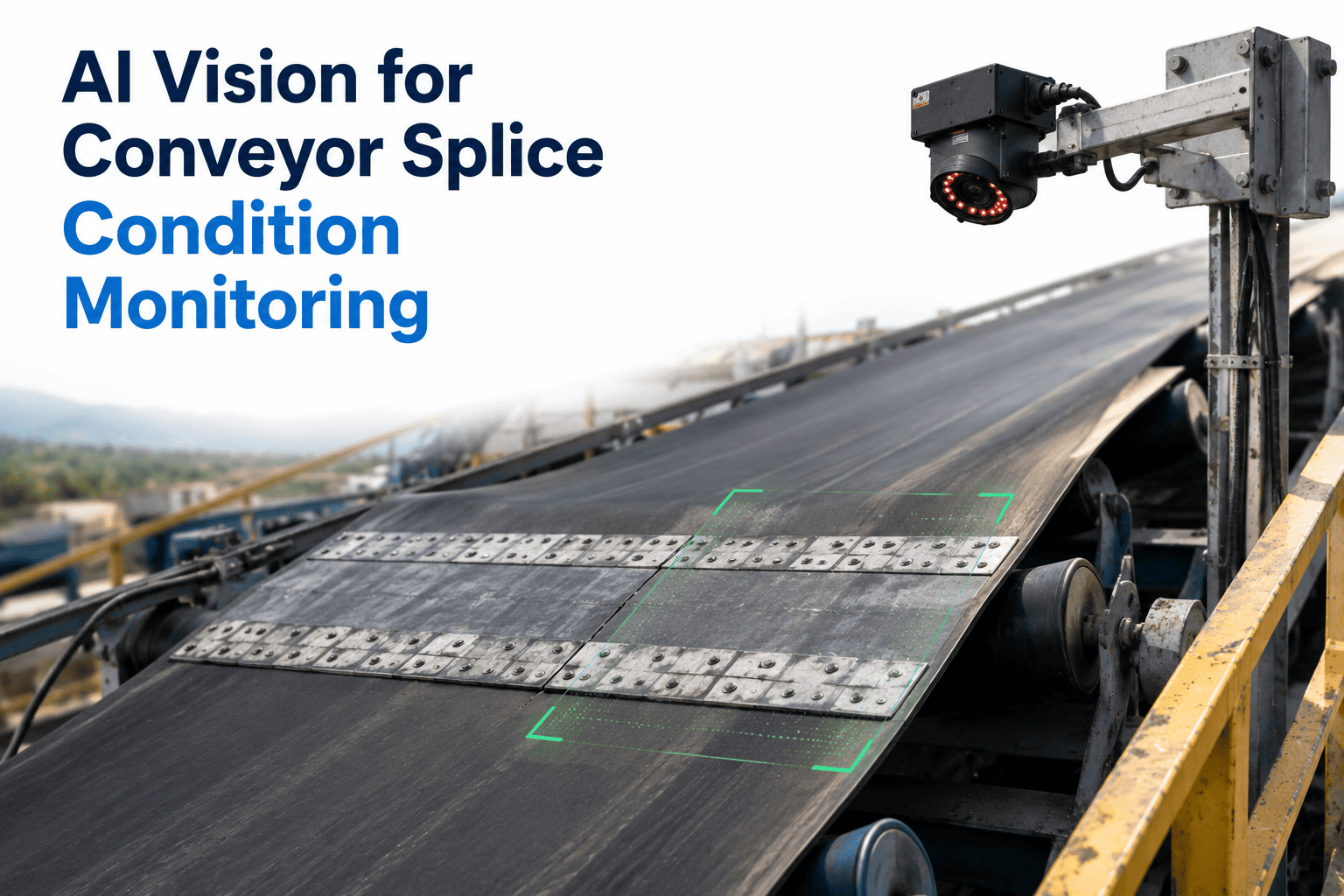
Every conveyor belt is only as strong as its weakest splice. A vulcanized splice that was installed perfectly under controlled conditions still degrades over time — thermal cycling, tension loads, moisture infiltration, and the constant flexing around pulleys gradually break down the bond between layers until the splice delaminates, separates, and fails. Mechanical splices face the same fate through fastener corrosion, plate separation, and clip fatigue. Industry data consistently shows that splice failure is among the most common causes of unplanned conveyor shutdowns, and that belt maintenance and replacement account for over 40 percent of the total cost of ownership of a conveyor system. The conventional approach — quarterly manual inspection where a technician walks the belt, visually checks each splice, and records findings on paper — catches degradation only at the frequency of the inspection interval, leaving weeks of unmonitored operation between checks where a splice can deteriorate from serviceable to critical without anyone knowing. AI vision cameras change this by monitoring every splice on every revolution, detecting the earliest visual signatures of edge lifting, surface cracking, fastener loss, and delamination, and generating maintenance alerts weeks before a splice reaches the failure point. You can book a demo to see splice monitoring applied to your own conveyor data.
The Splice That Failed Last Month Was Deteriorating for Weeks. Nobody Saw It.
iFactory's AI vision platform monitors every splice on every belt revolution, detects delamination, edge separation, and fastener degradation at the earliest visible stage, and predicts splice failure weeks before it disrupts production.
The Weakest Point on Every Belt — and the Hardest to Monitor Manually
A conveyor belt splice, whether vulcanized or mechanical, never matches the full tensile strength of the original belt. Even the best hot vulcanized splice achieves only 80 to 90 percent of the belt body's rated strength, while mechanical fastener joints reach only 40 to 50 percent. This inherent weakness means splices are where failure begins — and every factor that stresses a belt concentrates its effect disproportionately at the splice.
Repeated heating and cooling from material temperature, ambient conditions, and friction around pulleys breaks down the adhesive bond in vulcanized splices over hundreds of thousands of revolutions. The bond degradation is invisible from the belt surface until delamination has already begun internally.
Water and chemical exposure penetrate splice edges and seep between bonded layers, causing the carcass to swell and the bond to weaken. In high-moisture environments, ply separation can progress from the edges inward within weeks once the seal is compromised.
Startup surges, overloaded belts, and sudden speed changes create peak tension forces that concentrate at the splice. Each overload event micro-damages the bond, and the cumulative effect over months of operation eventually exceeds the splice's residual strength.
Every time the splice wraps around a pulley, the belt surface compresses on the inside radius and stretches on the outside. Undersized pulleys amplify this flex stress and accelerate delamination at the splice zone, particularly on thicker multi-ply belts.
Mechanical splice fasteners — steel clips, plates, and hinges — corrode in wet, dusty, or chemically aggressive environments. Corroded fasteners lose grip strength progressively, and a single failed clip can redistribute load to adjacent fasteners, creating a cascade of clip failures across the splice.
Contaminated bonding surfaces, incorrect vulcanization temperature or pressure, uneven ply separation during preparation, and improper fastener sizing all create splices that are compromised from day one. These installation defects are invisible until the splice begins to degrade under operational stress.
Understanding What AI Vision Monitors for Each Splice Type
| Attribute | Hot Vulcanized Splice | Cold Vulcanized Splice | Mechanical Fastener Splice |
|---|---|---|---|
| Tensile Strength vs Belt | 80–90% | 60–70% | 40–50% |
| Typical Lifespan | Longest — matches belt life when maintained | Medium — suitable for moderate-duty applications | Shortest — requires more frequent replacement |
| Primary Failure Mode | Internal delamination, edge lifting | Bond deterioration, edge peeling | Clip corrosion, plate separation, hinge wear |
| What AI Vision Detects | Surface cracking, edge lift, profile change | Edge peeling, bubbling, surface distortion | Missing clips, plate offset, fastener corrosion |
| Manual Detection Difficulty | High — internal bond failure invisible from surface until advanced | Medium — edge peeling visible but easily missed on walk-around | Medium — fastener damage visible but requires close proximity |
How Many Splices Are on Your Belt Right Now — and When Were They Last Inspected?
iFactory builds a complete splice inventory from your camera feeds and monitors every joint continuously from the day the system goes live.
Four Detection Layers That Catch Degradation Before Failure
Splice Identification and Mapping
The AI automatically identifies every splice on the belt during the initial learning phase and maps each one to a specific physical position. Every subsequent revolution, the system recognizes and re-locates each splice, building a continuous condition record per splice that tracks changes over time. This eliminates the need for operators to manually count, locate, or log splice positions.
Surface and Edge Analysis
Deep learning models trained on thousands of labeled splice images analyze the surface condition and edge geometry of each splice on every pass. The model detects surface cracking, edge lifting, rubber peeling, fastener displacement, and any change in the splice's visible profile compared to its baseline state. Sub-centimeter changes in edge geometry are flagged as early indicators of delamination forming beneath the surface.
Degradation Trend Tracking
Rather than treating each frame as an isolated snapshot, the system tracks how each splice changes over days, weeks, and months. A splice edge that has lifted 2mm this week versus 1mm last week is exhibiting an accelerating degradation trend that will be flagged at a higher priority than a splice with stable, low-level wear. This trend analysis is what enables the system to predict failure weeks in advance rather than merely detecting damage after it occurs.
Severity-Based CMMS Integration
Each splice is assigned a health score based on current condition and degradation rate. When a splice crosses a configurable threshold — from "monitor" to "plan repair" to "urgent action" — the system generates a structured work order in the connected CMMS with the splice location, camera evidence, condition history, and recommended action. Maintenance teams receive the alert with full context to plan the repair during the next available window.
Why Quarterly Walk-Arounds Cannot Keep Up With Splice Degradation
Planned Splice Repair vs Unplanned Splice Failure — The Numbers
What Operations Report After Deploying AI Splice Monitoring
Getting AI Splice Monitoring Running on Your Conveyors
Deploying AI vision for splice monitoring follows the same non-invasive, add-on architecture used for tear detection and misalignment monitoring. No belt modification, no embedded sensors, no conveyor shutdowns for installation. Most sites are fully operational within 6 to 12 weeks.
Camera Positioning
Industrial cameras are mounted at head pulleys or return-side inspection zones where the full belt width is visible on every revolution. Existing CCTV infrastructure can be leveraged where resolution and frame rate meet minimum requirements.
Splice Learning Phase
During the first 2 to 4 weeks, the AI model identifies, maps, and baselines every splice on the belt. Each splice is assigned a unique identifier, its current condition is recorded, and the baseline becomes the reference for all future degradation tracking.
Integration and Alerting
Detection events route to your existing CMMS via API, with severity tiers, escalation rules, and work order templates configured to match your maintenance workflow. PLC integration via MQTT or OPC-UA enables automated belt-stop triggers for critical splice events.
Continuous Monitoring
The system runs in production, monitoring every splice on every revolution. Degradation trends are tracked per splice, health scores update daily, and the model continues improving detection accuracy as it learns from your specific belt and environmental conditions.
Common Questions About AI Vision Splice Monitoring
Your Splices Are Degrading Right Now. The Only Question Is Whether You Will Know Before They Fail.
iFactory turns every splice into a continuously monitored asset with a health score, a degradation trend, and an alert that fires weeks before failure — not hours after.