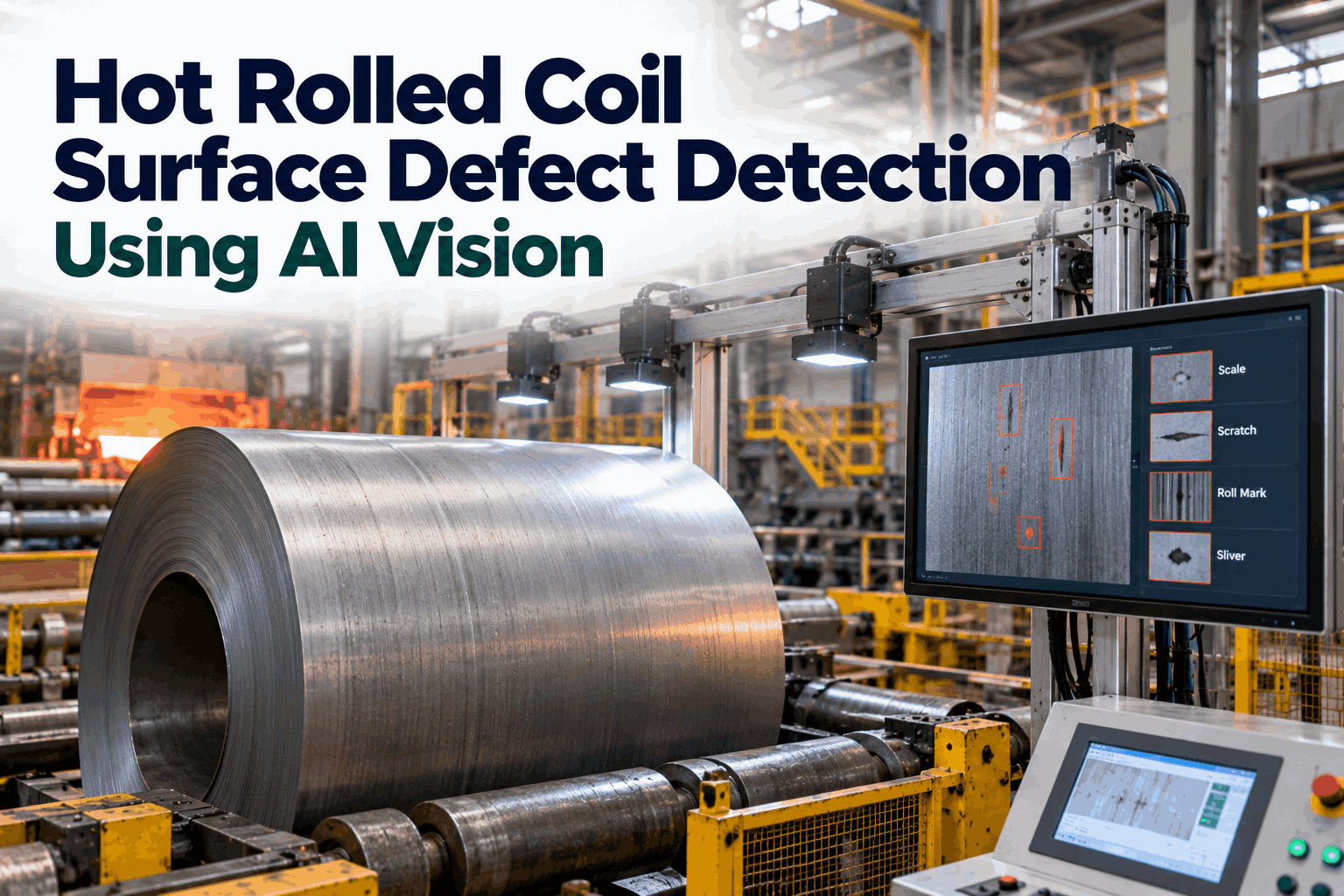
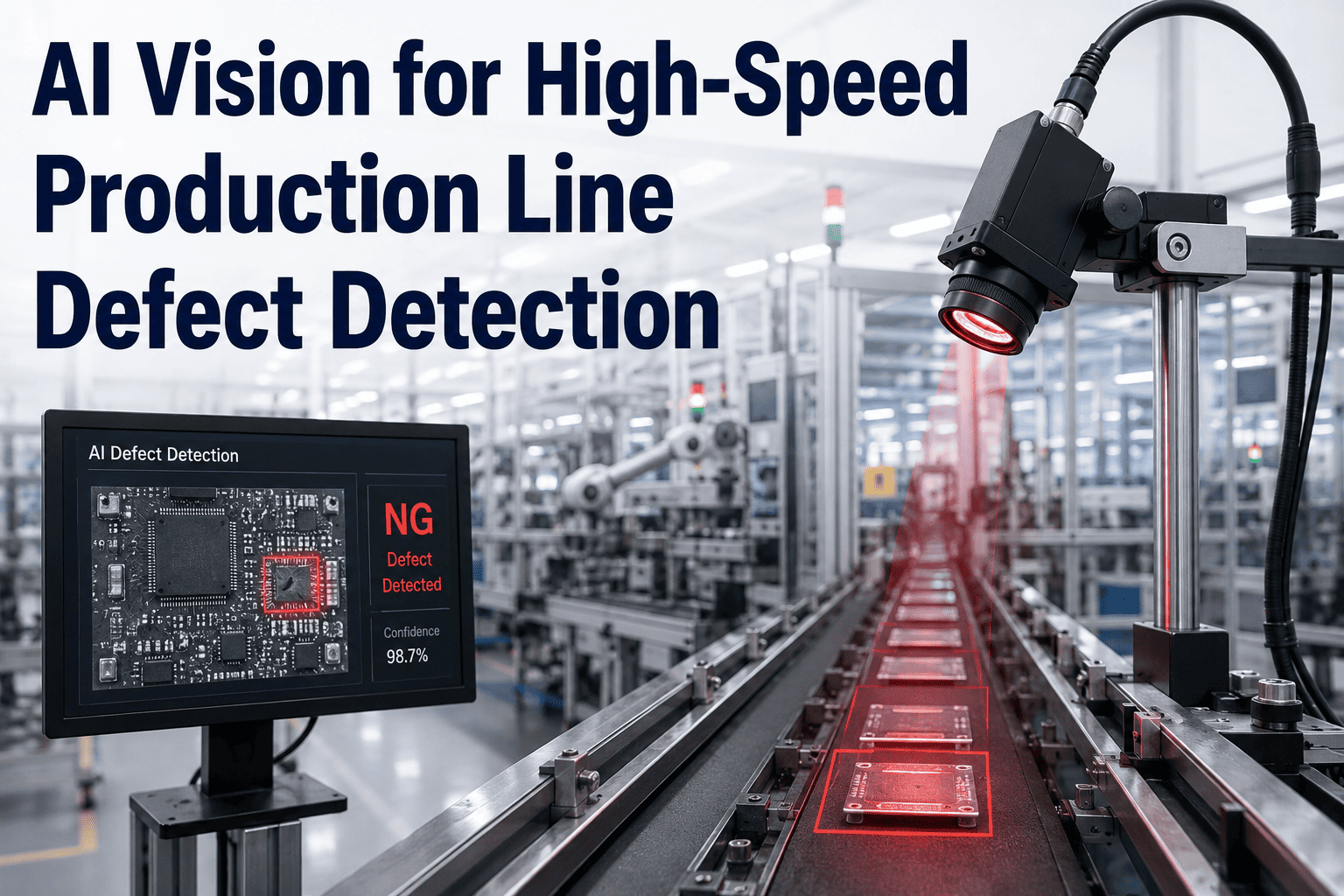
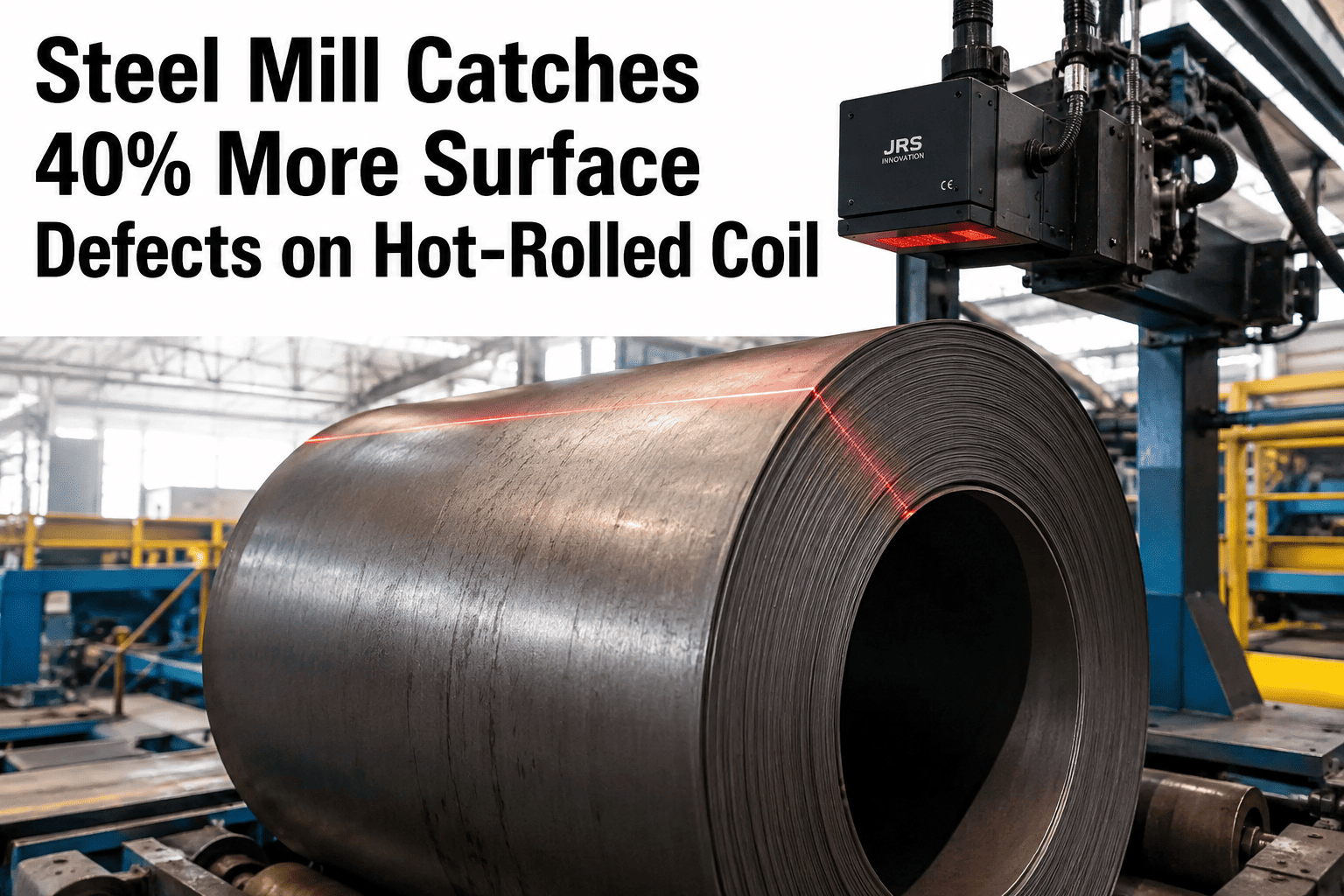
Hot strip mill monitoring at speeds exceeding 900 meters per minute creates an inspection challenge that no human team can reliably solve. At rolling temperatures above 1,000°C and strip thicknesses ranging from 1.2 mm to 25 mm, defects form and propagate in fractions of a second across coil lengths that span hundreds of meters. Scale pits, edge cracks, and subsurface laminations that are invisible to the naked eye under high-heat, high-vibration conditions are precisely the defects that cause downstream failures — rejected coils at the cold mill, delamination during stamping operations, or field failures in automotive structural components. iFactory's AI vision camera platform was built to close this gap: deep learning models trained on real steel surface defect libraries detect, classify, and log surface anomalies in real time across the full strip width, at line speed, without contact.
Why Hot Strip Mill Inspection Demands AI Vision
Surface quality on hot-rolled coil is determined across three critical zones: the run-out table, the finishing mill exit, and the downcoiler entry. Each zone presents a different combination of temperature, speed, scale density, and strip geometry that affects what defects are detectable and how. Traditional inspection at these points relies on human observers working under heat radiation and poor lighting, or on legacy laser-based systems that flag intensity anomalies without the classification accuracy needed to distinguish a true lamination from a water streak or a roll mark from a scale pit. The result is systematic under-detection of real defects and systematic over-flagging of non-conformances, both of which carry operational cost. Under-detection allows defective coils to advance to cold rolling or dispatch, generating warranty exposure and downstream processing losses. Over-flagging generates unnecessary holds, re-inspection labor, and coil downgrade decisions that reduce yield on material that was actually conforming. AI vision inspection solves both failure modes simultaneously by applying deep learning models that distinguish defect classes with specificity that exceeds human judgment, even at high line speeds. iFactory's AI vision camera system is designed specifically for the high-temperature, high-vibration, high-speed environment of the hot strip finishing line — with enclosures rated for mill environments, optics tuned for 700–900°C surface emission spectra, and inference hardware that processes full-width strip imagery without frame drops at maximum line velocity.
Defect Classes Detected Across the Hot Rolling Process
Hot strip mill defects originate at different stages of the rolling sequence and present with distinct morphological signatures on the strip surface. Scale-related defects — including primary scale pits, secondary scale impressions, and rolled-in scale — form when oxide layers fragment and embed into the strip surface during roughing and finishing passes. Edge cracks initiate at the slab edges during roughing, propagate under tension in the finishing mill, and manifest as linear or branched discontinuities along the strip edges that cannot be trimmed without width loss. Laminations are subsurface segregation planes in the original slab that delaminate under rolling reduction, producing flat separations parallel to the surface that are often invisible until the strip is cut or formed downstream. Roll marks, chatter marks, and transverse scratches are imposed by the rolling equipment itself and repeat at predictable intervals corresponding to roll circumference or vibration frequency. Each defect class requires a different response — scale defects indicate descaling system performance issues, edge cracks trace back to slab conditioning or roughing pass reductions, and roll marks identify specific roll stands requiring inspection or replacement. iFactory's vision defect detection platform classifies each defect by type, location, severity, and spatial frequency — providing the structured data that connects surface quality outcomes to specific process variables upstream.
| Defect Class | Origin Stage | Detection Challenge | Process Feedback Signal |
|---|---|---|---|
| Scale Pits & Rolled-In Scale | Roughing / Descaling | Variable contrast at high temperature | Descaling pressure, nozzle condition |
| Edge Cracks | Roughing mill edges | Geometric distortion at strip edges | Slab edge conditioning, edger pass reduction |
| Laminations | Slab segregation zones | Subsurface — visible only under tension or cutting | Slab quality grading, cast section source |
| Roll Marks | Finishing mill rolls | Periodic pattern vs. background texture | Roll stand ID, roll wear schedule |
| Chatter Marks | High-speed finishing passes | Fine transverse banding at speed | Roll bearing condition, mill vibration frequency |
| Transverse Scratches | Run-out table guides | Fine linear marks against scale background | Guide wear, table roller alignment |
iFactory's deep learning models are trained on defect libraries built from real hot strip mill imagery — not synthetic data — covering the full range of surface conditions found across carbon steel, HSLA, and API grade products. Classification accuracy above 95% per defect class is validated against manual inspection benchmarks across operating hot strip mills.
Real-Time Coil Grading and Automated QC Decision Support
The economic value of hot strip mill AI vision is realized not at detection but at the coil disposition decision. A detection system that flags defects without grading them against customer specifications, order requirements, and internal quality tiers adds workload rather than reducing it. iFactory's platform integrates defect detection with automated coil grading logic — mapping detected defect classes, densities, and locations against configurable grade criteria to produce a per-coil quality disposition recommendation at the end of each rolling sequence. A coil with isolated edge scale pits in the outer wraps and a clean body may grade as prime for most applications. The same coil destined for exposed automotive panel applications would trigger a hold for manual review. Grade thresholds, defect weighting, and disposition rules are configurable by product family, customer specification, and internal quality standard — allowing the same detection platform to serve a mixed product mix without manual re-configuration between heats. The AI vision camera platform outputs structured coil quality records — defect maps, class distributions, severity indices — that integrate directly with Level 2 and Level 3 quality management systems through OPC-UA and REST API connections, creating a digital quality record for every coil without manual data entry. This traceability closes the loop between process performance and product quality in a form that supports both internal continuous improvement and customer quality documentation requirements.
Integration with Rolling Mill Process Control and Maintenance Systems
Surface defect data from the finishing line is most actionable when it reaches the right system in the right format immediately after detection — not after a quality hold review cycle that takes hours or shifts. iFactory's platform is designed for tight integration with the mill's existing control and maintenance architecture. Roll mark signatures detected by the vision system are automatically correlated with roll stand position data from the Level 2 system to generate work order triggers in the CMMS for specific roll changes before the next campaign begins. Scale defect density trends are logged to the process historian and visualized on rolling mill operator HMIs, enabling descaling system performance monitoring without additional instrumentation. Coil-level defect reports are pushed to the Level 3 MES immediately at coil completion, updating the production order quality status and triggering hold flags in the inventory management system for coils that do not meet prime grade criteria. This level of integration eliminates the latency between defect occurrence and corrective action that characterizes manual inspection workflows — where defects detected at the coil yard may not be traced back to the rolling campaign that produced them until the following shift or the next morning's quality meeting. Book a Demo with iFactory's engineering team to walk through the specific integration architecture for your mill's Level 1, Level 2, and CMMS environment.
System Architecture for the Hot Strip Finishing Environment
Deploying AI vision on a hot strip finishing line requires hardware and enclosure engineering that matches the severity of the environment — not standard machine vision equipment adapted after the fact. Ambient temperatures near the run-out table and downcoiler exceed 60°C in many mills. Water, steam, and mill scale particles are present in the inspection zone continuously. Strip vibration and lateral movement at high line speeds require camera mounting solutions that maintain focal plane stability under mechanical loading. iFactory's platform addresses these constraints with thermally managed enclosure systems that maintain sensor operating temperature within specification without air conditioning infrastructure, IP66-rated optical windows with integrated air purge to prevent scale particle deposition, and line-speed synchronization that maintains correct image exposure and pixel registration at strip speeds from crawl to maximum rolling velocity. The deep learning inference pipeline runs on dedicated edge compute hardware installed in the mill pulpit environment — with results available to the operator HMI within 200 milliseconds of strip passage, enabling real-time feedback rather than post-process quality review. Camera configurations are available for full-width coverage from 600 mm to 2,200 mm strip widths, with single-camera or multi-camera array arrangements depending on width range and required resolution at strip edges.
Quantifying the Return on Hot Strip Mill Vision Inspection
The business case for AI vision on the hot strip mill is built on four value streams: prime yield recovery, downstream processing loss reduction, roll campaign optimization, and quality documentation efficiency. Prime yield recovery is the largest single driver. When defective coils that would previously pass as prime are correctly identified and downgraded before dispatch, the quality cost is captured at the mill rather than in a customer return, credit, or warranty claim — where the cost per ton of rejected material is five to ten times higher than the internal downgrade value. Downstream processing loss reduction is driven by catching lamination and edge crack defects before they reach the cold mill, where a coil break caused by an undetected lamination carries line stoppage costs that can exceed the value of multiple coils. Roll campaign optimization follows from connecting roll mark detection to roll change scheduling — extending campaign lengths on rolls that are performing within specification while triggering timely changes on rolls that are generating surface defects before they produce a significant proportion of defective production. Quality documentation efficiency is achieved by replacing manual coil inspection records and inspector time with automated digital quality records that are more complete, more consistent, and immediately available in the quality management system without transcription. Organizations that have implemented AI vision inspection on hot strip finishing lines report prime yield improvements of 1.5–3.0 percentage points, downstream processing claims reductions of 30–50%, and roll utilization improvements of 10–20% from data-driven campaign management. Book a Demo to model the specific ROI profile for your mill's product mix and current quality performance baseline.
The highest-maturity deployment of hot strip mill AI vision connects defect detection data not just to coil disposition decisions but to upstream process parameter adjustments that reduce defect formation in subsequent heats. When iFactory's platform detects a rising scale pit density trend across consecutive coils from the same cast sequence, that signal — correlated with descaling header pressure logs from the Level 2 system — enables the process engineer to adjust descaling parameters before the defect rate reaches the disposition threshold rather than after it has already affected dispatched product. When roll mark frequency analysis identifies a specific roll stand as the defect source, the maintenance team can target the affected stand for inspection during the next scheduled outage rather than waiting for a customer complaint to initiate the root cause analysis. This closed-loop architecture — from AI detection to structured data to process feedback to corrective action — is the operational model that converts a surface inspection system from a quality checkpoint into a continuous improvement engine. Teams ready to implement this model can Book a Demo with iFactory's steel industry engineering team for a live walkthrough of the detection-to-process feedback pipeline on a hot strip finishing line configuration.
Frequently Asked Questions About AI Vision for Hot Strip Mills
Yes, with enclosure and optics engineering designed specifically for the hot strip environment. Standard industrial vision hardware is not rated for sustained operation near a run-out table where ambient temperatures exceed 60°C, water and steam are continuous, and mill scale particles are airborne. iFactory's system uses thermally managed enclosures that maintain sensor operating temperature within specification without requiring site air conditioning, IP66-rated optical windows with integrated air purge to prevent scale deposition on the lens surface, and vibration-isolated mounting hardware that maintains focal stability at the strip velocities and mill vibration frequencies found on hot strip finishing lines. The enclosure and mounting architecture is engineered first, with the optics and compute specified around the environmental constraints rather than the reverse.
This is the core technical challenge that separates AI vision from legacy threshold-based detection on hot strip lines. Legacy systems flag intensity anomalies without understanding morphology — they cannot distinguish a water streak from a scale pit from a genuine surface crack because they process individual pixels rather than spatial patterns. iFactory's deep learning models are trained on actual hot strip mill imagery captured under the full range of surface temperature, scale density, and line speed conditions found in operating mills. The models learn the morphological signatures that distinguish defect classes — the angular edges and depth shadows of scale pits, the linear geometry of edge cracks, the banded pattern of roll marks — from the background variation produced by secondary scale, thermal emission gradients, and surface texture differences between steel grades. The result is classification specificity that exceeds human inspector performance on the same imagery, validated against ground truth defect maps from destructive inspection and downstream processing outcomes.
The platform produces structured coil-level quality records containing defect maps with X-Y coordinates referenced to coil length and width, defect class labels, severity scores, and defect images. These records are available via REST API and OPC-UA interfaces for integration with Level 2 process control systems, Level 3 MES, and CMMS platforms. Coil disposition recommendations — prime, hold, downgrade — are generated in real time at coil completion and pushed to the MES to update production order quality status without manual entry. Roll mark and periodic defect signatures are correlated with roll stand position data available from the Level 2 system to generate maintenance triggers for specific equipment. The data schema is configurable to match the field structures and coil identification conventions used in the customer's existing quality management system, reducing integration effort and avoiding the data normalization overhead that complicates most third-party system connections.
Physical installation, including enclosure mounting, cabling, and edge compute installation in the mill pulpit, typically takes 3–5 days during a planned maintenance outage. Model configuration for the specific product mix and grade portfolio starts from iFactory's pre-trained hot strip mill base models and is adapted to the customer's steel grades, surface finish requirements, and defect classification taxonomy. Initial model validation runs in parallel with production for 2–4 weeks while the system collects site-specific imagery to fine-tune classification boundaries. Full production deployment with automated coil grading active is typically achieved within 6–8 weeks of installation. The base model library covers carbon steel, HSLA, API line pipe, and dual-phase grades across the standard finishing mill temperature and speed range — reducing the cold-start data collection requirement compared to training from scratch on a new defect class set.