Search for AI vision inspection pricing and you'll find numbers ranging from three thousand dollars to over two hundred thousand for what sounds like the same thing, which makes budgeting feel like guesswork rather than planning. The real answer is that "AI vision inspection" spans a wide spread of configurations, and the price you should expect depends on a small number of concrete factors: camera count, part complexity, line speed, and whether you buy hardware and software separately or as a single integrated deployment. This guide breaks pricing down by tier so you can identify roughly where your own project lands before a sales conversation ever starts. Book a demo to get an exact quote scoped to your specific line.
2026 PRICING GUIDE · AI VISION INSPECTION
Three Pricing Tiers, One Straightforward Question: Which One Fits Your Line?
Entry, standard, and advanced tiers cover the vast majority of manufacturing inspection needs. Find your tier below, then get an exact number for your specific parts and line speed.
Entry Tier
$3,000 – $10,000per station
Single-camera presence, absence, and basic defect checks on one line
MOST COMMON
Standard Tier
$10,000 – $50,000per station
Multi-angle defect classification, dimensional checks, moderate line speeds
Advanced Tier
$50,000 – $250,000+per station
High-speed, multi-camera, 3D or hyperspectral inspection with full integration
WHAT'S ACTUALLY IN THE PRICE
A Sticker Price and a Working Inspection Station Are Different Things
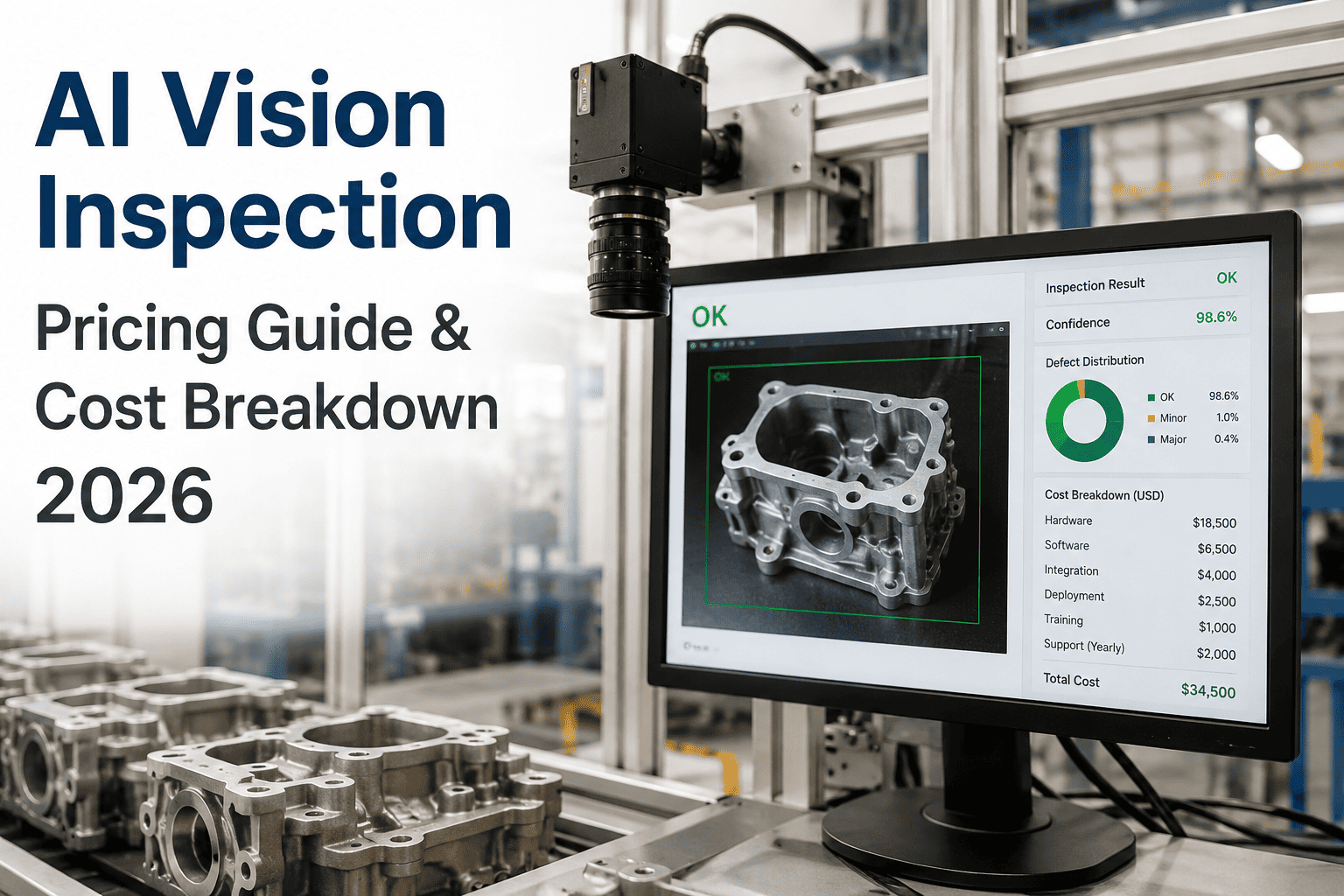
The camera or sensor is only one line item in a working inspection deployment. Lighting, mounting, edge compute, software licensing, model training, and integration with your PLC or MES all add cost on top of the hardware, and skipping any of them on a budget spreadsheet is how a project ends up costing far more than the original estimate suggested. This is the single most common reason internal budget approvals get revised mid-project — someone priced the camera and assumed the rest would be minor, when in a typical deployment the camera hardware itself is often less than a third of the total station cost once everything else is accounted for.
$3K-$25K
Typical camera hardware cost alone, before lighting, compute, or integration
$4K-$45K
Typical installation and integration cost depending on line complexity and existing automation
$30K-$200K
Realistic total deployment cost per inspection station once every component is included
THE FULL LINE-ITEM BREAKDOWN
Every Component That Contributes to Your Final Number
A transparent quote itemizes each of these categories rather than bundling everything into one opaque figure. Here is what belongs in a complete inspection station budget, and this is exactly the checklist to hold up against any vendor proposal you receive — if a category below is missing entirely from a quote, ask why before assuming it means the cost doesn't exist.
Camera and Optics
$3,000 – $40,000
Lighting and Enclosure
$1,000 – $4,000
Edge Compute or GPU
$2,000 – $15,000
Software License, Year One
$4,000 – $18,000
Model Training per Defect Class
$1,500 – $6,000
Installation and Integration
$4,000 – $45,000
Realistic Total, Per Station
$15,500 – $128,000
WHAT PUSHES YOUR PRICE UP OR DOWN
Six Factors That Move You Between Tiers
The single biggest driver of where your project lands in the pricing spread is not the vendor you choose — it is the combination of these six factors specific to your line. Two manufacturers buying from the exact same vendor can land at opposite ends of the standard tier purely because one runs a single-SKU line at moderate speed while the other runs high-mix production with tight tolerances, so understanding which of these factors apply to you is the fastest way to set a realistic budget expectation before requesting a quote.
Line Speed
Faster lines require faster cameras, tighter motion control, and more edge compute, pushing budget toward the advanced tier.
Number of Cameras Per Station
Complex geometry often needs two to four camera angles rather than one, multiplying hardware and integration cost proportionally.
Defect Complexity
Simple presence or absence checks cost far less to train and validate than subtle cosmetic or dimensional defect classification.
Existing Automation Depth
A line with existing PLC and MES connectivity integrates faster and cheaper than one requiring new control infrastructure.
Environmental Conditions
Washdown, high-temperature, or dust-heavy environments add specialized enclosures and cooling that raise hardware cost.
Number of SKUs or Product Variants
Each product variant typically needs its own trained model, so high-mix lines carry more model training cost than single-SKU lines.
BUY IT PIECE BY PIECE VS TURNKEY
The Line Item That Determines Whether You Hit Your Budget or Blow Past It
The most common source of pricing surprise is not any single line item — it is buying camera, compute, and software from separate vendors and discovering the integration work between them was never actually budgeted by anyone. Each vendor in a piece-by-piece purchase has every incentive to quote their own component competitively and let the buyer discover the integration cost later, once hardware has already shipped and the project has real momentum behind it. A turnkey deployment folds hardware, software, training, and integration into a single scoped number from day one, which removes this specific failure mode entirely rather than just making it smaller.
PIECE-BY-PIECE PROCUREMENT
Camera vendor, compute vendor, and software vendor each quote their own piece, often through separate purchase orders and separate contracts. Integration between them is discovered mid-project, often adding 20 to 40 percent to the original combined estimate before the system actually works end to end, and the timeline stretches accordingly while your internal team fields the coordination burden between vendors who have no contractual relationship with each other.
TURNKEY DEPLOYMENT
Hardware and software ship pre-integrated, with installation, model training, and PLC or MES integration priced as one scoped deployment. The number in the proposal is the number on the invoice, and a single vendor is accountable for the entire pipeline working together rather than pointing at another company's component when something in the chain doesn't perform as expected.
TURNKEY DEPLOYMENT INCLUDED
What's Bundled Into an iFactory Quote, Start to Finish
iFactory ships a pre-configured NVIDIA AI server, racked and ready, with the vision software pre-loaded. Rack it, plug power and Ethernet, and the AI is live — with everything below included in the scoped price rather than billed separately as the project unfolds, so the number in your proposal is the number you should expect to see on the invoice at each stage of the deployment.
Pre-configured NVIDIA edge AI hardware, racked and shipped ready to install
Camera, lighting, and mounting hardware sized to your part geometry and line speed
Software licensing with model training included, not billed as a separate line item
Cabling, network integration, and PLC or SCADA connection
Operator training and documentation for the go-live team
Twenty-four seven remote monitoring from day one of production
TURNKEY DEPLOYMENT TIMELINE
Live in 6 to 12 Weeks From Contract to Production
Pricing only matters relative to how fast a system actually starts generating value. A pre-integrated turnkey deployment reaches production in weeks rather than the multi-quarter timelines common with piece-by-piece procurement, and every week spent in integration limbo is a week the system is not yet catching defects or reducing scrap — which is its own real cost even though it never appears as a line item on any invoice.
Weeks 1–4
Ship, Network, and Data Collection
Hardware ships pre-racked. Network integration to PLC or MES completed, baseline defect imagery collected across your product mix.
Weeks 5–8
Model Training and Pilot Run
Model trained on your specific defect classes. Pilot run against live production data with accuracy and false positive rate validated before reject authority is granted.
Weeks 9–12
Go-Live and Operator Training
System takes reject authority with operator training complete and twenty-four seven remote monitoring active from day one.
Start a Six-Week Pilot Before Committing to a Full Rollout
Deploy on one station, validate accuracy against your own parts, and see the real number for your line before scaling to additional stations.
HOW TO READ A VENDOR QUOTE
Four Questions to Ask Before You Sign Anything
A proposal that looks complete on the surface can still be missing categories that surface later as change orders. Asking these four questions directly, and insisting on a written answer rather than a verbal reassurance, protects your budget more reliably than any amount of line-item scrutiny after the fact.
Does this number include model training for every defect class?
Confirm
Is PLC or MES integration included or billed separately?
Confirm
What happens to price if we add a new product variant later?
Confirm
Is ongoing monitoring and support included in year one?
Confirm
WHERE THIS FITS
Typical Budgets by Industry Application
Pricing tiers translate differently depending on industry, since defect complexity and line speed vary significantly by sector, and the tier that fits a food packaging line rarely fits an automotive weld cell without significant adjustment.
Automotive and Metal Fabrication
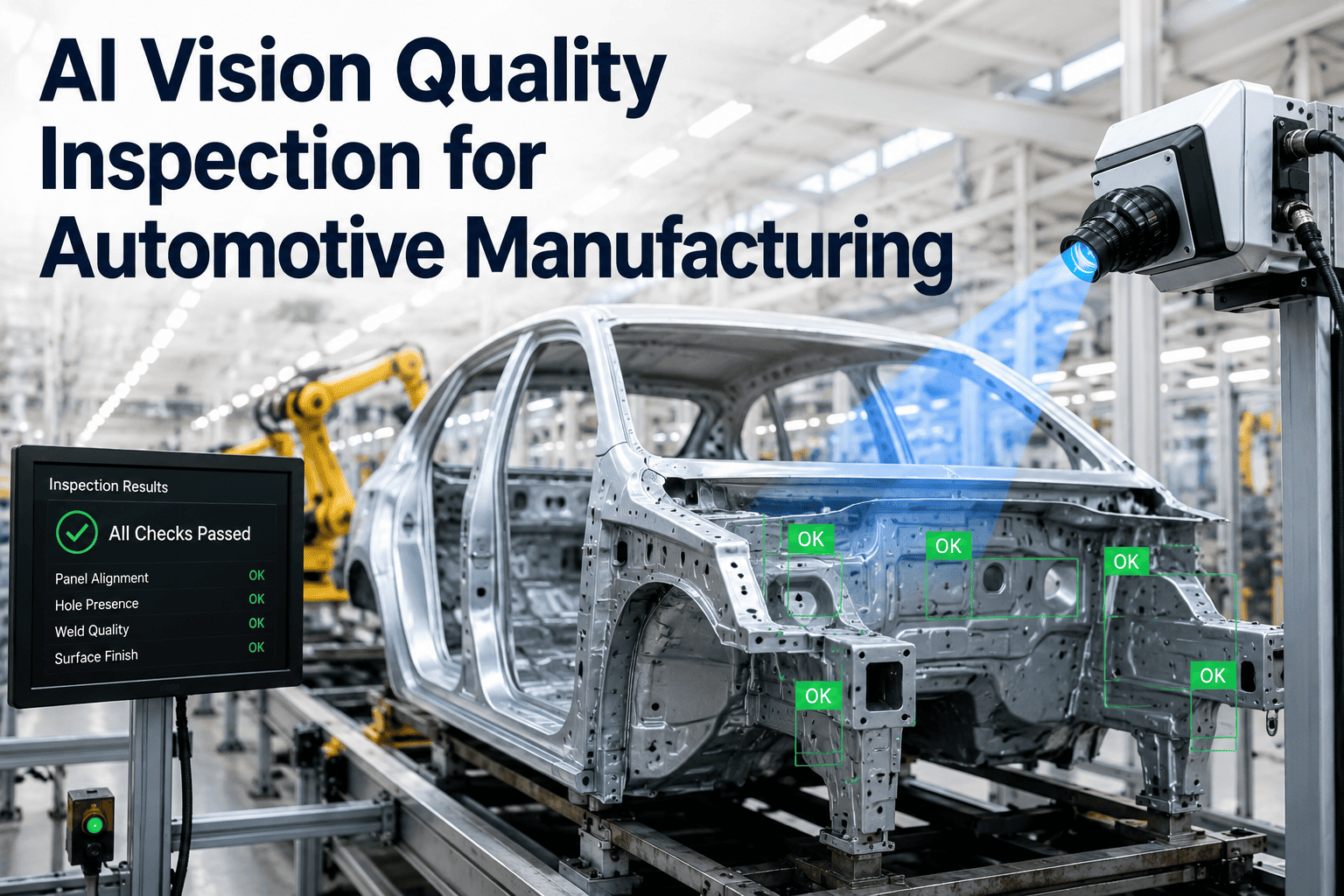
Typically standard to advanced tier, driven by weld and surface defect complexity and high line speeds.
Electronics and PCB Assembly
Standard tier common, with advanced tier for high-density boards requiring multi-angle inspection.
Food, Beverage, and CPG
Entry to standard tier for fill level and label checks, advanced tier for foreign-object detection at high speed.
Textiles and Continuous Materials
Standard to advanced tier, driven by web speed and the number of camera angles needed for full-width coverage.
FREQUENTLY ASKED QUESTIONS
Questions Buyers Ask Before Requesting a Quote
Why do quotes for what sounds like the same system vary so widely between vendors?
The variation almost always comes from what is included rather than the core camera technology itself. A low quote may cover camera hardware alone, leaving lighting, edge compute, software licensing, model training, and integration as separate line items that surface later, while a higher quote from a turnkey vendor bundles everything into one number from the start. Comparing two quotes fairly means confirming exactly which of the six cost categories in this guide each one actually covers, not just comparing the bottom-line figure, since a quote that looks 40 percent cheaper on paper can end up costing more once the missing categories are added back in during implementation.
Book a demo to see a fully itemized quote for your specific line.
Is it cheaper to buy hardware and software from separate vendors and integrate ourselves?
The line-item hardware and software costs can look lower when purchased separately, but the integration work between them — getting the camera feed into the edge compute, the model into the software, and the decision into your PLC — is real engineering effort that someone has to do and pay for, whether that shows up as an internal engineering hour count or a third-party integrator invoice. Facilities that attempt this in-house commonly find the actual total cost, once internal engineering time and delayed timelines are counted, exceeds a turnkey quote that priced integration in from the outset. The hidden cost isn't dishonesty on any single vendor's part — it's simply that nobody in a piece-by-piece purchase owns the connection points between components.
Contact our support team to compare a piece-by-piece estimate against a turnkey quote for your line.
How much should we budget for ongoing costs after the initial installation?
Beyond the upfront hardware and integration cost, expect recurring software maintenance or subscription fees, periodic model retraining as new product variants or defect types appear, and modest infrastructure costs for data storage and network capacity. These recurring costs are typically a fraction of the initial deployment cost once amortized, but budgeting for them from year one avoids the common mistake of treating the first invoice as the entire financial commitment. A realistic rule of thumb is that ongoing annual costs land somewhere between 10 and 20 percent of the initial deployment cost, though facilities with high SKU turnover or frequent new product introductions should budget toward the higher end of that range since each new variant typically needs its own trained model.
Book a demo to see a full multi-year cost projection for your specific deployment.
Can we start small and scale up rather than committing to a full plant-wide rollout?
Yes, starting with a single high-impact station is the standard and recommended approach, letting you validate accuracy, false positive rate, and actual ROI on real production data before committing budget to additional lines. A well-structured pilot on one station typically falls at the lower end of the standard tier and generates the evidence needed to justify a larger rollout, rather than requiring a large upfront commitment based on projected rather than measured performance. Once the pilot has proven out on real production data, expanding to additional stations is usually faster and less expensive per station than the first one, since the infrastructure templates, integration approach, and model training workflow are already established.
Contact our support team to scope a pilot for your highest-priority line.
What is a realistic payback period once we've made the investment?
Payback period depends heavily on your current cost of poor quality and inspection labor costs, but manufacturers with meaningful defect-related scrap and warranty costs commonly see payback within 7 to 17 months once defect detection, scrap reduction, and labor reallocation savings are combined. The specific number depends on your production volume, current defect escape rate, and inspection labor structure, which is why an accurate payback estimate requires your actual production numbers rather than an industry average pulled from a case study that may not resemble your operation. Facilities with higher current scrap rates or heavier reliance on manual inspection labor generally see faster payback, since both of those cost drivers shrink immediately once the system goes live.
Book a demo to model payback for your specific operation.
Get an Exact, Itemized Quote for Your Line
iFactory ships turnkey hardware and software together with transparent, itemized pricing and no surprise integration costs. Book a demo and get a real number scoped to your specific parts and line speed.