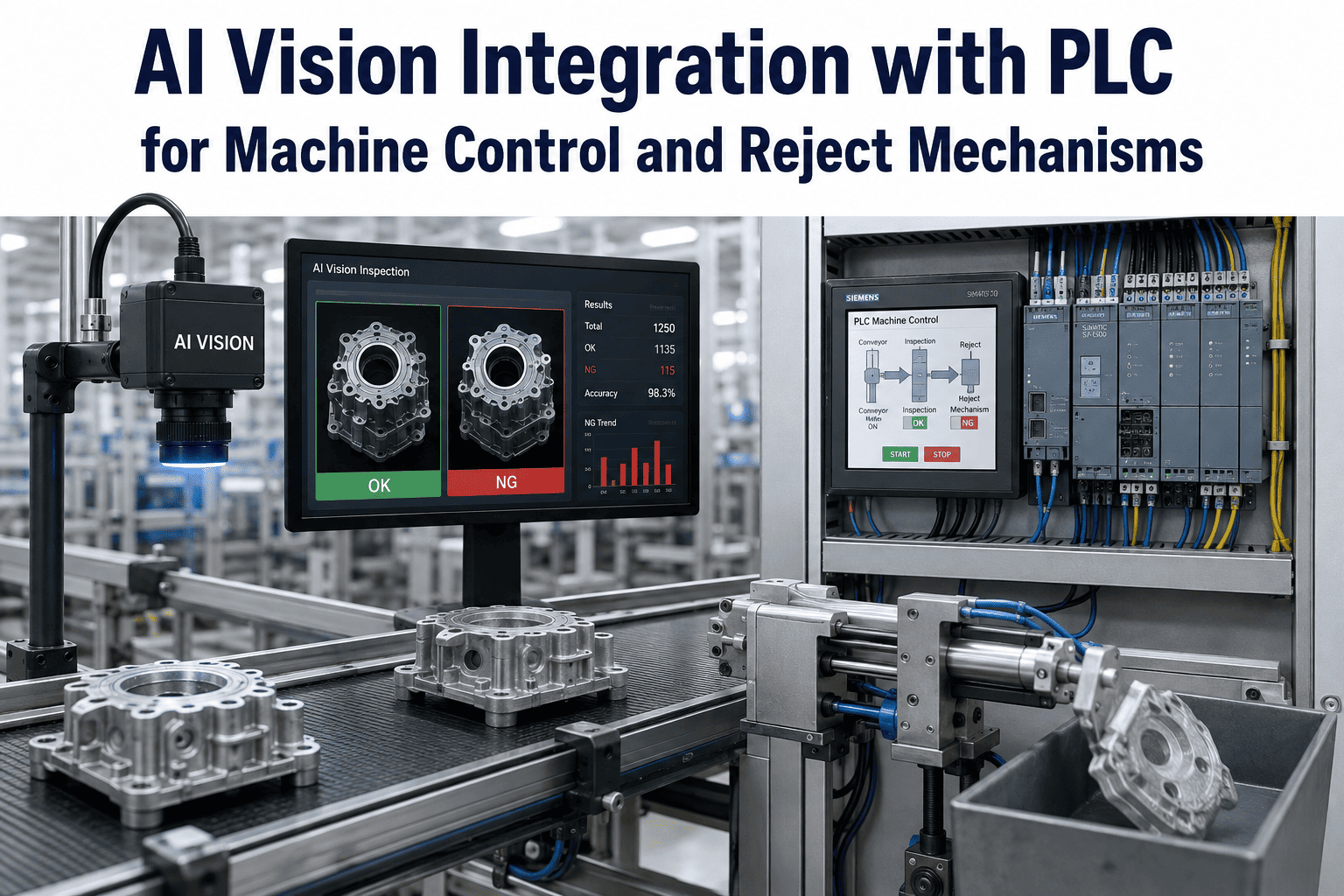
On a modern production line running at 60 parts a minute, the entire decision-to-action loop — camera capture, AI inference, PLC command, actuator movement, and defective part removed from the belt — has to complete before the next good part reaches the reject station. That window is often under 200 milliseconds end to end. Every hop in the chain either fits inside that budget or the reject fires on the wrong part, which is worse than not firing at all. AI vision integration with PLCs is the discipline of engineering that entire millisecond chain: choosing the right industrial protocol, the right actuator physics, and the right handshake pattern so the pass/fail decision reaches the reject mechanism deterministically, every cycle, every shift. Plant engineers and controls teams ready to see a working sub-50ms vision-to-PLC handshake on their own line can book a demo and walk through the timing budget with the iFactory team.
PLC INTEGRATION · REJECT MECHANISMS · INLINE CONTROL · 2026
AI Vision to PLC, in Under 50 Milliseconds
Pass/fail signals reach your Allen-Bradley or SIMATIC PLC over EtherNet/IP, PROFINET, or Modbus TCP. Reject cylinders, diverters, and sorting gates fire in deterministic scan time. No missed rejects, no wrong-part removals.
under 50ms
Vision inference to PLC command latency, camera capture to signal received at the controller
Sub-4ms
Deterministic PLC scan time for reject actuator commands over EtherNet/IP or PROFINET fieldbus
28%
Reduction in false rejects reported when PLC-level triple verification is layered on vision decisions
99%+
Reject accuracy achievable on inline production control with a properly tuned vision-to-PLC handshake
Why the Millisecond Budget Decides Everything
Every AI vision system in the world can find a defect. The engineering problem in a production environment is getting the defective part physically off the line before it becomes finished goods. That requires the vision decision to reach the PLC, the PLC to write to the reject actuator, the actuator to complete its stroke, and the belt or conveyor to still be presenting the correct part to the reject station when the stroke finishes. Miss the timing budget by 20 milliseconds and the reject fires on the good part behind the defective one. Miss it by 100 milliseconds and the defective part ships. The difference between a vision project that works in production and one that lives in a pilot forever is almost always the millisecond budget.
The budget itself has four components that manufacturing engineers have to size carefully: capture latency (camera trigger to image ready), inference latency (image to pass/fail decision), transport latency (edge device to PLC over industrial protocol), and actuation latency (PLC output to actuator complete). Each component has its own physics. A pneumatic cylinder responds in tens of milliseconds. A servo-driven diverter responds in single-digit milliseconds. A high-speed air-blast reject is faster still. Choosing the right actuator for the line speed is as important as choosing the right camera or the right AI model.
The Millisecond Waterfall: Where the Budget Actually Goes
The waterfall below shows a realistic timing budget for a discrete manufacturing line running at 60 parts per minute. Every bar is a component the controls engineer has to size. Add them up and the total decision-to-action window must land inside the physical spacing between the inspection point and the reject station on the conveyor.
Reading the waterfall from top to bottom tells a controls engineer where the trade-offs live. Camera capture is almost always fast enough — modern GigE Vision and USB3 Vision cameras deliver a full frame in under 10 milliseconds. AI inference on an edge GPU is next and is the single most tunable component: a heavier model produces higher accuracy but eats budget, while a distilled model runs faster but may need PLC-side verification to catch its false negatives. Transport over EtherNet/IP or PROFINET is deterministic and rarely a problem as long as the network is properly segmented. PLC scan and output latency are engineered around the specific controller family — a ControlLogix cycle is different from a CompactLogix cycle and different again from a SIMATIC S7-1500. The actuator stroke is the physics of the mechanism itself and cannot be shortened without changing the mechanism type. That is why the reject mechanism selection matters as much as the vision model choice.
Camera Trigger & Capture
6-10 ms
AI Inference on Edge GPU
20-45 ms
EtherNet/IP or PROFINET to PLC
2-5 ms
PLC Scan & Ladder Logic Decision
2-4 ms
PLC Output to Actuator Coil
1-3 ms
Actuator Physical Stroke
15-80 ms
Total End-to-End Budget
50-150 ms
Typical millisecond budget for an AI vision to PLC to reject actuator chain on a 60 parts-per-minute discrete manufacturing line. The actuator physical stroke is usually the largest single line item and often decides the total window.
Four Reject Mechanism Types, Four Timing Profiles
The reject mechanism itself is the last link in the chain and the one that consumes the most time. Choosing the right mechanism for the line is a controls decision that depends on part weight, line speed, belt width, and whether the reject has to be sorted into multiple bins. The four common families below cover the vast majority of discrete manufacturing lines.
A common mistake plant teams make is over-specifying the mechanism. A high-speed air blast is exciting on paper but genuinely unnecessary on a line running at 40 parts per minute, where a simple pneumatic push cylinder does the job at a fraction of the maintenance burden. The opposite mistake is under-specifying: trying to make a pneumatic cylinder work on a 400 bottles-per-minute line always ends with the mechanism firing on the wrong bottle or missing rejects entirely. The right mechanism is the slowest one that reliably completes its stroke inside the timing budget for the line — that rule alone eliminates most of the reject-mechanism disasters seen in the field.
TYPE 01
Pneumatic Push Cylinder
Stroke time · 30-80 ms
The workhorse of discrete manufacturing reject stations. Solenoid-controlled pneumatic cylinder pushes the defective part off the belt into a reject bin. Reliable, simple to wire, and easy to integrate with any PLC digital output.
Best fit: light-to-medium parts, line speeds up to 120 parts per minute
TYPE 02
High-Speed Air Blast
Response · 5-15 ms
Directional air jet blows small, lightweight defective parts off a moving belt. Extremely fast response and no mechanical wear, but requires clean dry compressed air and precise nozzle alignment for consistent operation.
Best fit: small parts, food/pharma sorting, high-speed lines above 300 parts per minute
TYPE 03
Servo-Driven Diverter Gate
Actuation · 8-25 ms
Servo-motor rotates a diverter arm or gate to route parts into one of multiple lanes. Ideal when reject is not binary — grade A, grade B, and scrap all need separate paths — and when part orientation must be preserved.
Best fit: multi-lane sorting, quality grading, orientation-sensitive parts
TYPE 04
Robotic Pick-and-Place
Cycle time · 200-800 ms
Delta or SCARA robot picks the defective part off the belt and places it in a bin, or moves the good part into a downstream tray. Slower than push or blast rejects but adds handling precision and can operate as a sorter, packager, and reject unit at once.
Best fit: fragile parts, mixed SKU lines, packaging with reject integration
PLC INTEGRATION · REJECT MECHANISMS · INLINE CONTROL · 2026
Size a Timing Budget for Your Line
Walk through your specific line speed, part geometry, and reject mechanism with the iFactory controls team. Get a millisecond-level timing budget mapped to your existing PLC and camera setup.
Protocol Choice: EtherNet/IP vs PROFINET vs Modbus TCP
The protocol that moves the pass/fail decision from the vision system to the PLC determines whether the timing budget holds under load. Every PLC brand has a preferred fieldbus, and picking the wrong one adds middleware, latency, and failure modes. The three-column comparison below covers the protocols that account for the vast majority of vision-to-PLC integrations in 2026.
For plants that already own the PLC hardware, the protocol choice is usually made for them — Allen-Bradley plants use EtherNet/IP, Siemens plants use PROFINET, and mixed brownfield plants fall back to Modbus TCP or OPC UA. The more interesting decision is whether to add a secondary path for redundancy. On safety-critical or high-throughput lines, iFactory often runs the primary decision path over the native fieldbus and a parallel logging path over OPC UA into the historian, so a network hiccup on the primary path does not lose the audit trail. This dual-path pattern is invisible to the operator and adds no measurable latency, but it removes one of the most common causes of missed traceability data in field deployments.
EtherNet/IP
Native toAllen-Bradley / Rockwell ControlLogix, CompactLogix, MicroLogix
LatencySub-4ms implicit cyclic exchange
ModelProducer / consumer with CIP objects
Best forNorth American discrete manufacturing lines standardised on Rockwell
Watch out forRequires EDS file management and CIP object tag alignment
PROFINET
Native toSiemens SIMATIC S7-1200, S7-1500, ET 200SP
LatencySub-4ms real-time cyclic, IRT for isochronous applications
ModelDeterministic frames with GSDML device description
Best forEuropean and global plants standardised on Siemens automation
Watch out forTopology-aware; ring or line topology needs planned commissioning
Modbus TCP
Native toUniversally supported across nearly every PLC brand and legacy device
Latency10-30ms typical, polling-based
ModelRegister read/write, simple client-server
Best forBrownfield lines, mixed-brand plants, quick integration where determinism is not critical
Watch out forPolling latency stacks with camera latency; watch total budget carefully
The Closed-Loop Handshake, Signal by Signal
A production-grade vision-to-PLC integration is not one signal but a handshake sequence. The PLC tells the vision system a part is approaching. The vision system captures, infers, and returns pass or fail. The PLC latches the decision, tracks the part through the belt shift register, and fires the reject at exactly the right moment. If any signal in the sequence is missed, the whole handshake breaks. The diagram below traces the six signals of a standard handshake.
1
PLC
Trigger: Part Present at Inspection
Encoder or photoeye tells the PLC a part has arrived at the inspection station. PLC writes trigger tag to the vision system over EtherNet/IP or PROFINET.
2
Vision
Capture and Infer
Vision system triggers the camera, runs the AI model on the edge GPU, and produces a pass/fail plus confidence score inside the timing budget.
3
Vision
Result: Pass / Fail / Defect Class
Structured result sent back to the PLC: decision, defect class, confidence, PartID, and a timestamp. PLC latches the result in a data block against the part index.
4
PLC
Belt Shift Register Update
PLC increments a shift register that tracks every part between inspection and reject station, carrying the fail flag along with the part as the belt advances.
5
PLC
Fire Reject at Reject Station
When the failed part reaches the reject station index in the shift register, the PLC fires the actuator output. Cylinder extends, diverter rotates, or air blast fires.
6
PLC
Confirm and Log
PLC confirms actuator stroke complete, decrements the shift register, and logs the reject event with timestamp back to the vision system, MES, or historian for traceability.
Where This Chain Lives in Real Industries
The vision-to-PLC-to-reject chain looks the same on paper but differs sharply in physics from one industry to the next. The four use cases below are common iFactory deployments and show how the timing budget, mechanism, and protocol choice shift with the application. Each one is a real pattern iFactory has deployed across multiple lines.
AUTOMOTIVE
Weld Bead and Paint Defect Rejection
High-value automotive body panels can't be rejected off the line — the PLC diverts flagged parts to a rework station rather than a scrap bin. Servo-driven diverters over EtherNet/IP to a ControlLogix PLC, with IATF 16949 traceability logged on every event.
FOOD & BEV
High-Speed Bottle and Can Sorting
Lines running above 400 bottles per minute use air-blast rejects for speed and hygiene. PROFINET to a SIMATIC S7-1500 handles the deterministic timing, and every reject is logged for FSMA and HACCP compliance.
PHARMA
Blister Pack and Vial Inspection
FDA-regulated lines demand pick-and-place robotic rejection to preserve chain-of-custody on rejected units. EtherNet/IP or PROFINET to the PLC, with 21 CFR Part 11 audit trails on every decision.
ELECTRONICS
PCB and Component Reject
SMT and PCB lines use pneumatic push rejects into an ESD-safe bin. Modbus TCP handles brownfield integrations to legacy PLCs, while EtherNet/IP or PROFINET drives newer high-speed placement lines with sub-30ms total budgets.
What Controls Engineers Are Reporting
The perspective below comes from a controls engineering lead who runs a mixed Rockwell and Siemens plant floor. It captures the operational payoff of getting the vision-to-PLC handshake right the first time.
Our old vision setup handed the reject decision to the PLC through a serial link with unpredictable latency. Half the time we were rejecting the good part behind the defective one and having to run a manual sort at end of line. Once we moved to a proper EtherNet/IP handshake with a shift-register-tracked reject on the PLC side, our false-reject rate dropped by roughly a third in the first quarter and our end-of-line manual sort headcount went to zero.
Controls Engineering Lead · North American Consumer Goods Manufacturer
Frequently Asked Questions
The questions below are the ones controls engineers, automation leads, and plant IT teams ask most often when scoping a vision-to-PLC integration. Each answer is written for engineers who need enough technical detail to make a real decision rather than a marketing summary. If your specific PLC brand, line speed, or reject mechanism raises a question that is not covered here, the fastest path to a precise answer is a working session with the iFactory controls team.
iFactory integrates natively with Allen-Bradley ControlLogix, CompactLogix, and MicroLogix over EtherNet/IP, and with Siemens SIMATIC S7-1200, S7-1500, and ET 200SP over PROFINET and S7 Communication. Brownfield or mixed-brand plants are handled through Modbus TCP, OPC UA, or direct digital I/O where determinism is not critical. The integration layer is protocol-agnostic on the vision side, so the same AI model and edge appliance can serve a Rockwell line and a Siemens line without any application-side changes. Plants running Schneider, Mitsubishi, Omron, or Beckhoff PLCs are supported through OPC UA and Modbus TCP as standard, and controls teams can book a demo for a brand-specific integration walkthrough.
Through a belt shift register in the PLC ladder logic. Every time the encoder or photoeye advances the belt by one part-position, the PLC shifts every fail flag down one slot in a data block that mirrors the physical positions between the inspection point and the reject station. When a flagged slot reaches the reject-station index, the actuator fires. This is a well-understood pattern in controls engineering and works reliably up to very high part densities. The shift register also cleanly handles missing parts, jams, and reverse-belt conditions if the PLC logic is written correctly. iFactory's reference ladder logic templates for Allen-Bradley Studio 5000 and Siemens TIA Portal include the shift register block already tuned for common line configurations.
No, and this is where the handshake protocol matters. If the vision system does not return a decision within the configurable timeout window, the PLC treats the missing decision as either a hard fail (reject the part) or a hard pass (let it through), depending on the safety-critical nature of the defect. For pharmaceutical or safety-critical automotive lines, the default is hard fail — better to reject a good part than let a defective one through. For high-volume consumer goods, the default is often hard pass with a logged timeout event for later review. The behaviour is fully configurable per line and per defect class during deployment, and the timeout event is logged in both the PLC and the vision system for traceability.
The flow is fully bi-directional. The PLC sends the trigger signal, product changeover indication, and reject-confirmation acknowledgement back to the vision system. Product changeover matters most: when the PLC signals a new SKU, the vision system reloads the correct inspection model in under two seconds, so a line that switches products every hour never inspects with the wrong model. Reject confirmation lets the vision system verify the physical stroke actually completed, which is important for regulatory audit trails and for detecting mechanical issues like a stuck cylinder before they produce a run of missed rejects. Digital I/O, EtherNet/IP, and PROFINET all support this bi-directional pattern natively.
Two things get tuned: the reject delay and the actuator stroke profile. The reject delay is a PLC parameter that controls how many belt positions the shift register waits before firing the reject after the fail flag arrives — it is adjustable from the HMI in seconds and is the first tuning point when line speed changes. The stroke profile is an actuator parameter that controls how long the cylinder stays extended or how fast the servo gate rotates, and is tuned once during commissioning per part geometry. iFactory provides an auto-tune workflow that measures the current line speed from the encoder feed, runs a series of test rejects with known-good and known-fail parts, and recommends the delay and stroke settings — controls teams can reach the team via support for the auto-tune tooling.
PLC INTEGRATION · REJECT MECHANISMS · INLINE CONTROL · 2026
Ready to Engineer a Deterministic Vision-to-PLC Chain?
See a live sub-50ms handshake from AI vision to your PLC brand of choice, driving a real reject mechanism at line speed. Bring your line's encoder rate and part geometry — the timing budget is walked through with the iFactory controls team on the call.