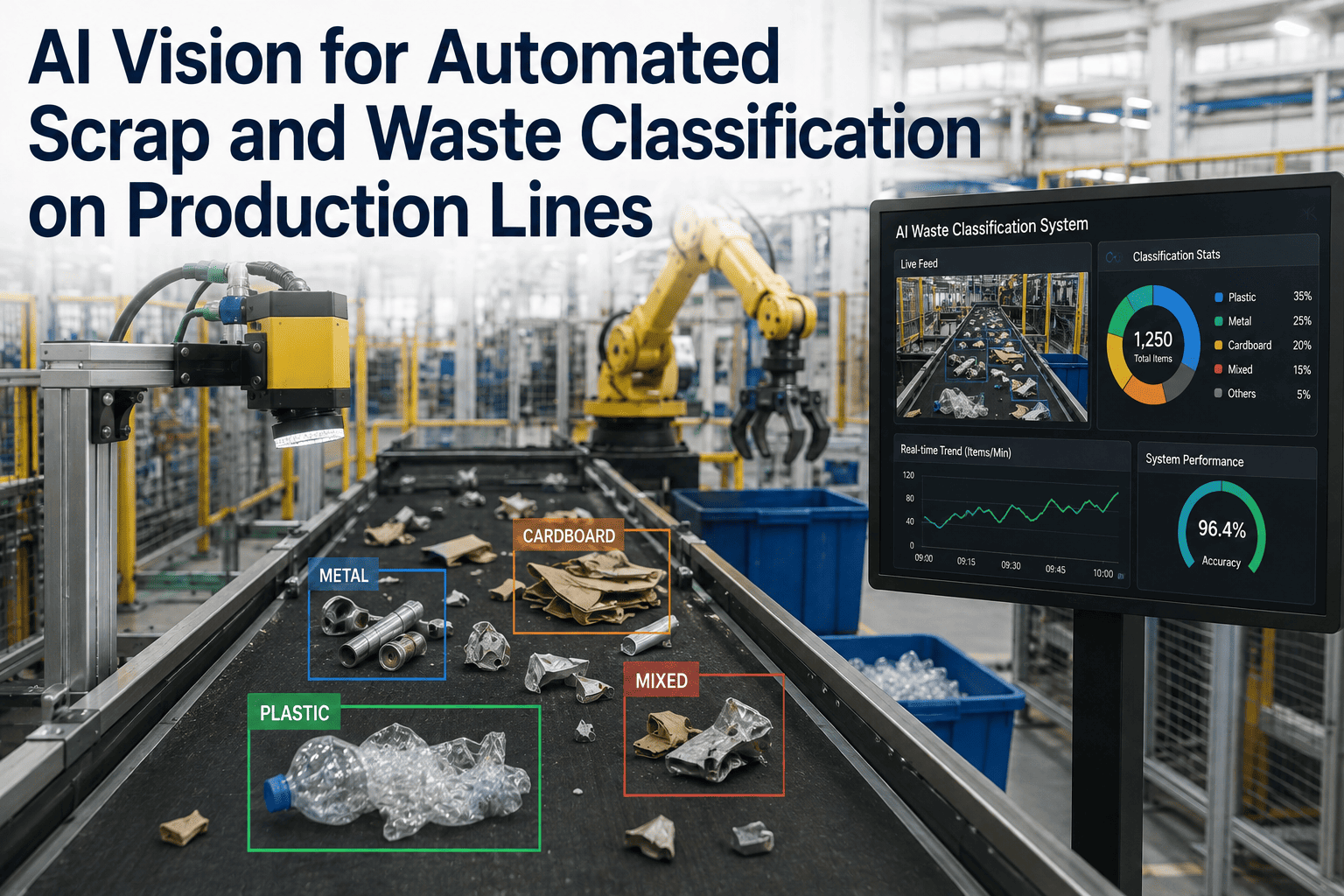
A single food-crusted takeout container on a fiber line can drop an entire bale grade, and a single stray battery on a plastics line can shut the belt down for hours. Sorting facilities have run on this fragility for decades because the belt moves faster than a human eye can reliably classify resin type, color, and contamination on every item passing beneath it. AI vision cameras do not get faster than the belt, they simply never look away from it, classifying PET, HDPE, aluminum, glass, paper, and cardboard at full conveyor speed and feeding that decision straight to a robotic picker or an air jet in under a tenth of a second. Facilities running this layer report cleaner bales, fewer belt stops, and commodity buyers who pay more for material they can trust, a shift iFactory's vision engineers now walk MRF operators through on live footage from their own lines.
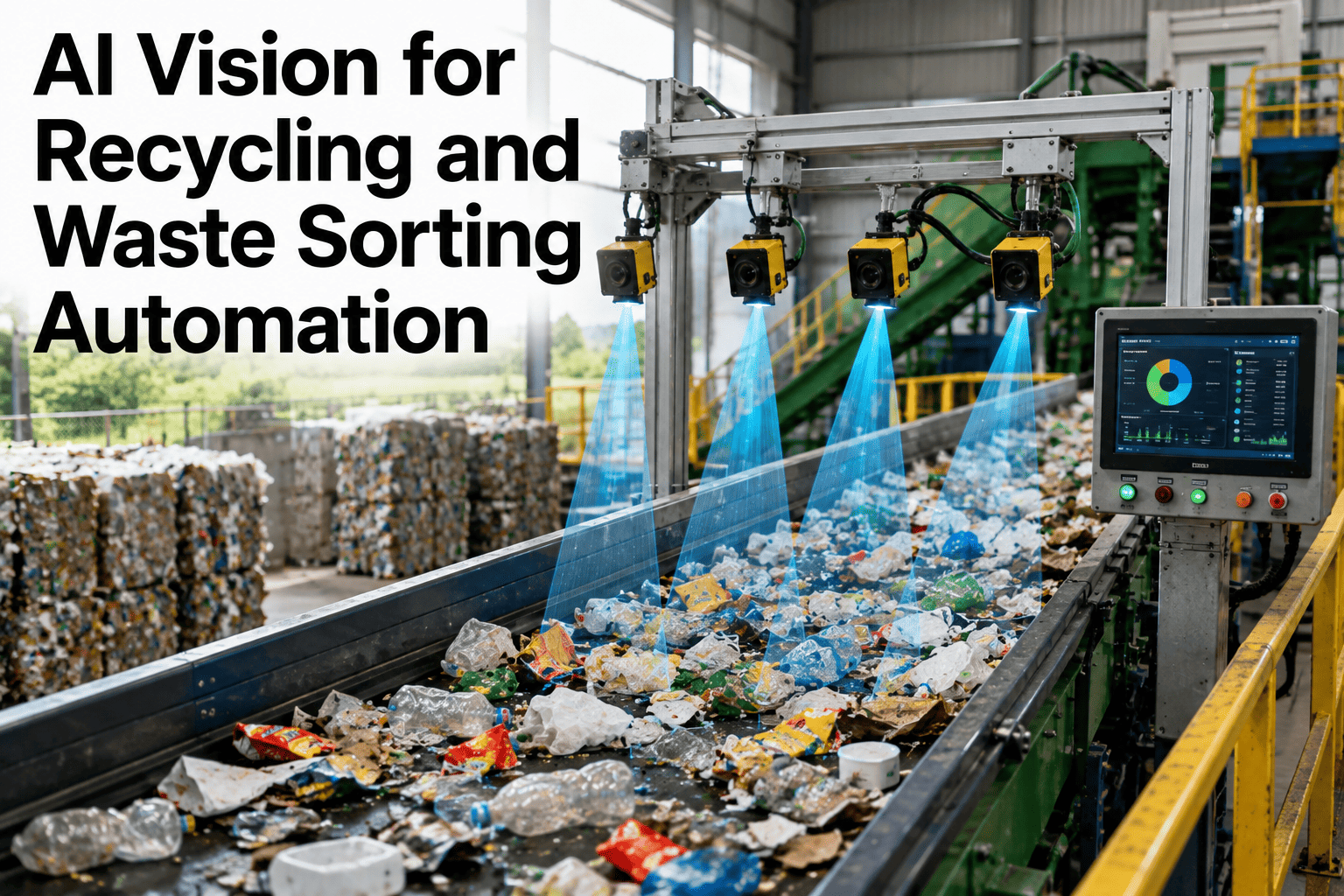
AI Vision for Recycling and Waste Sorting Automation
Cameras that classify every item on the belt by material type, in real time, and hand that decision to a robotic picker or air jet before it reaches the end of the line.
The Belt Does Not Wait for the Eye
A single-stream conveyor moving mixed recyclables presents a new item to a sorter every fraction of a second, in every orientation, partially obscured by other material, wet, crushed, or covered in a label that hides its resin code. A human picker manages this by scanning fast and guessing well, which is a genuinely skilled task, but it caps out at a picking rate no facility can scale past without adding people, and people brought onto a fast-moving contaminated line come with real safety exposure. Traditional optical sorters using near-infrared reflectance solved part of the speed problem decades ago, but they struggle with black plastics that absorb infrared, visually similar polymers like PET and PLA, and anything obscured by contamination, which is exactly why so much recoverable material still ends up baled with the wrong stream or landfilled entirely.
Computer vision changes the sensing layer itself. A camera trained on millions of labelled examples reads shape, color, texture, printed labels, and surface condition simultaneously, the same cues a trained human eye uses, at a speed and consistency no human shift can sustain. That is the entire premise of AI vision on a sort line: give the belt a sensing system that performs like your best picker, on every item, every hour, without a shift change.
Every item crossing the camera's field of view is classified independently, in the same pass, regardless of how tightly packed the stream is or how many material types are mixed together.
Material Classification, One Stream at a Time
Not every material presents the same challenge to a vision model, and a serious deployment tunes detection differently for each stream rather than applying one generic model across the whole facility. The panel below breaks down what the camera is actually looking for on each major recyclable category and where the classification difficulty concentrates.
PET Plastics
Bottles, clamshells, and thermoforms. The model reads shape, resin code where visible, and color to separate clear PET from colored PET, since colored bales command different pricing. Crushed and partially obscured bottles are the primary difficulty.
HDPE Plastics
Detergent bottles, milk jugs, and rigid containers. Natural and pigmented HDPE are separated automatically, since natural HDPE holds a significant price premium over colored material in most commodity markets.
Aluminum
Cans and foil, distinguished from steel and other metals by surface reflectivity and shape signature. Crushed cans and foil fragments are the hardest cases, and this is where combining vision with eddy current sensing improves capture further.
Glass
Sorted by color where color-separated glass streams are required by end markets. Broken glass fragments mixed into fiber streams are also flagged, since glass contamination in paper bales is one of the most common rejection triggers.
Paper
Mixed paper, newsprint, and office paper graded by fiber quality and contamination level. Wet or food-soiled paper is identified and diverted before it degrades the quality of an entire bale.
Cardboard
Old corrugated containers separated from mixed paper by texture and structure, with wax-coated and heavily contaminated boxes flagged for removal before baling rather than after.
From Camera Frame to Robotic Pick in Under a Second
Classification alone does not sort anything, the value comes from what happens in the instant after a material is identified. The workflow below is the same basic sequence running inside every AI-guided sort line, whether the actuator is a robotic arm, an air jet array, or a diverter gate, and the entire loop closes fast enough to act on an item that is still moving at full belt speed.
Capture
High-resolution cameras positioned above and alongside the belt capture continuous imagery of the material stream, with lighting configured to expose color, texture, and surface detail consistently regardless of ambient conditions.
Classify
A trained model identifies material type, color grade, and contamination status for every item in the frame simultaneously, assigning each one a coordinate position as it continues moving down the belt.
Route
The classification result is sent to the nearest actuator, a robotic pick arm, an air jet bank, or a mechanical diverter, timed precisely to intercept that specific item as it reaches the actuation point.
Divert
The item is physically separated into the correct stream, whether that means a positive pick of a high-value item or a negative pick removing a contaminant before it reaches the baler.
Log
Every classification and diversion event is recorded, building a continuous composition dataset that feeds the plant's purity dashboard and improves the model's accuracy over time.
Why Bale Purity Is the Number That Actually Pays You
Contamination is not a compliance footnote, it is the single biggest lever on facility revenue. Buyers price recovered material against a contamination threshold, and material that misses that threshold is discounted, rejected outright, or accepted only at a steep penalty. Since China's National Sword policy tightened accepted contamination levels sharply below what many facilities had operated at for years, bale quality shifted from a nice-to-have to the deciding factor in which facilities kept access to premium buyers at all. That pressure has not eased, it has spread to domestic reprocessors who now demand the same clean, consistent bales that export markets require.
Accepted by premium buyers at full market price, with fewer rejected shipments and a stronger long-term buyer relationship that survives tightening quality standards.
Accepted at a discounted price or routed to a secondary buyer with lower quality requirements, eroding margin on every ton processed even though the material was technically recoverable.
Rejected outright, requiring the load to be reprocessed, rerouted to another buyer, or in the worst case landfilled, converting a revenue-generating ton into a net operating cost.
See Your Line's Composition Data in One Live View
Book a walkthrough and iFactory will show you what continuous material composition monitoring looks like on a real conveyor feed, including how contamination gets flagged and diverted before it ever reaches your baler.
What Changes on the Floor Once Vision Goes Live
The operational shift is not abstract, facilities running AI-guided sorting describe a specific, repeatable set of changes across throughput, staffing, and downtime. The comparison below reflects the pattern reported across documented deployments rather than any single site's exact figures, since equipment mix, inbound composition, and facility layout all shift the specifics.
Manual and Optical-Only Sorting
- Picking capped near 40 items per minute per person
- Contamination caught inconsistently, often missed entirely
- Composition data limited to periodic manual audits
- Belt stops triggered reactively after jams or blockages
- Bale quality varies with picker fatigue and staffing gaps
- Black plastics and similar polymers frequently missorted
AI Vision-Guided Sorting
- Robotic picks exceeding 80 items per minute per arm
- Contamination flagged and diverted on every pass
- Continuous composition dashboard, updated in real time
- Predictive flagging of buildup before a jam occurs
- Bale quality holds steady across every shift and every day
- Visually similar and obscured materials classified correctly
Composition Analytics: Seeing What Is Actually Coming In
A facility that only sees output bales is managing the business half blind. Every camera on the line is also a continuous composition sensor, and the data it generates answers questions that used to require a manual waste characterization study run once or twice a year. That shift from occasional sampling to continuous measurement is where the operational value compounds beyond the sorting decision itself.
Real-Time Contamination Rate
A live contamination percentage for the current inbound load, rather than a figure discovered only when a buyer rejects a bale weeks later, giving operators the chance to adjust sourcing or pre-sort staffing before quality slips further.
Inbound Composition Trends
A rolling view of what is actually arriving on trucks, by material type and by source route, which turns anecdotal complaints about a bad load into a documented pattern that can be taken back to a hauler or municipality.
Recovery Rate by Material
Tracking what percentage of each material type entering the facility is actually recovered into the correct stream, surfacing exactly which fractions are leaking value so equipment and staffing investment can target the biggest gap first.
Equipment Health Signals
Sudden shifts in classification confidence or diversion accuracy often precede a mechanical issue, a misaligned screen or a failing air jet, giving maintenance a lead indicator instead of waiting for a downstream quality complaint.
The Economics Behind Every Sorting Decision
Every material stream on a sort line carries a different commodity value, and that value shifts constantly with global scrap markets, which is exactly why sorting accuracy matters more than facility operators sometimes assume when they are focused purely on throughput. Aluminum recovered cleanly can be worth many times more per ton than mixed plastics, and a facility that lets even a small percentage of aluminum slip into a fiber stream is quietly discarding some of its highest-margin material into a low-value bale. Vision-guided sorting does not just catch contamination, it also catches value leaking in the wrong direction, positive-picking high-worth items out of streams where they would otherwise be lost.
This is the part of the business case that often gets underweighted in facility planning. Contamination reduction protects revenue you already expect to collect. Improved recovery of high-value fractions like aluminum and natural HDPE creates revenue that was previously being thrown away entirely, sorted into the wrong bale and sold, if at all, at the price of a completely different and less valuable material. Facilities that track recovery rate by material type, rather than an aggregate diversion rate, are the ones that find where this leakage is concentrated and can prioritize investment accordingly.
Handling the Hard Cases Optical Sorting Misses
Every facility operator who has evaluated automated sorting technology has a list of materials that gave older systems trouble, and it is worth addressing those cases directly rather than glossing over them. Black plastics remain a genuinely difficult category for near-infrared optical sorters because carbon black pigment absorbs the infrared signal the sensor depends on, effectively making the item invisible to that detection method regardless of its actual resin type. A vision model does not depend on infrared reflectance at all, it reads shape, surface texture, and visible packaging cues instead, which is why black plastic classification is one of the clearest wins vision brings to a line an NIR-only system has already struggled with for years.
Flexible film and bags present a different challenge, tangling around rotating equipment and frequently escaping both manual and mechanical sorting entirely. Vision systems positioned early in the line can flag film for pre-removal before it reaches equipment prone to tangling, reducing the maintenance downtime that film contamination causes on ballistic separators and star screens. Multi-layer and composite packaging, an increasingly common category as brands adopt flexible pouches and laminated cartons, is likewise difficult for single-sensor systems to classify correctly, since the visible outer layer often does not match the material composition underneath. These are the categories where a facility's actual inbound stream matters most for training, since composite packaging trends shift by region and by the retail mix feeding a given facility.
Deployment on Your Existing Line
A common concern among facility operators is that AI vision means ripping out mechanical sorting infrastructure that already works. In practice, vision is almost always deployed as an additional intelligence layer on top of existing screens, ballistic separators, and optical sorters, not a wholesale replacement of them. The rollout below reflects the typical sequence for adding vision guidance to an operating line without extended downtime.
Line Assessment
Engineers walk the line to identify the highest-value camera positions, typically just ahead of the point where contamination currently causes the most rejected bales, and confirm compatibility with existing mechanical equipment.
Camera and Lighting Install
Cameras and structured lighting are mounted above the belt at the selected positions, configured to handle the dust, moisture, and variable ambient light conditions typical of a working sort floor.
Model Training on Your Stream
The model is trained and validated against your facility's actual inbound material mix rather than a generic dataset, since local composition, brand mix, and contamination patterns vary meaningfully between facilities.
Actuator Integration and Go-Live
Classification output is connected to robotic pickers, air jets, or diverters, running in parallel with existing sorting for a validation period before full authority is handed to the vision-guided system.
Measuring the Results After Go-Live
The value of a vision deployment should not be a matter of impression, it should be a set of numbers tracked consistently before and after the system goes live. Facilities that build this discipline into their rollout get two things: proof that the investment performed as expected, and the specific data needed to plan the next expansion, whether that means adding cameras to a second line or extending robotic picking to a fraction that was previously handled manually. Contamination rate per bale, recovery rate by material type, belt stop frequency, and picking throughput per actuator are the four metrics that most directly reflect what a vision system is actually contributing, and all four can typically be tracked automatically once the composition dashboard is in place.
Reporting these figures on a rolling basis also changes the conversation with commodity buyers. A facility that can show a documented, consistent contamination trend rather than a single audit snapshot is in a stronger negotiating position, particularly with buyers who have tightened their own acceptance standards in recent years. Consistent, provable bale quality is increasingly a competitive differentiator between facilities competing for the same limited pool of premium buyers, and continuous composition data is the evidence that makes that differentiation credible rather than anecdotal.
Frequently Asked Questions
Can AI vision tell the difference between visually similar plastics like PET and PLA?
Yes, though this is precisely the case where AI vision earns its advantage over older optical sorting technology. Traditional near-infrared sorters that identify polymer by spectral reflectance frequently struggle to separate PET from PLA because their reflectance signatures overlap. A vision model trained on labelled examples of both materials learns additional cues, container shape, printed labeling conventions, and surface texture, that a spectral-only system cannot use. This is also where a facility's own training data matters most, since the exact packaging mix on your line shapes how reliably the model separates these lookalike materials, which is why our deployment team trains models against each facility's real inbound stream rather than a generic dataset.
Does adding AI vision mean replacing our existing optical sorters and screens?
No, in the large majority of deployments vision is added as an additional sensing and decision layer on top of the mechanical infrastructure already installed, rather than a wholesale replacement of it. Ballistic separators, screens, and existing optical sorters continue performing the coarse separation they already handle well, while cameras positioned at key points add finer material classification and drive robotic pickers or air jets for tasks the existing equipment cannot resolve on its own. This approach protects the capital already invested in the line and typically shortens deployment time considerably compared with a full line rebuild.
How much does bale purity actually affect what we get paid for material?
Substantially, and the effect has grown sharper since major buyers tightened accepted contamination thresholds well below levels facilities operated at for years. A bale that clears a buyer's purity threshold sells at full market price, a moderately contaminated bale is typically discounted or routed to a lower-paying secondary buyer, and a bale that fails the threshold outright can be rejected entirely, forcing costly reprocessing or, in the worst case, landfill disposal of material that was fully recoverable. Because contamination is priced at the bale level rather than averaged across a facility's output, even a modest improvement in per-item sorting accuracy translates directly into fewer discounted or rejected loads.
What happens to our sorting staff once robotic pickers are handling classification?
Most facilities redeploy pre-sort and quality staff toward the tasks that still genuinely require human judgment, monitoring the composition dashboard, handling oversized or hazardous items flagged by the system, and managing the exceptions a model correctly escalates rather than guesses on. Manual picking on a contaminated, fast-moving belt also carries real safety exposure, and shifting that specific task to a robotic arm while keeping people in supervisory and quality roles is the pattern most operators describe as the more sustainable staffing model, not a straight headcount reduction.
How long does it take to get a vision-guided sorting line fully operational?
Timelines vary with the number of camera positions and actuators involved, but a single-stream deployment on an existing line commonly moves from initial assessment to live operation within a matter of weeks rather than months, since the cameras and lighting install without requiring a full line shutdown. Model training against your facility's actual material mix and a parallel validation period before handing the system full authority are the stages that most affect the overall timeline. Walking your specific line configuration through this sequence with an engineer on a short call gives the most accurate estimate for your facility.
Stop Losing Bale Value to Material You Cannot See in Time
Every ton of contaminated material that reaches your baler is a ton priced below what it should have earned. iFactory's AI vision layer classifies every item on the belt in real time and hands the decision straight to your pickers, before contamination becomes a rejected shipment.