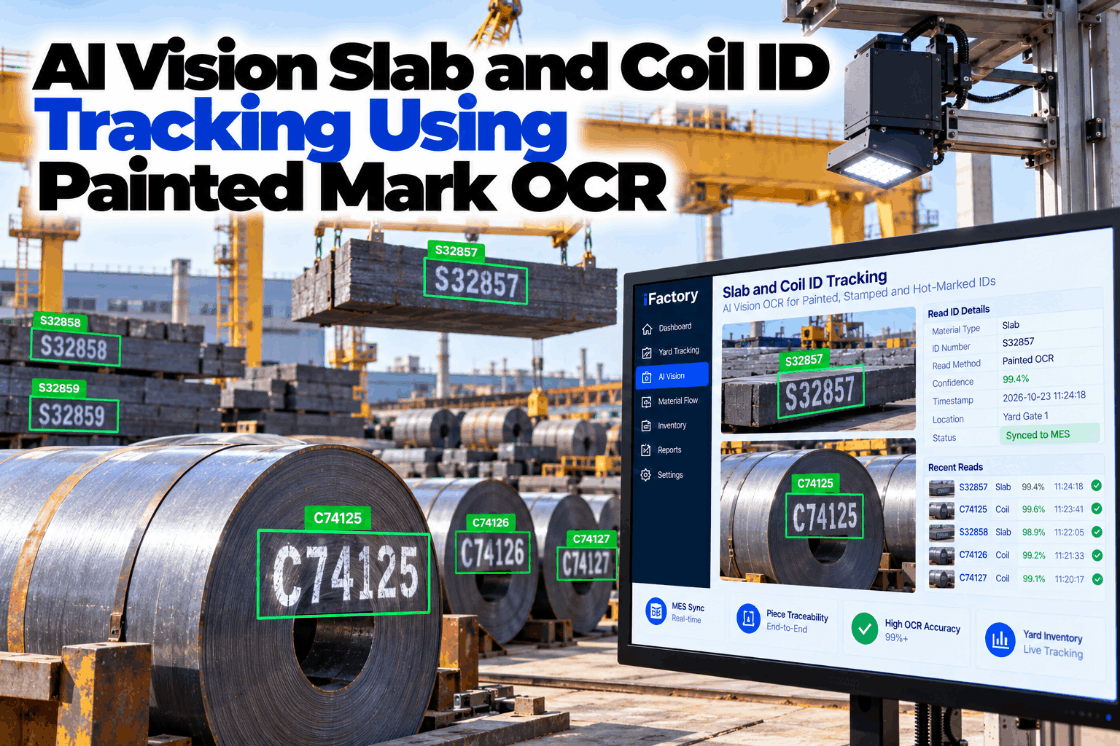
In a slab yard or coil bay, a piece is only as good as the number painted on it. If that number is misread or keyed in wrong, the wrong slab can be charged, the wrong grade rolled and the wrong certificate sent to a customer. Manual reads from a crane cab or a clipboard happen hundreds of times a shift, through scale, steam and fading paint. AI vision OCR reads painted, stamped and hot-marked IDs at every move and checks each one against the plan. See it on real yard images in a short ID tracking demo.
Read Every Slab and Coil Number, Every Time It Moves
iFactory Vision OCR Inspection reads painted, stamped and hot-marked numbers on slabs, billets and coils in yards and mills. Each read is checked and synced to MES, so mix-ups are caught before a piece is charged, rolled or shipped.
Painted, Stamped, Hot-Marked and Labelled
Each product carries its number in a different way, and each way looks different to a camera. Dot-matrix marking machines print characters onto hot or cold metal, even on scaly or uneven surfaces, and some can add a 2D code. Pneumatic hot stampers punch heat and cut numbers one character at a time. Billets are often machine-marked or written by hand on the end. Coils get spray-marked numbers or codes and printed labels. Map the marks your plant uses with our tracking team.
Six Conditions That Defeat Ordinary OCR
Office OCR reads clean black text on white paper. A yard camera reads grey paint on grey scale, at an angle, through steam. Published research on slab and billet numbers names the same problems: complicated backgrounds, low-quality characters, and numbers that are distorted, peeled or damaged by heat and oxidation. Test your worst marks in a sample image review.
Read Points From the Caster to the Shipping Bay
Automatic tracking does not need a camera everywhere. It needs a reliable read at each point where a piece changes hands, so the system always knows which piece moved and where it went. Between reads, crane and transfer car positions carry the identity forward. Cameras sit where the mark faces them naturally: end faces on the run-out rollers and charging line, top surfaces under the crane path, coil sides at the walking beam. Plan your read points with our support engineers.
Catch the Wrong Slab Before It Is Charged
The cheapest place to stop a mix-up is the furnace entry. iFactory checks every read against the charging plan and tells the crane operator at once when a piece does not belong.
Check Characters and Plausibility, Not Just Reading
A read is a guess until it is checked. Many mills build a check character into the ID, worked out from the other digits, so a single misread character fails the check. iFactory then asks whether the number makes sense: is this piece expected here, now, in this sequence, with this grade? Each read lands in one of five outcomes. Set your own rules with a tracking rules session.
A plan match can confirm a partial read, but it should never invent a number the camera did not see. Every confirmed-by-plan read keeps its image and is counted separately in the weekly review.
Where Each Read Goes After the Camera
A read only helps if the right system hears it. Slab and coil yard systems in steel plants already link to Level 2 process control and Level 3 MES, often with barcode, RFID or vision at yard entry. iFactory adds reliable reads at the points that have none, and passes each confirmed identity and location to all three. Review your integration plan with our integration team.
When every pick and set-down carries a confirmed read, the yard map stays true without walking the stacks. The same chain links each coil number back to its slab and heat, so the genealogy from caster to coil is built as the steel moves, not pieced together after a claim.
What a Swapped Number Really Costs
Mix-ups rarely show up where they happen. They appear later, at testing, at the customer or during an audit. Under EN 10204, a type 3.1 inspection certificate reports results from specific inspection tied to the delivered product and its heat, so a swapped coil number means the certificate describes different steel. These illustrations show the usual path. Talk through your own risks in a traceability review.
From Read-and-Key to Read-at-Every-Move
Most yards still depend on a person reading a number and typing it in. That works until the shift is busy, the paint is faded or the slab is still hot. Camera reads remove the typing, not the people, and leave a picture behind for every move. Operators still decide what happens when a read is unclear, but they decide with the image in front of them. Compare your current process with our support team.
- Operator reads the number from the cab or the floor
- Typing errors and skipped entries on busy shifts
- No proof of what was actually seen
- Mix-ups found at the mill, the lab or the customer
- Number read at pick, set-down and charging
- Each read checked against the plan before the move ends
- Image stored with every read
- Mix-ups stopped at the crane, before charging
The Fields Kept for Every Read
Each read becomes a small record that links the piece, the place and the evidence. When a customer or auditor asks where a coil came from, the chain of reads answers it. Ask our team for a sample record in a short walkthrough.
A Time Worksheet With Assumed Inputs
The biggest value, a mix-up that never reaches a customer, is hard to price and should not be guessed. The time spent reading, keying and searching is easier to size. The worksheet uses assumed inputs only, so swap in your own. Our support team can help you build the full case.
Add crane time spent on searches, and keep claim and downgrade costs out of the sum unless your own records support them.
Heat-Rated Cameras, OCR Models and Edge Server in One Package
iFactory delivers ID tracking as a turnkey system. Cameras are fitted at your read points, and a pre-configured NVIDIA AI server ships racked and ready with OCR models loaded, so every read is processed on site within the crane move. You rack it, plug in power and Ethernet, and the AI is live. Scope it for your yard with a turnkey quote.
- Pre-configured NVIDIA AI edge server, racked and ready
- Heat-protected cameras for caster, yard and furnace entry
- OCR models trained on your paint, stamp and label styles
- Check character and plan plausibility rules
- Links to Level 2, MES and the yard crane system
- Read records with images for every move
- 24×7 remote monitoring of models and hardware
Read points agreed, cameras and server installed, Level 2 and MES links opened.
Models trained on your marks and run beside manual entry, with every gap reviewed.
Camera reads become the record, crane operators trained, weekly read review started.
Vision OCR Built for Yards and Mills
iFactory Vision OCR Inspection is designed for heat, scale and moving cranes, where a number must be read right the first time. Our support team can walk you through a pilot plan.
What Plant Managers Ask About Slab and Coil ID Tracking
Know Which Piece Moved, Where and When
Read every slab, billet and coil number at every move, check it against the plan and keep MES in step with the yard. The full system is delivered turnkey and goes live in 6 to 12 weeks.