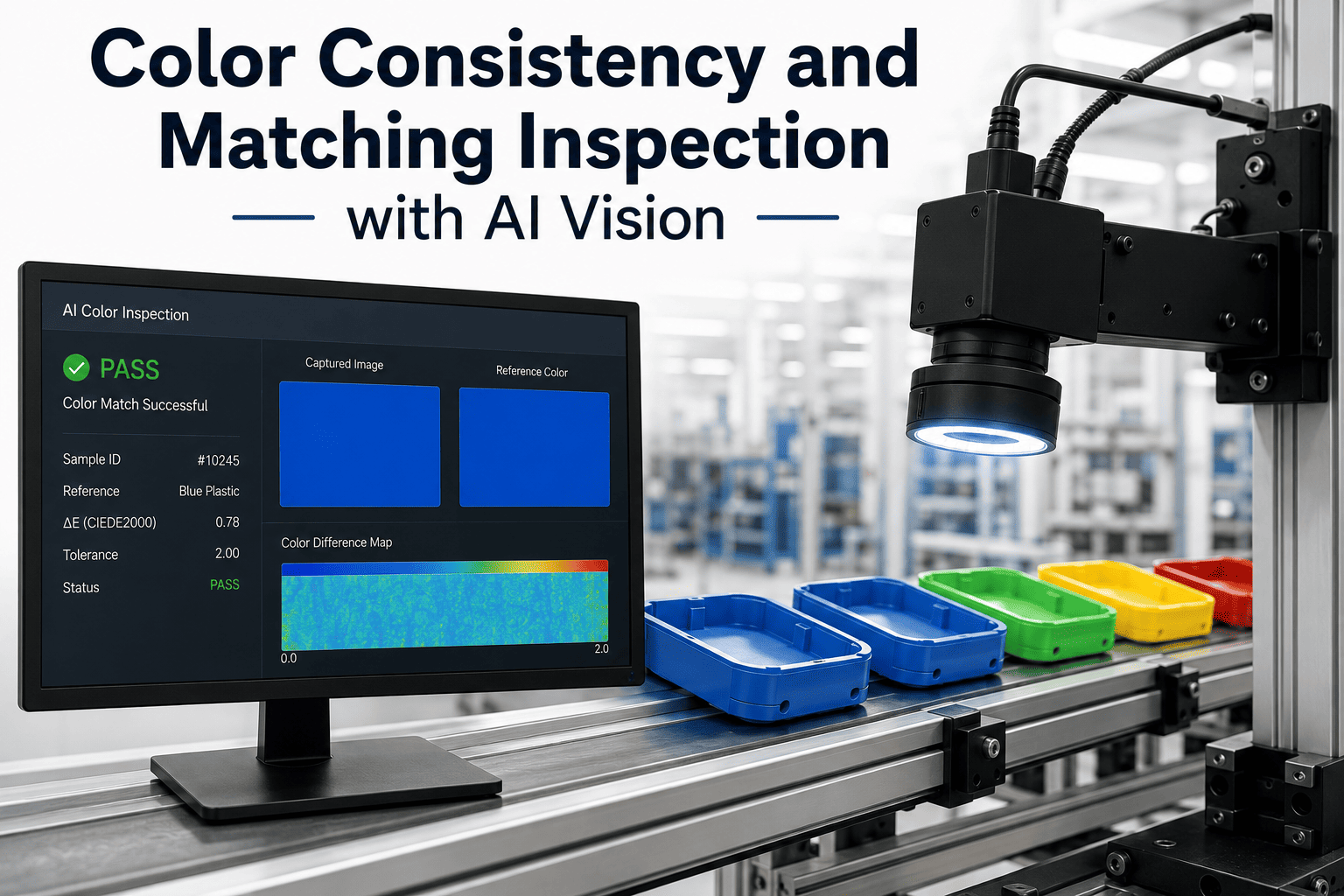
A textile dye lot that comes off the jet at ΔE 3.2 against the customer's approved standard is a lot that has to be redyed, downgraded, or rejected — and by the time the QC lab kicks back that reading three hours after the fabric was made, the dye vessel has already run two more batches with the same off-recipe. That's the fundamental problem with lab-based color inspection: the answer arrives after the mistake has been repeated. AI vision changes that entirely. A camera pointed at fabric leaving the range measures shade continuously, computes ΔE against the standard in real time, and stops the recipe drift at batch one instead of batch three. The mills that have already made this move don't talk about it as a technology upgrade — they talk about it as the moment their first-time-right rate stopped being a hopeful target and started being a controlled metric. For textile operations building out this capability, iFactory's color vision engineering team maps the sensor placement, illuminant calibration, and CMMS-integrated deviation alerts to each dyeing line's specific fiber, machine, and shade portfolio.
Process Vision · Color Consistency
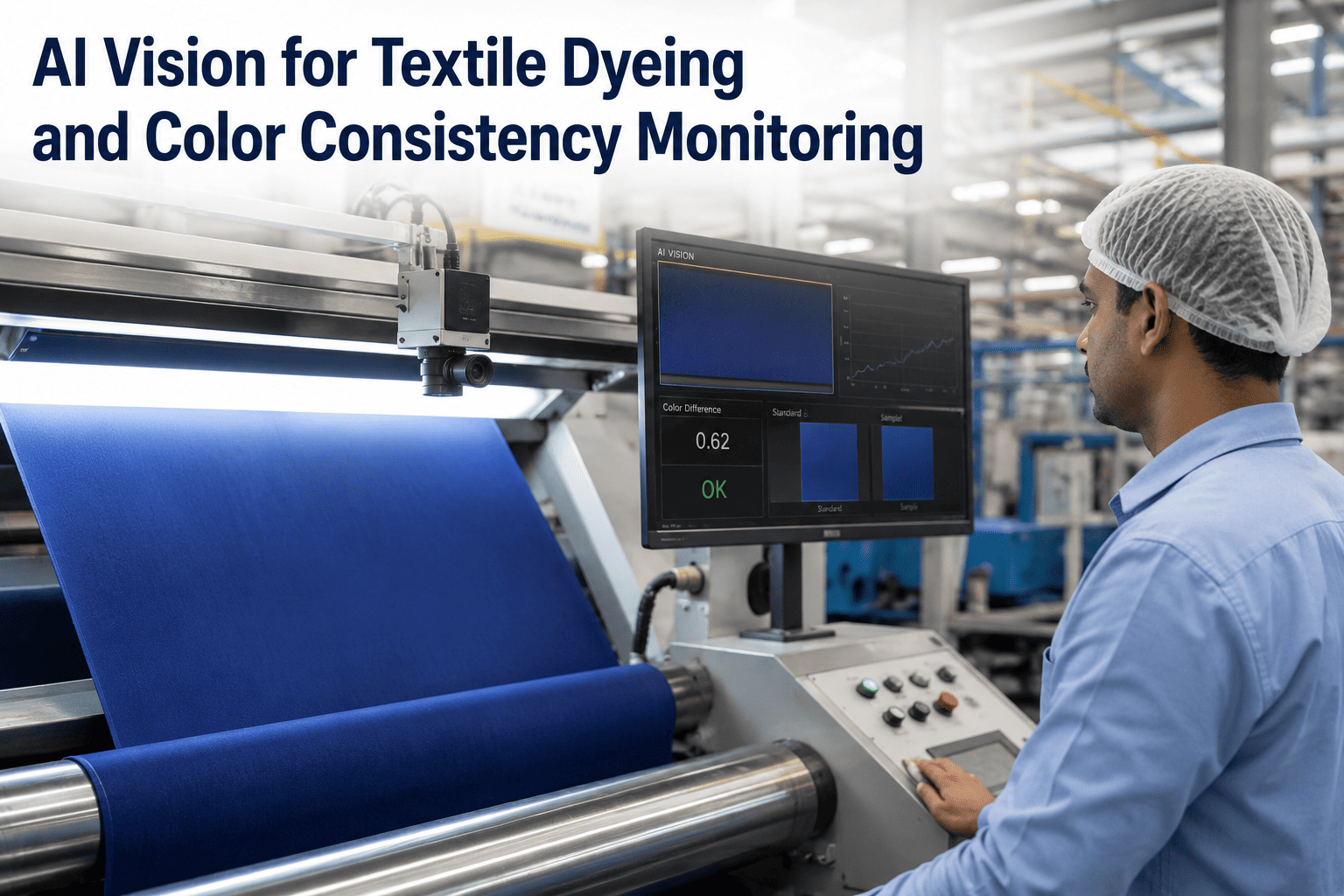
AI Vision for Textile Dyeing and Color Consistency Monitoring
Measure fabric color the moment it leaves the dye range. Compare every meter against the customer's approved standard in real time. Catch shade drift, batch-to-batch inconsistency, and metamerism before the next batch runs — not three hours later when the QC lab report finally lands.
ΔE Shade Tolerance Scale
ΔE 0–1
Imperceptible · Premium apparel spec
ΔE 1–2
Commercial pass · Typical brand tolerance
ΔE 2–3
Correction needed · High-end reject line
ΔE 3+
Off-shade · Redye or downgrade
The Cost Of A Missed Shade
Why Color Consistency Is The Highest-Leverage Quality Metric In Dyeing
Every textile mill runs on a first-time-right rate — the percentage of dye lots that pass shade approval on the first attempt without redyeing, shading correction, or downgrade. In continuous, exhaust, and jet dyeing operations, that number is the single most important cost driver on the whole line. A first-time-right rate of ninety percent versus seventy percent doesn't just change the QC report — it changes water consumption per kilo, chemical spend per kilo, energy per kilo, and downstream delivery reliability into apparel factories that will not accept anything but the approved shade.
The catch is that traditional shade approval workflows are structurally slow. A lab technician cuts a swatch from the fabric, conditions it, measures it on a benchtop spectrophotometer under controlled illumination, calculates ΔE against the standard, and reports the result back to the dyeing floor. That entire loop takes anywhere from thirty minutes to several hours depending on the mill's process flow, and during that entire window the dyeing line has already committed to the next batch — sometimes several batches — using the same recipe that produced the failed shade. The lab result closes the loop after the damage is already scaling.
AI vision closes the loop before the damage scales. A calibrated line-scan or area camera positioned after the dye range captures fabric continuously as it exits, converts each frame to CIELAB coordinates against a validated illuminant, and computes ΔE against the customer's stored standard for that specific shade. When the reading drifts beyond tolerance, the alert fires within seconds — not hours — and the operator has the option to stop the batch, tune the recipe, or route the fabric before the same drift compounds across the shift. That's the mechanical difference between reactive shade control and real-time shade control, and it's why AI vision is moving from optional tech pilot to standard installation in mills serious about first-time-right economics.
Where Shade Problems Actually Come From
The Six Root Causes Of Batch-To-Batch Color Variation
Textile color variation almost never has a single cause. It's the compound of small deviations across dye recipe, machine state, substrate variability, and environmental drift — and it's the compounding that makes traditional visual and lab inspection so unreliable at catching the problem early. The six categories below cover the overwhelming majority of variation sources documented in industrial dyeing operations, and each one is a signature that AI vision is specifically trained to isolate and flag.
Recipe
Dye Concentration & Auxiliary Drift
Small variations in dye stock strength, weighing accuracy, and auxiliary chemical dosing produce shade shifts that only become visible on finished fabric. AI vision correlates finished shade with recipe input data to surface drift before it becomes a rejection.
Substrate
Fiber & Fabric Preparation Variability
Uneven scouring, residual sizing, and lot-to-lot fiber variability all shift how the substrate accepts dye. The same recipe on two prep lots can produce two different shades, and AI vision quantifies the difference against the standard rather than the previous batch.
Machine
Liquor Ratio, Temperature & Time Deviation
Deviations in liquor ratio, dye bath temperature profile, and dwell time drive predictable shifts in shade depth and hue. Continuous vision monitoring against the standard turns these process signals into shade evidence that engineers can act on.
Optical
Metamerism Under Different Illuminants
Two batches that match under one light source can look different under another — the classic metamerism problem. AI vision systems calibrate to multiple standard illuminants and flag when a batch passes under D65 but fails under store lighting or CWF.
Prep Error
Fabric Wrinkles, Folds & Moisture
Wrinkles, folds, and residual moisture distort spectrophotometer readings and drive false shade results in lab-based inspection. Line-mounted vision measures fabric flat and moving under controlled conditions, eliminating the sample-preparation error class entirely.
Instrument
Cross-Instrument Reading Discrepancy
Different spectrophotometers, or the same instrument at different calibration states, read the same fabric with subtle discrepancies. A single vision system reading every batch removes the instrument-to-instrument drift that plagues multi-lab operations.
The Closed-Loop Vision Workflow
How Continuous AI Vision Replaces The Lab-Based Approval Loop
The value of AI vision in dyeing isn't just faster measurement — it's a fundamentally different feedback loop between the color reading and the recipe. The five-stage loop below is what runs in production once the system is calibrated. Every stage compresses a delay that lab-based QC could not compress.
01
Standard Storage & Illuminant Calibration
Customer-approved shade standard measured with laboratory-grade spectrophotometry and stored as CIELAB coordinates. Vision system calibrated against multiple standard illuminants — typically D65, A, and CWF — with reference tiles verified daily.
02
Continuous In-Line Fabric Imaging
Line-scan or area camera captures fabric leaving the dye range under controlled illumination housing. Every frame processed for L*, a*, b* coordinates across the fabric width, sampling thousands of measurement points per meter.
03
Real-Time ΔE Computation Against Standard
Every fabric measurement compared against the stored standard using ΔE2000 or CMC formulas. Center-to-selvage variation, machine direction variation, and batch mean all computed continuously with sub-second latency.
04
Deviation Alert & Recipe Correlation
When ΔE crosses the customer's tolerance threshold, the alert fires to the dyeing supervisor with the deviation signature — hue shift, chroma shift, or lightness shift. Recipe and machine data correlated to identify the likely process root cause.
05
CMMS Work Order & Trending Archive
Deviations routed as structured work orders into the maintenance system for recipe correction, machine tuning, or preparation review. Every batch's full ΔE trace archived for customer audit, brand approval, and long-term first-time-right trending.
See ΔE Trending Live On A Real Dye Range
Watch AI Vision Catch Recipe Drift Before The Second Batch Runs
Book a walkthrough with iFactory's color vision engineering team and see live in-line shade measurement running against a customer standard — center-to-selvage variation, batch-to-batch drift, metamerism flags, and automatic recipe correlation alerts.
Where The First-Time-Right Rate Actually Moves
The Six Cost Categories AI Vision Compresses
The ROI on AI vision color monitoring shows up across every major cost line on a dyehouse P&L. The stack below is the pattern iFactory's engineering team consistently sees at mills that have moved to real-time in-line monitoring, sorted by the categories where the impact is most visible on the balance sheet.
01
Redye & Shading Correction Cost
Every redye consumes another cycle of water, energy, chemicals, and machine time. Catching drift at batch one instead of batch three cuts redye volume dramatically — usually the single largest visible saving on the dyehouse P&L.
02
Water & Effluent Load Reduction
Fewer redyes and shading corrections means less water consumed per kilo of fabric and less effluent load pushed to treatment. In water-stressed regions, this alone is often the decision-maker on capital approval.
03
Chemical & Auxiliary Spend
Reduced redye cycles translate directly to reduced dye, salt, alkali, and auxiliary chemical consumption. Combined with recipe optimization signals from ΔE trending, chemical spend per kilo drops measurably within the first quarter of deployment.
04
Downgrade & Reject Fabric Loss
Fabric that comes off the range at ΔE 4 or higher is often outside the customer's acceptance window entirely and moves to downgrade or reject. Catching the drift early keeps yield inside the primary grade — which is where the margin lives.
05
Delivery Reliability & Order Penalties
Redyes push delivery dates and expose the mill to late-shipment penalties from apparel brands. First-time-right lots ship on time, and the compounded effect across a season materially improves the brand-facing service level.
06
Audit & Brand Approval Evidence
Every batch's complete ΔE trace is archived automatically. When brand auditors ask for color evidence across a production run, the record is one export away — a workflow that used to require manually assembling lab reports.
Lab Spectrophotometer vs In-Line AI Vision
Where Each Method Wins — And Why The Mills Run Both
Lab-based spectrophotometry isn't going away, and in-line AI vision doesn't replace it. What the vision system does is close the feedback loop that the lab structurally cannot close in real time. The table below is the direct comparison mill managers use when deciding how the two layers work together in a production color program.
| Dimension |
Lab Spectrophotometer |
In-Line AI Vision |
| Measurement Frequency |
Post-batch sample only |
Continuous, every meter of fabric |
| Result Latency |
30 minutes to several hours |
Sub-second, real-time |
| Coverage Per Batch |
Cut swatch, ~10 grams sampled |
Full batch width and length |
| Sample Preparation Errors |
Wrinkles, moisture, alignment sensitive |
Flat, in-motion, controlled housing |
| Center-To-Selvage Variation Detection |
Not visible from a single swatch |
Quantified across full fabric width |
| Process Feedback Loop |
After batch complete |
During batch, mid-recipe drift catch |
| Cross-Instrument Drift |
Multiple instruments, calibration required |
Single system, one reference per line |
| Best Fit |
Customer standard, lab pass-fail, audit |
Real-time control, drift catch, trending |
In practice, mature dyehouses run both. The lab spectrophotometer sets and validates the master standard from the customer's approved swatch. The in-line AI vision continuously measures against that standard on the production line and closes the loop with the operator before the batch commits to the same drift again. Together they turn shade control into a two-layer program instead of a one-layer sampling exercise.
Shade Categories Under Vision Monitoring
Where Real-Time Color Monitoring Delivers The Biggest Return
Not every shade in a mill portfolio has the same sensitivity to color drift. Some shade categories are structurally more forgiving; others are notorious for tight tolerances and high rejection risk. The four categories below are where AI vision consistently delivers the highest first-time-right improvement, sorted from most demanding to most tolerant.
Tier 1
Pastels & Light Shades
The most demanding tolerance category. Light shades reveal every small deviation in preparation, dyestock concentration, and machine state — brands typically demand ΔE below 0.8. In-line vision catches the sub-ΔE-1 drift that lab sampling routinely misses on light backgrounds.
Tier 2
Fashion & Brand Spot Colors
Signature brand shades where the fabric must match a globally distributed color standard. Tolerance windows typically ΔE 1 to 1.5. In-line vision reduces the risk of the "same recipe, different mill" shade drift that plagues multi-source apparel programs.
Tier 3
Deep & Saturated Shades
Deep navies, blacks, and saturated brights carry high dye loading and high sensitivity to bath exhaustion. Vision monitoring quantifies exhaust levelness across the batch and catches the deep-shade tone variation that visual inspection struggles to grade reliably.
Tier 4
Basic & Bulk Shades
Everyday bulk shades with wider tolerance windows (ΔE 1.5 to 2). Vision monitoring here contributes less to defect catch and more to yield consistency, resource optimization, and audit-quality documentation across large recurring volumes.
Field Perspective
"
The way I explain it to dyehouse leadership is that color is the one quality metric where the cost of being wrong compounds inside the shift. If a fabric weight is off, you catch it, you flag the batch, you move on. If a shade is off, you're often already halfway through the next batch by the time the lab report comes back — and the same recipe drift is producing the same off-shade fabric while everyone waits. That's why the argument for real-time vision isn't really an argument about technology; it's an argument about the feedback loop that used to be broken by physics. You cannot make a benchtop spectrophotometer read faster than the batch commits to the next batch. You can only put a calibrated eye on the fabric as it leaves the range and let the numbers tell the operator what the swatch would have said hours later. Once mills see that first shift where a recipe drift is caught inside batch one instead of at the end of batch three, the conversation about ROI resolves itself pretty quickly. What surprises operators more is the center-to-selvage story — the shade variation across fabric width that only becomes visible when you're measuring the whole width instead of a cut swatch. Every mill has a suspicion that their edges dye differently than their center. In-line vision either confirms it or dispels it, and either answer is worth having.
Priya Ramanathan-Sørensen
Textile Coloration Systems Lead · 21 years in dyehouse process engineering, brand color program implementation, and machine vision deployment across knit and woven mills
Common Questions
Frequently Asked Questions
Does in-line AI vision replace the lab spectrophotometer entirely?
No, and the mills getting the best results explicitly run both together as complementary layers. The lab spectrophotometer remains the authoritative source for the master customer standard, brand-approved shade sign-off, and formal batch acceptance under the customer's contractual quality framework. In-line vision layers on top of that as the continuous production monitor that closes the real-time feedback loop the lab structurally cannot close. Together they turn color control into a two-layer program instead of a one-layer post-batch sampling exercise, which is where the first-time-right rate improvement actually comes from.
Talk to color vision engineering about the right layering for your specific customer program.
How does the vision system handle different fibers, weaves, and fabric structures?
Modern vision platforms are calibrated per fabric family rather than per SKU, and the calibration is driven by the reflectance and texture characteristics of the substrate. A cotton woven, a polyester knit, and a wool fabric all reflect light differently and require the vision system to be trained on representative samples from each family. Once calibrated, the system reads any shade on that fabric family against any stored standard — the standards library grows as the mill's customer program grows. Multi-fiber operations typically maintain calibration profiles for each substrate type they run, with switchover between profiles taking a few seconds when the range changes fabric class. The initial calibration during deployment is where the engineering effort concentrates, and it becomes a repeatable process across mill lines.
How accurate is AI vision compared to a benchtop spectrophotometer for ΔE readings?
Well-calibrated in-line vision systems consistently achieve ΔE agreement within about 0.3 of a laboratory benchtop spectrophotometer when both are measuring the same reference tile under the same illuminant. That gap is small enough that when the vision system flags a batch drifting from ΔE 0.8 toward ΔE 2, the lab spectrophotometer will confirm the same trend within its own measurement uncertainty. The residual gap comes from illuminant differences, fabric surface geometry effects, and the fact that the two instruments physically integrate light over different spot geometries. For real-time process control the small residual doesn't matter — what matters is that the vision system catches the drift direction and magnitude within seconds of it developing on the fabric.
How does the system handle metamerism — batches that match under one light but not another?
Metamerism is one of the specific problems in-line AI vision is designed to address. The system measures the fabric's full reflectance signature and computes ΔE against multiple standard illuminants simultaneously — typically D65 (daylight), A (incandescent), and CWF (fluorescent). A batch that reads a passing ΔE under D65 but fails under CWF is flagged as a metameric match, and the operator gets that flag before the batch ships to a customer whose retail lighting is not D65. Traditional lab sampling often catches metamerism only if the technician specifically remembers to switch illuminants and re-measure — real-time vision does it every meter, every batch, without operator dependence.
Book a demo to see multi-illuminant reporting on real fabric.
What integration is needed between the vision system and the dyehouse ERP or MES?
The vision system is most valuable when its ΔE data is correlated with the recipe, machine state, and preparation history recorded in the existing dyehouse systems. Standard integration ties the vision output to the batch identifier from the MES or ERP, so every fabric measurement is automatically linked to the recipe number, the machine that ran the batch, the operator on shift, the preparation lot, and the customer order. That correlation is what turns raw color data into root-cause intelligence — when a shade drift appears, the platform can compare against similar recipes, same-machine batches, or same-prep lots to isolate where the variation is coming from. Integration typically uses standard REST APIs and completes during the deployment engineering phase without requiring the mill to change its existing ERP or MES.
Turn Shade Control Into A Real-Time Program
Stop Catching Off-Shade Batches Hours After The Damage Has Already Scaled
iFactory's AI vision color consistency platform is built for the specific realities of textile dyeing operations — cotton, polyester, blends, knits, and wovens. Continuous in-line measurement, ΔE2000 and CMC computation against customer standards, multi-illuminant metamerism flagging, and CMMS-integrated deviation routing come together into a single color intelligence layer that turns first-time-right rate into a controlled metric instead of a hopeful target.