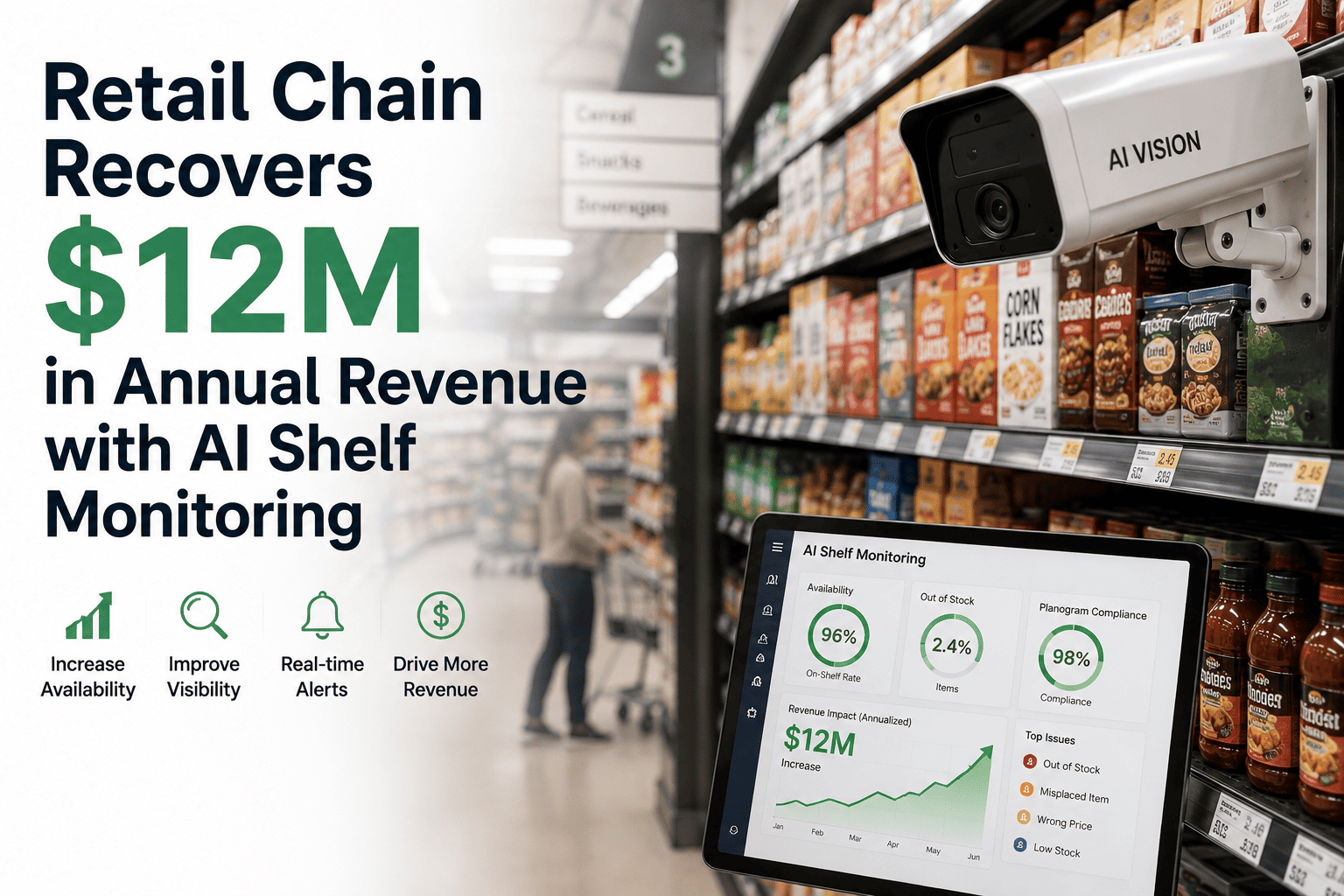
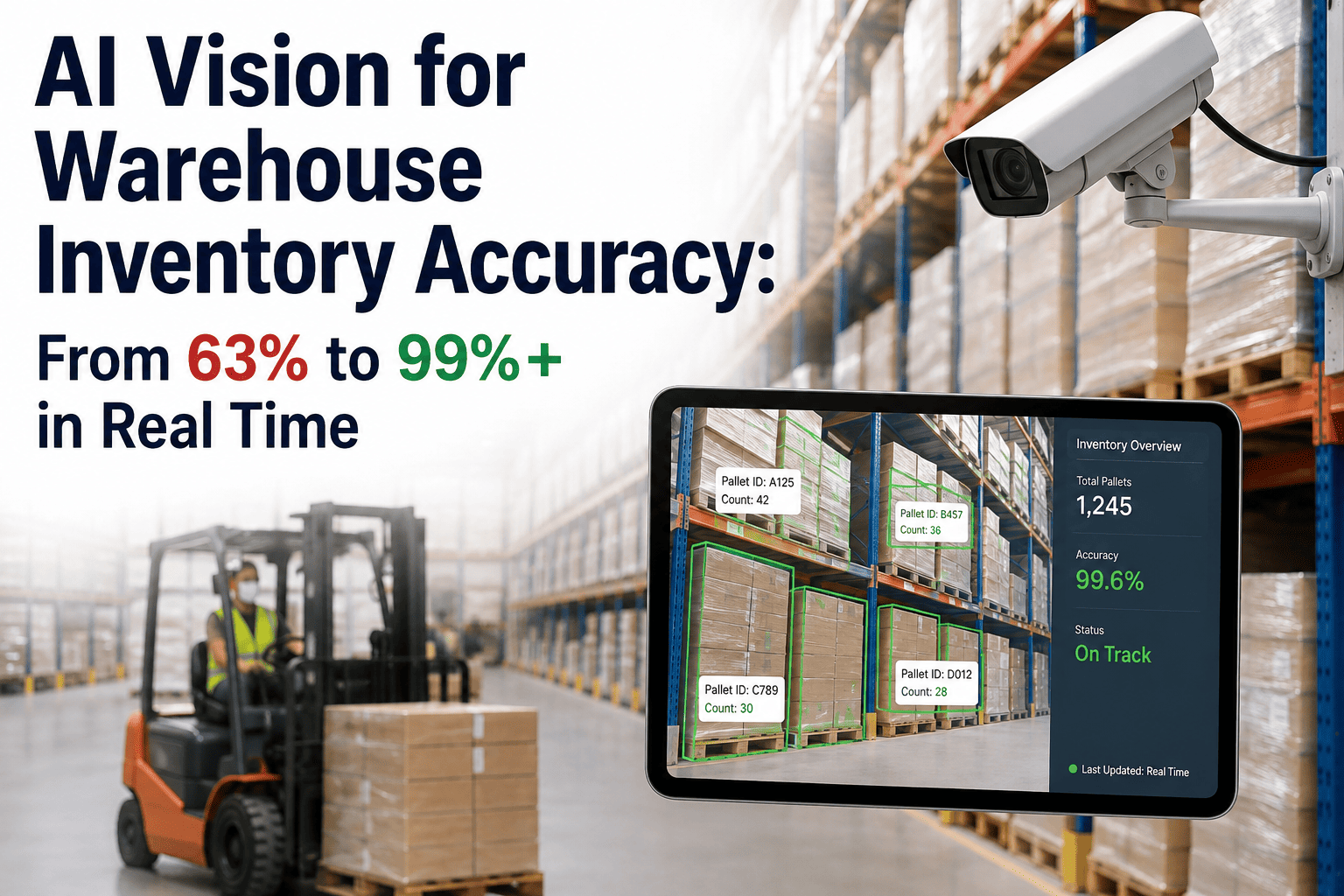
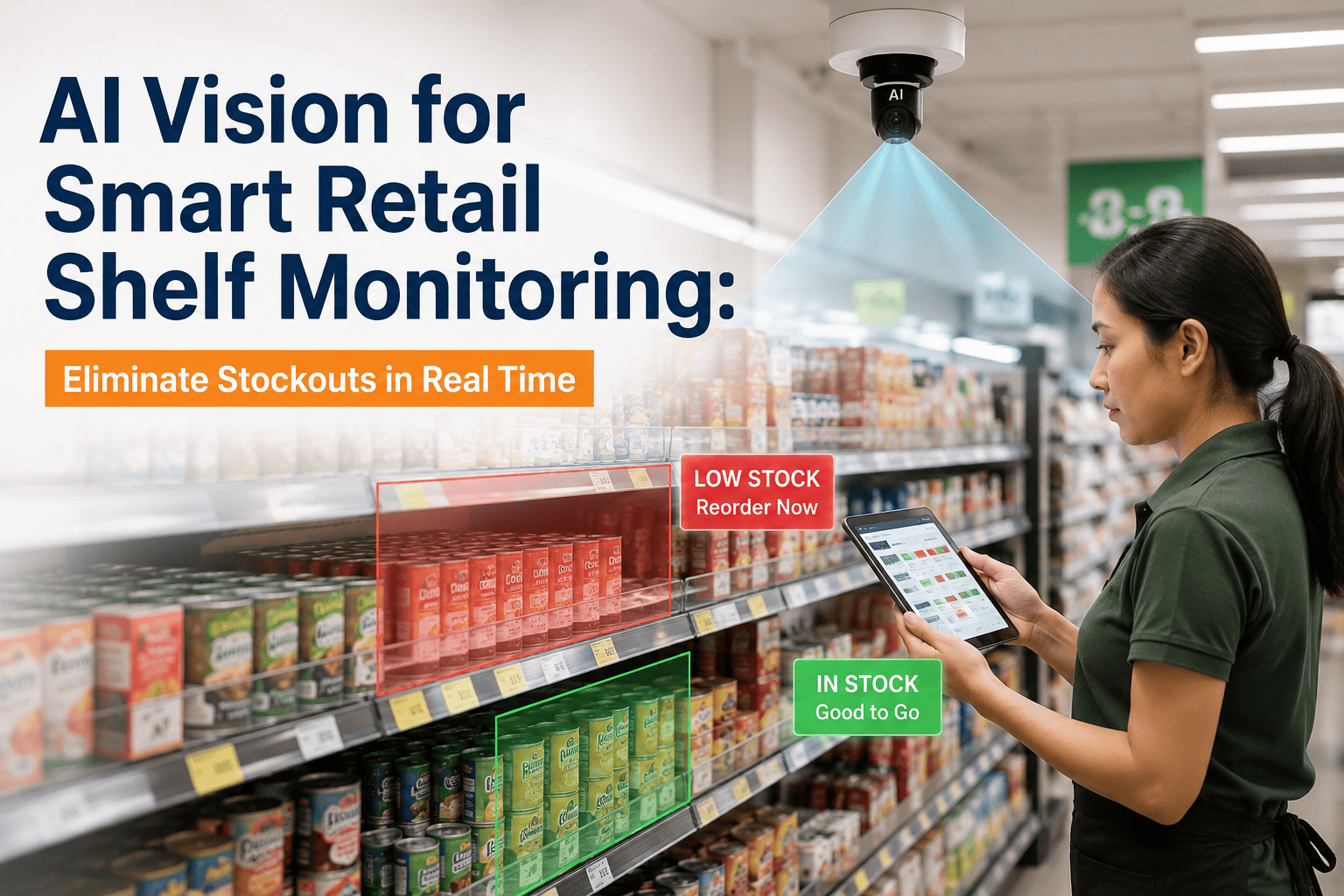
A shelf audit finished at 10:47 AM is a snapshot of what the shelf looked like at 10:47 AM. By the time the clipboard becomes a spreadsheet, the spreadsheet becomes a dashboard, and the dashboard reaches a category manager, six hours have passed, the endcap has been shopped through twice, and three of the flagged out-of-stocks have already been quietly refilled or forgotten. This is the invisible tax on manual shelf auditing — every finding arrives too late to act on, and the ones that matter most decay fastest. iFactory's AI Vision Cameras collapse that gap from hours to seconds, and it is worth walking through the head-to-head to see exactly how far apart the two approaches actually are, then booking a Book a Demo to test it against your own shelves.
Manual Audits Are Old By The Time They're Read. AI Vision Isn't.
iFactory's AI Vision Cameras watch every shelf continuously, flag stockouts and planogram drift in seconds, and eliminate the multi-hour delay between what a store actually looks like and what your team thinks it looks like.
Four Metrics That Actually Decide Shelf Performance
Debating "manual versus AI" as a general concept gets nowhere. The decision is made on four specific operational metrics — how fast a stockout is detected, how accurately position-level deviations are read, how much labor the audit consumes, and how much of the store is actually covered. Every other benefit follows from these four numbers, and every argument against automation eventually breaks against one of them. The scorecard below is the industry-average comparison drawn from field studies, retailer benchmarks, and enterprise deployments across grocery, drug, mass, and specialty formats.
A Stockout Happens at 9:00 AM — Here's Who Sees It When
The most expensive stockouts are the ones that persist through peak traffic before anyone realizes they're happening. A gap on the shelf during the 11 AM lunch rush or the 5 PM commute home does not wait patiently for tomorrow's field visit — it turns into lost transactions and shopper substitutions that quietly train customers to look elsewhere. Follow the same missing SKU through both systems and the response-time gap becomes obvious — one path measures in seconds, the other in hours, and every minute in between is a shopper walking past an empty facing with a competing brand right next to it.
What A Rep Can See In Fifteen Minutes vs What A Camera Sees Always
A field rep on a fifteen-minute store visit is scanning hundreds of SKU positions with a human eye that naturally focuses on obvious gaps and skims past subtle deviations. That is not a training problem — it is a bandwidth ceiling, and no amount of coaching or checklist discipline actually raises it. Position-level accuracy on manual audits reliably sits in the sixty to seventy percent range for the deviations that matter most commercially, while enterprise-grade computer vision routinely runs at ninety-five to ninety-eight percent. AI vision doesn't have that ceiling because it doesn't get tired, doesn't skip low-velocity SKUs, and doesn't unconsciously round off subtle changes, and the categories of miss it eliminates are exactly the ones that quietly cost the most revenue.
- Facing count reductions (2 facings dropped to 1)
- Position drift within a set
- Products trapped behind overstock
- Old promotional price tags still in place
- Competitor SKU encroachment on planogram slot
- Rear-facing SKUs and depleted secondary rows
- Deviations in low-traffic aisles between visits
- Every SKU by position, facing count, and orientation
- Planogram compliance drift within minutes of change
- Price tag mismatches read from the shelf edge
- Empty facings the instant the last unit is picked
- Encroachment and misplaced products across the set
- Share-of-shelf shifts and adjacency violations
- Every aisle equally, every hour, every store
Where The Money Actually Goes In A Manual Audit Program
Most brands underestimate the true cost of manual auditing because the largest line items don't sit inside the audit budget. They sit inside lost sales, missed promo execution, and rep hours spent auditing instead of selling. A manual audit program looks affordable when you count only the rep time explicitly tagged to shelf checks, and looks very different when you add the revenue leaking through undetected out-of-stocks and the promo execution issues that only surfaced after the campaign ended. When you tally the full picture across all four cost buckets below, the ROI math on continuous vision stops being close — and the payback window shrinks dramatically from anything a spreadsheet-only comparison suggests.
Rep Hours Spent Counting Instead Of Selling
Field reps spend a significant share of every store visit on shelf checks — hours that could be spent on relationship selling, distribution expansion, or promo negotiation. Automated Image Recognition has been shown to reduce audit costs by around sixty percent and speed audits by roughly thirty percent, freeing reps for revenue-driving activity.
Lost Sales From Undetected Out-Of-Stocks
Global on-shelf out-of-stock rates hover around 8.3 percent, and worldwide lost sales from poor shelf execution surpass one trillion dollars annually. Even a single point of on-shelf availability improvement — the kind continuous AI auditing routinely delivers — recovers material top-line revenue that would otherwise disappear without a trace.
Planogram Compliance Slippage
Planogram compliance monitoring alone saves retailers on the order of ten thousand dollars per store per year, money that typically leaks through misplaced displays, missing hero SKUs, and endcaps set up without the intended anchor products. Manual audits catch these too late — vision catches them the day they happen.
Decisions Made On Stale Data
A category manager reviewing week-old audit data is making replenishment, promotion, and space allocation decisions on a picture of the store that no longer exists. Continuous vision replaces the weekly rearview mirror with a real-time windshield — decisions catch up to reality instead of chasing it.
Sample vs Complete — And Why It Matters More Than It Sounds
A weekly rep visit auditing a portion of the assortment in a portion of the stores at a portion of the times of day produces a statistical sample. A camera looking at every shelf continuously produces the actual reality. The math is not close, and the operational consequences show up in exactly the places manual programs cannot see — the aisles nobody has time to walk, the evenings nobody is scheduled to visit, the low-velocity SKUs that don't make it onto the priority list. Coverage isn't a nice-to-have; it is the difference between finding out about a problem while it is still small and finding out about it when a category review surfaces a quarter of unexplained decline.
See Your Shelves Through The Camera's Eye
Bring a shelf photo or a store aisle plan to the walkthrough. We'll show you what AI vision reads that a fifteen-minute rep visit reliably misses.
Same Store, Same Day — Two Very Different Workflows
The best way to understand the difference is to trace what actually happens on the floor from the moment a shelf issue exists to the moment someone acts on it. Below is the same store, the same shift, and the same set of shelf issues — handled two ways, step by step. The gap between the two columns is not marginal at any single row; it compounds down the workflow until the response times are living in different orders of magnitude entirely.
| Step | Manual Shelf Audit | iFactory AI Vision |
|---|---|---|
| Detection | Human observation during scheduled walk | Continuous frame-by-frame detection |
| Data Capture | Clipboard, tablet, or manual note | Structured event log with image evidence |
| Data Transfer | End-of-shift upload to reporting tool | Real-time push to alerting and BI systems |
| Alert Routing | Next-day dashboard review | Immediate task to nearest associate |
| Response Window | Hours to a day | Under a minute for critical alerts |
| Historical Trend | Fragmented, dependent on rep | Continuous, timestamped, always on |
| Rework On Errors | Re-audit, sometimes next cycle | Instant re-read on the next frame |
Four Reasons Teams Delay The Switch — And Why Each One Doesn't Hold Up
Every operations leader evaluating AI vision hears the same four internal objections before the first camera goes on the wall. They are reasonable-sounding on the surface, and each of them has a specific counter that most brands only see clearly after deployment. Here are the four that come up almost every time, and what the honest response to each actually is.
"Our reps already do this — we don't need cameras."
Reps do this the way reps can — sampled, hurried, and interrupted by everything else on their route. The question is not whether they audit; it is whether their audit is happening at the frequency and precision the modern shelf actually requires. Continuous vision doesn't compete with reps; it frees them from the parts of the job that don't need a human and points them at the parts that absolutely do.
"The technology isn't accurate enough for real store conditions."
That was true five years ago. Modern retail computer vision reads shelves through glare, packaging refreshes, overlapping facings, and cluttered adjacencies at ninety-five to ninety-eight percent accuracy in production environments, not lab conditions. The systems are trained on real store data with all its noise, and low-confidence reads are surfaced for human validation rather than silently passed through as certainty.
"Deploying this will take a year and a full IT project."
Enterprise vision deployments now measure in weeks per store, not months per program. The vision layer sits alongside existing systems rather than replacing them, integration happens through standard interfaces, and phased rollouts let value start compounding from the first live store. There is no equivalent to a full ERP or WMS implementation project embedded in the timeline.
"The ROI won't justify the investment."
Most ROI models look only at audit labor savings and miss the larger returns from recovered on-shelf availability, planogram compliance capture, and rep hours redirected to selling. Even a one-point improvement in on-shelf availability moves meaningful top-line revenue in most categories, and continuous auditing routinely delivers several points of improvement in the first year alone.
We used to argue with our retail partners about whether a promo was set correctly, and we lost most of those arguments because our evidence was a photo taken three days later. Continuous vision changed the conversation entirely. Now the compliance data is timestamped, per-store, and impossible to dispute — and the reps stopped spending half their route on shelf checks and started spending it on real selling conversations. That shift alone paid for the deployment inside the first year.
Frequently Asked Questions
Q: Does AI vision auditing completely replace field reps, or do they still play a role?
Q: How accurate is AI shelf recognition on packaging that changes seasonally or across variants?
Q: What happens on shelves with poor lighting, reflective packaging, or crowded product arrangements?
Q: How quickly can a store or a chain get to fully deployed continuous shelf monitoring?
Q: How does the data from AI vision get into the systems our merchandising and category teams already use?
Stop Auditing Yesterday's Shelf
Book thirty minutes with our team, share a sample store layout, and see how iFactory AI Vision reads your shelves in real time — and what your team could stop doing tomorrow morning.