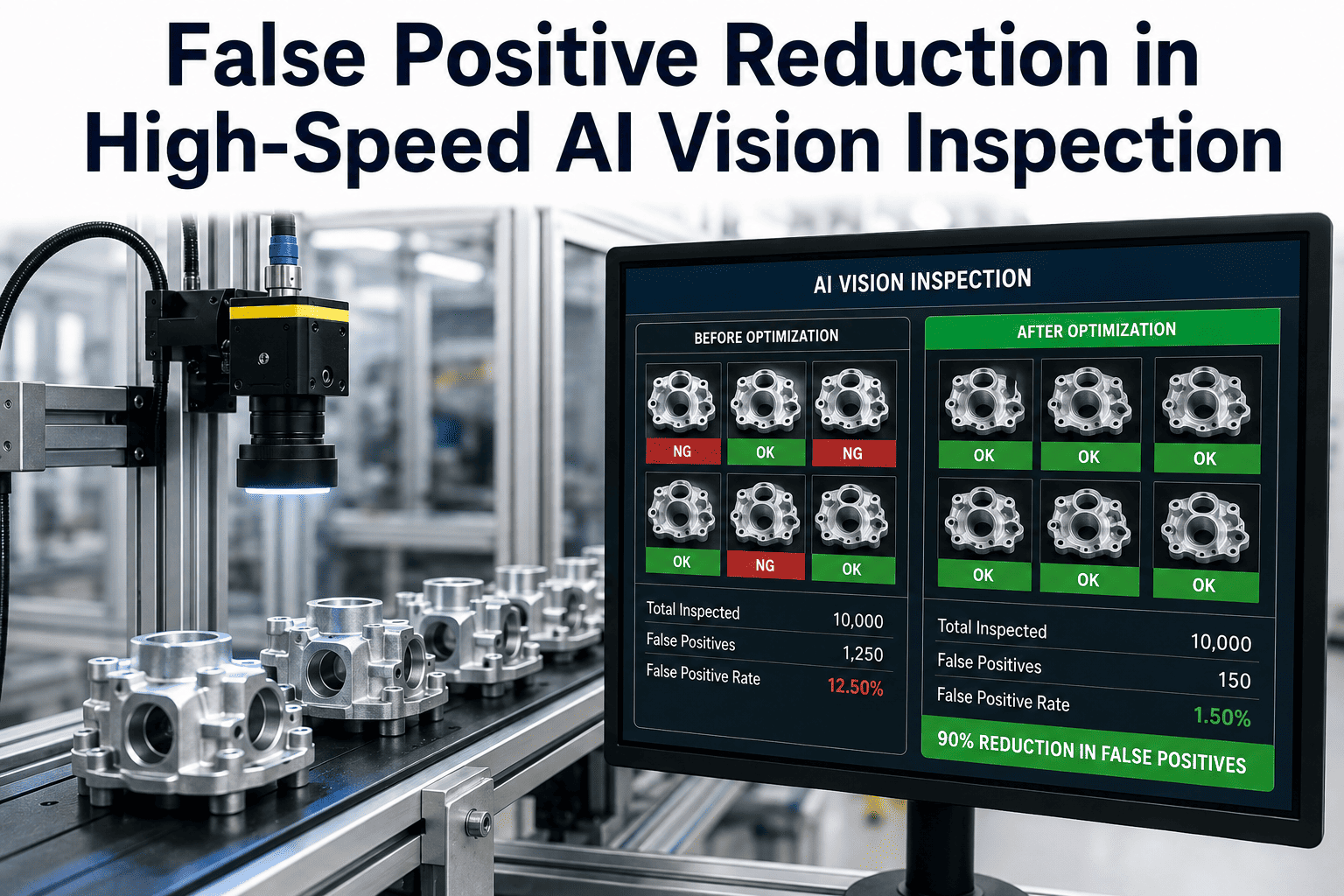
Your rule-based AOI machine flags 30 out of every 100 boards as defective. Your rework operators review them and pass 27 through. That is 27 false calls per hundred — a hidden second inspection station eating shift hours, chewing throughput, and training your operators to distrust the alerts that actually matter. AI deep-learning vision cuts that number below three. This guide is for the process engineer, quality lead, or plant manager staring at a legacy AOI line and asking whether it is time to augment, upgrade, or replace. Every question you should ask before signing the PO is answered below. When you are ready to run the numbers against your line, book a 30-minute upgrade assessment.
AI Vision vs Traditional AOI: When to Upgrade Legacy Inspection Systems
A decision framework for manufacturers running rule-based automated optical inspection who need to know whether they should tune, augment, or replace — with the false-call math, the accuracy comparison, and the upgrade pathway that actually pays back. Written for the process engineer building the internal business case, and the plant leadership signing the PO.
Five Signals You've Outgrown Your Rule-Based AOI
If more than two of these are true on your line, you are past the "tune the thresholds" stage and into the "evaluate deep learning augmentation" stage. Each of these signals is a specific pain point that rule-based AOI is architecturally unable to solve — no amount of parameter tweaking closes the gap, because the underlying model is rigid pixel comparison against a golden reference, not learned feature recognition. The tell is not usually a dramatic failure. It is a slow accumulation of workarounds — a rework operator who now knows to ignore certain flag types, a process engineer who reprograms every Monday, a quality lead who quietly widened the acceptable-defect threshold last quarter to keep throughput. Those are the signals worth acting on.
Your Operators Spend More Time Clearing False Calls Than Inspecting
If the rework station has become a de-facto second inspection line where operators review, dismiss, and reset AOI flags all shift, false calls are already the bottleneck. On many SMT lines, 70% of boards flagged NG by AOI are ultimately deemed acceptable at manual review — meaning the AOI is telling operators the wrong answer more often than the right one. The economic cost is not just labor; it is desensitization, and desensitization is how real defects escape to the customer.
Every New Product Introduction Takes Days of Programming Time
Rule-based AOI needs a geometric inspection program written for every new board — copper trace tolerance, pad geometry, component placement window, silkscreen area. A new PDN with a hundred component types takes a senior process engineer three to five days to program, tune, and validate. If your product mix is accelerating or your NPI cadence is increasing, that programming labor becomes a hard constraint on how fast you can ship new designs.
Your Defect Escape Rate Is Non-Zero on Solder Joints Post-Reflow
Solder joint quality is the central inspection challenge in SMT — sufficient solder, complete fillet, proper wetting, no cold joint. The visual difference between an acceptable joint and a marginal one is subtle, varies with paste batch and reflow profile, and depends on component and pad geometry. Rule-based AOI catches the obvious failures but escapes the subtle ones. If field returns include intermittent solder-related failures, that is the defect class deep learning was invented to catch.
HDI, Fine-Pitch, and BGA Boards Trigger Constant Overkill
On High-Density Interconnect boards, traditional AOI false-positive rates run as high as 60% — the pixel-comparison logic cannot distinguish between a laser-marking reflection and an actual scratch. Fine-pitch components, BGAs, and mixed-technology assemblies compound the issue. If your product roadmap includes denser boards, smaller pitches, or newer package types, the false-call rate on the legacy AOI will get worse, not better, as the geometry tightens. Deep learning models handle new geometry by adding labeled examples to the training set — the model expands its recognized feature space rather than needing a new rule per package type.
Lot-to-Lot Process Variation Retriggers Threshold Retuning Every Week
Paste batch shifts, reflow profile drift, board warp, ambient temperature — rule-based AOI treats every source of natural process variation as a defect and requires manual threshold re-tuning to compensate. If your process engineers spend a chunk of every week adjusting AOI parameters instead of improving the process, the inspection system has become the constraint. Deep learning models learn the natural variation envelope from data — they do not need to be retuned every time the paste vendor changes lot. The model expects variation and treats process drift within the learned envelope as normal, only flagging patterns that fall outside the learned distribution.
Head-to-Head Technical Comparison
The comparison below is the honest engineering delta between the two approaches — not marketing claims, but the specific capability differences that determine which technology fits which inspection problem. Where AOI is still the better answer, this table says so. Where AI vision is clearly superior, it says that too. The purpose of the table is to give the buyer a defensible framework for the internal conversation with operations, quality, and finance — not to argue that one technology beats the other on every dimension, because it does not.
| Capability | Traditional AOI | AI Deep-Learning Vision |
|---|---|---|
| Detection method | Pixel comparison to golden reference | Learned feature recognition |
| False-call rate — solder joints | 8-30% | Under 3% |
| False-call rate — HDI boards | Up to 60% | Under 5% |
| Escape rate on cold joints | 2-5% typical | Under 0.5% |
| New product setup time | Days per new board | Hours with sample images |
| Lot variation tolerance | Requires manual retuning | Learns variation envelope |
| Board warp handling | Frequent false calls | Robust to real-world variation |
| Handles mixed-tech assemblies | Multiple rule sets required | Single unified model |
| Improves with production data | No — static rules | Yes — retrains on operator feedback |
| Gross defect detection | Fast & reliable | Also strong |
| Component presence check | Well established | Also strong |
| Barcode & text read | Native | Also native |
| Programming skill required | Vision engineer / rule-based | Quality engineer labels examples |
| Explainability of verdicts | Deterministic rules | Confidence + region attribution |
The Hidden Cost of False Calls — Math You Can Run in Ten Minutes
Most manufacturers underestimate what false calls actually cost — because the DPMO number does not appear on the escapes report. It shows up as operator overtime, throughput bottleneck, and gradual desensitization to real defects. The worked example below shows the annualized burden of running an AOI line at a 20% false-call rate against a mainline SMT throughput. Plug in your own numbers to see whether the AI upgrade pays for itself before the end of the first year — most lines above 100,000 boards a year comfortably do. The three cost lines below are the ones most CFOs immediately recognize as real: labor is auditable payroll, throughput opportunity is measurable against unshipped orders, and escape cost shows up in warranty and return-materials-authorization reports. None of them are speculative — they are all sitting in your existing operations data waiting to be totaled.
Every False Call Is a Vote of No-Confidence in Your Inspection
iFactory's AI vision augments existing AOI without ripping out your line — deep learning models trained on your defects, deployed at the review station, cutting false calls to under 3% while catching what your rules miss. Prove the delta on one line, then scale to the plant. Existing camera infrastructure is reused wherever the image quality supports it, so the CAPEX profile stays proportional to the value the pilot proves out.
Defect Classes Where the AI Delta Is Largest
Not every inspection task benefits equally from deep learning. Rule-based AOI is genuinely excellent at gross defect detection, component presence, and barcode reading — where the answer is deterministic and the signal is unambiguous. Deep learning pulls ahead exactly where AOI has always struggled: subtle, variable, context-dependent visual judgments. The six defect classes below are the ones where iFactory customers see the biggest false-call reduction and escape improvement when the AI vision layer takes over the inspection call. If your line's dominant pain point maps to any of these, the AI upgrade math is usually easy — the false-call reduction alone pays for the deployment inside a year, and the escape improvement is upside on top.
Sufficient solder, complete fillet, no cold joint, no insufficient wetting. The visual distinction between acceptable and marginal is subtle and depends on paste batch, reflow profile, and pad geometry. AI catches subtle differences AOI thresholds cannot express.
Ball grid arrays, 0.4mm pitch, QFN and CSP packages. Rule-based systems generate overkill on any deviation from ideal geometry; AI vision learns the natural range of acceptable ball formation and package placement.
Laser marking reflections, micro-vias, and dense copper traces produce optical patterns that rule-based systems misread as defects. AI vision distinguishes true defects from reflection artifacts on complex board surfaces.
Uniform coverage verification, keep-out zone respect, thickness consistency. Rule-based approaches struggle with the natural variation of coat thickness and edge geometry; AI models handle the variability robustly.
Scratches, dents, paint runs, and finish inconsistencies on machined or molded parts. Highly variable acceptable-appearance standards make rule-based grading nearly impossible; deep learning grades from example imagery.
Boards combining SMT, through-hole, press-fit, and connector types demand multiple rule sets in traditional AOI. A single deep learning model handles the entire assembly with unified accuracy — no per-technology programming.
Three Upgrade Paths — Which One Fits Your Line
The best-fit deployment pattern depends on how mature your existing AOI investment is, how much of the line you need to keep intact, and how fast you need to see the ROI. The three paths below cover the vast majority of manufacturers upgrading from legacy AOI — augmentation is the fastest and lowest-risk, replacement is the highest-ceiling long-term play, and hybrid sits in between. Most iFactory deployments start on Path A and evolve toward Path C over eighteen months — augmentation delivers the immediate false-call relief and generates the production data that makes a broader rollout much less risky. The initial pilot at one review station provides the reference imagery, the confidence calibration, and the operator-workflow validation that de-risks every subsequent expansion step, whether that means adding more inspection points or replacing the legacy machine outright.
Augment — AI at the Rework Station
Keep the existing AOI machine in place, add AI vision downstream at the manual review point. The AI reviews everything AOI flagged NG and lets the operator focus only on the genuinely defective boards.
Hybrid — AOI Plus AI in Parallel
Add AI vision at strategic inspection points where AOI is weakest — post-reflow joint inspection, conformal coat verification, final visual. Both systems run and their verdicts are reconciled in a shared quality dashboard.
Replace — Full AI-Native Line
Rip and replace when the legacy AOI has reached end of life, when the product portfolio has fundamentally outgrown it, or when a new line is being commissioned. Deep learning models handle inspection end to end.
The Upgrade Decision Matrix — Where Does Your Line Land?
If you are between paths, this matrix maps common line profiles to the recommended upgrade approach. It is the same framework iFactory engineers use during the initial assessment call — with the answers grounded in your specific line, false-call baseline, product mix, and NPI cadence. The false-call percentage is the single strongest signal, but it is not the only one — a line running at 12% false calls on a stable, low-mix product looks very different from a line running at 12% on a growing HDI portfolio, and the recommended path reflects both the current pain and the direction the product roadmap is pushing.
Frequently Asked Questions
Does AI vision completely replace rule-based AOI, or work alongside it?
Both patterns are valid, and the right answer depends on the maturity of your existing AOI investment. Rule-based AOI is excellent at gross defect detection, component presence checks, and barcode reading — where deterministic rules are actually the right tool. AI deep learning is dramatically better at solder joint quality, subtle process defects, HDI inspection, and any scenario where the natural process variation envelope is too wide for rigid thresholds. The most common iFactory deployment pattern is augmentation: keep the AOI, add AI vision at the review station or at the specific inspection points where AOI struggles. To scope the right pattern for your line, book an assessment call.
How much training data does the AI model need before it works?
Less than most manufacturers expect. Modern deep learning models for PCB inspection start from pretrained foundations that already recognize the core defect classes — solder joints, component placement, surface defects, text and barcode content — and are fine-tuned on your specific product with a few hundred labeled examples per defect class. For a typical new board introduction, useful accuracy is achieved within one to two shifts of labeling by a quality engineer, and full-production accuracy is reached inside two to three weeks of production feedback. The model then continues to improve as operators confirm or correct verdicts on borderline cases in normal production flow.
How does deep learning handle a verdict that turns out to be wrong?
The model exposes a confidence score with every verdict, and every borderline verdict is queued for operator confirmation with the source image and the annotated region. When an operator flips a verdict — the AI said reject and the operator confirms pass, or vice versa — the correction feeds back into the retraining loop. The model version is updated on a controlled cadence, typically weekly, with the changed behavior reviewed by the quality engineer before promotion to production. This continuous-learning loop is why deep learning inspection accuracy improves over time in production, while rule-based AOI accuracy is fixed on the day it was programmed.
Do we need new cameras and hardware, or can existing AOI images be reused?
Both approaches work, and iFactory supports both. Existing AOI images can be fed into the AI vision layer as a data source — the vision model reviews the same images the AOI captured, applies the deep learning classification, and returns a cleaner verdict without any new hardware. For inspection points where the existing AOI does not have coverage, iFactory installs smart cameras with calibrated lighting at the specific inspection position, running the model on-device or on an edge inference cabinet. The scoping call determines which mix is right for your line based on the specific inspection points and image quality of your current capture.
What does a realistic ROI window look like for a mid-volume SMT line?
The payback drivers are false-call reduction at the review station, escape reduction on the classes AOI was missing, and setup-time savings on new product introductions. A mid-volume SMT line inspecting 500,000 boards a year at a 20% false-call baseline typically saves $400,000 or more per year on operator review labor and throughput alone — before counting escape reduction and NPI acceleration. Payback on the augmentation deployment pattern lands inside nine months for most manufacturers. For a facility-specific projection built against your board volume and false-call baseline, book a 30-minute ROI walkthrough.
The Right Question Is Not AOI or AI — It Is How Fast You Cut False Calls
Whether you augment, hybrid, or replace, iFactory scopes the deployment against your line, your product mix, and your false-call baseline. Fixed-price pilot. Existing hardware where possible. Operator-friendly review workflow. Start with the highest-pain inspection point, prove the delta, then scale to the line. The pilot report lands in your inbox with the specific accuracy numbers, false-call reduction figures, and payback timeline mapped to your production data.