Corrosion is called the silent destroyer for a reason. On manufacturing equipment — motors, gearboxes, storage tanks, structural steel, conveyor frames, and process piping — it advances quietly through five distinct stages, and by the time a human inspector notices it on a routine walk-down, the asset is usually already in the third or fourth stage of that progression. AI vision changes when the plant sees corrosion, not just how it sees it. A camera-based inspection can classify the surface, detect where the corrosion is, and segment exactly how much area is affected — feeding measurements into the maintenance schedule before the asset reaches a stage where paint alone will not save it. Plant maintenance and reliability leaders evaluating vision-based corrosion monitoring for their equipment can start by talking with the iFactory support team.
Corrosion Costs Are Baked In Before the Inspector Sees the First Blister
iFactory's AI vision watches equipment for the earliest surface changes — discolouration, staining, pitting — and turns them into a measured, tracked, and prioritised maintenance signal months before manual inspection would flag them.
The Gap Between Inspection Cycles Is Where Corrosion Wins
Every plant already has a corrosion inspection program. The problem is not the program — it is what happens in the months between the scheduled walk-downs, when the corrosion is doing its actual work and no one is watching.
The Three Computer Vision Techniques That Do the Work
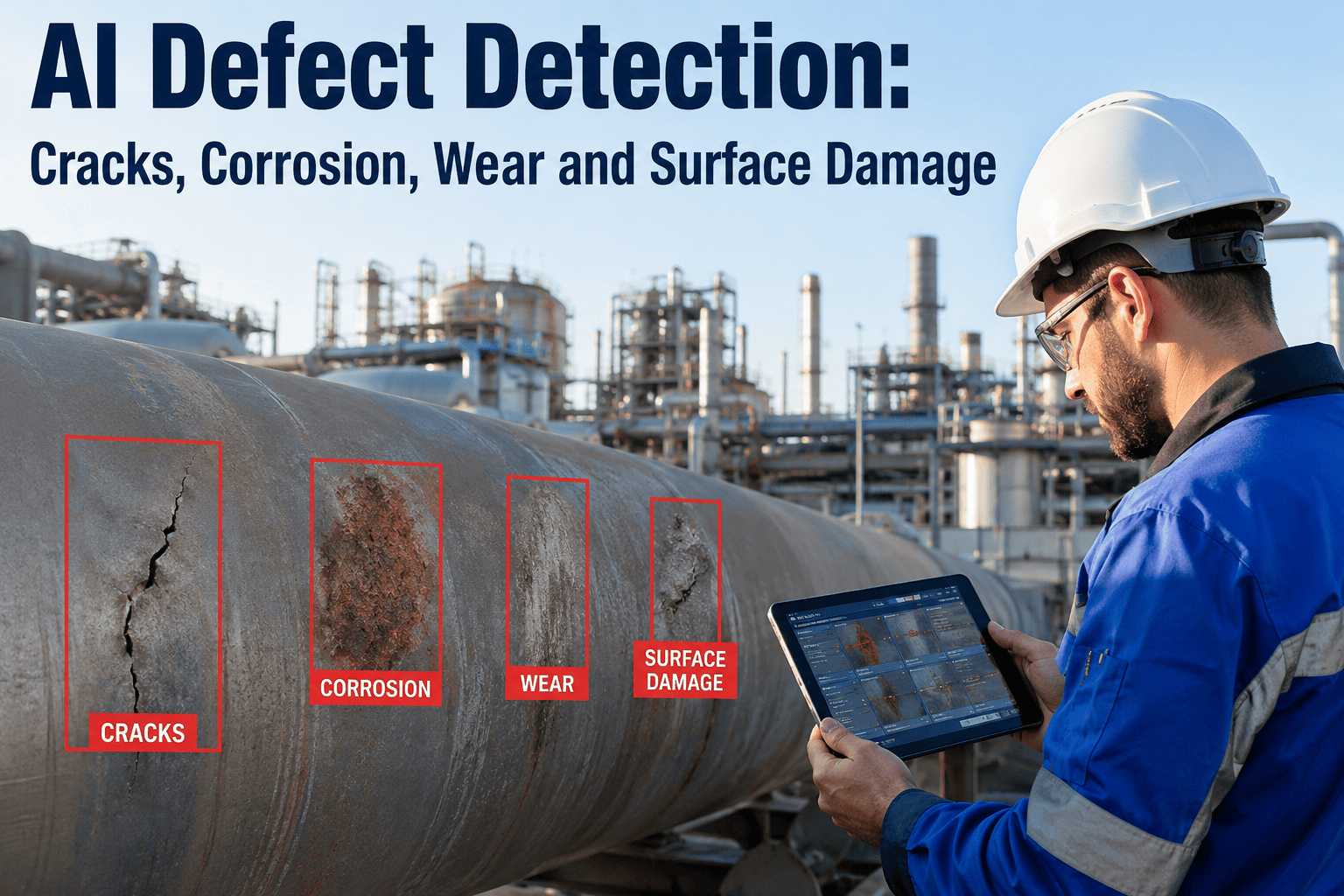
Corrosion detection uses three different vision techniques, each answering a different question about the asset. A mature program uses all three together — one to screen, one to locate, one to quantify.
Classification
The fastest and most computationally light of the three. A classification model looks at an image of a motor, tank, or steel column and returns a binary or graded answer — clean, early-stage, or advanced. Ideal for high-volume screening across a large asset base.
Object Detection
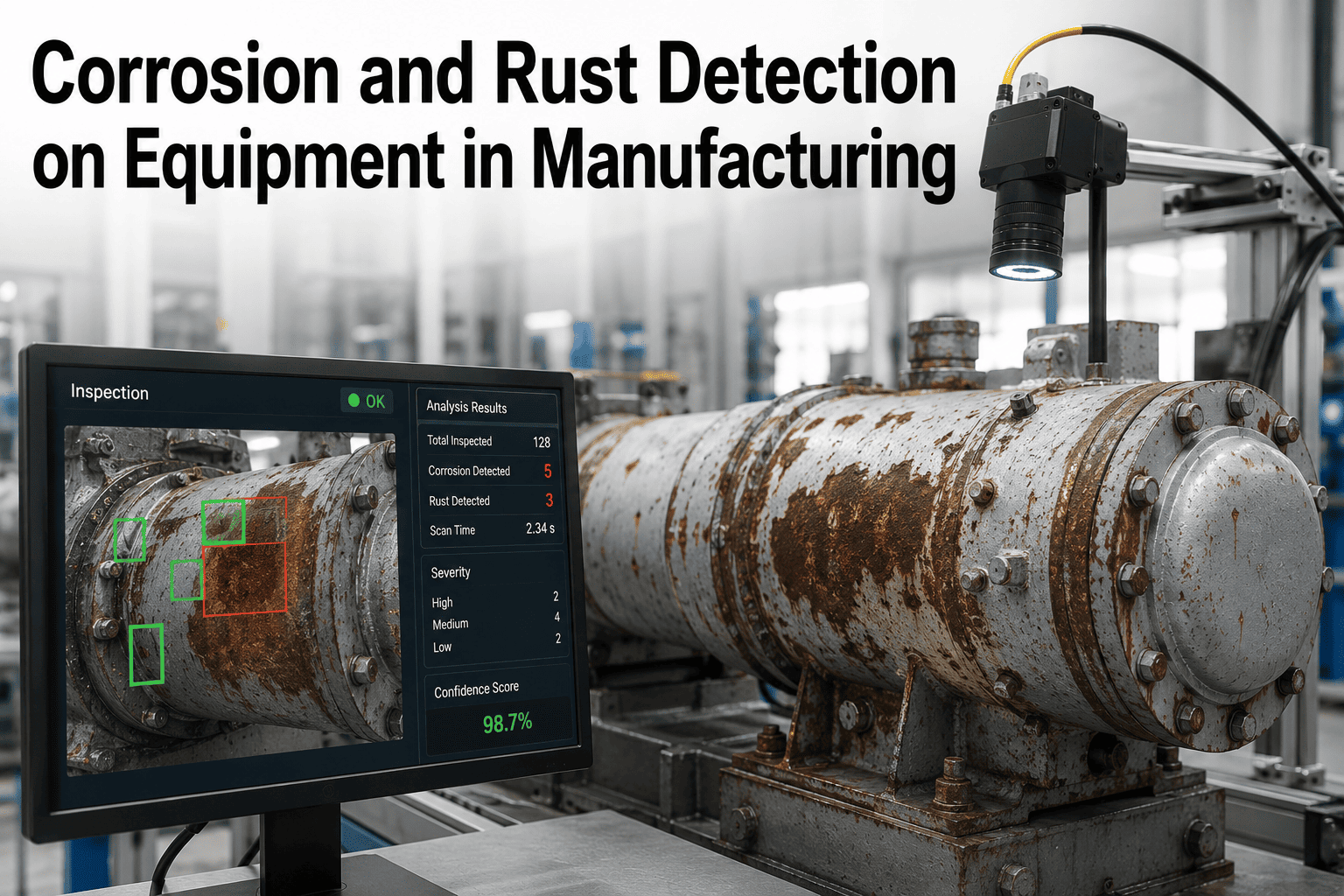
A detection model draws bounding boxes around each corroded region, so the maintenance planner can see which flange, which support saddle, which weld seam — and can dispatch the right repair team with the right materials to the exact location.
Semantic Segmentation
A segmentation model labels every pixel as clean or corroded, producing a precise measurement of affected surface area. That measurement is what turns "the tank looks bad" into "12.4% of the tank shell is corroded, up from 8.1% ninety days ago" — trendable, actionable data.
Where Corrosion Actually Attacks a Manufacturing Plant
Not every square metre of a plant corrodes at the same rate. A vision program that inspects everything equally wastes camera budget; a program that focuses on the ten or twelve highest-risk asset types buys the most reliability for the least cost.
Corrosion under insulation (CUI) is one of the most expensive failure modes in process manufacturing. Rust staining at the termination point is often the only external signal that CUI has started underneath.
Where a pipe rests on a saddle, moisture is trapped and airflow is limited. Crevice corrosion at these points typically appears years before it shows on the pipe's open surface.
Rotating equipment in humid or wash-down environments corrodes at the mounting feet, the terminal box, and any painted surface where the coating has been chipped by tools during previous maintenance.
Storage tanks corrode most aggressively at the shell-to-roof interface and around nozzle penetrations, where coatings fail first and rain water tends to pool.
Column base plates in wash-down zones or near loading docks corrode from the ground up, hidden by grout, plinths, or accumulated debris until section loss is already advanced.
Painted structural members exposed to condensation, dust, and cleaning chemistry lose their coating unevenly, and the resulting patchwork of surface rust is exactly what a segmentation model handles well.
Map the Highest-Risk Corrosion Zones in Your Plant
Book a 30-minute walkthrough and we will show how iFactory's vision platform pinpoints the asset classes most likely to reward continuous corrosion monitoring in your plant.
Manual vs Vision-Based Corrosion Programs
Vision-based monitoring does not replace the qualified corrosion inspector — it changes what the inspector spends their time on. The routine visual sweep becomes automated, and the human expertise concentrates on decisions and mechanisms rather than on walking the plant looking for the obvious.
| Dimension | Manual Walk-Down Program | AI Vision Continuous Program |
|---|---|---|
| Coverage Cadence | Point-in-time, every 1–10 years per API rules | Every day the equipment is imaged |
| Coverage Scope | Whatever the inspector can safely reach | Everything in the camera's field of view, including height and hazardous zones |
| Consistency | Subject to inspector judgment and fatigue | Same model, same criteria, every image |
| Measurement Output | Qualitative — "light rust noted" | Quantitative — percentage of surface area affected, trended over time |
| Safety Exposure | Rope access, scaffolding, confined-space entries | Ground-level or drone-based image capture, no direct exposure |
| Audit Evidence | Inspector's report and paper checklist | Time-stamped image record with segmentation mask retained |
From Image to Maintenance Action — The Full Loop
A camera producing beautiful segmentation masks changes nothing on its own. The value is in what happens after — how the measurement flows into the maintenance planning system and drives a decision that costs less than the failure it prevents.
A Composite Scenario: The Storage Tank Farm That Got Ahead of Its Backlog
A mid-sized chemical intermediates plant operated a tank farm of 42 vertical storage tanks with an average external inspection cycle of every four years per its API 653 program. Between cycles, corrosion was reported only when an operator happened to notice a visible problem during a routine walk. Two tanks had reached advanced pitting during the previous cycle and required emergency blast-and-recoat work that carried a combined direct cost of $340,000 and roughly six weeks of throughput impact on the associated production lines.
A fixed-camera vision program was installed to image each tank shell weekly, running a classification pass and — for tanks flagged as showing early rust — a segmentation pass to measure affected area. Within the first quarter, the system flagged three tanks that had not been due for manual inspection for another eighteen months but were already at 4–6% affected area with a rising trend. All three were spot-repaired at a combined cost of under $60,000, well before they would have required a full blast-and-recoat cycle.
The trend record from the first year has since been used to shift two other tanks to a longer inspection interval — the vision data proved they were degrading more slowly than the fleet average, so scarce inspector time can be reallocated to the assets that need it most. The reliability manager reports that the shift from surprise emergency work to planned early repairs has quieted the maintenance backlog in a way no additional headcount would have — the value showed up in fewer weekend calls, not in a headline capex avoidance.
Common Mistakes in Vision-Based Corrosion Programs
Treating Every Rust Flag as a Work Order
Not every discoloured pixel is a maintenance action. Programs that dispatch a crew on every classification hit quickly overwhelm the planner and lose credibility. The right output is a prioritised list driven by area trend, not raw event count.
Skipping the Trend and Reporting Snapshots
A single "12% corroded" number does not drive action. What drives action is the same asset at 8% ninety days ago and 12% today. Trend is the metric; snapshot alone is just a photograph.
Using Only Classification and Calling It Done
A classification-only program tells you an asset has corrosion but cannot tell you where or how much. Without detection and segmentation, the maintenance team still has to visit the asset to figure out what to actually do.
Not Retraining for Site-Specific Coating Colours
A model trained on generic imagery will over-flag on beige paint that resembles rust and under-flag on dark coatings where early staining is subtle. Site-specific retraining on the plant's own coating palette is what makes the numbers reliable.
Ignoring Lighting and Wet-Surface Effects
Wet steel and low-angle sunlight can both fool a model into seeing corrosion where there is none. Programs that image outdoors need lighting normalisation and rules that either wait for stable conditions or discount images taken in adverse ones.
Buying Cameras Without Owning the Trend Loop
Hardware alone does not change reliability outcomes. Someone in the reliability organisation has to own the trend dashboard and the retraining cadence, or the program silently degrades within a year of go-live.
Is Your Plant Ready for Vision-Based Corrosion Monitoring
You know your ten highest-consequence corrosion assets
The pilot deployment starts on the assets where a failure would carry the highest downtime or safety cost, so the payback is fastest. Where that list has not been written down, a two-week ranking exercise using existing inspection records is usually enough to produce it.
Your current inspection intervals leave months of unmonitored time
If your API or NACE-driven intervals are one year or longer, there is real time for corrosion to progress unnoticed. That gap is exactly the space vision-based continuous monitoring is designed to close.
Your CMMS or EAM can accept a triggered work order from an external system
The value of the vision loop is realised when a rising trend automatically raises a prioritised work order in the maintenance system the planners already use. A CMMS or EAM that can accept an inbound API call is the right integration surface for that.
A named owner in reliability will hold the trend and retraining cadence
The program's long-term accuracy depends on someone owning the review queue, the retraining schedule, and the tuning of thresholds as the plant learns which trends actually matter. Buying the cameras without naming that owner is the surest way to lose the value inside a year.
Frequently Asked Questions
Does AI vision replace our qualified corrosion inspectors?
No — it changes what they spend their time on. Routine visual walk-downs and screening imagery become automated, which frees the qualified inspector to focus on mechanism analysis, coating specification, ultrasonic thickness follow-up, and the decisions the vision system cannot make. Programs typically report that the qualified inspector's time-on-tool goes up, not down, because the vision layer feeds them a shorter, better-prioritised list of assets to actually assess in detail. Plants can walk through this operating model on their own program by contacting iFactory support.
How accurate is a vision-based corrosion program compared to manual inspection?
Modern segmentation models running on well-captured imagery routinely reach detection performance that matches or exceeds a trained inspector on external surface corrosion, and they do so at a fraction of the labour cost and with far higher consistency across time. Where vision cannot yet substitute is in mechanism attribution — deciding whether observed damage is atmospheric, galvanic, or stress-corrosion-related — which is why the qualified inspector remains in the loop. The right way to read the accuracy comparison is that vision is superior on coverage and consistency, and humans remain essential for interpretation.
Do we need drones, fixed cameras, or handheld devices?
All three have their place, and most mature programs use a mix. Fixed cameras suit critical assets that justify continuous monitoring — high-consequence tanks, key motors, structural columns near wash-down zones. Drones cover elevated or hard-to-access equipment on a regular cycle without scaffolding. Handhelds suit spot inspections and repair verification. The right blend depends on asset criticality, plant geometry, and the safety exposure of the current manual program.
How does this fit alongside our API 510, API 570, or NACE inspection program?
Vision-based monitoring is complementary to compliance-driven inspection programs, not a substitute. The API and NACE frameworks define minimum inspection intervals and evidence requirements the plant must meet; the vision system provides the continuous coverage between those scheduled events, so the plant catches deterioration in the blind windows and arrives at each formal inspection with a much better picture of asset condition. In many cases the trend data from the vision program also supports risk-based inspection decisions to lengthen intervals on assets that are demonstrably stable.
Can it monitor corrosion under insulation, or only external surfaces?
Vision monitors external surfaces directly, and it monitors corrosion under insulation (CUI) indirectly through the tell-tale external symptoms — staining at termination points, moisture-driven discolouration around cladding edges, and rust bleeding at support saddles. Those external signals are often the earliest visible evidence that CUI has started underneath, and catching them early is what lets the plant schedule an insulation removal on its own timeline rather than in response to a leak. For direct sub-insulation measurement, vision is paired with ultrasonic testing on a targeted list. Book a demo to see how the two layers work together.
Turn Corrosion From a Surprise Into a Trend You Can Plan Around
iFactory's AI vision platform sees corrosion earlier, measures it more precisely, and feeds every change straight into your maintenance planning system — so the blind windows between inspections stop deciding your reliability outcomes. Book a walkthrough to see the platform on plants running today.