A vision inspection station rarely fails the way people expect. The camera sensor itself can run for decades without a hardware fault, yet the station still goes down — because the part that actually quit was a lighting unit, a connector, or a lens that nobody thought to stock. Plants that treat every vision component as equally durable end up scrambling for an overnight part while a line sits idle and rejects pile up unseen. The fix is not buying more spares, it is knowing which specific parts fail first and stocking exactly those. iFactory's support team helps reliability teams build that exact list from their own station history.
Your Camera Will Probably Outlive the Plant — But Six Other Vision Parts Won't Make It a Year
Industrial camera sensors are built for decades of continuous duty, but the lighting, lenses, cables, and connectors around them wear out fast and rarely get stocked. iFactory tracks the real degradation signals on every vision station so your team stocks the parts that actually fail — before a missing spare turns a five-minute swap into a five-hour line stoppage.
The Part Everyone Worries About Is the Part That Almost Never Fails
Camera manufacturers publish MTBF numbers in the hundreds of thousands to millions of hours because the sensor and processing board are solid-state electronics with no moving parts. That number is real, but it describes the imager alone, not the station around it. The components doing the physical work — bending light through a lens, flooding a part with high-intensity illumination thousands of times a shift, carrying signal through a cable that flexes on every part change — degrade on a completely different, much shorter timeline that a single MTBF figure never captures.
This mismatch is exactly why so many procurement teams get their vision spares budget backwards. They buy a second full camera because it feels like the most expensive, most critical part on the station, then treat lighting, lenses, and cabling as consumables to order after they already fail. In practice it should be the other way around: the camera is the part you can safely under-stock, and the wear items around it are the ones that deserve a shelf slot before the first shift ever runs.
What Actually Breaks First on a Vision Station, Ranked
Reliability teams that build their spares list from a single generic MTBF number almost always overstock the part that never fails and understock the parts that do. The table below reflects how these components behave in a real production environment, not a lab datasheet.
| Component | Typical Failure Driver | Recommended Spare Stock |
|---|---|---|
| Camera sensor / body | Electrical surge, thermal shock, physical impact | 1 per station type, shared across a cell |
| LED lighting array | Gradual output decay, LED die failure | 1-to-1 per active fixture |
| Lens / optics assembly | Coating haze, contamination, focus drift | 1 per lens type in use |
| Cables and connectors | Flex fatigue, vibration, corrosion at contacts | 2-3 per run length, highest priority item |
| Lighting controller / power supply | Component-level electrical stress, heat exposure | 1 per controller model on the line |
| Mounting hardware & back-focus shims | Vibration loosening, thread wear | Small kit per station, low cost to overstock |
Six Parts Every Vision Station Should Have Sitting on a Shelf, Not on Order
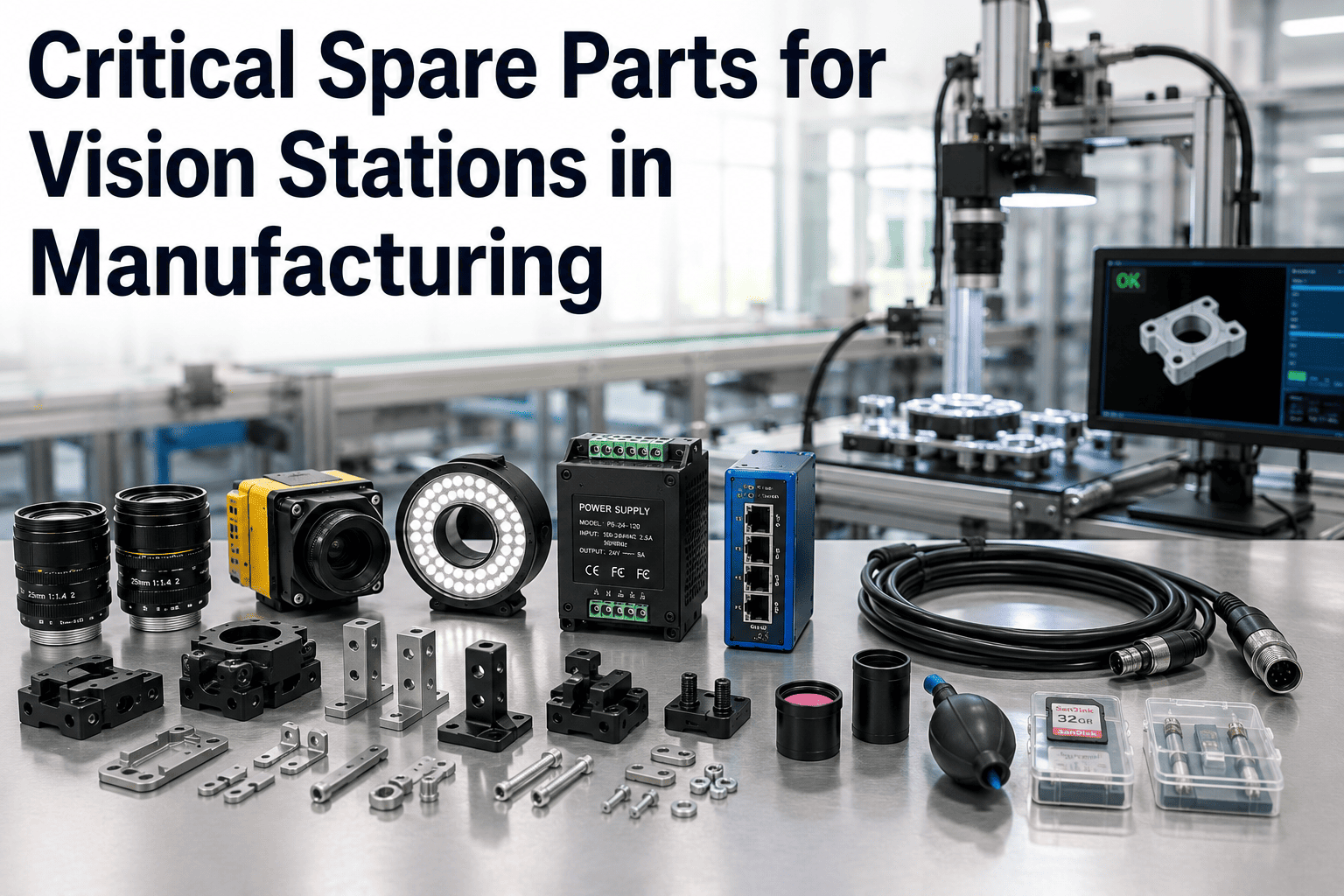
A well-stocked vision spares kit is small, inexpensive relative to the line it protects, and built around parts that fail predictably rather than parts that sound expensive. Here is what a properly scoped kit actually contains.
Pre-Focused Lens, Same Model and Focal Length
Swapping a lens without re-shimming shifts focus and scale on a calibrated station, so the spare should already be matched and ready to drop in without a re-teach cycle eating the outage.
Identical LED Lighting Fixture
Because output brightness decays over the fixture's operating life, a matched spare with a known intensity curve lets the station return to the exact lighting condition the inspection algorithm was trained on.
Terminated Cable Assemblies, Not Bulk Cable
A pre-terminated, tested cable assembly gets a station back online in minutes, while bulk cable that needs field termination turns a routine swap into an hour of downtime waiting on a technician.
Lighting Controller or Strobe Power Supply
Controllers absorb electrical stress every time a light fires, and a failed controller looks identical to a failed light from the operator's view, so having both spares prevents a misdiagnosed swap.
Back-Focus Shim Set and Mounting Hardware
The flange distance between lens and sensor is trimmed per camera, and a missing shim kit means a swapped camera can sit physically installed but optically out of calibration.
One Complete Camera Body, Shared Across a Cell
Because sensor failure is rare, one shared spare camera per cell or per station type is usually enough coverage without tying up capital in a part that almost never gets used.
Stop Guessing Which Vision Spares Actually Matter
iFactory reads the real degradation signal from every camera, light, and lens on your line and tells you which spares to stock before a station goes dark.
A Missing $200 Cable Can Cost More Than the Entire Spares Kit
The financial gap between having a part on the shelf and waiting for one to ship is not a maintenance detail — it is one of the more expensive line items reliability leaders rarely put a number on until it happens to them. A single overnight-shipped connector or a technician driving in on a weekend to re-shim a swapped camera can easily cost more than an entire year of properly stocked vision spares, which is the comparison that gets this line item approved once it is actually laid out in front of a plant manager.
Four Signals iFactory Trends So a Failing Part Never Surprises Your Team
A spares list only prevents downtime if someone knows a part is degrading before it fails outright. iFactory connects to the vision station's own data stream to catch that drift early.
Lighting Intensity Trend
iFactory logs measured brightness against the baseline set at commissioning, flagging a fixture once it drops toward the threshold where defect detection accuracy starts to slip.
Image Quality and Contrast Drift
Gradual haze on a lens or a dimming light shows up as a slow contrast decline across thousands of images, a pattern easy for software to catch and hard for a human to notice day to day.
Camera Temperature Readout
Most industrial cameras expose an internal temperature sensor over the standard interface, and iFactory watches it for the thermal drift pattern that precedes an electrical fault.
False Reject Rate by Station
A rising false reject rate at one specific station, isolated from the rest of the line, is one of the earliest practical signs that a lens, light, or cable is starting to fail before a hard stoppage occurs.
A Washdown Station and a Weld Cell Need Two Completely Different Spares Kits
The generic six-part list is the right starting point, but the ratio of spares you actually need shifts hard once you account for where the station physically sits on the floor. A vision station bolted next to a robotic weld cell fails on a different clock than one mounted over a slow-moving conveyor in a climate-controlled clean room, and treating every station the same way is how plants end up over-stocked on parts that never fail and out of stock on the one that always does.
Washdown and Wet-Process Areas
Constant moisture and detergent exposure accelerates connector corrosion and seal failure far faster than the cable jacket itself wears out, so these stations justify carrying double the normal cable and connector stock alongside spare gaskets and IP-rated housings.
Weld Cells and High-Vibration Lines
Constant mechanical shock loosens mounting hardware and back-focus shims well before any electronic component shows stress, which is why these stations need a heavier hardware kit and more frequent physical inspection rather than more electronic spares.
High-Ambient-Heat Zones
Elevated ambient temperature near ovens, furnaces, or curing lines pushes lighting controllers and power supplies toward their thermal limits faster, making controller spares a higher priority here than on a station running at room temperature.
Clean, Climate-Controlled Assembly Areas
Stations in electronics or pharmaceutical clean rooms see the slowest wear across the board, so a lighter spares kit weighted toward lighting decay monitoring is usually enough coverage without tying up unnecessary capital.
A Simple Way to Size Your Vision Spares Inventory Without Overspending
Most reliability teams either wildly overstock every vision station out of caution or carry almost nothing and hope for the best. Neither approach holds up once a station actually goes down mid-shift. A more disciplined way to size the kit is to work through it station by station rather than plant-wide, using the failure behavior each component actually shows in the field rather than a single blanket rule applied everywhere.
Start by grouping stations into the environment categories above, then apply the spares ratios from the earlier table as a baseline before adjusting up or down for that specific zone. A washdown station gets the doubled cable allowance, a weld cell gets the extra mounting hardware, and a clean room gets the lighter kit. From there, the single highest-leverage step is connecting the station's own data to a monitoring platform so the kit gets adjusted automatically as real degradation data comes in, instead of staying frozen at whatever assumptions were made on day one. Plants that make this shift typically find they were overstocked on camera bodies and dangerously understocked on cabling, and the correction alone often pays for the monitoring investment within the first prevented outage.
Questions Reliability Teams Ask About Vision Spare Parts
Turn Your Vision Spares List Into a Condition-Based Plan
iFactory trends lighting intensity, image quality, and camera health continuously so your team knows exactly which vision part to stock next, before it fails on the line.