A drone inspection program doesn't fail because the pilot can't fly — it fails because nobody checked the airspace map before the flight was scheduled, or a night inspection got planned around a waiver that takes 90 days to approve. Compliance sits across two different rulebooks depending on where the facility operates — FAA Part 107 in the US, EASA's risk-based categories across Europe — and getting either one wrong doesn't just risk a fine, it grounds the program the day it's needed most. See how iFactory's drone inspection reporting keeps flight authorization and compliance records in one place.
Drone Inspection · Regulatory Compliance · FAA & EASA Checklist
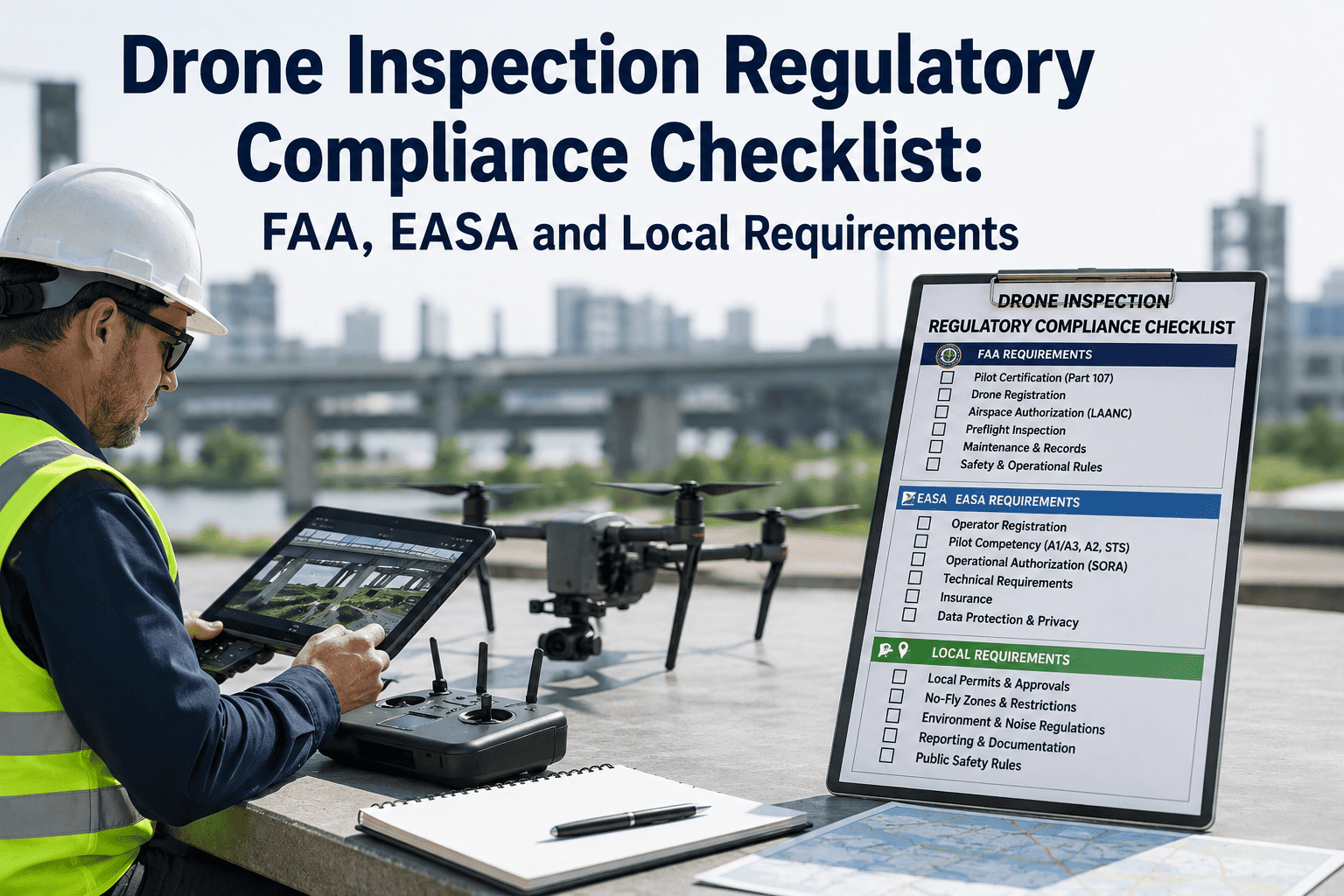
Drone Inspection Regulatory Compliance Checklist
Five components a compliant industrial drone inspection program actually needs — pilot certification, airspace authorization, visual observer coverage, night flight waivers, and facility-specific approval — mapped across FAA Part 107 and EASA's Open, Specific, and Certified categories.
$32,666
Maximum fine per incident for flying in controlled airspace without authorization in the US
90-120 Days
Typical FAA processing time for a complex waiver application, including most BVLOS requests
3 Categories
EASA's Open, Specific, and Certified risk tiers — each with its own authorization path
Two Rulebooks, One Inspection
Why Facility Location Changes the Entire Compliance Path
A US facility operates under FAA Part 107, a certificate-and-waiver system built around a small set of standard operating limits with exceptions granted case by case. A European facility operates under EASA's Open, Specific, and Certified framework, which sorts every flight into a risk tier before it happens rather than granting exceptions after the fact. Neither system recognizes the other's paperwork, and a facility running inspections in both regions needs two separate compliance tracks, not one translated version of the same checklist.
Section 01 — Pilot Certification
Confirming the Person Flying Is Legally Allowed To
Certification is the baseline every other requirement sits on top of, and the two regulatory systems handle it differently enough that a certification valid in one is meaningless in the other.
FAA Part 107 (US)
Any commercial drone flight requires a Remote Pilot Certificate — a 60-question knowledge test at 70% or higher, covering airspace, weather, and operating rules. The certificate is current for 24 months, renewed through free online recurrent training with no re-test required.
Individual pilot certificate, 24-month renewal
EASA (Europe)
Requirements scale with risk category — Open category needs only an online competency certificate for most subcategories, while Specific category flights require an operational authorization tied to a documented risk assessment, and Certified category requires aviation-grade licensing similar to manned aircraft.
Category-dependent, operator registration required
Pilot Certification Checklist
Every pilot flying for the facility holds a current, unexpired certificate appropriate to the operating region — Part 107 in the US, the correct EASA category competency in Europe
Verify: Current certificate on file per pilot
Recurrent training or renewal is tracked against each pilot's individual expiration date, not assumed current because the pilot was certified at hire
Verify: Renewal date tracked per pilot, not fleet-wide
Every drone used commercially is registered with the appropriate authority — FAA registration in the US, operator registration under EASA — separate from the pilot's own certification
Verify: Aircraft registered, not just pilot certified
Section 02 — Airspace Authorization
Clearing the Airspace Before the Drone Leaves the Ground
Most industrial facilities aren't in the middle of nowhere — plants, ports, and distribution centers routinely sit near controlled airspace, and flying there without authorization is one of the most common and most penalized compliance failures in commercial drone operation.
Airspace Authorization Checklist
The facility's airspace classification is checked against current UAS Facility Maps before every new flight location is scheduled, not assumed unchanged from the last inspection
Verify: Airspace class confirmed per site, per flight
Controlled airspace authorization is obtained through LAANC where the facility sits near an airport with LAANC coverage, since manual authorization requests can take significantly longer to process
Verify: LAANC authorization pulled for controlled airspace
Any flight above the pre-approved altitude ceiling shown on the facility maps is submitted as a further-coordination request well in advance, since these are not near-instant approvals like standard LAANC requests
Verify: Above-ceiling requests submitted with lead time
Temporary flight restrictions and NOTAMs are checked immediately before launch, not only during initial mission planning, since restrictions can appear on short notice
Verify: NOTAMs/TFRs checked day-of, not just at planning
Cost of skipping this
Flying in controlled airspace without authorization is a federal violation in the US, carrying civil fines that can reach into the tens of thousands of dollars per incident, along with possible suspension or revocation of the pilot's certificate. For a recurring inspection program, one uncleared flight can end the program's ability to fly at all.
Section 03 — Visual Observer Requirements
Keeping the Aircraft Within Sight Without Grounding the Inspection
Standard drone operation requires the aircraft to stay within the pilot's unaided visual line of sight, but large facilities and tall structures routinely push an inspection flight beyond what one person can reliably track alone. A visual observer extends coverage without requiring a BVLOS waiver, provided the role is properly structured.
01A visual observer is stationed to maintain continuous visual contact with the aircraft at any point where the pilot's own view is obstructed by structures or distance
02The observer maintains reliable two-way communication with the remote pilot in command throughout the flight, not just at handoff points
03Observer positions are planned in advance around the facility's specific structures — tanks, buildings, stacked inventory — that could break line of sight mid-flight
04Facility inspections that genuinely require flying beyond what any observer chain can maintain are flagged early as a BVLOS waiver case, not attempted informally
Keep certification records, flight authorizations, and inspection reports in one connected system instead of scattered across pilot logbooks and email.
Section 04 — Night Flight Waivers
Planning Around What Actually Requires a Waiver Today
Night operations are less restrictive than many facility teams assume — the rule changed in 2021 — but the requirements that remain are specific enough that skipping them is a common, avoidable compliance gap.
Night Flight Checklist
Every pilot flying at night has completed the updated recurrent training that specifically covers night operations, confirming a standalone waiver is generally no longer required for basic night flight in the US
Confirms: Night-ops training complete, not a legacy waiver
The aircraft carries anti-collision lighting visible for at least 3 statute miles, checked and functional before every night flight
Confirms: Anti-collision lighting present and functional
Airspace authorization is confirmed separately for night flights in controlled airspace under 400 feet, since the standard night-operations allowance does not remove the underlying airspace authorization requirement
Confirms: Night ops in controlled airspace still authorized
Where a real waiver is still needed
The category that still routinely needs a formal waiver — and the longest processing time — is BVLOS. Historical FAA processing for BVLOS waivers has run 90 to 120 days depending on the completeness of the risk assessment and operations manual submitted, so a facility planning a BVLOS inspection program needs to build that lead time into the schedule from the outset, not treat it as a fast-follow request.
Section 05 — Facility-Specific Flight Approval
Getting Internal Sign-Off, Not Just Regulatory Sign-Off
Regulatory compliance clears the flight legally — it doesn't clear the flight with the facility itself. Plant operations, safety, and security teams often have their own approval requirements layered on top of what the FAA or EASA requires, and skipping this step is what turns a fully compliant flight into an unplanned incident on-site.
Site Risk Assessment
Facility-specific hazards — active process areas, crane operations, restricted zones — are documented before flight, separate from the regulatory risk case
Operational Coordination
Flight timing is coordinated with plant operations so an inspection doesn't overlap with a process that shouldn't have aircraft overhead
Documented Sign-Off
Facility approval is recorded per flight, not assumed standing from a one-time site access agreement
What Goes Wrong
Common Compliance Pitfalls
Assuming certification never expires
A pilot's Remote Pilot Certificate lapses because recurrent training wasn't tracked against their individual 24-month renewal date.
Treating airspace status as static
A facility's airspace classification or nearby restrictions changed since the last inspection, and nobody rechecked before scheduling the next flight.
Informal visual line of sight coverage
A large facility's structures break the pilot's line of sight mid-flight with no properly briefed visual observer stationed to cover the gap.
Confusing the 2021 night rule with older requirements
A team still assumes every night flight needs a standalone waiver, missing that updated recurrent training now covers most standard night operations.
Underestimating BVLOS waiver lead time
A BVLOS inspection is scheduled without accounting for the realistic 90 to 120 day FAA processing window, stalling the program before it starts.
Regulatory clearance without facility sign-off
A flight is fully compliant with FAA or EASA rules but was never coordinated with on-site operations, creating an unplanned conflict with plant activity.
FAQs
Frequently Asked Questions
Does a facility need separate compliance programs for US and European operations?
Yes, in practice. FAA Part 107 and EASA's Open, Specific, and Certified framework are built on different underlying logic — Part 107 grants exceptions to a standard rule set through case-by-case waivers, while EASA sorts every operation into a risk category before the flight happens, each with its own authorization path. A pilot certificate valid under one system carries no legal standing under the other, and a facility running inspection programs in both regions needs distinct compliance tracks — matched pilot certifications, separate authorization records, and region-specific risk documentation — rather than one translated checklist.
Book a demo to see how iFactory tracks compliance records separately by region for multi-site operators.
Do we still need a waiver for night drone inspections?
Usually not, for the core night-flight allowance itself. Since the 2021 Operations Over People rule update, Part 107 pilots can fly at night without a standalone waiver as long as they've completed the updated recurrent training covering night operations and the aircraft carries anti-collision lighting visible for at least 3 statute miles. What still requires separate attention is airspace authorization — flying at night in controlled airspace under 400 feet still needs its own clearance, and that requirement doesn't disappear just because the general night-flight ban was lifted.
How far in advance should we plan a BVLOS inspection to account for waiver processing?
Historical FAA processing time for BVLOS waivers has typically run 90 to 120 days, with the more complex and better-documented applications tending to move faster than incomplete ones. Applications built around a thorough risk assessment, a detailed operations manual, and documented detect-and-avoid capability generally move through review more smoothly than thin submissions. Facilities planning a BVLOS-dependent inspection program — long pipeline runs, large tank farms, extended perimeter surveys — should treat that lead time as a hard planning constraint from the outset rather than something to request once the need becomes urgent.
What's the actual penalty risk if we skip an airspace authorization check?
Flying in controlled airspace without the required authorization is a federal violation under 14 CFR 107.41, and published fine ranges for unauthorized drone operation can run into the tens of thousands of dollars per incident, alongside possible suspension or revocation of the pilot's certificate. Beyond the direct penalty, an enforcement action against the certified pilot flying for the facility can ground that individual — and by extension the inspection program — for an extended period while the matter is resolved.
Do visual observers need their own pilot certification?
No — a visual observer does not need a Remote Pilot Certificate under Part 107, since they aren't the one operating the controls. What they do need is a clear, structured role: continuous visual contact with the aircraft at any point where the pilot's own sightline is broken, and reliable two-way communication with the remote pilot in command throughout the flight. Facilities with large or visually complex sites — tall storage, multiple buildings, long perimeters — should plan observer positions deliberately as part of every flight brief rather than treating the role as an informal add-on.
Contact solutions engineering for guidance on structuring observer coverage for a specific facility layout.
Fly Compliant Inspections Without the Paperwork Chasing You Down
iFactory's drone inspection reporting keeps pilot certifications, flight authorizations, and facility-specific approvals connected to every inspection report — so your program is audit-ready across FAA and EASA requirements instead of reconstructing compliance history from scattered logbooks the week an inspector asks for it.