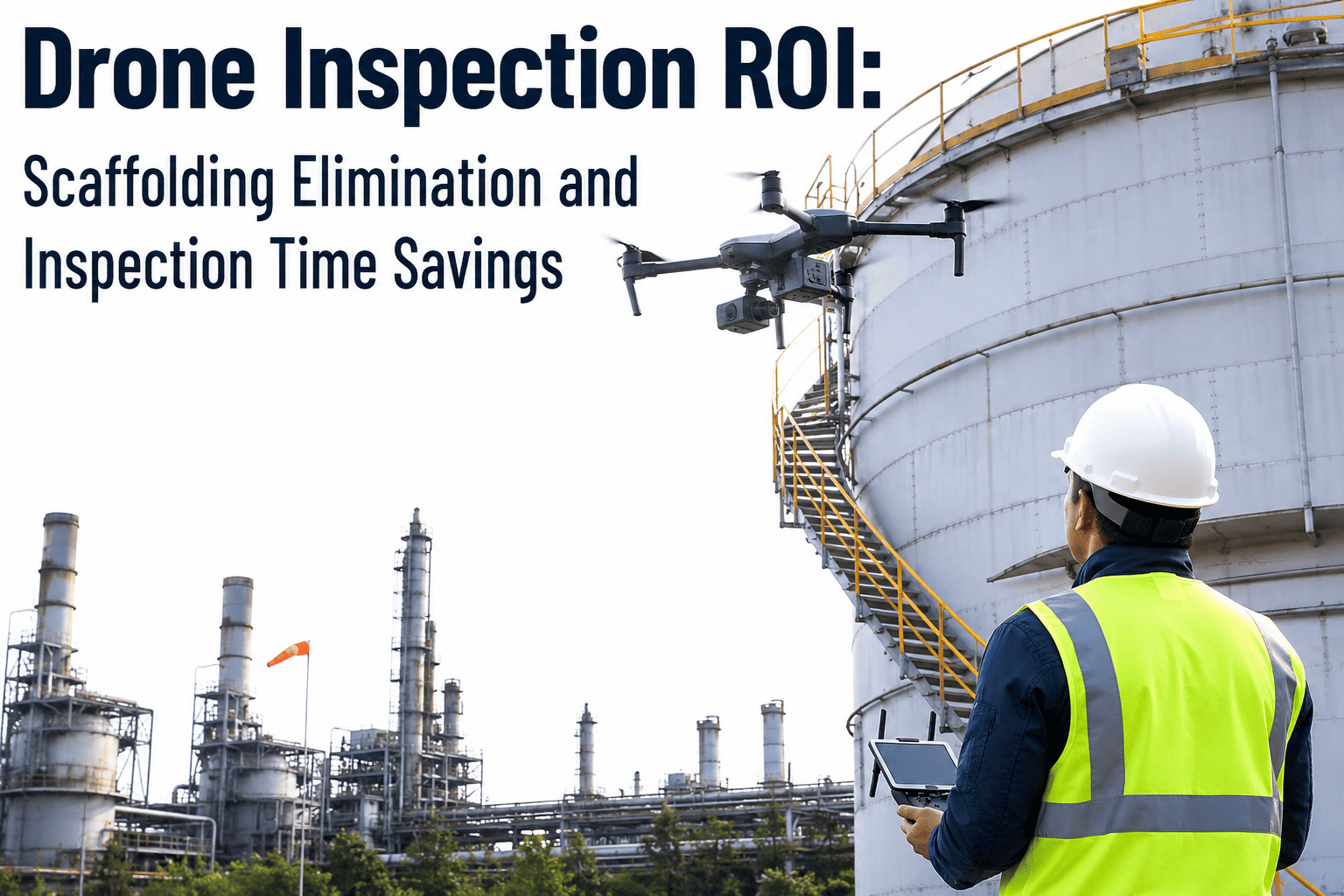
Every elevated asset inspection begins with a hidden invoice that lands long before an inspector spots a single defect: scaffolding rental, setup crews, permits, fall-arrest gear, and the days of production paused while towers go up. For flare stacks, storage tanks, cooling towers, and building facades, that access bill routinely dwarfs the inspection itself, and it repeats on every cycle. Drone inspection collapses that cost structure by turning a three-week scaffolding project into a same-day flight, documenting every square meter at height without putting a person in harm's way. The economics are no longer a maybe, they are a line-item decision waiting on the numbers, and the fastest way to see yours is to book a demo with our team.
Stop Paying to Build Scaffolding You Don't Need
Most inspections find no repair work at all — yet you pay full scaffolding cost every time. Drone inspection flips that math, cutting access spend 60-85% and turning weeks of setup into hours of flight.
The Real Cost of Scaffolding Isn't the Scaffolding
When leaders price a traditional inspection, they usually see the scaffolding rental line and stop there. But that number is only the visible tip of the invoice. Industry cost breakdowns show scaffolding systems running $15,000 to $40,000 per month, with a single storage tank setup consuming three to five days and $50,000 before anyone climbs. For a ten-tank farm, setup alone can burn 30 to 50 days and over $150,000 in cost before the first defect is even logged. Layered on top are mandatory safety equipment rentals, elevated work permits, worker compensation premiums that run 15 to 25 percent higher for at-height work, and the production downtime that ticks the whole time towers stand. Drone inspection does not shave these costs — it removes the entire category, and that is where the ROI story actually lives.
Traditional Scaffolding vs Drone Inspection: The Full Invoice
| Cost & Time Factor | Scaffolding-Based Inspection | Drone Inspection |
|---|---|---|
| Facade / tank inspection cost | $25,000 - $75,000+ | $4,000 - $12,000 |
| Total project timeline | 3 - 6 weeks | 1 - 2 days |
| Setup before inspection begins | 3 - 50 days (asset dependent) | 24 - 48 hours to deploy |
| Asset coverage per setup | 10 - 15% (reposition required) | 90 - 100% in one mission |
| Crew required | Large multi-person access team | Single remote pilot |
| Worker fall exposure | High (every hour at height) | None (inspector stays grounded) |
| Worker comp premium impact | 15 - 25% higher for elevated work | Reduced Total Cost of Risk 20-30% |
| Re-inspection cost to re-verify | Full setup again | Repeatable flight, minimal cost |
Where the Savings Actually Come From
ROI on drone inspection is not a single number — it stacks from four independent levers, each of which pays on its own. Understanding how they compound is what turns a budget conversation into an approval.
Eliminated Access Equipment
Scaffolding, cherry pickers, aerial lifts, and rope-access rigging disappear entirely. For most elevated assets this is the single largest line, and building scaffolding only when a defect is actually confirmed cuts access spend 80 to 90 percent.
Compressed Inspection Time
Inspection cycles that ran weeks compress to hours. Overall inspection time drops 75 to 85 percent, and a boiler inspection needing three days of setup, one of inspection, and two of teardown becomes a single day of drone flight.
Recovered Production Uptime
Power generation assets can lose $500,000 or more per day of unplanned outage. Even a one-day reduction in turnaround from faster data capture pays for the entire drone program many times over, before any equipment savings are counted.
Reduced Risk & Insurance Load
Removing rope access and scaffolding from routine cycles lowers Total Cost of Risk 20 to 30 percent, feeding directly into liability, workers' comp, and auto premiums that carriers increasingly price against your fall exposure.
See Your Own Numbers, Not Industry Averages
iFactory builds a facility-specific ROI model from your current inspection spend, elevated asset count, and turnaround schedule. Most operators recover their investment inside a single inspection season.
A Worked Example: Ten-Tank Farm, One Inspection Cycle
Numbers make the case sharper than adjectives. Consider a mid-size tank farm facility running a scaffolding-based integrity program, using published industry cost ranges. The point is not that every facility hits these exact figures — it is that the shape of the savings holds across almost every elevated-asset scenario.
Scaffolding Approach
Drone Approach
The break-even on a transition like this typically lands within two to three inspection cycles, with full payback in six to twelve months for active facilities. Because drone flights are cheap to repeat, the second-order benefit is inspection frequency: when access no longer costs six figures, operators stop inspecting at the bare regulatory minimum and start catching corrosion and cracks early, deferring capital expenditure and avoiding the catastrophic-failure costs that dwarf any inspection budget.
The Safety Line Nobody Puts on the Invoice
Falls from elevation remain the leading cause of death in construction. BLS data recorded 389 fatal falls to a lower level out of 1,034 construction fatalities in 2024, and scaffold-related accidents alone cause roughly 4,500 injuries and 60 deaths in the U.S. each year. Every rope-access mission and every hour on a scaffold platform is a fall-exposure event. Drone inspection removes the human from the height entirely — the inspector operates from the ground while the UAV documents the asset. Beyond the moral case, this reshapes the financial one: fall protection is OSHA's most-cited standard for over a decade running, citations trigger abatement, litigation, and elevated premiums, and carriers now price the removal of at-height exposure directly into what you pay. Since 2023, drone programs supporting offshore operations have eliminated thousands of hours of confined-space work, cutting injury risk while widening access to hard-to-reach assets.
The Numbers Change by Industry, the Direction Doesn't
Drone inspection ROI is not one story — it is a family of them, each shaped by the asset type, the cost of access, and the price of downtime in that sector. What stays constant across every vertical is the direction of the arrow: less access equipment, less time, less exposure, more inspection frequency. Below is how the economics tend to break out across the industries iFactory works with most.
Oil, Gas & Refineries
Flare stacks, storage tanks, and pipeline crossings are the classic scaffolding trap. A Gulf Coast refinery eliminated roughly $450,000 in annual scaffolding costs by moving its pipeline and storage inspections to drones. Setting up scaffolding around a single tank runs three to five days and upward of $50,000; a drone maps every angle without a pole. Pipeline crossings over rivers that once needed rigging or $2,500-per-hour helicopter time are now flown across in minutes.
Power Generation
Here the biggest lever is not equipment — it is uptime. Nuclear, gas-fired, and combined-cycle plants can lose $500,000 or more per day of unplanned outage, so compressing a multi-day boiler or cooling-tower inspection into a single day of flight pays for the program many times over before scaffolding savings are even added. Building scaffolding only when a defect is confirmed cuts access cost 80 to 90 percent.
Wind & Renewables
A 300-foot turbine that took a full day of rope-access work can be inspected in under an hour. Studies of wind farms found drones cut inspection costs up to 70 percent and downtime-related revenue loss up to 90 percent versus rope-access crews, with six-figure savings per inspection reported across mining and cement as well.
Buildings & Facades
A 15-story facade inspection that runs $25,000 to $75,000 and three to six weeks with scaffolding drops to $4,000-$12,000 and one to two days by drone, while covering 90-100% of the surface instead of the narrow band scaffolding touches. Contractors have cut multi-week facade inspections to a matter of hours and saved $25,000 or more per project.
How Operators Actually Make the Switch
Capturing this ROI is not a rip-and-replace exercise. The operators who see the fastest payback treat the transition as a phased shift, proving the numbers on a high-cost asset first and scaling from there. The path below is the one that consistently minimizes disruption while surfacing savings early.
Baseline Your Current Access Spend
Pull the true, fully loaded cost of your last inspection cycle — scaffolding rental, setup and teardown labor, permits, elevated-work insurance loading, and the production downtime that ran alongside it. This baseline is what the drone program is measured against, and it is almost always larger than the headline rental figure.
Pilot on Your Most Expensive Asset
Start where scaffolding costs the most — a tall tank, a flare stack, or a facade requiring repeated repositioning. Running the first drone mission on the highest-cost access point produces the clearest, fastest ROI signal and builds internal confidence before wider rollout.
Adopt the Defect-Triggered Model
Shift the standing rule so that scaffolding and rope access are deployed only after a drone confirms a defect requiring hands-on repair. Because most inspections reveal no repair work at all, this single policy change captures the largest share of eliminated access spend across the program.
Raise Inspection Frequency
Once access is cheap and fast, stop inspecting at the regulatory minimum. Higher cadence catches corrosion and cracks earlier, deferring capital expenditure and avoiding catastrophic-failure costs — the compounding return that makes drone programs one of the highest-ROI moves in an asset-integrity budget.
Why the ROI Compounds Over Time
Cheaper Inspections Mean More Inspections
When a facade scan costs a fraction of scaffolding, weekly or monthly checks become viable instead of annual ones. Higher inspection cadence raises early-detection rates, which translates directly into fewer unplanned outages and deferred capital spend.
Full Coverage, Not a Narrow Band
Scaffolding exposes only the 10-15% of a facade it physically touches; the rest requires teardown and rebuild elsewhere. A single drone mission documents 90-100% of the asset from every angle, producing an auditable record your team can reference for years.
Defect-Triggered Access Only
Most inspections reveal no repair work at all. Deploying scaffolding only after a drone confirms a defect that needs hands-on repair eliminates the largest source of wasted access spend across the entire inspection program.
Repeatable, Standardized Data
Automated flight paths capture the same angles every cycle, making corrosion progression measurable over time. Consistent, georeferenced imagery beats the variable quality of manual at-height photography and strengthens compliance documentation.
Frequently Asked Questions
How much cheaper is drone inspection than scaffolding, realistically?
Published industry comparisons consistently show drone inspection running 60 to 85 percent below scaffolding-based alternatives for elevated assets. A facade inspection that costs $25,000 to $75,000 or more with scaffolding typically runs $4,000 to $12,000 by drone, and tank-farm facilities save $175,000 to $400,000 in the first year alone. The exact figure depends on asset height, complexity, and inspection frequency, which is why a facility-specific model matters. Book a demo to see the numbers modeled against your own assets.
How quickly does a drone inspection program pay for itself?
Most active facilities reach break-even within two to three inspection cycles, with full payback realized in six to twelve months. Where production downtime is expensive — power generation assets can lose $500,000 or more per day of outage — even a single day of reduced turnaround can cover the entire program cost. The payback accelerates further when you factor in reduced insurance load and the deferred capital expenditure that comes from catching defects earlier. Contact support to walk through the payback math for your operation.
How much inspection time do drones actually save?
Overall inspection time typically drops 75 to 90 percent. Projects that ran three to six weeks with scaffolding compress to one or two days by drone, and setup phases that consumed 30 to 50 days shrink to a 24 to 48 hour deployment. A boiler inspection needing three days of scaffolding setup, a day of inspection, and two days of teardown becomes a single day of flight — with scaffolding erected only if a confirmed defect requires physical repair. Book a demo to see a time comparison built around your turnaround schedule.
Does eliminating scaffolding really lower our insurance and risk cost?
Yes, and it is increasingly measurable. Removing rope access and scaffolding from routine inspection cycles lowers Total Cost of Risk by 20 to 30 percent, feeding into general liability, workers' compensation, and auto premiums. Elevated work already carries premiums 15 to 25 percent higher than ground-level work, and with fall protection being OSHA's most-cited standard for over a decade, carriers now price the removal of at-height exposure directly into your rates. Fewer citations, fewer incidents, and cleaner audit records all compound the effect. Contact support to discuss how the risk reduction is documented.
Will drone inspection give us the same data quality as hands-on inspection?
For the visual assessment phase, drone inspection is more thorough, not less. A single mission documents 90 to 100 percent of an asset versus the 10 to 15 percent scaffolding exposes per setup, and thermal, zoom, and high-resolution sensors capture detail from safe standoff distances. The recommended model is hybrid: drones handle comprehensive visual data capture, and scaffolding or rope access is deployed only where a confirmed defect requires physical hands-on repair. This preserves data quality and compliance while eliminating the cost of building access you never end up needing. Book a demo to review sample inspection outputs.
Turn Your Inspection Spend Into an ROI Calculation
Every scaffolding cycle you defer, every day of downtime you recover, and every worker you keep on the ground is a number on your balance sheet. Let iFactory model exactly what a drone inspection program returns for your facility.