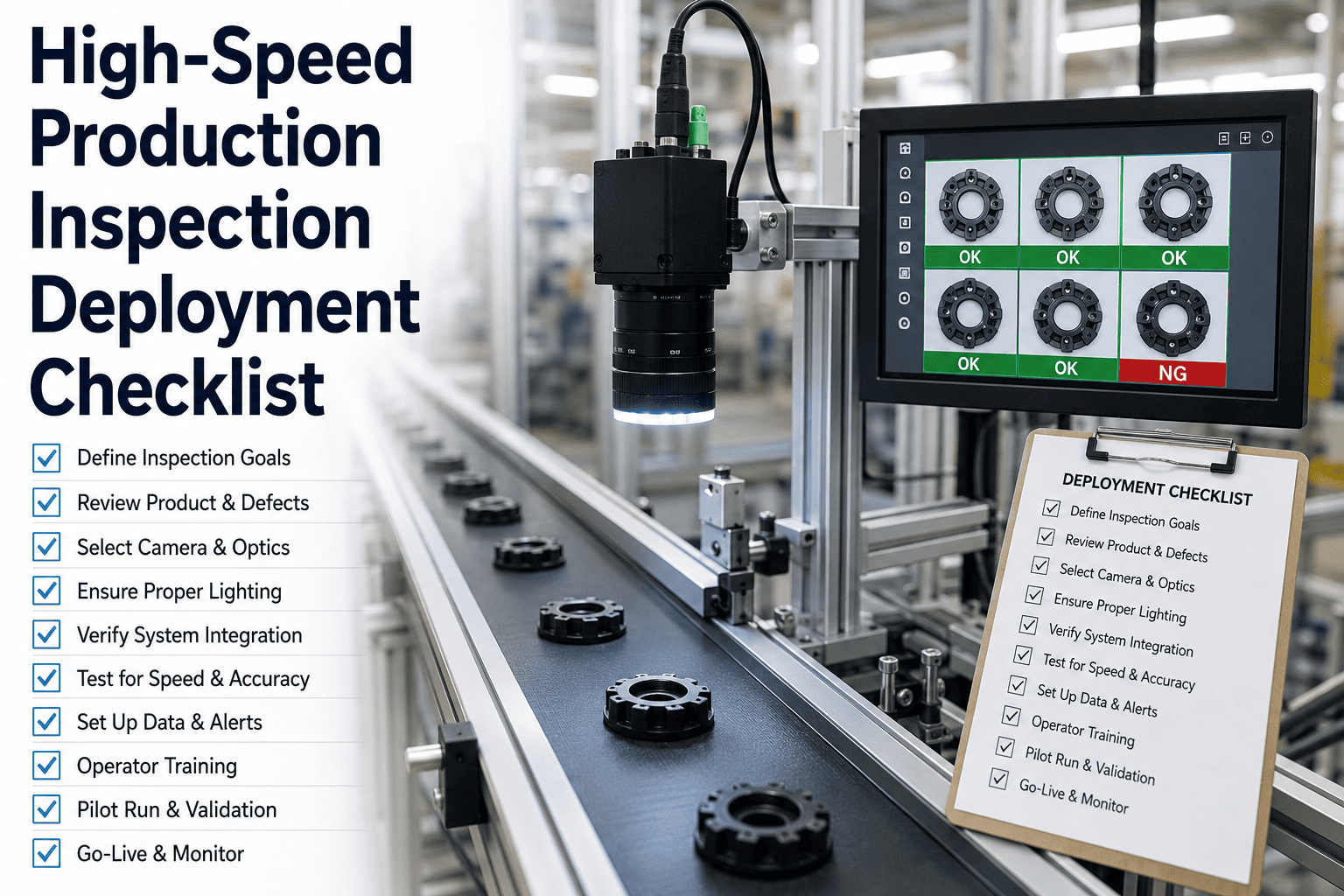
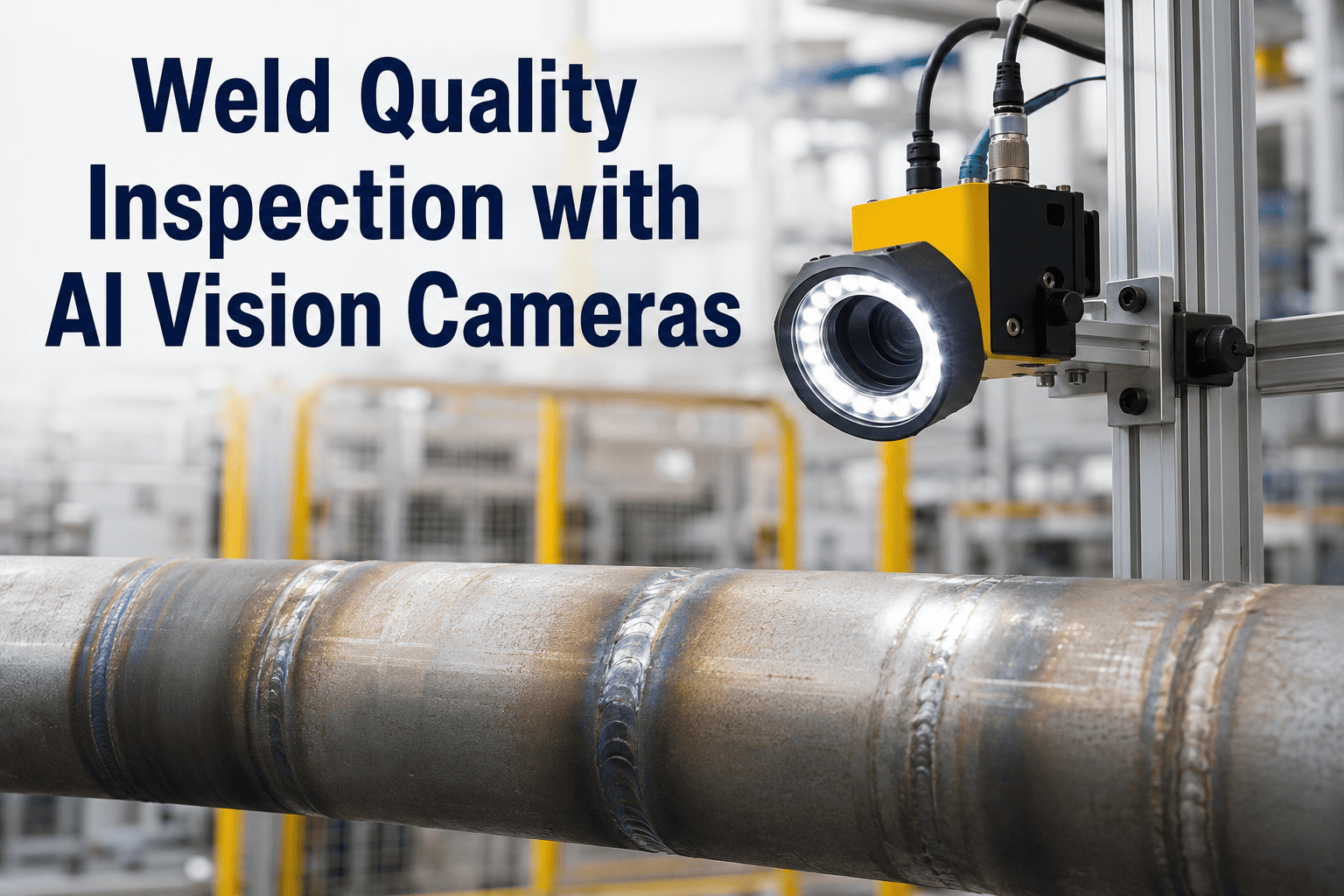
Most AI vision projects never die from bad technology — they die from timelines that stretch past six months while the pilot loses budget, momentum, and the champion who fought for it. Manufacturers who wait for a "perfect" dataset or a custom integration plan often watch a competitor go live first with a fraction of the polish. The truth is that a production-ready vision inspection system does not need six months of proof-of-concept purgatory — it needs a fixed four-week sequence with clear outputs at every stage. Below is the exact week-by-week path from camera installation to a fully autonomous inspection station, and what separates a deployment that reaches the floor from one that stalls in a lab. If your quality team is still debating whether to start, book a demo and see the timeline mapped to your own line.
Deployment Playbook
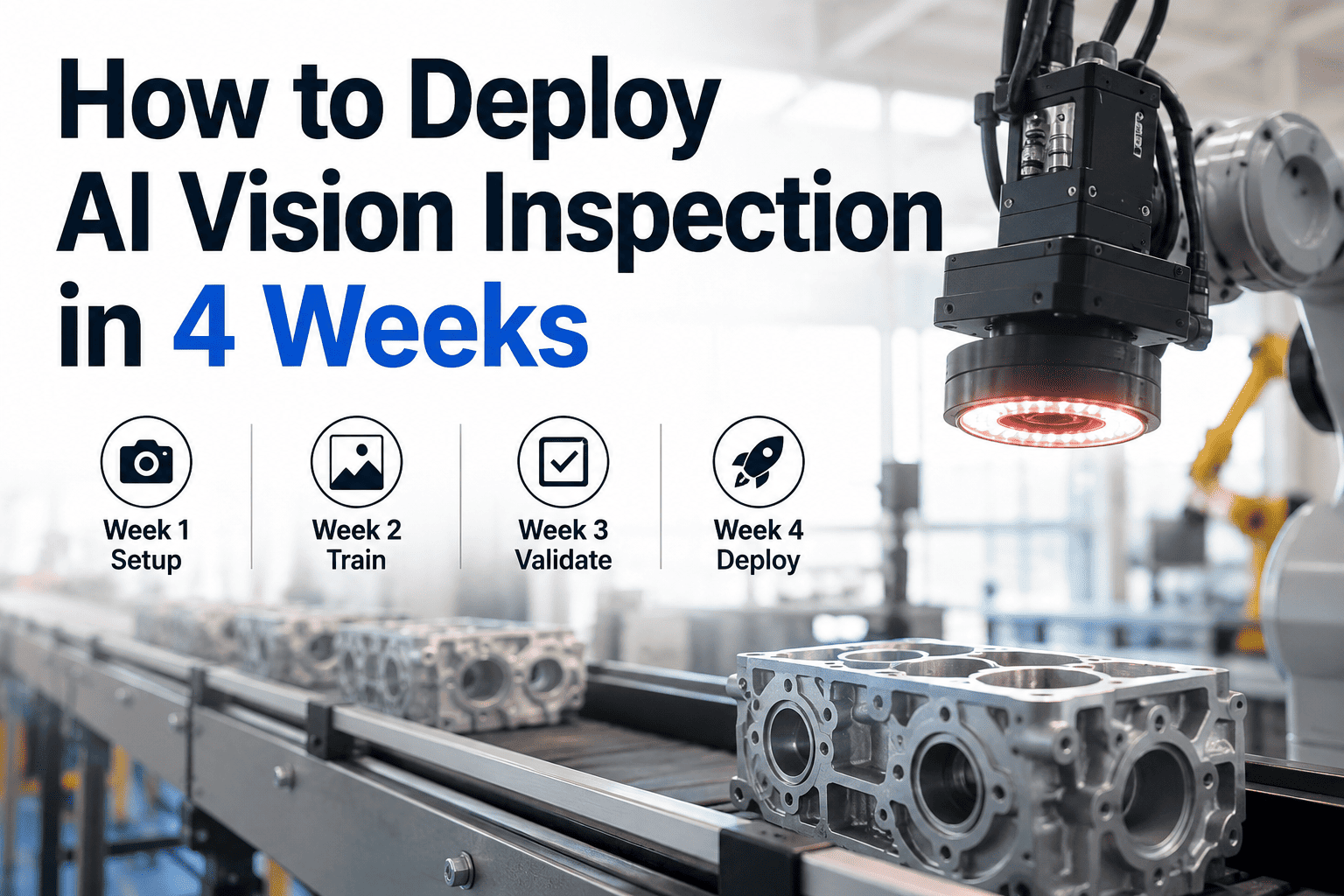
How to Deploy AI Vision Inspection in 4 Weeks
Camera install to production go-live — the exact sequence that gets AI vision inspection catching defects on your line before the quarter ends, not after it
4 Weeks
Camera install to full production go-live
99%+
Detection accuracy reached before handover
Why Most Vision Projects Never Reach Production
Quality teams do not lack interest in AI vision — they lack a deployment model that fits inside a single budget cycle. Most stall for the same three reasons, repeated across nearly every industry.
01
The Endless Pilot
Teams try to prove the concept in a lab before touching the production line. Every extra month of lab testing is a month of scrap, escapes, and warranty exposure that continues untouched on the actual floor.
02
The Dataset Trap
Waiting for a "complete" labelled dataset before training starts adds months for no real accuracy gain. Modern models begin usefully accurate and improve fastest once they see live production images, not idle ones.
03
Full-Facility Ambition
Attempting every inspection point at once multiplies integration risk. A single high-impact station proves the model, the workflow, and the ROI case before anything else gets touched.
The 4-Week Deployment Timeline
A production-ready deployment follows a fixed sequence, not an open-ended project plan. Each week has one job and one measurable output.
Week 1
Camera Installation & Image Capture
Cameras and lighting are specified and mounted at the highest-impact inspection point. Baseline images of conforming and defective parts are captured directly from the live line — not a staged sample — so the model learns your actual conditions from day one.
Output: Camera rig live, image capture pipeline running
Week 2
Data Labelling & Model Training
Captured images are labelled by defect class and used to train the detection model. Early models typically reach roughly 90–92% accuracy at this stage — enough to begin structured validation, not enough for full autonomy yet.
Output: Trained model ready for shadow validation
Week 3
Shadow-Run Validation
The model runs silently alongside your existing manual inspection, comparing every call against human judgment without affecting production decisions. Disagreements are reviewed, thresholds are tuned, and confidence rises toward the 99% recall target.
Output: Validated model with documented accuracy against your defect classes
Week 4
Production Go-Live & Continuous Learning
The model takes over primary inspection while the shadow comparison continues as a safety net. Active learning keeps improving classification on borderline cases automatically, so accuracy keeps climbing after go-live rather than freezing on day one.
Output: Fully autonomous inspection station, live on the floor
Every week above has a defined deliverable, not a vague milestone. Book a demo to see which inspection point on your line qualifies as the fastest path to go-live.
How Accuracy Climbs Across the Four Weeks
Accuracy is not a switch that flips on go-live day — it is a curve that rises through every phase of the deployment, driven by more real production data at each step.
Week 1
Baseline capture
Setup
Week 2
Initial training
~91%
Week 3
Shadow validation
~97%
Your Line Could Be Live in 28 Days
No open-ended pilots, no six-month proof-of-concept cycles. A single high-impact inspection station, a fixed four-week sequence, and a documented accuracy result before your next budget review.
Fast Deployment vs. Traditional Proof-of-Concept
The difference between a stalled pilot and a live production system usually comes down to structure, not technology. Here is how a fixed four-week sequence compares with the open-ended approach most teams default to.
| Dimension |
Traditional Proof-of-Concept |
4-Week Rapid Deployment |
| Timeline to go-live |
3 to 6 months, often longer |
4 weeks, fixed sequence |
| Scope on day one |
Full-facility ambition |
One high-impact station first |
| Dataset requirement |
Waits for a complete labelled set |
Trains on live production images from week one |
| Validation method |
Lab testing on staged samples |
Shadow-run against real manual inspection |
| Accuracy at handover |
Unverified against live conditions |
Documented recall on priority defect classes |
| Model improvement after launch |
Manual retraining projects |
Continuous active learning built in |
What Changes in the First 90 Days After Go-Live
The four-week deployment is the starting line, not the finish line. Once live, the same system compounds value across the quarter that follows.
15–25%
Defects human inspectors typically miss under sustained shift conditions
7–8 mo
Typical payback period once a station reaches full autonomy
2 Weeks
Time to retrain and redeploy when a new defect type appears
100%
Of parts inspected at line speed, not a sampled fraction
Where a 4-Week Deployment Fits Best
The fixed sequence works across production environments, but the starting station and lighting configuration change depending on what you are inspecting.
Automotive & Assembly
Surface defects on Class A panels and assembly completeness checks are the fastest path to a documented win, since escape costs are high and visible.
Electronics & PCB
Legacy automated optical inspection equipment often produces high false-positive rates. A retrained model at one station typically cuts that noise fast.
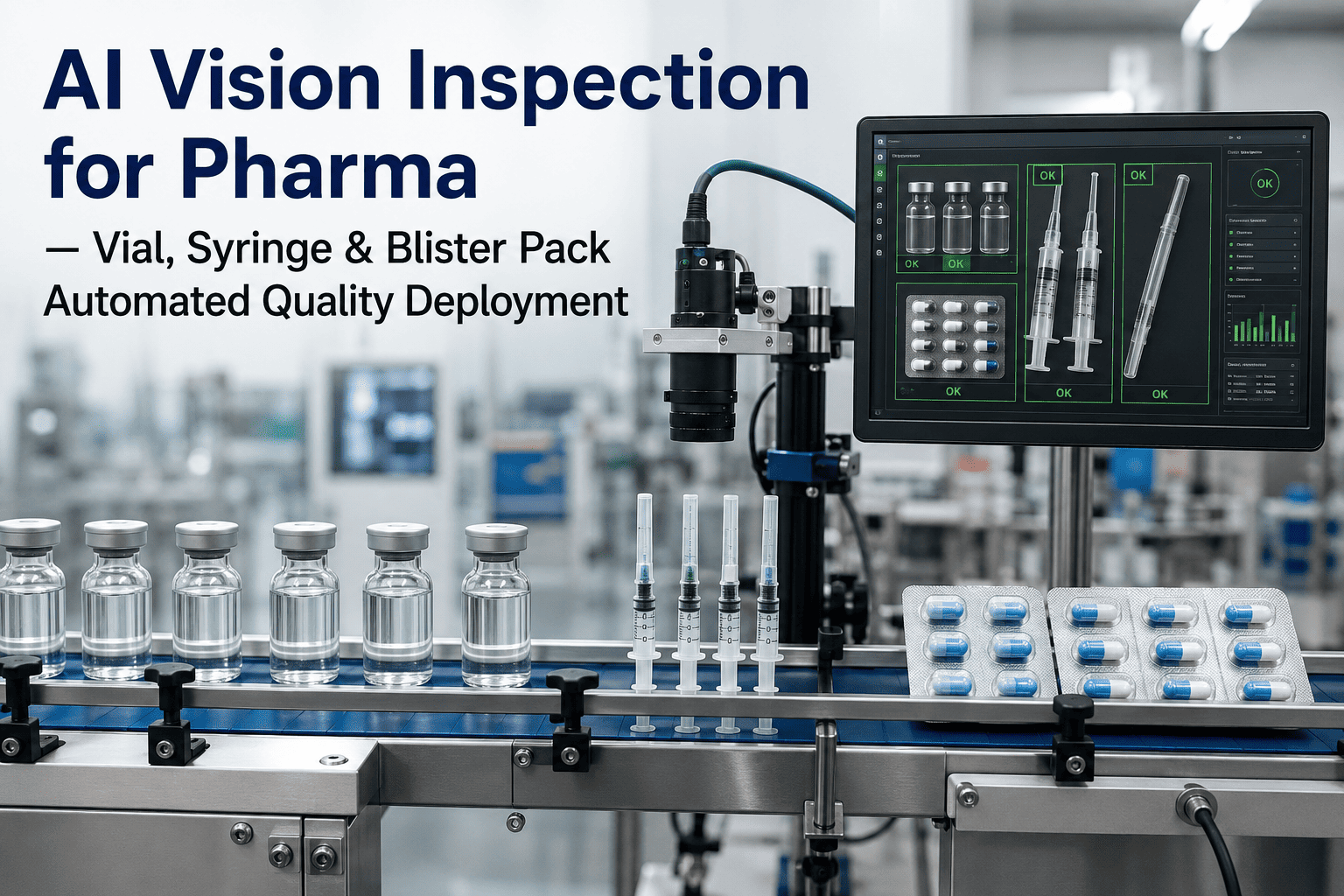
Food & Pharmaceutical
Labelling accuracy and batch-level traceability are the highest-value starting points, given how costly a single labelling-driven recall becomes.
General Manufacturing
Dimensional verification and assembly checks on a single bottleneck station usually deliver the clearest four-week proof before wider rollout.
Frequently Asked Questions
Can a deployment really go live in four weeks with no prior dataset?
Yes. Camera installation and image capture begin in week one using your live production parts, so the model never waits on a hypothetical dataset. Early models typically start in the low nineties for accuracy and climb through the shadow-run phase in week three as they see more real conditions. By week four, thresholds are tuned against your actual defect classes rather than a generic sample set. If your current data situation is unclear, a quick audit during a
demo call can confirm what is already usable.
What happens if the model gets something wrong during the shadow-run week?
That is exactly what week three is designed to catch. The model runs silently alongside your existing manual inspectors, and every disagreement between the two is logged and reviewed before any production decision depends on the AI call. Confidence thresholds are adjusted based on those disagreements, and the model does not take over primary inspection until its recall on priority defect classes is documented and accepted by your quality team.
Do we need to inspect every station at once to see value?
No, and attempting that is one of the most common reasons vision projects stall. The four-week sequence is built around a single high-impact inspection point — the station with the highest escape cost or the most inconsistent manual results. Once that station is live and its accuracy and ROI are documented, the same camera and model configuration typically extends to additional stations far faster than the first one did.
How does the system handle a brand new defect type after go-live?
When operators flag a defect pattern the model has not seen before, production continues with enhanced manual review for that specific category while new training images are collected. Quality engineers label the new examples, and the model is retrained and redeployed within roughly two weeks. This retraining cycle is a built-in part of ongoing operation, not a separate project that needs to be re-scoped and re-budgeted each time.
Will this integrate with our existing cameras, PLCs, and quality systems?
In most cases, yes. Existing IP cameras can often be reused where placement and resolution are sufficient, and the platform is built to connect with common MES, ERP, and quality management systems through standard integration protocols. Edge processing keeps inspection decisions fast enough for real-time line speed without depending on a constant cloud connection. Specific compatibility with your PLC and reporting stack is confirmed during the initial planning call —
reach out to support with your current setup for a direct answer.
Start the Clock on Your 4-Week Deployment
Every week your highest-escape station runs on manual inspection alone, the same losses keep repeating quietly. See exactly which station qualifies for the fastest path to a documented, autonomous result.