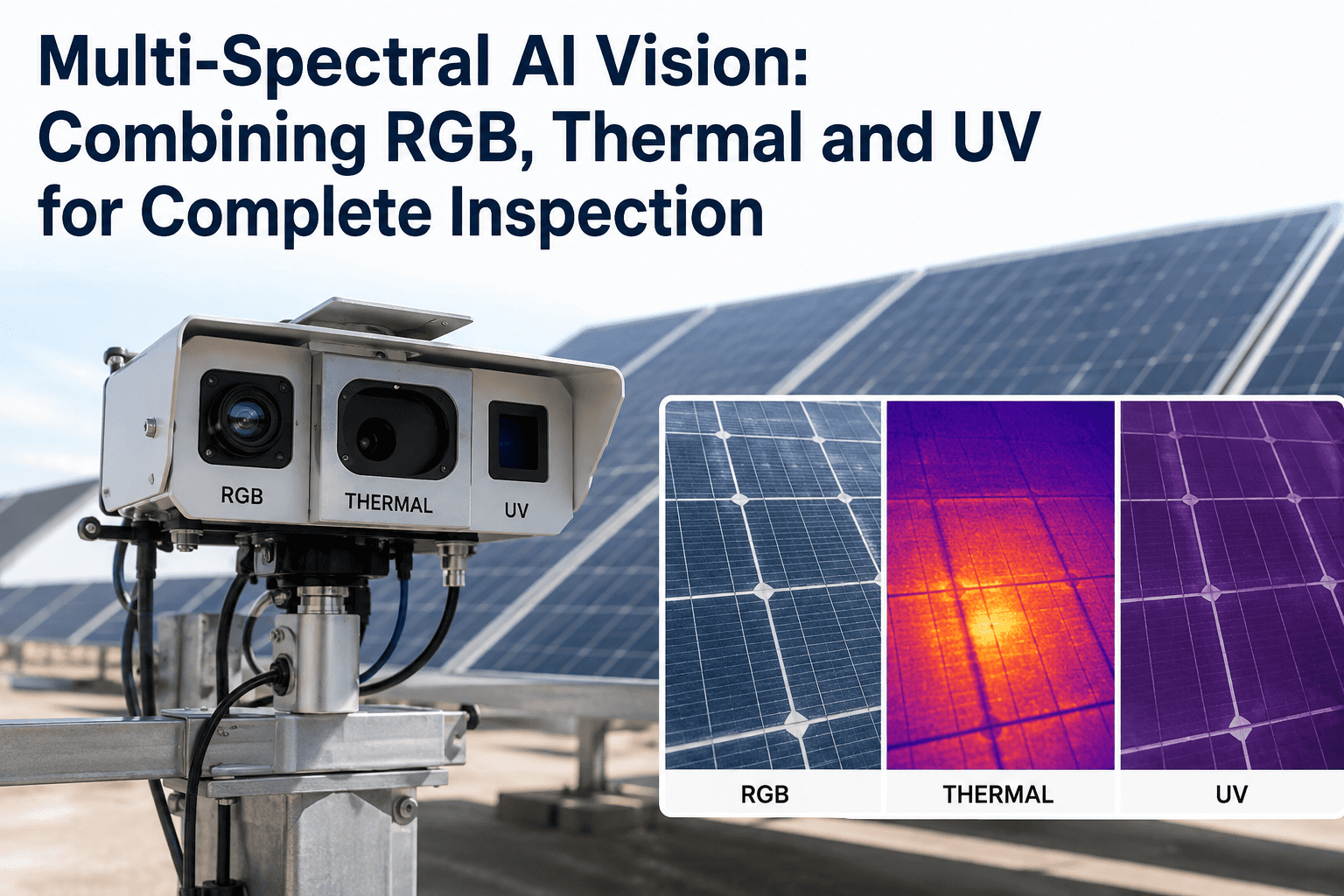
A camera sees what light gives it, and visible light only tells one story. A hairline crack with no discoloration is invisible to RGB. A cold solder joint that looks perfect radiates heat once current runs through it. Colorless contamination glows unmistakably under ultraviolet. Three defect classes, three parts of the spectrum, one sensor only ever sees one. Multi-spectral fusion runs RGB, thermal, and UV on the same station. Book a demo to see the fused output on your own product.
TECHNOLOGY · MULTI-SPECTRAL VISION · SENSOR FUSION
One Defect, Three Spectrums, One Station
iFactory combines RGB, thermal, and UV imaging into a single fused inspection, so a defect invisible to visible light doesn't get a pass just because that's the only sensor watching.
THE BLIND SPOT OF A SINGLE SENSOR
Why RGB Alone Was Never Going to Catch Everything
Standard machine vision runs on RGB cameras because RGB is cheap, fast, and matches how a human inspector already looks at a part. That's also its limit. RGB only captures what reflects visible light differently than its surroundings, which means any defect that doesn't change surface color, texture, or geometry in visible light simply doesn't register, no matter how sharp the camera or how well trained the model.
Subsurface and Thermal Defects
A weak solder joint, a delaminating bond, or an overheating component can look completely normal in visible light while radiating a heat signature that only an infrared sensor picks up.
Colorless Contamination and Cracks
Oil residue, certain adhesives, and hairline surface cracks frequently produce no visible color change at all, but fluoresce distinctly under ultraviolet light the way they always have for decades of manual UV inspection.
Neither of these is a hypothetical edge case. Research combining RGB and infrared imaging for defect detection in applications ranging from building inspection to semiconductor packaging has repeatedly found that fusing the two modalities catches defects that either sensor misses on its own, because the two spectrums are responding to physically different properties of the same material.
THREE SENSORS, THREE DIFFERENT QUESTIONS
What Each Spectrum Is Actually Measuring
RGB, thermal, and UV aren't three versions of the same measurement at different sensitivities, they're answering three genuinely different physical questions about the same part. That's why combining them adds real coverage instead of just redundant confirmation.
RGB · VISIBLE LIGHT
"What does the surface look like?"
Captures color, texture, geometry, and surface-level defects the way a human eye would: scratches, dents, misalignment, discoloration, missing components, and print or label defects.
THERMAL · INFRARED
"Where is heat behaving abnormally?"
Reveals temperature variation invisible to the eye: cold solder joints, overheating electrical connections, insulation gaps, uneven curing, and subsurface voids that disrupt normal heat flow through a material.
UV · ULTRAVIOLET
"What fluoresces that shouldn't, or doesn't that should?"
Excites fluorescent penetrant dyes to reveal hairline surface cracks invisible to the naked eye, and separately flags contamination, adhesive residue, or coating gaps that fluoresce differently than the surrounding material.
HOW FUSION ACTUALLY WORKS
Combining Three Feeds Into One Verdict
Multi-spectral fusion isn't three separate inspections bolted together with three separate reports, it's a single classification model that takes input from all three sensors and produces one pass/fail decision per part. The technical approach matters because it determines whether a defect visible in only one spectrum gets diluted or preserved in the final call.
01
Synchronized Capture
RGB, thermal, and UV sensors are triggered on the same part at the same station, aligned to the same field of view so the three feeds describe the same physical location rather than three separate glimpses.
02
Registration and Alignment
Because each sensor type has different resolution and optical characteristics, the three images are spatially registered against each other so a pixel in the thermal feed maps to the correct pixel in the RGB and UV feeds.
03
Modality-Preserving Classification
The classification model is trained so a strong signal in one modality isn't averaged away by a normal reading in the other two, since a defect that fluoresces under UV but looks fine in RGB should still fail the part.
04
Single Fused Verdict
The output is one classification per part, with the underlying spectrum-by-spectrum evidence retained and logged so a quality engineer can see exactly which sensor caught what, without needing three separate systems to check.
SINGLE-SPECTRUM VS FUSED INSPECTION
What Coverage Actually Looks Like Side by Side
The comparison that matters isn't which single spectrum is "better," it's how much of the real defect population each approach actually sees when the defects in question don't all announce themselves the same way.
| Factor |
RGB-Only Inspection |
Multi-Spectral Fusion |
| Surface Defects |
Caught reliably, this is what RGB is built for |
Caught the same way, plus cross-checked against thermal and UV |
| Subsurface/Thermal Anomalies |
Invisible, no thermal channel to detect them |
Flagged directly by the infrared feed |
| Hairline Cracks, No Discoloration |
Frequently missed at production line resolution |
Fluoresces under UV even when RGB shows nothing |
| Colorless Contamination |
Passes inspection, no visible color difference |
Fluorescence signature flags it under UV |
| False Confidence Risk |
A clean RGB pass can mask a real thermal or UV-only defect |
A part only passes when all three spectrums agree |
None of this makes RGB obsolete, it remains the fastest and cheapest way to catch the surface defects that make up the majority of any defect population. What fusion adds is coverage for the minority of defects that were always going to slip past a single-spectrum system by physical necessity, not by model error.
See what a second and third spectrum reveal on your own part
iFactory can run a side-by-side comparison against your current RGB-only inspection, showing exactly which defect classes were passing through undetected.
WHERE FUSION EARNS ITS COST
Applications Where a Second or Third Spectrum Changes the Outcome
Multi-spectral fusion isn't the right fit for every inspection point, it's the right fit where the defects that matter most are the ones a single sensor structurally can't see.
ELECTRONICS ASSEMBLY
Solder Joint and Thermal Verification
Thermal imaging catches cold solder joints and overheating connections that visually appear identical to a properly formed joint, a defect class RGB cannot resolve by definition.
AEROSPACE & CRITICAL METAL
Fatigue Crack Detection
UV fluorescent penetrant inspection has been the standard method for finding hairline surface cracks in high-integrity metal components for decades, and automating that same fluorescence check at line speed extends a proven method rather than replacing it.
COATINGS & ADHESIVES
Coverage and Contamination Verification
Adhesive and coating gaps frequently fluoresce differently from a properly coated surface under UV, making incomplete coverage visible even when it produces no discernible color change under normal lighting.
COMPOSITE & LAYERED MATERIALS
Delamination and Void Detection
Thermal imaging can reveal subsurface voids and delamination in composite and layered materials by detecting how the anomaly disrupts normal heat flow, a signature with no visible-light equivalent.
THE MARKET IS ALREADY MOVING HERE
Multi-Spectral Isn't an Emerging Bet, It's a Growing Standard
Industrial machine vision as a whole continues expanding as manufacturers push toward zero-defect quality targets, and multi-spectral and hyperspectral imaging specifically is one of the fastest-growing segments within it, expanding at a double-digit compound annual growth rate as more inspection programs move past what a single RGB sensor can resolve.
10%+
Compound annual growth rate for the multi-spectral and hyperspectral imaging market through the end of the decade
2
Defect categories most commonly cited as invisible to RGB-only inspection: thermal anomalies and colorless surface flaws
Decades
UV fluorescent penetrant inspection has been the trusted method for finding hairline cracks in critical metal components
Growth in this segment is being driven by exactly the pattern this page describes: manufacturers with a mature RGB inspection program hitting a wall on defect classes that visible light structurally cannot reveal, and adding the sensor that can rather than accepting that class of defect as a permanent blind spot.
TURNKEY DELIVERY
How iFactory Deploys Multi-Spectral Inspection
iFactory installs a synchronized RGB, thermal, and UV camera array at your inspection station, calibrates the fused classification model against your own defect history, and connects the result to a dashboard that shows which spectrum caught what on every part.
What Gets Built
Synchronized RGB, thermal, and UV camera array at the inspection station
Spatial registration calibration so all three feeds align to the same part location
Fused classification model trained on your defect history across all three spectrums
Per-part logging showing which spectrum flagged which defect
24×7 remote monitoring with model drift alerts across all three channels
Deployment Timeline
Weeks 1-4: Station audit, sensor placement, three-channel data pipeline setup
Weeks 5-8: Registration calibration, fused model training against defect history
Weeks 9-12: Dashboard go-live, threshold tuning, quality team training
FREQUENTLY ASKED QUESTIONS
What Quality Teams Ask About Multi-Spectral Vision
Does adding thermal and UV sensors slow down the inspection station?
No, the three sensors capture simultaneously rather than sequentially, so the fused inspection runs at essentially the same cycle time as a single-spectrum RGB station would on its own. The synchronization happens in hardware, the cameras all trigger on the same part at the same moment, so there's no queuing between spectrums that would add time to the line. The processing that fuses the three feeds into one verdict happens in parallel with the next part's capture, not as a sequential bottleneck.
Book a demo to see the actual cycle time against your current line speed.
Do we need to replace our existing RGB inspection system entirely?
Not necessarily. In many deployments, the existing RGB camera and its trained model stay in place, and thermal and UV sensors are added alongside it at the same station, feeding into a fusion layer that combines all three verdicts. This preserves the RGB detection capability your team has already validated while extending coverage into the defect classes it was never going to catch on its own.
Contact our support team to scope what integrates with your current setup.
How do we know which specific defects on our product actually need a second spectrum?
This is typically the first thing a pilot establishes rather than something assumed up front. Running thermal and UV alongside your existing RGB inspection on a sample of known-good and known-defective parts reveals exactly which defect classes were passing an RGB-only check and which spectrum would have caught them. Not every product needs all three spectrums, some benefit from RGB plus thermal only, others from RGB plus UV, and the pilot data makes that call rather than a generic assumption.
Book a demo to run that comparison against your own defect history.
Is UV fluorescent inspection safe to run continuously on a production line?
UV-A inspection, the wavelength range used for fluorescent penetrant and contamination detection, is the same range used in manual NDT inspection for decades and is standard practice in aerospace, automotive, and critical-component manufacturing when proper enclosure and exposure controls are in place. An automated station enclosed for continuous operation is generally safer for personnel than handheld manual UV inspection, since the light source is contained rather than aimed by an operator repeatedly across a shift.
Contact our support team to review safety and enclosure requirements for your specific line.
How long does it take to train a fused model versus a single-spectrum model?
Most deployments reach full go-live within twelve weeks, with the fused model calibration phase typically running through weeks five to eight once all three sensors are installed and synchronized against your product. Training a fusion model does take somewhat more data than a single-spectrum model, since the classification logic has to learn how signals across all three channels correlate with known good and defective parts, but the underlying twelve-week timeline holds because registration and pipeline setup happen in parallel with early data collection.
Book a demo to scope a realistic timeline against your product and defect history.
THREE SPECTRUMS, ONE VERDICT, EVERY PART
Stop Letting Wavelength Decide What Counts as a Defect
iFactory fuses RGB, thermal, and UV inspection into a single station and a single verdict, so a defect that only shows up outside visible light doesn't get to pass just because that's the only sensor that was watching.