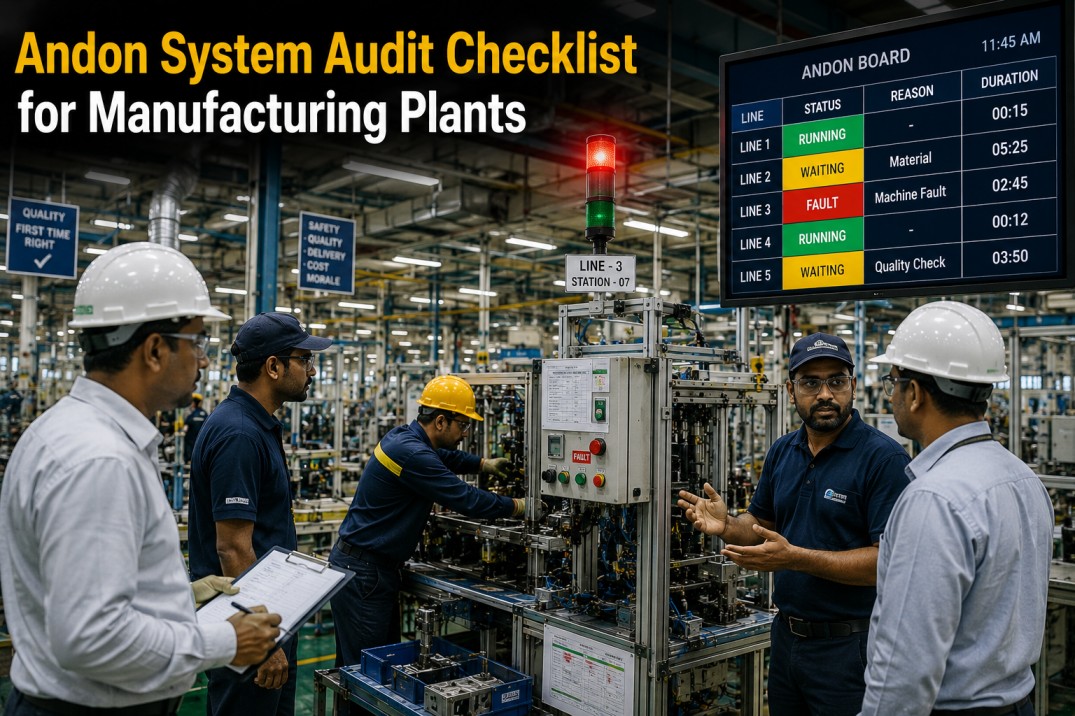
An andon system is the nervous system of a manufacturing plant — connecting operators, supervisors, and support teams through visual alerts and structured escalation. But an andon system that isn't audited regularly can develop blind spots: slow response times, ignored alerts, broken escalation paths, and unresolved root causes that erode trust in the system.
This checklist provides plant managers, continuous improvement leads, and production supervisors with a structured audit framework to evaluate their andon system across five critical dimensions — escalation design, response discipline, root cause closure, visual management integration, and digital readiness. Built from deployment patterns across 500+ manufacturing plants, it covers every element that determines whether your andon system drives real-time problem solving or just adds noise.
Audit Your Andon System
iFactory's Digital Andon Replaces Lights with Mobile Alerts — With Escalation, Tracking, and Root Cause Closure Built-In
Stop walking past dark andon lights. iFactory's digital andon delivers mobile alerts with timed escalation, automated response tracking, and root cause documentation — so every alert gets resolved, not just acknowledged. No hardware. No rewiring. No missed issues.
Andon System Health Scoreboard
Tracking the health of your andon system is the first step toward continuous improvement. The metrics below measure how effectively your plant's andon alerts are being raised, responded to, and closed with lasting corrective actions.
Andon Escalation Rules Reference Table
An effective andon system depends on clearly defined escalation rules — who is notified, at what timeout, and what action they must take. The table below defines standard escalation levels for common alert types and the expected response at each level.
| Alert Type | Level 1 Responder | Timeout | Level 2 Escalation | Level 3 Escalation | Max Closure |
|---|---|---|---|---|---|
| Quality Defect | Operator / Team Lead | 3 min | Quality Engineer | Plant Manager | 60 min |
| Machine Stop | Operator / Maintenance Tech | 5 min | Maintenance Engineer | Maintenance Manager | 120 min |
| Safety Incident | Operator / Safety Rep | 1 min | Safety Manager | Plant Manager | Immediate |
| Material Shortage | Operator / Material Handler | 5 min | Production Supervisor | Supply Chain Manager | 30 min |
| Process Deviation | Operator / Process Tech | 5 min | Process Engineer | Plant Manager | 90 min |
| Changeover Delay | Operator / Setup Team | 10 min | Production Supervisor | Production Manager | 45 min |
| Environmental Alert | Operator / EHS Rep | 3 min | EHS Manager | Plant Manager | 60 min |
Andon System Audit Checklist: 5 Critical Domains
Work through each domain below to assess your andon system against industry best practices. Each checklist item targets a specific aspect of andon effectiveness — from alert visibility to root cause closure. Mark items as compliant, partial, or non-compliant.
- Andon alerts are visible from every workstationOperators can see or receive alerts without leaving their station. Digital andon systems send mobile or desktop notifications. Physical andon lights or displays are unobstructed and within line of sight.
- Alert types are colour-coded by categoryQuality, machine, safety, material, and process alerts use distinct colours or icons so responders can triage at a glance. Colour coding is standardised across all shifts and documented in training.
- Alert acknowledgement is tracked and time-stampedEvery alert has a recorded acknowledgement time — whether by button press, mobile tap, or system auto-acknowledge. Unacknowledged alerts escalate automatically after the timeout period.
- Response time targets are defined per alert typeEach alert type has a maximum response time target (e.g., safety: 1 min, quality: 3 min, machine: 5 min). Actual response times are tracked and reported weekly against these targets.
- Escalation rules are documented and enforcedClear rules define when an alert escalates to the next level — by timeout or by alert type. Escalation paths are documented, understood by all shifts, and enforced by the system automatically.
- No alert is closed without a responder assignmentEvery alert must have a named responder who is responsible for resolution. Alerts cannot be closed without a documented responder name and action taken. This prevents ghost acknowledgements.
- Root cause is documented for every tier-1 alertQuality defects, machine stops, and safety incidents require a documented root cause before the alert is closed. Root cause categories are standardised and linked to corrective action tracking.
- Corrective actions are tracked to closureEvery root cause must generate a corrective action with an owner and due date. The andon system or connected platform tracks each action to completion. Open actions are reviewed weekly.
- Alert recurrence is monitored and flaggedRepeated alerts for the same issue at the same station are flagged automatically. Three or more repeats of the same alert type within a shift triggers a mandatory escalation and root cause review.
Go Digital
Replace Physical Andon Lights with Mobile Alerts — No Rewiring Required
iFactory's digital andon platform works on existing mobile devices and desktop browsers. Operators raise alerts with one tap. Supervisors get timed escalation. Root cause tracking is built in. Start your digital andon deployment in hours, not weeks.
Andon System Maturity Model: 4 Levels of Digital Andon Readiness
Andon system maturity progresses from reactive physical lights to predictive digital platforms with closed-loop corrective action. Assess your current level to identify the next step in your andon transformation journey.
6 Common Andon System Audit Gaps in Manufacturing Plants
Based on andon system audits across 500+ manufacturing plants, these six gaps appear most frequently and carry the highest operational impact. Use this gap analysis to prioritise your andon improvement initiatives.
Without specific response time targets, operators and supervisors have no benchmark for urgency. A safety incident and a changeover delay should trigger very different response expectations. Define targets for each alert type and report weekly compliance against them.
Documented escalation rules are useless if they rely on manual intervention. A supervisor who is busy with another issue may not notice that an alert has gone unanswered. Automated escalation — by timeout or alert type — ensures no alert falls through the cracks.
Many plants track andon alerts but fail to capture root cause data consistently. Without standardised root cause categories, aggregated analysis is impossible. The plant cannot identify which defect types, stations, or shifts generate the most repeat alerts.
Root causes are identified but corrective actions are not assigned, tracked, or followed up. The same alert repeats because the underlying issue was never resolved. Every root cause must generate a corrective action with an owner, due date, and closure verification.
When the same alert type fires repeatedly at the same station, it indicates a systemic problem that needs investigation. Without automatic recurrence detection, these patterns go unnoticed until they escalate into major disruptions. Three repeats in a shift should trigger a mandatory review.
Andon system performance — response times, escalation rates, closure rates, recurrence patterns — should be reported to plant leadership weekly. Without visibility, andon improvement lacks sponsorship and accountability. A weekly andon dashboard closes this gap.
Book a Demo
See How iFactory's Digital Andon Replaces Physical Lights with Mobile Alerts and Escalation
iFactory's digital andon platform gives you mobile alert raising, timed escalation to the right responder, automated response tracking, and integrated root cause closure — all without hardware installation. Book a personalised demo to see how manufacturers are transforming their andon systems in days.
Frequently Asked Questions
What is an andon system audit and why is it important?
An andon system audit is a structured evaluation of how alerts are raised, responded to, and resolved on your plant floor. It covers alert visibility, escalation rules, response discipline, root cause documentation, and corrective action tracking. Regular audits are important because andon systems degrade over time — operators stop raising alerts if nobody responds, escalation paths become outdated as people change roles, and recurring issues go unnoticed without closure tracking. A quarterly audit prevents this degradation and keeps the andon system effective.
How often should an andon system be audited?
We recommend a comprehensive andon system audit quarterly, with a lighter monthly review of response time metrics and closure rates. After any significant change — new production line, new shift structure, new alert types — conduct an immediate audit to validate the system. The andon audit checklist in this page provides a structured framework you can use for both quarterly and ad-hoc audits.
What is the difference between physical and digital andon?
Physical andon uses light towers, buzzers, or display boards that are visible only within a limited area. Digital andon uses mobile devices, desktop computers, or smart watches to deliver alerts anywhere in the plant. Digital andon offers automatic timed escalation, response tracking, root cause documentation, and integration with production dashboards — none of which are possible with physical lights. Digital andon also enables remote visibility for plant managers who are not on the floor.
What are the key metrics for measuring andon system effectiveness?
The five key metrics for andon effectiveness are: average response time (time from alert to first action), escalation rate (percentage of alerts escalated beyond first responder), closure rate with root cause (percentage of alerts closed with documented root cause), recurrence rate (percentage of alert types that repeat at the same station within a shift), and corrective action closure rate (percentage of corrective actions completed on time). Track these metrics weekly and report them to plant leadership.
How do I train operators to use the andon system effectively?
Effective andon training covers three areas: when to raise an alert (every abnormality, not just major issues), how to categorise the alert correctly (quality vs machine vs safety), and what to do while waiting for a responder (stop production, contain the issue, document observations). Training should be hands-on with real scenarios and repeated quarterly. The most common root cause of andon failure is not technology — it is operators who are afraid to raise alerts because they think it reflects poorly on their performance.
What are the most common reasons andon systems fail?
The most common failure patterns are: slow or no response to alerts (operators stop raising them), escalation rules that are documented but not enforced (alerts sit unanswered), no root cause capture (the same issue repeats indefinitely), alert fatigue from too many low-priority alerts, and lack of leadership visibility into andon performance. A structured audit using this checklist will identify which of these patterns exist in your plant and provide a roadmap for fixing them.

.png)