Manufacturing analytics platforms are increasingly available in both cloud and on-premise deployment models, and the choice between them has become one of the most consequential decisions plant IT and operations teams face. Cloud deployments offer elastic scalability, automatic updates, and reduced infrastructure overhead — while on-premise deployments provide complete data sovereignty, deterministic latency, and air-gapped security. Manufacturing analytics in the cloud vs on-premise is not a one-size-fits-all decision; the right choice depends on plant size, network reliability, regulatory environment, and IT team maturity. This comparison examines the key factors that differentiate cloud and on-premise manufacturing analytics in 2026.
Get Started
Cloud or On-Prem — Choose the Right Analytics Platform
iFactory delivers manufacturing analytics in both cloud and on-premise deployments with identical functionality. Get a personalised recommendation based on your plant's infrastructure, security requirements, and scalability needs.
Cloud vs On-Premise Decision Matrix
Each deployment model offers distinct advantages across the factors that matter most to manufacturing operations. The decision matrix below compares cloud and on-premise across eight critical dimensions, providing a structured framework for evaluating which model aligns with your plant's operational requirements and strategic priorities.
| Evaluation Factor | Cloud | On-Premise |
|---|---|---|
| Data Latency | 2–5 seconds typical | <100 milliseconds |
| Upfront Cost | Low (OPEX model) | High (CAPEX + setup) |
| Ongoing Cost | Monthly subscription | Maintenance + IT staff |
| Scalability | Elastic, instant | Hardware-limited |
| Data Sovereignty | Region-dependent | Full control |
| Security Compliance | Certified providers | Air-gap capable |
| Update Cadence | Continuous, automatic | Manual, scheduled |
| Offline Resilience | Requires connectivity | Fully independent |
The decision matrix reveals that neither model is universally superior. Cloud excels in scalability, cost accessibility, and update velocity — making it ideal for multi-plant rollouts and facilities with reliable internet infrastructure. On-premise wins on latency, data sovereignty, and operational independence — critical for defence, aerospace, and pharmaceutical plants where data cannot leave the facility network.
Total Cost of Ownership — 3-Year Comparison
Total cost of ownership for manufacturing analytics extends beyond software licensing to include infrastructure, IT operations, data storage, and upgrade costs. A 3-year TCO analysis reveals how cloud and on-premise costs diverge over time, with cloud offering lower year-one investment and on-premise achieving cost parity or advantage in longer horizons depending on plant scale.
| Cost Category | Cloud (3yr) | On-Prem (3yr) |
|---|---|---|
| Software Licensing | $85K | $65K |
| Infrastructure / Hosting | $45K | $70K |
| IT Operations & Admin | $20K | $55K |
| Data Storage & Backup | $30K | $25K |
| Training & Onboarding | $15K | $20K |
| Upgrades & Migration | $10K | $30K |
| Total 3-Year Cost | $205K | $265K |
The TCO comparison shows cloud typically delivering 20–30% lower total cost over three years for mid-size deployments, primarily due to reduced IT operations overhead and infrastructure management. On-premise costs are front-loaded with hardware and licensing but can become more economical at very large scale where per-server economics improve. Manufacturing analytics platforms that offer both deployment models enable organisations to choose the cost structure that aligns with their financial planning and operational requirements.
Deployment Architecture Comparison
The architectural differences between cloud and on-premise manufacturing analytics extend beyond where the server sits. Data flow patterns, integration topology, edge processing requirements, and connectivity dependencies all differ significantly between the two models. Understanding these architectural distinctions is essential for designing a deployment that meets reliability, latency, and data governance requirements.
| Architecture Layer | Cloud Deployment | On-Premise Deployment |
|---|---|---|
| Data Ingestion | Edge gateway → Cloud API → Data lake | PLC/SCADA → Local DB → Analytics engine |
| Processing Tier | Cloud compute (auto-scale) | On-prem server / VM cluster |
| Storage Layer | Managed cloud storage (S3 / Blob) | Local NAS / SAN + backup |
| Visualisation | Browser-based dashboards (any device) | Thick client or browser (LAN) |
| Integration Bus | REST API + MQTT + WebSocket | OPC-UA + Modbus + REST (local) |
| Identity & Access | SAML / SSO + MFA (cloud IdP) | LDAP / Active Directory (local) |
| Disaster Recovery | Multi-region failover (built-in) | Cold standby / tape backup |
Cloud architectures leverage managed services for compute, storage, and identity — reducing operational overhead but introducing dependency on internet connectivity and cloud provider availability. On-premise architectures keep every layer inside the facility network, eliminating external dependencies but requiring in-house expertise to manage and scale each component. Hybrid architectures that combine on-premise edge processing with cloud-based analytics and reporting are increasingly popular as they capture the latency benefits of local computation with the scalability and accessibility of cloud dashboards.
Data Latency Comparison by Scenario
Data latency — the time from data generation on the plant floor to its availability in analytics dashboards — is one of the most operationally significant differences between cloud and on-premise deployments. Different manufacturing use cases have different latency tolerance, ranging from sub-millisecond requirements for closed-loop process control to minutes or hours for daily production reporting. Understanding these latency profiles helps match deployment model to use case.
| Use Case | Latency Requirement | Cloud Achievable | On-Prem Achievable |
|---|---|---|---|
| Real-time Process Control | < 10 ms | Not suitable | Native support |
| SPC / Control Chart Alerts | < 1 second | 2–5 seconds | < 100 ms |
| Operator Dashboards | < 5 seconds | 2–5 seconds | < 1 second |
| Shift Summary Reports | < 1 minute | 10–30 seconds | < 5 seconds |
| Daily Production Reports | < 1 hour | Near real-time | Near real-time |
| Multi-Plant Rollup | < 15 minutes | Native advantage | Requires aggregation |
| Predictive Models (ML) | < 1 minute | GPU cloud compute | GPU on-prem required |
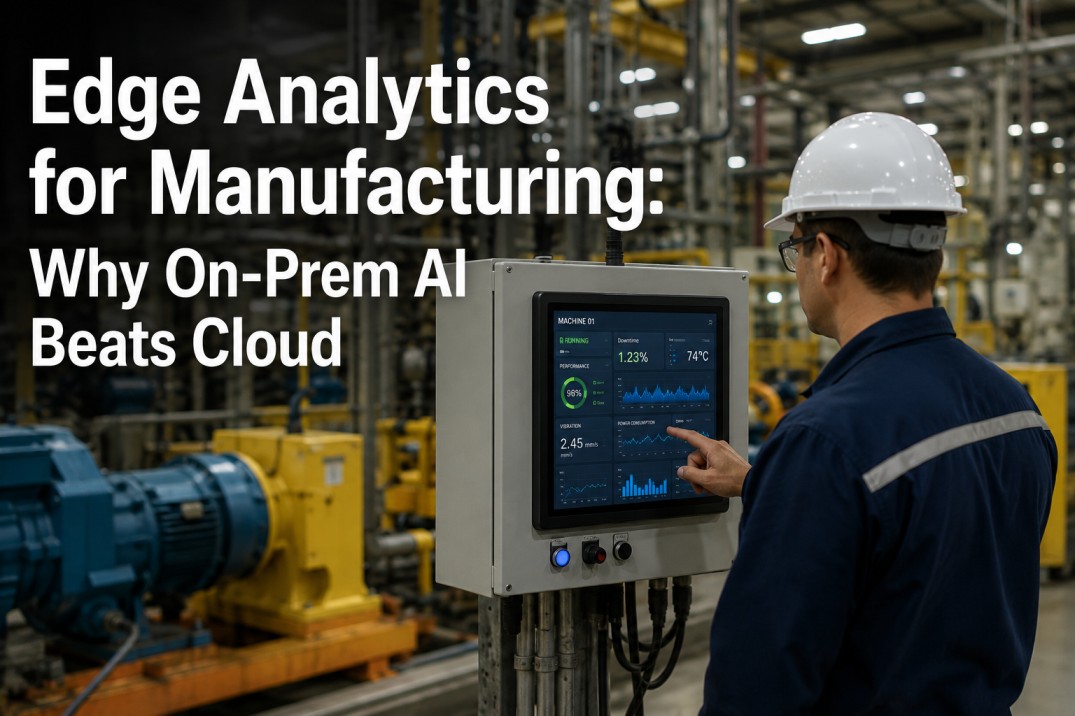
The latency comparison reveals that on-premise deployments are necessary for use cases requiring sub-second data delivery, such as real-time SPC and closed-loop process control. Cloud deployments are well-suited for operator dashboards, production reporting, and multi-plant aggregation where latencies of 2–30 seconds are acceptable. Manufacturing analytics platforms that support edge processing can bridge this gap by running real-time calculations on-premise while syncing results to the cloud for broader visibility and historical analysis.
Feature Depth Comparison
Modern manufacturing analytics platforms offer comparable feature sets across cloud and on-premise deployments, but the depth and implementation of specific capabilities can differ. The feature depth comparison below evaluates capability availability and maturity across fourteen key functional areas, providing a comprehensive view of what each deployment model delivers in practice.
| Feature Area | Cloud | On-Prem |
|---|---|---|
| Real-time Dashboards | ||
| Historical Analytics | ||
| SPC / Control Charts | ||
| ML / Predictive Models | ||
| Multi-Plant Rollup | ||
| API / Integration | ||
| Mobile Access | ||
| Custom Reporting | ||
| Role-Based Access | ||
| Audit Trail | ||
| Alarm & Alerting | ||
| Data Export |
Both deployment models deliver strong core analytics capabilities, but cloud holds an advantage in scalability-dependent features such as multi-plant rollup, ML model training, and mobile access — where elastic compute and global infrastructure provide inherent benefits. On-premise excels in latency-sensitive features like real-time SPC, alarm processing, and audit trail granularity, where local computation eliminates network round-trip delays. Manufacturing analytics platforms that offer feature parity across both deployment models allow organisations to standardise on a single platform regardless of deployment choice.
Evaluate Your Options
Compare Cloud and On-Prem with Your Own Data
iFactory offers identical functionality in both cloud and on-premise deployments. Get a side-by-side comparison tailored to your plant's latency requirements, data volume, and IT infrastructure in a 30-minute demo.
Deployment Decision Flow
Choosing between cloud and on-premise manufacturing analytics is a structured decision process that depends on plant connectivity, latency requirements, data governance policies, and IT team capability. The decision flow below guides teams through the key questions that determine which deployment model best fits their operational context and strategic objectives.
The decision flow provides a structured path through the four most critical factors: latency sensitivity, data sovereignty policy, multi-plant requirements, and internal IT capability. In practice, many organisations find that a hybrid deployment — on-premise edge processing for real-time plant-floor analytics with cloud-based aggregation for enterprise reporting — delivers the optimal balance of performance, control, and scalability.
Security & Compliance Comparison
Security and compliance requirements vary significantly across manufacturing verticals, and the deployment model can directly affect an organisation's ability to meet regulatory obligations. The security and compliance comparison below maps common manufacturing regulatory standards to cloud and on-premise deployment suitability, helping teams assess which model aligns with their compliance landscape.
| Standard / Regulation | Cloud | On-Premise | Best Model |
|---|---|---|---|
| ISO 27001 (Information Security) | Certified | Certifiable | Either |
| IATF 16949 (Automotive) | Achievable | Achievable | Either |
| 21 CFR Part 11 (Pharma) | Possible | Native | On-Prem |
| GDPR (Data Privacy) | Region config | Full control | Either |
| ITAR / Export Control | Restricted | Air-gap capable | On-Prem |
| NIST SP 800-82 (ICS) | Configurable | Native | On-Prem |
| SOX (Financial Controls) | Audit trails | Audit trails | Either |
For regulated industries such as pharmaceutical, defence, and aerospace, on-premise deployment provides the highest level of data sovereignty and air-gap capability — essential for ITAR compliance and environments where data cannot traverse external networks. Cloud deployment with region-specific data centres, compliance certifications, and configurable encryption satisfies the majority of regulatory requirements for automotive, food and beverage, and general manufacturing. Manufacturing analytics platforms that support both deployment models allow organisations to standardise on a single platform while meeting the specific compliance requirements of each plant location and product line.
Frequently Asked Questions
Which deployment model is better for manufacturing analytics in 2026?
There is no universal answer — the best model depends on plant connectivity, latency requirements, data governance policies, and IT team capability. Cloud is generally preferred for multi-plant organisations with reliable internet and elastic scaling needs. On-premise is favoured for single plants with sub-second latency requirements, strict data sovereignty policies, or air-gap security mandates. Many organisations adopt hybrid architectures that combine both models.
Can cloud manufacturing analytics meet real-time latency requirements?
Cloud analytics typically delivers 2–5 second latency for data from plant floor to dashboard, which is sufficient for operator dashboards, shift reporting, and historical analysis. For use cases requiring sub-second latency — such as real-time SPC control chart alerts or closed-loop process control — on-premise deployment or edge processing is necessary. Some platforms offer hybrid architectures with local edge computation and cloud aggregation.
Is cloud manufacturing analytics secure for regulated industries?
Cloud manufacturing analytics platforms with ISO 27001 certification, SOC 2 reporting, data encryption at rest and in transit, and region-specific data centres can meet the security requirements of most manufacturing industries. However, for ITAR/export-controlled environments, defence applications, and certain pharmaceutical serialisation systems, on-premise deployment with air-gap capability remains the required standard.
What is the total cost difference between cloud and on-premise over 5 years?
Cloud deployments typically cost 20–30% less over three years for mid-scale deployments due to lower IT operations overhead and infrastructure management. Over five years, on-premise can achieve cost parity or advantage at very large scale as hardware is fully amortised. The breakeven point depends on plant size, IT staffing costs, data volume growth rate, and whether existing on-premise infrastructure can be repurposed.
Can I run both cloud and on-premise simultaneously?
Yes — hybrid deployments that combine on-premise edge processing for real-time plant-floor analytics with cloud-based aggregation for enterprise reporting and multi-plant comparison are increasingly common. This approach captures the latency benefits of local computation while providing the scalability and accessibility of cloud dashboards. Manufacturing analytics platforms with unified data models support seamless hybrid architectures.
How does cloud manufacturing analytics handle internet outages?
Cloud manufacturing analytics platforms typically include edge caching and local buffering capabilities that continue collecting and processing data during internet outages. When connectivity is restored, cached data synchronises with the cloud backend. The duration of offline resilience depends on the edge cache capacity, which can range from hours to weeks of local data retention depending on the platform configuration and hardware.
Talk to Us
Ready to Choose Your Deployment Model?
iFactory delivers identical manufacturing analytics capabilities in both cloud and on-premise deployments. Our team will help you evaluate latency, security, TCO, and scalability for your specific plant environment. Schedule a 30-minute consultation.