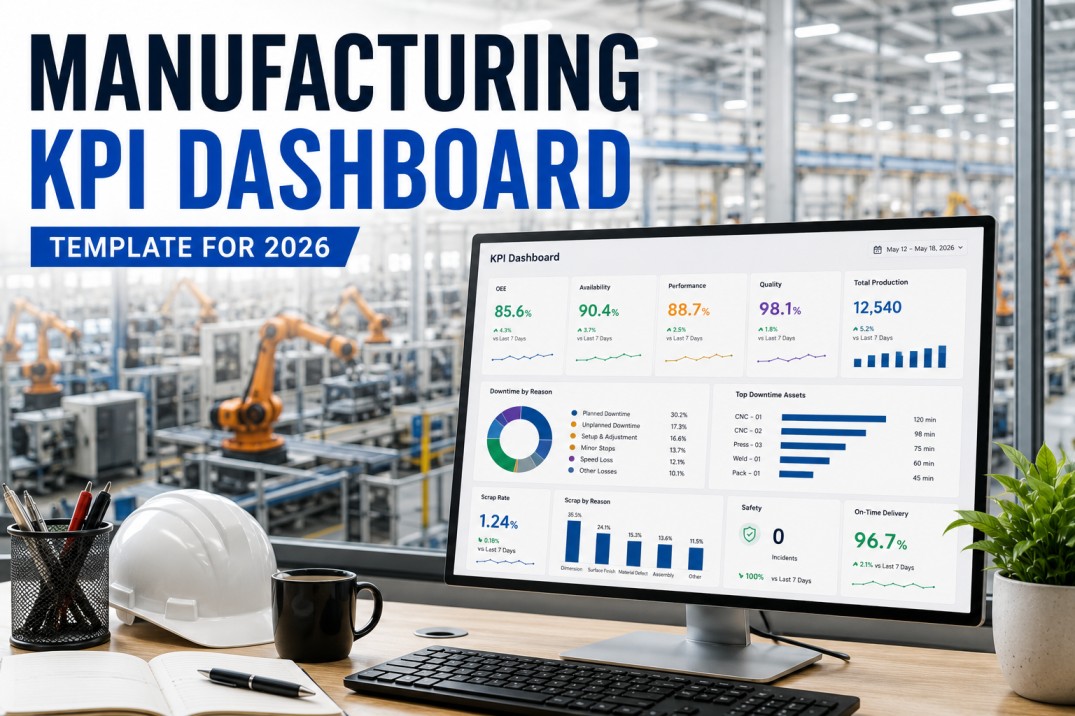
A manufacturing scorecard template that tracks safety, quality, delivery, and cost in a single operational view is the difference between managing a plant by instinct and leading it with data. The SQDC framework — Safety, Quality, Delivery, Cost — has been the standard for plant performance management for decades, yet most plant leaders still build their scorecards manually, pulling data from disconnected systems and spending hours reconciling numbers before every leadership review. iFactory's analytics platform delivers a live SQDC scorecard for every plant, department, and shift, pulling directly from PLCs, CMMS, ERP, and quality systems without spreadsheets or manual data entry. This guide covers what a complete manufacturing scorecard template should include, how to structure SQDC metrics for maximum leadership impact, and why automated scorecards accelerate decision-making velocity across the plant management team.
Deliver a Live SQDC Scorecard to Every Plant Leader Without Building a Single Spreadsheet
iFactory connects to your plant's existing systems and generates live manufacturing scorecard templates for every leadership level — plant manager, department head, and shift supervisor. No manual data pulls. No reconciliation. No delays.
Why a Manufacturing Scorecard Template Is Essential for Plant Leadership
Plant leaders without a structured scorecard template spend 40% of their review time reconciling data instead of making decisions. A standardized SQDC scorecard eliminates data disputes and focuses every leadership meeting on action.
Plant managers using automated SQDC scorecard templates save an average of 5.3 hours per week that was previously spent pulling data from separate systems, checking for errors, and reformatting numbers for leadership reviews.
Plants with live scorecard templates reach decisions in leadership reviews 2.4x faster than plants using static spreadsheets. Disputed numbers drop by 87% when every metric is sourced from the same live data layer.
SQDC scorecards create a single source of truth shared across production, maintenance, quality, and supply chain teams. Cross-functional alignment on priorities improves by 15% within 90 days of deployment.
Your Plant's Data Is Already in Multiple Systems. iFactory Unifies It Into One Scorecard.
A 30-minute demo shows how iFactory connects to your PLCs, CMMS, ERP, and quality systems to build a live SQDC scorecard template populated with your actual plant data — in real time, without spreadsheets.
The Complete SQDC Scorecard: Safety, Quality, Delivery, Cost
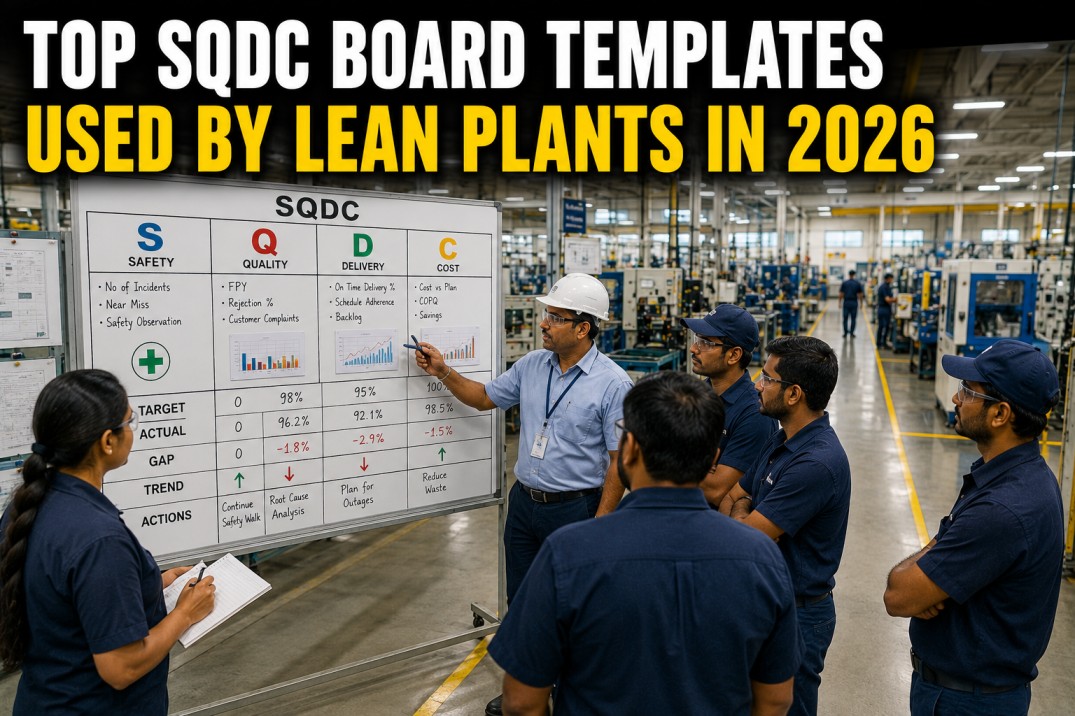
A well-structured SQDC scorecard organizes metrics into four balanced quadrants. Each quadrant includes leading indicators (predictive, forward-looking) and lagging indicators (historical, outcome-based) to provide both early warning signals and trend validation.
Safety
Quality
Delivery
Cost
Scorecard Layers: From Plant Manager to Shift Supervisor
An effective manufacturing scorecard template adapts its granularity to each leadership level while maintaining a consistent data foundation. The same underlying data source populates all three layers — only the aggregation level and time horizon change.
Monthly Strategic Overview
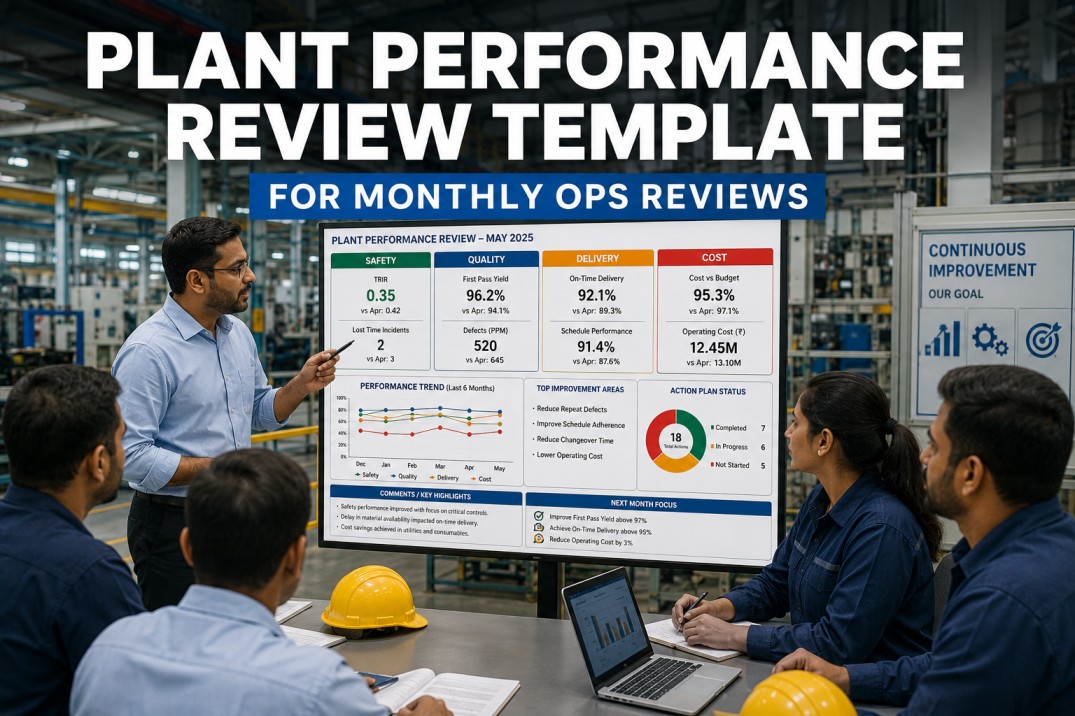
High-level SQDC metrics aggregated across all departments and production lines. Focus on trend direction, target achievement percentages, and exception-based alerts. Includes financial summaries — total manufacturing cost, revenue per unit, and capital efficiency. Updated monthly with weekly flash updates for metrics that exceed threshold bands.
Enables 15-minute leadership reviews focused on exceptions rather than data presentationWeekly Operational Review
Department-level SQDC breakdown by production line, shift, or asset group. Includes leading indicators — PM compliance, training completion, inventory accuracy — alongside lagging metrics. Trend comparison against prior 4 weeks with statistical process control limits for each metric.
Drives cross-functional action within the same week, before small gaps become systemic problemsDaily Operational Dashboard
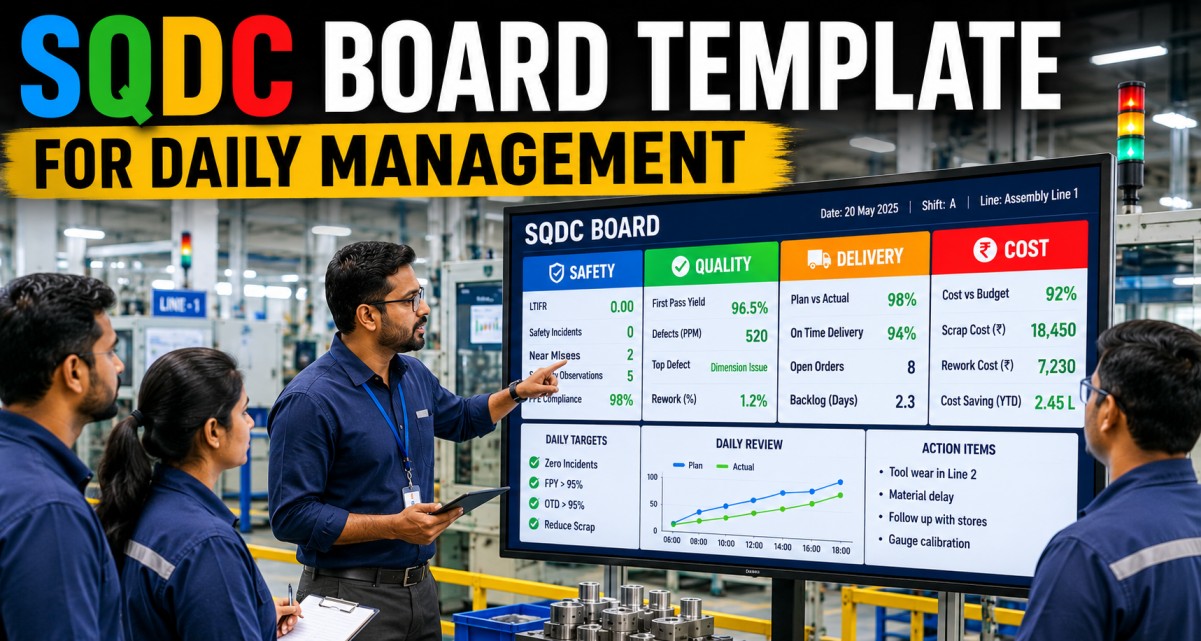
Real-time SQDC metrics at shift and individual asset level. Focus on current-shift performance against daily targets, safety observations, quality holds, and production attainment. Alerts trigger when any metric deviates beyond the control limit for more than 30 minutes.
Enables same-shift corrective action, preventing end-of-shift surprises and downstream quality eventsThree Scorecard Layers. One Data Foundation. Zero Spreadsheets.
Book a 30-minute demo and see how iFactory delivers live SQDC scorecards at every leadership level from the same connected data sources. Plant manager, department head, and shift supervisor scorecards populate automatically.
Scorecard Metric Selection: Leading vs. Lagging Indicators
A balanced SQDC scorecard includes both leading and lagging indicators in each quadrant. Leading indicators predict future performance and enable proactive intervention. Lagging indicators confirm outcomes and validate strategy. The table below maps the recommended metric mix for each SQDC dimension.
| Dimension | Leading Indicators | Lagging Indicators | Update Frequency |
|---|---|---|---|
| Safety | Near miss reports, safety audit scores, training completion, hazard identification rate | TRIR, lost time injury rate, workers' compensation cost, days since last incident | Near misses: daily; TRIR: monthly |
| Quality | In-process defect rate, first-pass yield trend, supplier quality score, calibration compliance | Scrap cost, customer PPM, warranty claims, rework hours, return rate | Yield: real-time; PPM: weekly |
| Delivery | Schedule attainment %, WIP turns, changeover time trend, supplier on-time delivery | OTIF %, backlog days, past-due orders, customer lead time variance | Attainment: daily; OTIF: monthly |
| Cost | OEE trend, energy intensity, labor efficiency, inventory turns, PM compliance | Cost per unit, total manufacturing cost, margin %, maintenance cost per asset | OEE: real-time; cost: monthly |
Data Sources Powering the Manufacturing Scorecard Template
Every metric in an iFactory SQDC scorecard is sourced from live production systems. No manual entry, no spreadsheet uploads, no delayed data. The data sources below cover the full spectrum of scorecard inputs across all four SQDC dimensions.
Frequently Asked Questions About Manufacturing Scorecard Templates
What is the difference between a manufacturing scorecard and a dashboard?
A manufacturing scorecard and a dashboard serve different purposes. A scorecard tracks performance against strategic targets over a defined time period — it answers "are we meeting our goals?" SQDC scorecards are typically reviewed weekly or monthly and focus on trend direction, target variance, and balanced performance across all four dimensions. A dashboard provides real-time operational data — it answers "what is happening right now?" Dashboards update continuously and focus on current-shift metrics like production count, downtime, and quality events. iFactory delivers both. The scorecard template aggregates data from the same real-time dashboards into time-bound summaries with target comparisons, creating a seamless connection between daily operations and leadership reviews.
How many metrics should a manufacturing scorecard template include?
The most effective SQDC scorecards include 4-6 metrics per quadrant, totaling 16-24 metrics. Fewer than 12 metrics risks oversimplifying plant performance — a single safety metric cannot capture both leading and lagging dimensions. More than 30 metrics creates cognitive overload and dilutes focus during leadership reviews. The 4-6 per quadrant structure forces deliberate metric selection: each metric should have a clear data source, a defined target, and an explicit decision threshold. iFactory's scorecard engine supports unlimited metrics but recommends starting with the critical few: 4 safety, 5 quality, 4 delivery, and 5 cost metrics cover the essential leadership information without overwhelming reviewers.
How does iFactory handle scorecard target setting and variance tracking?
iFactory's scorecard template engine supports target setting at multiple levels. Annual targets cascade to quarterly and monthly targets automatically with linear or nonlinear distribution. Variance is calculated as actual vs. target with percentage and absolute difference displayed in each scorecard cell. Color coding uses standard traffic light logic: green for on-target or above (within 5% of target), yellow for cautionary (5-15% below target), red for critical (more than 15% below target). Variance bands are configurable per metric — safety metrics typically have tighter tolerance bands than cost metrics. iFactory also supports target revision tracking, so leadership can see whether targets were adjusted during the period and why.
Can a manufacturing scorecard template include custom metrics beyond SQDC?
Yes. While SQDC is the most widely adopted framework for plant scorecards, iFactory's template engine supports any metric structure. Common custom additions include an Environment quadrant (carbon emissions, waste diversion rate, water usage), a People quadrant (training hours per employee, turnover rate, certification completion), or an Innovation quadrant (continuous improvement projects completed, idea generation rate, automation ROI). The template structure — leading and lagging indicators per dimension, target comparison, trend direction — remains the same regardless of which quadrants you define. iFactory's deployment team typically recommends starting with standard SQDC and adding custom quadrants in a second phase once the base scorecard is operational.
How long does it take to deploy an automated SQDC scorecard template?
iFactory's standard scorecard deployment takes 2-4 weeks for a single facility. Week one covers data source connection — PLCs, CMMS, ERP, and quality systems are integrated into the unified data layer. Week two covers metric definition, target configuration, and scorecard template layout. Week three covers user access setup, role-based scorecard views (plant manager, department manager, shift supervisor), and leadership team training. Week four covers go-live with parallel run to validate data accuracy against existing reporting. Most plants have a live, accurate SQDC scorecard replacing their spreadsheet-based process within 20 business days. Multi-site deployments typically require 2-3 weeks per additional site after the first.
Your Next Plant Leadership Review Deserves Better Than a Spreadsheet Scorecard.
A 30-minute demo shows how iFactory builds live SQDC scorecards from your existing systems — PLCs, CMMS, quality, and ERP — delivering accurate, real-time metrics to every leadership level without spreadsheets or manual data entry.