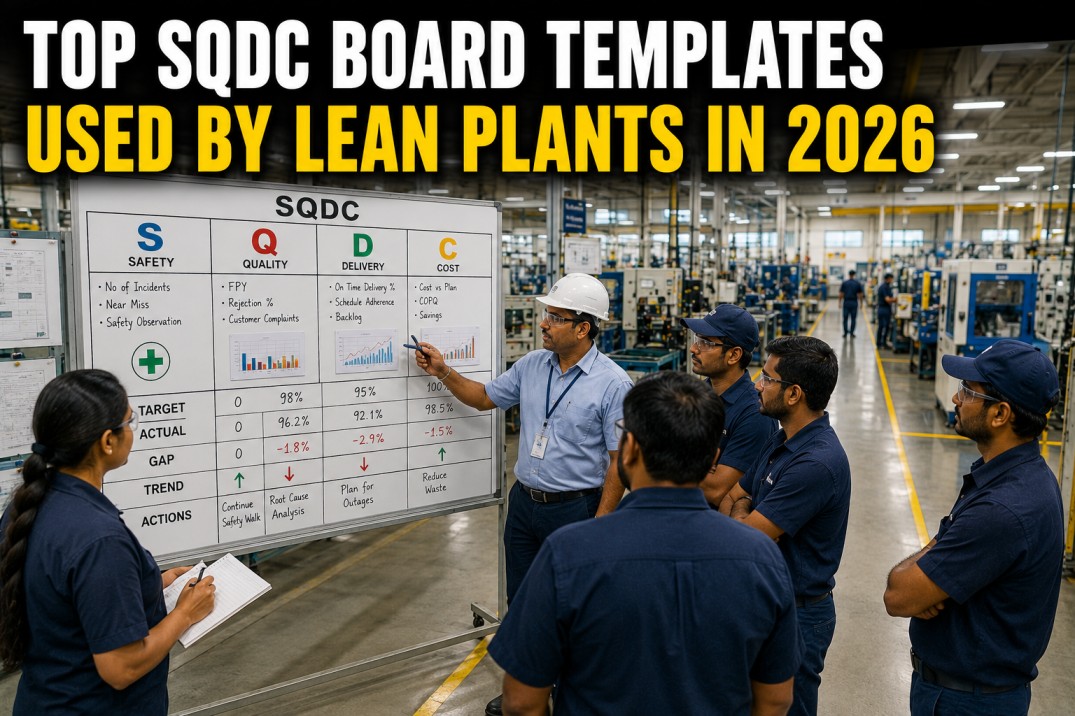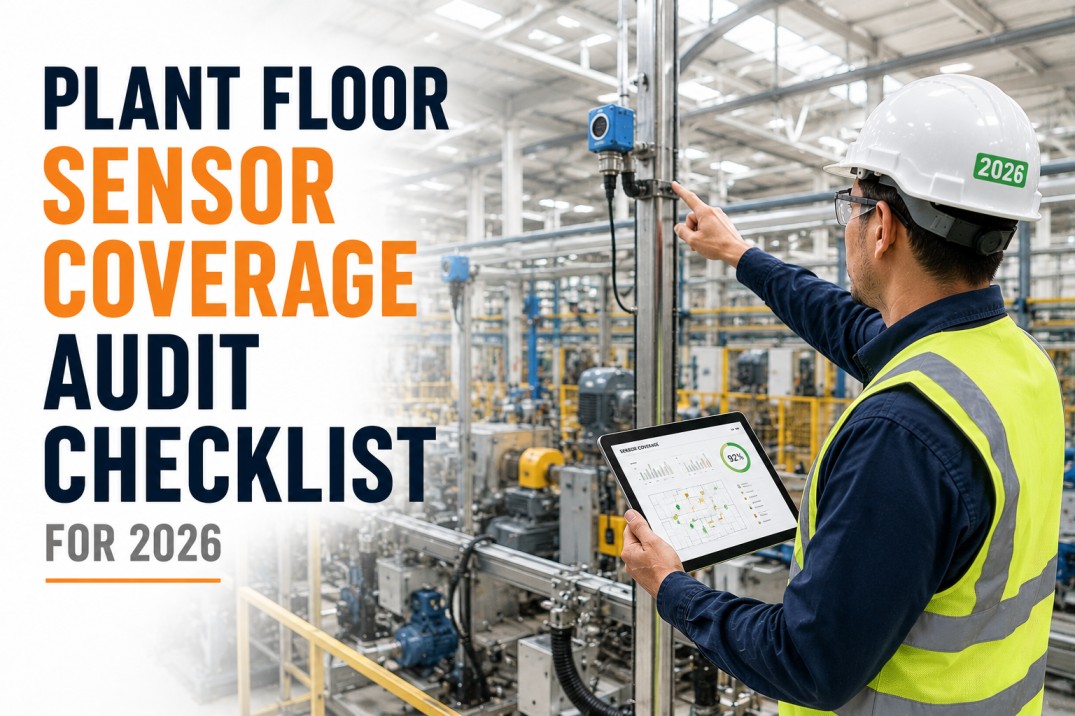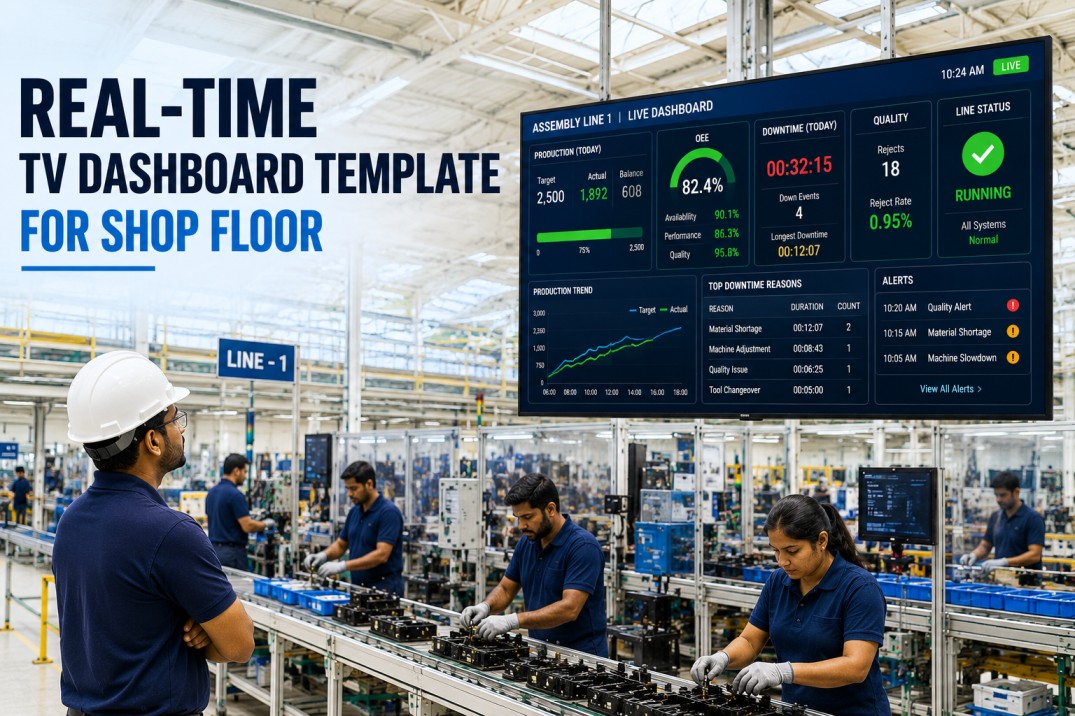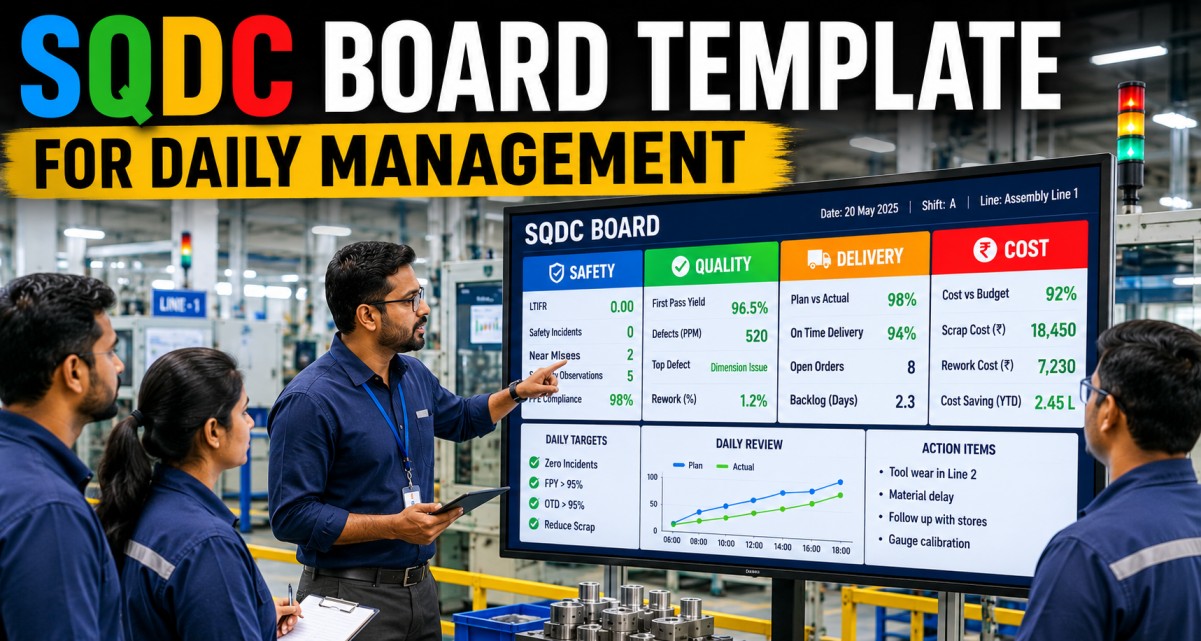
Most manufacturing plants have invested in visual management — whiteboards, digital displays, andon lights — but few have a structured process to audit whether those tools actually drive performance. Boards go stale. Metrics drift. Displays become wallpaper. Without a formal audit framework, visual management decays from a lean discipline into decoration.
This checklist gives plant managers, lean leaders, and continuous improvement teams a systematic audit framework for every visual management element on the plant floor — from production dashboards and quality boards to andon alert systems and shift handover displays. Use it to assess board effectiveness, identify gaps in metric relevance, and build a roadmap toward a truly visual factory.
iFactory replaces static whiteboards with live digital displays that update automatically from your production systems — no manual entry, no stale data.
Visual Management Is Only as Good as Its Last Audit
Without regular audits, visual boards lose their purpose. Metrics become stale, layouts drift from standards, and teams stop relying on them for decisions. The data tells the story.
Visual Management Audit Checklist
Work through each domain. Every checklist item maps to a measurable standard for board effectiveness, data integrity, or team engagement.
-
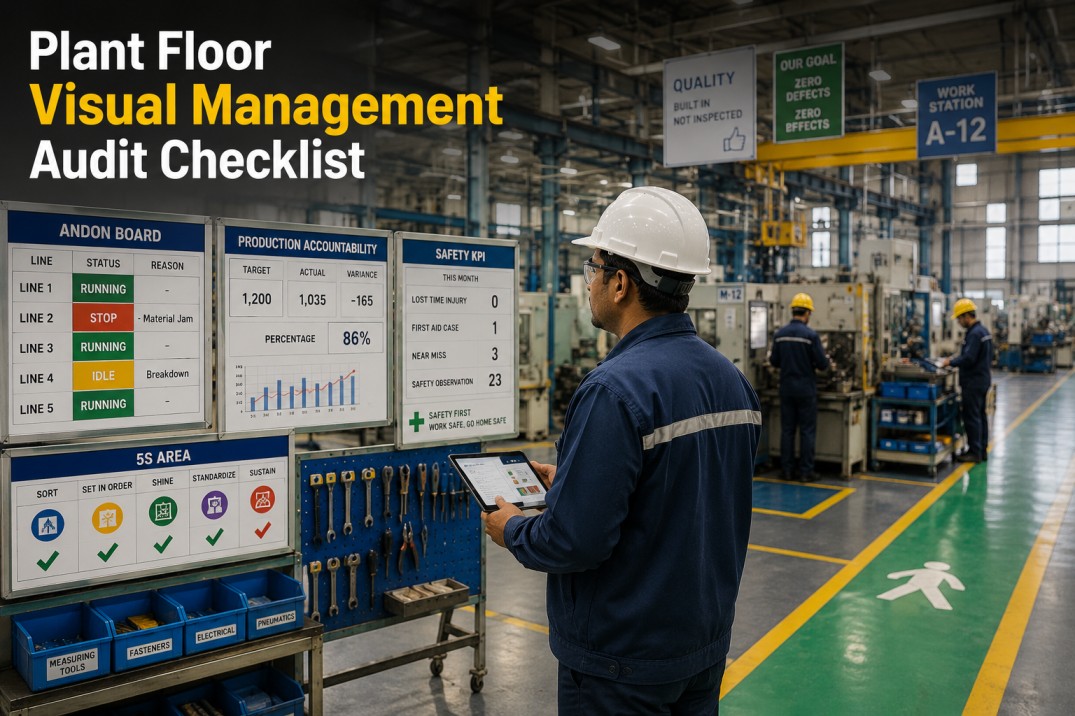
Board displays current shift target vs actual attainment Every production board must show the current shift's target and actual output. Attainment percentage should be calculated automatically or updated at each huddle. Target must be visible and unambiguous. -
OEE or primary efficiency metric displayed with trend OEE (or the area's primary efficiency KPI) must be posted with at least the last 4 weeks of trend data. A single snapshot number without context is insufficient for identifying performance direction. -
Downtime tracked by category with Pareto analysis Downtime must be logged by category (mechanical, electrical, material, changeover, awaits). A Pareto chart or ranked list should be displayed showing the top 3-5 downtime drivers for the current period. -
Visual standard template followed consistently Board layout must match the site's visual standards playbook. Zone positions, color coding, font sizes, and icon usage should be identical across all production boards to enable instant recognition. -
Board owner and last-updated date clearly displayed A named board owner and the date of last update must be visible on the board. If the data is more than one shift old, the board should flag itself as requiring refresh before the next huddle.
-
First-pass yield and defect Pareto displayed Quality boards must show current first-pass yield (FPY) with a target line overlay. A defect Pareto chart identifying the top defect types ranked by frequency or cost should be updated at least weekly. -
Safety leading and lagging indicators visible Days since last lost-time incident, near-miss count for the current period, and open safety corrective actions must be displayed. Leading indicators (audit scores, training completion) should balance the reactive lagging metrics. -
CAPA register with owner and due dates Open corrective and preventive actions must be listed with assigned owners, due dates, and current status. Overdue items should be highlighted in red. Closed actions should show results and closure date. -
Audit scores trended over rolling 12 months Internal and external audit scores must be charted monthly for the past 12 months. The trend line should include the plant's target score and any regulatory minimum threshold.
-
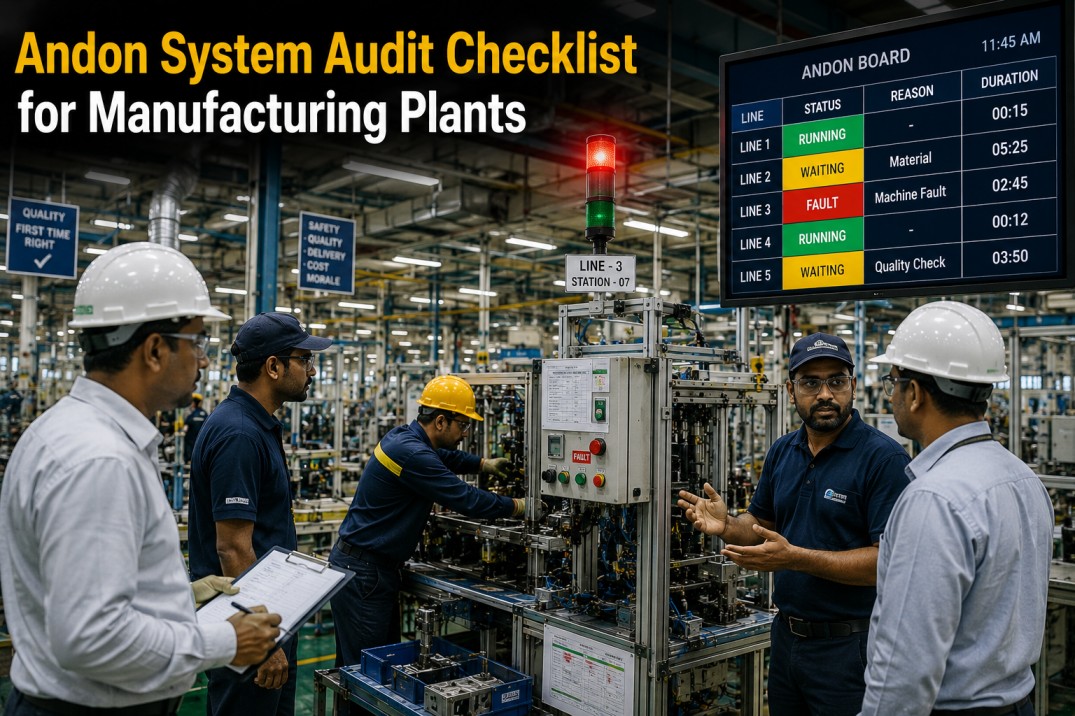
Active alerts visible on dedicated andon display A dedicated andon display or screen must show all active production alerts. Each alert must specify the area, issue type, elapsed time, and responder assigned. Alerts should be color-coded by severity. -
Escalation rules defined and posted Escalation levels and response time targets must be posted next to the andon display. If an alert exceeds its response SLA, the system must escalate to the next level automatically with clear notification. -
Alert history and response time metrics tracked Historical data on alert frequency, mean time to respond, and mean time to resolve must be maintained and reviewed weekly. A response time compliance percentage should be calculated against defined SLAs. -
Andon triggers mapped to production events Each andon trigger must be directly linked to a production event — machine fault, quality deviation, material shortage, or safety stop. Triggers without clear event mapping lead to alert fatigue and should be eliminated.
Visual Management KPI Reference: What to Measure on Every Board
Below is a consolidated reference of the primary KPIs that should appear on each board type, with recommended target ranges and the lean principle they support.
| KPI | Board Type | Recommended Target | Update Frequency | Lean Principle |
|---|---|---|---|---|
| OEE (Overall Equipment Effectiveness) | Production | ≥ 85% world-class | Per shift / real-time | TPM — Autonomous Maintenance |
| Schedule Attainment | Production | ≥ 95% | Per shift | JIT — Takt/Heijunka |
| First-Pass Yield (FPY) | Quality | ≥ 97% | Daily | Jidoka — Built-in Quality |
| Defect PPM | Quality | Plant-specific target | Daily | Jidoka — Defect Prevention |
| Days Since Last LTI | Safety | ≥ 30 days minimum | Daily | Respect for People — Safety First |
| Near-Miss Reporting Rate | Safety | ≥ 2 per 100 employees/month | Weekly | Respect for People — Proactive Safety |
| Mean Time to Respond (MTTR) | Andon | ≤ 3 minutes | Per event / real-time | Jidoka — Andon / Stop-the-Line |
| Kaizen Implementation Rate | Continuous Improvement | ≥ 1 per employee per quarter | Weekly | Kaizen — Continuous Improvement |
| 5S Audit Score | Standard Work | ≥ 80% | Monthly | 5S — Sort, Set, Shine, Standardize, Sustain |
| Visual Board Audit Score | All Boards | ≥ 32 / 40 (80%) | Monthly | Standardized Work — Visual Factory |
Automate every board on this checklist — from production dashboards to andon alerts — without custom development.
Connect your production systems, set your targets, and let iFactory keep every visual board accurate and updated in real time.
Visual Board Effectiveness Scorecard: Rate Each Board Against 10 Criteria
Score each visual board or display area against ten criteria. Use the guide below: 1 = absent or broken, 2 = partial but inconsistent, 3 = functional, 4 = well-executed, 5 = exemplary. Total out of 50 — a score below 30 indicates the board needs a redesign.
| # | Criteria | Weight | Score 1–5 | Weighted Score |
|---|---|---|---|---|
| 1 | Board positioned in line of sight, well-lit, readable from 10 ft | 2× | 8.0 / 10 | |
| 2 | Metrics show date/time of last update; data within defined cadence | 2× | 6.0 / 10 | |
| 3 | All metrics tie directly to team- or area-level goals; no vanity metrics | 1.5× | 4.5 / 7.5 | |
| 4 | Board follows site standard template — consistent zones, colors, icons | 1.5× | 6.0 / 7.5 | |
| 5 | Action register with owners, due dates, and status visible on board | 1.5× | 3.0 / 7.5 | |
| 6 | Named board owner displayed; backup assigned for absences | 1× | 3.0 / 5 | |
| 7 | Color coding follows site standard (green/yellow/red with clear definitions) | 1× | 4.0 / 5 | |
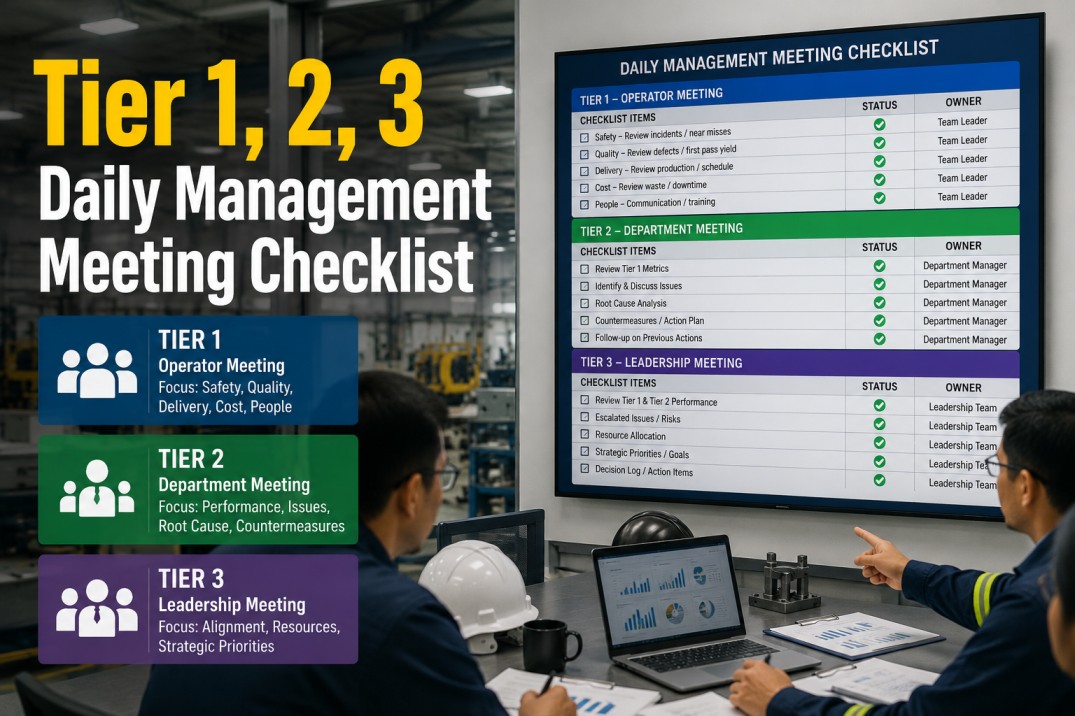
| 8 | Huddle conducted daily at board with structured agenda | 1.5× | 4.5 / 7.5 | |
| 9 | Historical trend data visible (minimum 4 weeks for production boards) | 1× | 2.0 / 5 | |
| 10 | Digital or automated update in place where available | 1.5× | 1.5 / 7.5 |
From Analog to Intelligent: The 4-Stage Visual Management Maturity Model
Visual management capability progresses through four stages. Each stage builds on the previous one, adding depth of insight, automation, and cross-functional integration.
Manual boards updated by hand. Inconsistent formats across areas. Data integrity depends entirely on the person updating. Huddles are informal with no standard agenda.
Standardized board templates deployed across all areas. Data pulled from production systems at regular intervals. Metrics aligned to departmental KPIs with consistent formats.
Displays integrated with MES, ERP, and IIoT. Metrics update in real time. Alerts trigger automatically when thresholds are breached. Board content adapts by shift and audience role.
System predicts near-term outcomes based on historical patterns. Boards recommend corrective actions and route issues to responders automatically. Cross-plant benchmarking is standard practice.
Cost of Poor Visual Management: Quantifying the Hidden Impact
Poor visual management is not a soft cost — it has direct financial consequences across every shift. The table below quantifies the annual impact of common visual management gaps in a typical mid-size manufacturing plant.
| Gap | Daily Impact | Annual Cost Estimate | Root Cause |
|---|---|---|---|
| Stale board data used in shift huddle | 12-minute delay per shift verifying actual numbers | $18,000 – $36,000 | No automated data feed to visual displays |
| Missed andon escalation | 1.7 additional minutes mean time to respond | $24,000 – $85,000 | No automatic escalation or alert routing |
| Inconsistent board formats across lines | 5 min per huddle spent orienting new or rotating team members | $12,000 – $24,000 | No visual standards playbook or enforcement |
| No action tracking on boards | 5–15% of corrective actions slip past due dates | $30,000 – $120,000 | No visible action register with owners |
| No historical trend data displayed | Decisions made without performance context | $15,000 – $50,000 | No data archiving or trend visualization |
The 6 Most Common Visual Management Gaps Found in Plant Audits
Based on audit patterns across U.S. manufacturing plants, these gaps appear most frequently and carry the highest operational impact.
Boards show raw counts without context against target or plan. A number that says "342 units" means nothing without the target attached. Without normalized attainment percentages, teams cannot assess performance at a glance.
Most boards have no timestamp or last-updated indicator. During audits, 60% of boards with no date stamp contain at least one metric that is more than one week old. A visible last-updated field is the single lowest-cost fix with the highest impact.
Without a structured huddle board or agenda template, huddles drift into status updates rather than problem-solving. Effective huddles follow a consistent format: review past performance, highlight current gaps, assign actions, and confirm escalation items.
When every area designs its own board layout, cross-plant consistency is lost. A visual standards playbook — defining zones, colors, iconography, and font sizes — is the essential reference document that ensures a team member can walk into any area and immediately understand the board.
Many plants have andon lights or displays showing current alerts but have no way to trend response times or alert frequency over time. Without historical data, it is impossible to identify systemic issues like a zone that consistently exceeds response SLAs.
Plants remain on manual whiteboard systems indefinitely because there is no phased plan to migrate to digital displays. The absence of a roadmap means the organization never moves beyond Level 1 of the maturity model, and the benefits of real-time data and automated andon remain unrealized.
Frequently Asked Questions
Stop managing visual boards with sticky notes and spreadsheets. iFactory gives your team live digital displays, automated data updates, and standardized templates across every board type — out of the box.