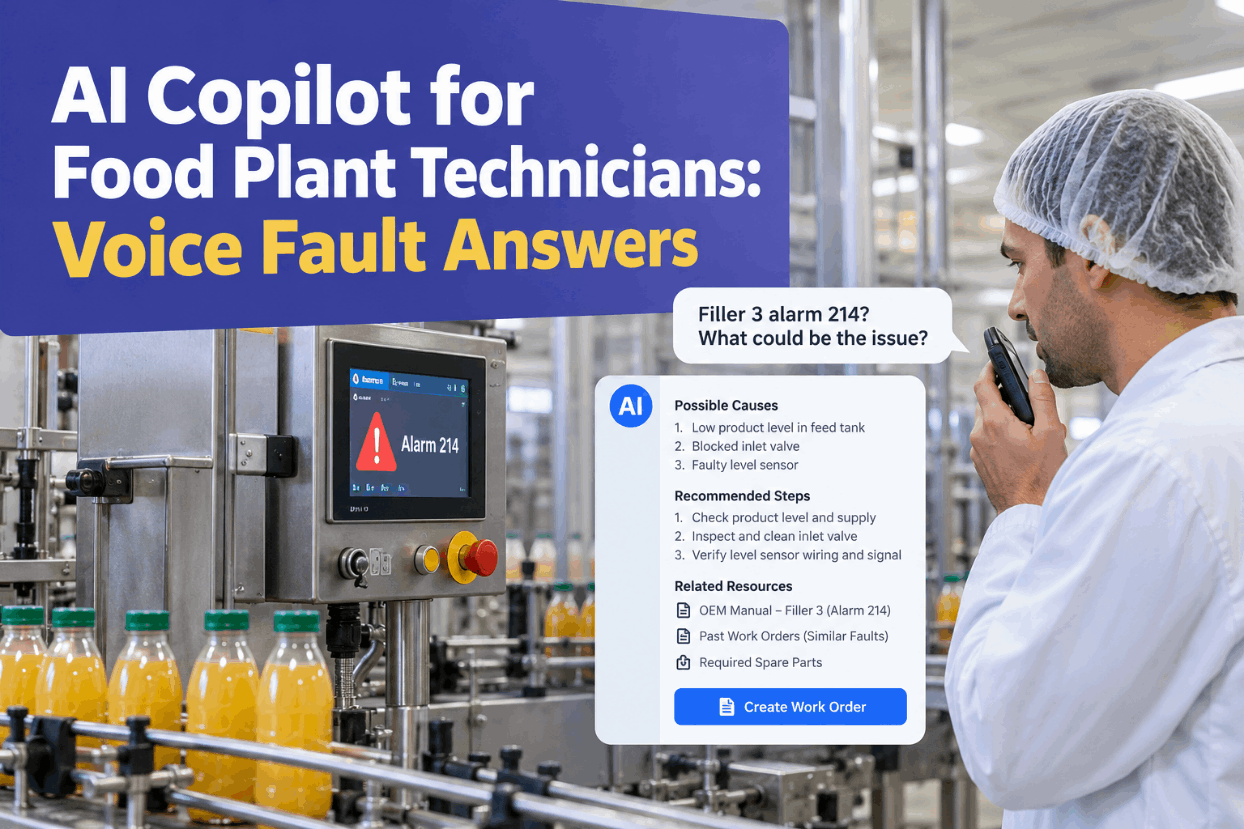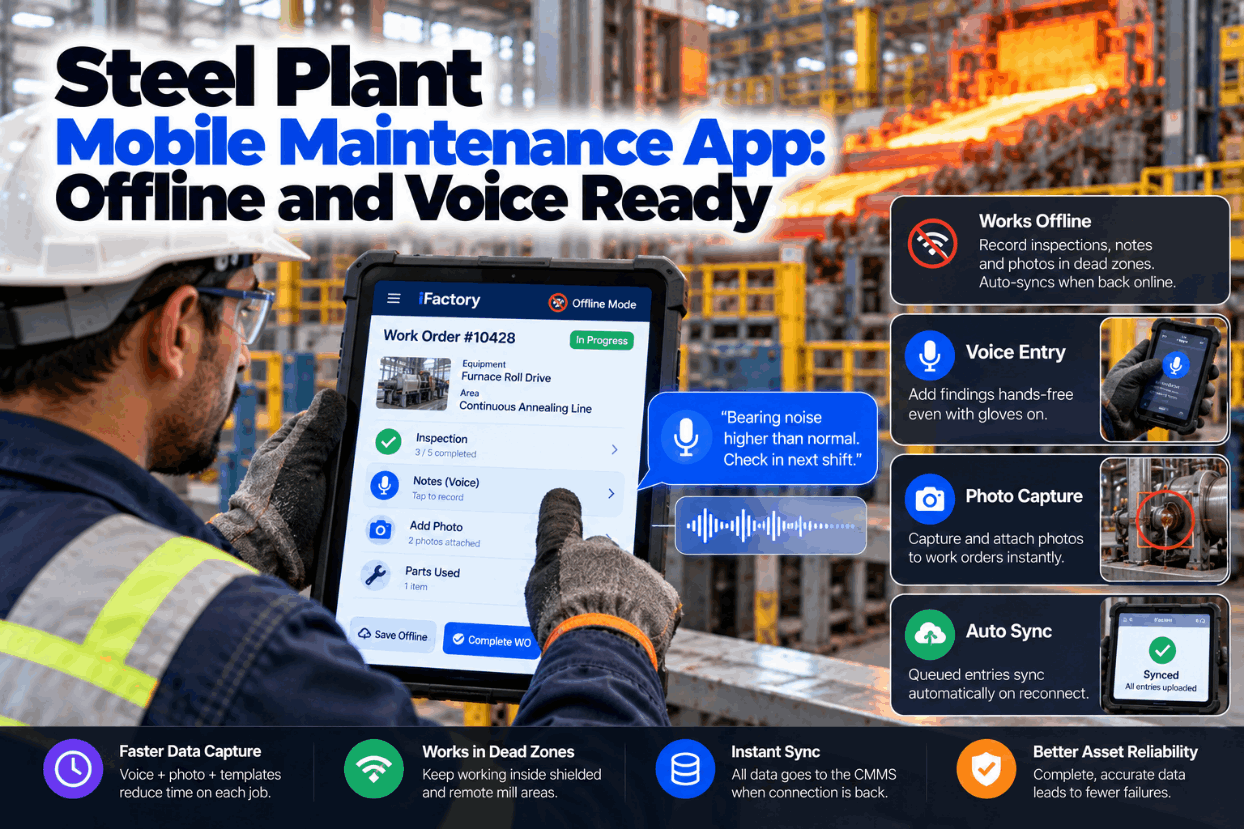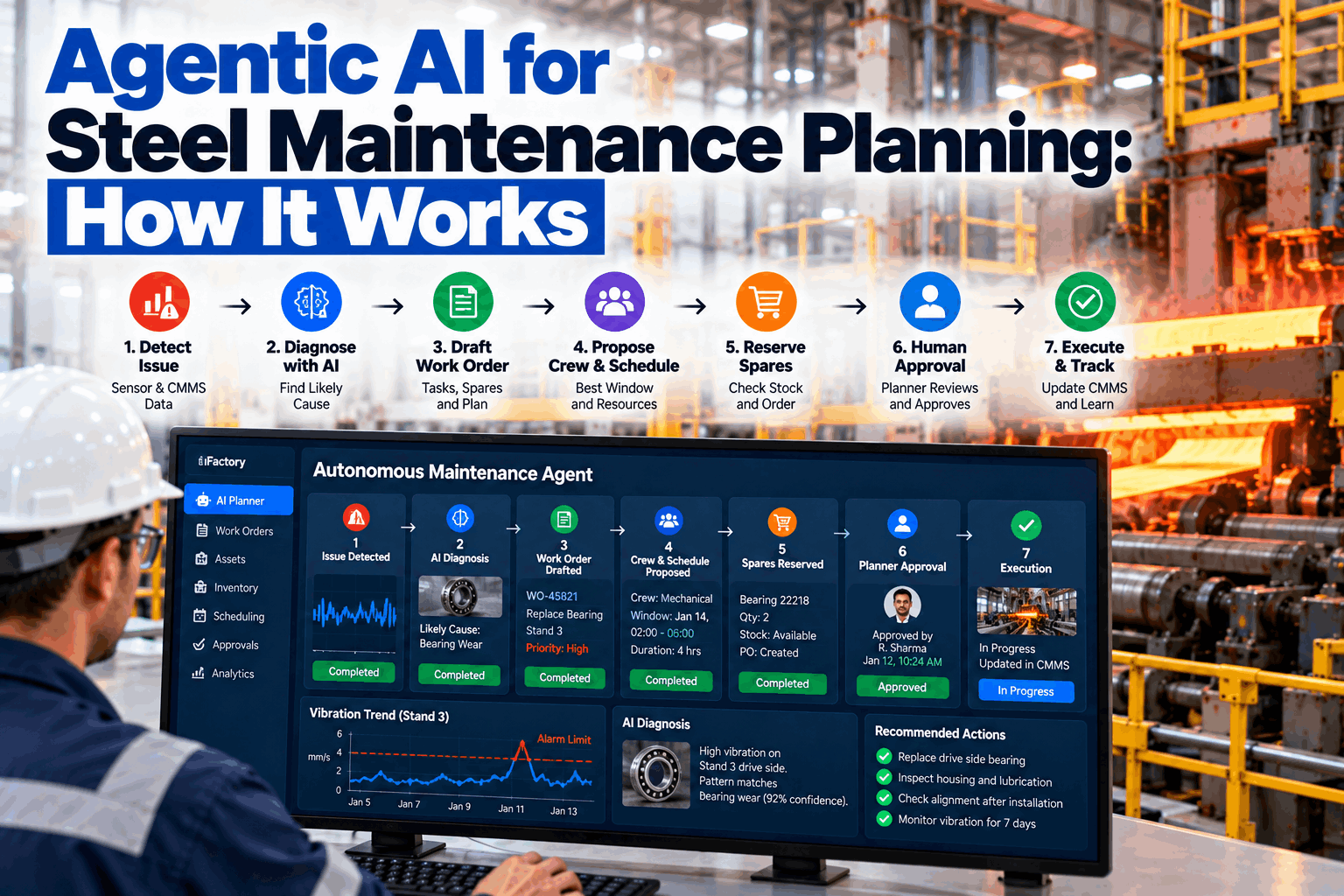
A technician at the hot strip mill descaler does not need a chatbot that sounds sure of itself. They need an answer that points to the manual page, drawing or past job behind it, and says plainly when the library has nothing. This guide is for maintenance leads buying and rolling out an AI maintenance copilot in a steel plant: what it reads, how it drafts work orders, how to test it and who governs it. Trace one answer in a sourced answer demo.
Every Answer Shows Its Source, or Says It Has None
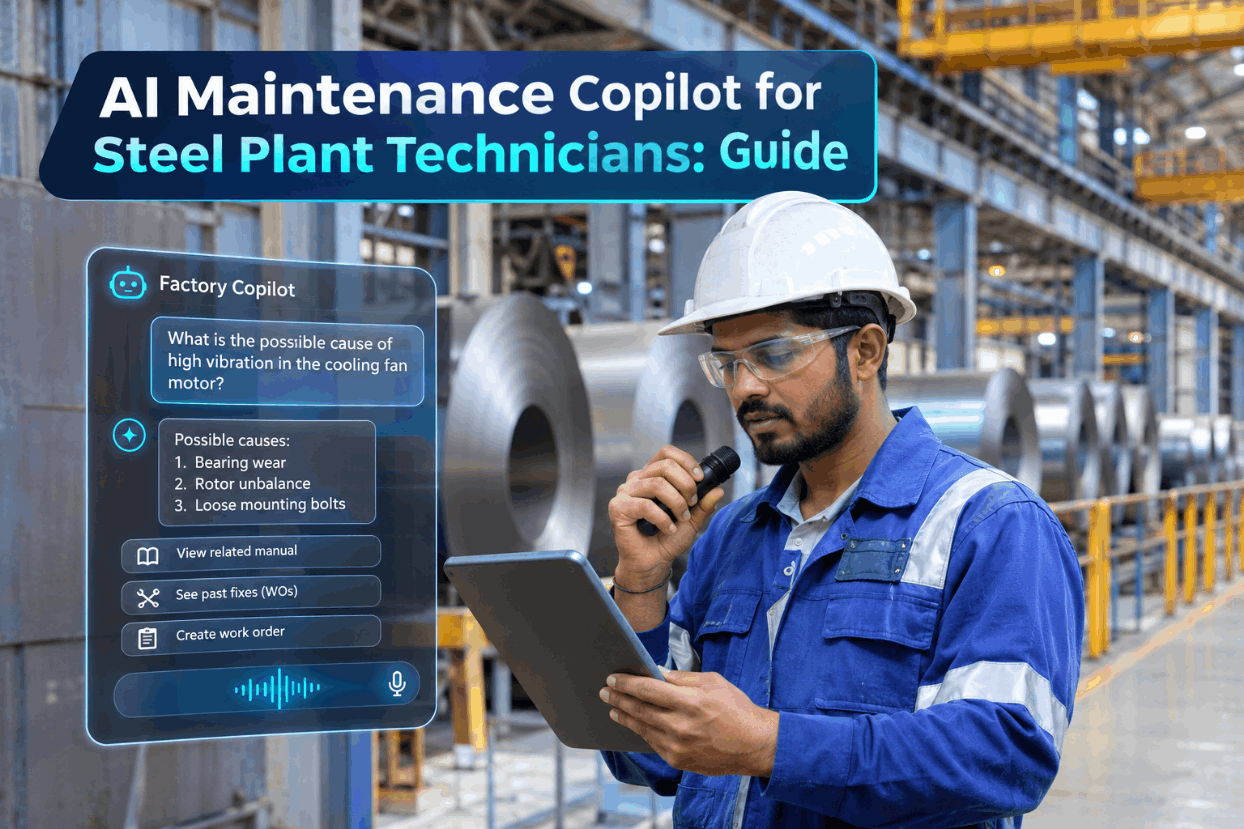
iFactory Factory Copilot answers spoken and typed questions from your own manuals, work order history and P&IDs. Each step carries a chip naming the page, job or drawing behind it, and the conversation becomes a draft work order the technician checks before it is saved.
Suction valve fully open and inlet strainer clean. A starved suction is the first item in the low-discharge chart.
OEM manual §5.2 p.41Unloader valve seat passing. The last low-pressure job on this pump found exactly that.
WO-61207Minimum-flow return valve to the tank passing water back.
P&ID 2-DSC-014 rev CIndexed From Your Library, Not Trained on It
Most buyers ask what the copilot is "trained on". The honest answer is that the language model is not retrained on your plant. Your documents are split into passages and indexed, and each question pulls the closest passages before an answer is written. This is retrieval-augmented generation, described by Lewis and colleagues at NeurIPS 2020, and it is what makes a citation possible. Ask which of your sources it can read in a library walkthrough.
Scanned Drawings and Old PDFs Need Work Before Day One
Steel plants keep decades of drawings, many scanned at low resolution with hand mark-ups. A copilot can only cite what it can read, so each document goes through four steps before anyone asks a question. On P&IDs, instrument tags follow the identification rules of ANSI/ISA-5.1, revised in October 2024 as Instrumentation and Control Symbols and Identification, which lets a tag such as PT-1404 link to its loop. Send us a sample drawing set via our support team.
A P&ID shows what was drawn, not what was changed during the last outage. When an answer depends on a valve or line, the copilot cites the sheet and its revision so the technician knows to confirm it on a walk-down.
Conversation, Draft, Technician Review, Then Saved
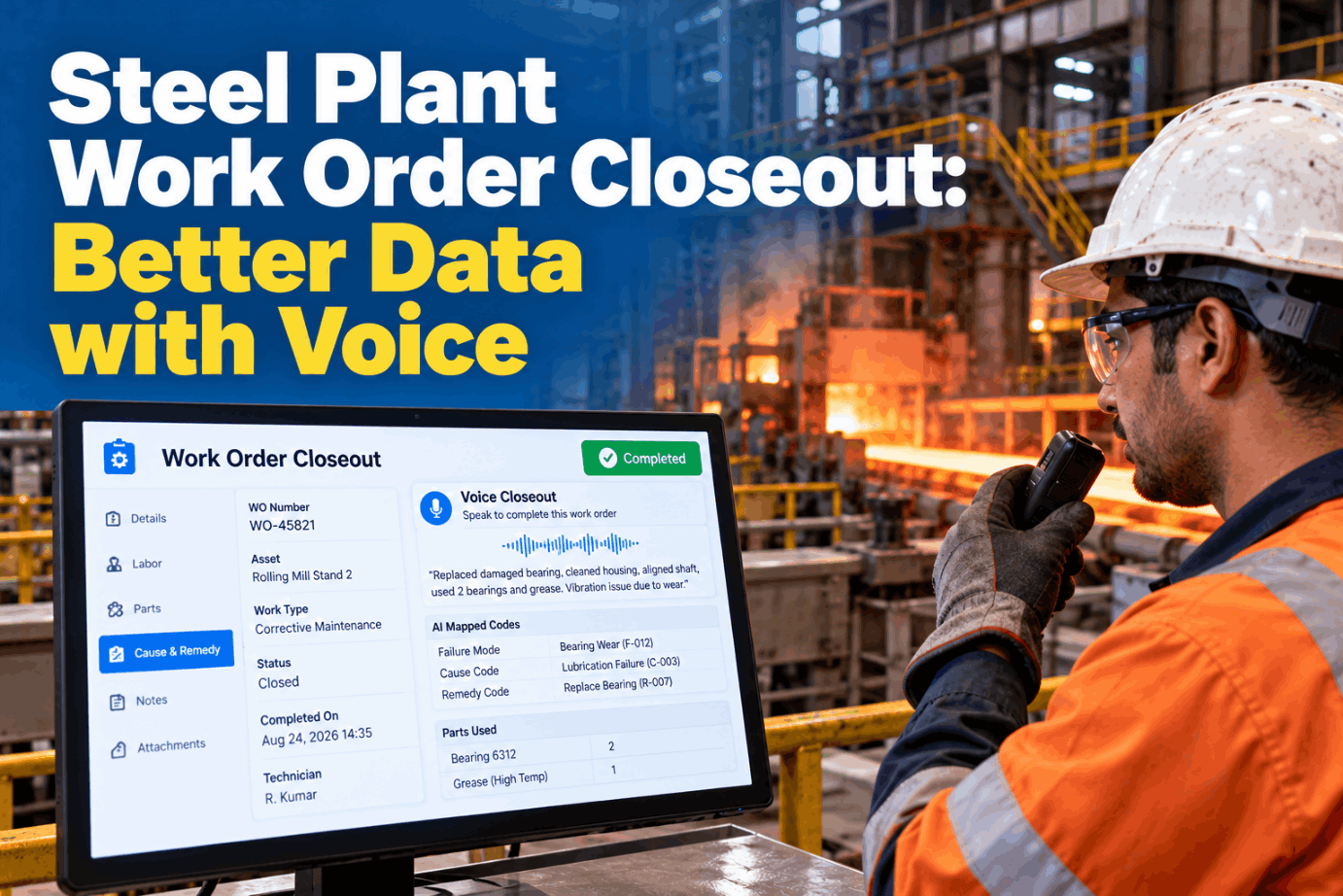
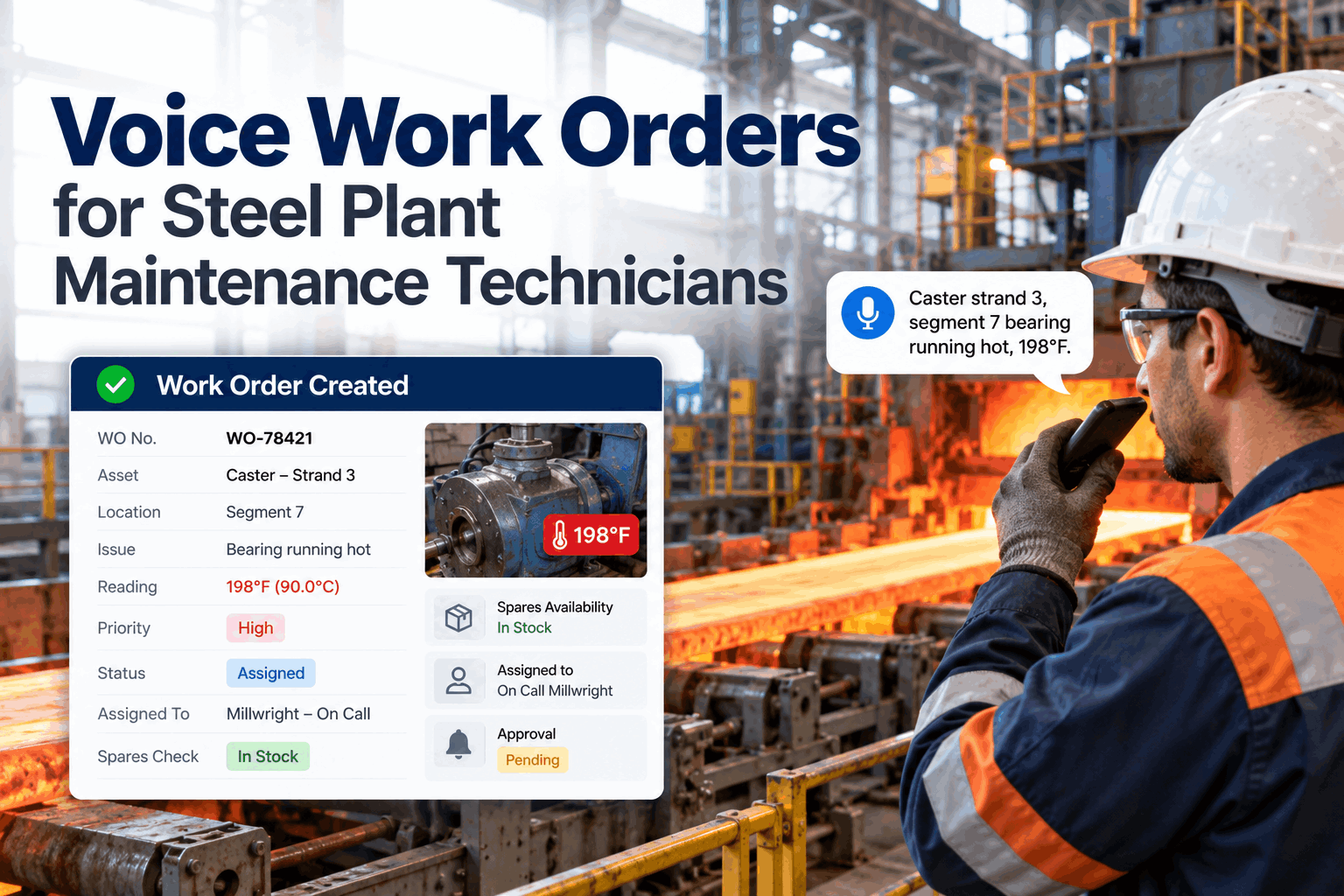
Much of a closeout is already said aloud during the job: the symptom, what was checked, what was found and what was fitted. The copilot builds a draft from that conversation, but a draft is not a record. Nothing reaches the CMMS until the technician has heard or read it, corrected it and confirmed it. See the review step in a drafting demo.
- Asset, symptom and checks done
- Cause the technician named
- Parts spoken, matched to stores
- Uncertain fields marked, not guessed
- Each field read back or shown
- Wrong cause or part fixed in one phrase
- Open questions stay visible
- Draft can be rejected outright
- Reviewer and time recorded
- Sources used in the answer attached
- Parts issued against the job
- Planner sees any follow-up work
What the Copilot Will and Won't Answer
Guardrails are rules, not model moods. The OWASP Top 10 for LLM Applications 2025 lists risks that map straight onto a plant: misinformation (LLM09), sensitive information disclosure (LLM02) and excessive agency (LLM06), the last meaning a model allowed to act beyond what it should. The matrix shows how each kind of question is handled. Review your own refusal list with our safety team.
A Copilot That Says "No Source Found" Out Loud
The most useful answer is sometimes a refusal. When nothing in the library covers a safety-critical value, Factory Copilot says so, logs the gap for the planner and keeps it open on the draft.
Manuals, Questions and Answers Stay Inside the Plant
Steel plants hold OEM manuals under licence, drawings that reveal process know-how and work orders that name people. Many security teams will not send those to a public AI service. The copilot runs on a server in your own network, so indexing, retrieval and answer writing all happen on site. Talk through your network rules in a deployment call.
Grade the Copilot on Your Questions Before Technicians Rely on It
A demo on vendor questions proves little. Build a question set from your own closed work orders and technician interviews, and include questions the library cannot answer. Grade three things: is the answer right, does the cited page actually support it, and does it refuse when it should? Citation support needs its own check: the ALCE study (Gao et al., EMNLP 2023) found even the best models it tested lacked complete citation support about half the time on one long-answer dataset. Get help drafting the set from our support team.
One Mill Area at a Time, Each With a Gate
Rolling a copilot out plant-wide on day one spreads a thin library across every asset. Go area by area instead. Each wave loads its documents, passes its own question set and then opens to every shift. The order below is an example for an integrated mill; pick yours by fault volume and document quality. Plan your waves in a rollout session.
A Worksheet Built on Lookup Time and Closeout Time
Every input below is assumed. Replace each one with a baseline measured over a few weeks before go-live. Downtime value is left out on purpose, because it is only real once your own repair data shows a change. Run the worksheet with your numbers through our planning team.
Governance Checklist Mapped to the NIST AI RMF
NIST released its AI Risk Management Framework 1.0 on 26 January 2023, built on four functions: govern, map, measure and manage. They make a practical frame for a plant copilot, with named owners rather than a policy nobody reads. Tick through the list with your EHS, IT and maintenance leads in a governance review.
The Copilot Server Arrives With Your Library Already Indexed
iFactory delivers Factory Copilot as one hardware and software package. A pre-configured NVIDIA AI server ships racked and ready, with the copilot software pre-loaded and your first area's manuals, drawings and work orders indexed at our facility before shipping. You rack it, plug in power and Ethernet, and the AI is live. Also in scope: cabling, network set-up, PLC/SCADA integration, operator and technician training, and 24×7 remote monitoring. Ask for a quote from our rollout engineers.
- Voice and chat copilot software, pre-loaded
- Pre-configured NVIDIA AI server, shipped in its rack
- Manual, P&ID and work order indexing with revision lock
- Training for technicians, with 24×7 remote monitoring
- Role permissions mirrored from your CMMS
- Draft-and-review work order link into your CMMS
- Cabling, network and PLC/SCADA integration
Server racked, documents read, split, tagged and locked to approved revisions.
Question set run, citation support checked, refusal list signed off by EHS.
Voice and chat live for the area, drafts flowing to the CMMS, next wave planned.
A Technician Assistant That Shows Its Working
iFactory gives steel plant crews answers they can check, drafts they can correct and refusals they can trust. Put it against your own descaler, caster or crane questions in a 30-minute session.
What Steel Maintenance Leads Ask Before Buying a Copilot
Give Every Shift an Answer It Can Check
Sourced answers at the asset, refusals where the library is silent and work order drafts the technician confirms. Shipped turnkey on an on-site server, with the first area answering questions within 6 to 12 weeks.