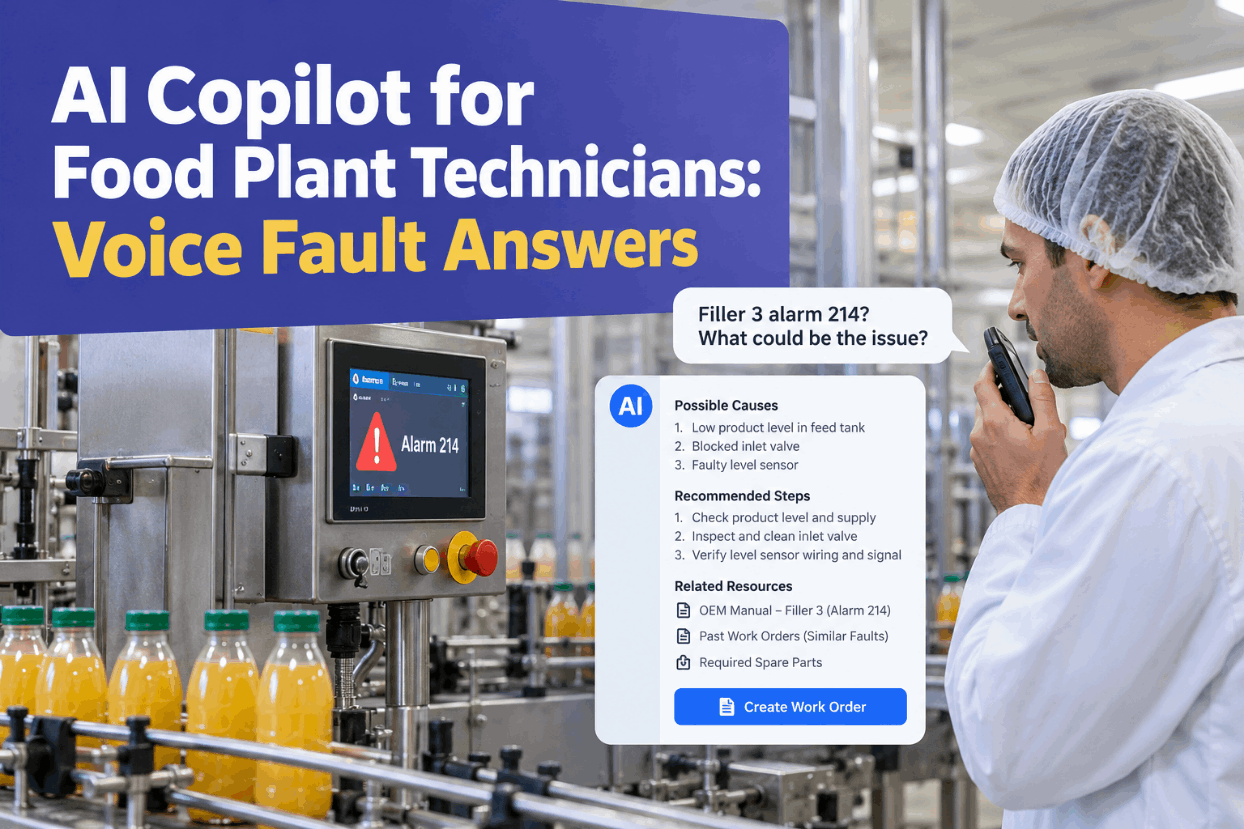
A filler stops mid-run with an alarm number on the HMI. The technician in front of it has a manual somewhere, a work order history nobody has time to search and a line supervisor asking how long. An AI copilot for food plant technicians closes that gap: ask the fault out loud, hear ranked causes with the manual page they came from, and let the conversation become the work order. Hear one answer a real alarm in a short copilot demo.
FACTORY COPILOT · TECHNICIAN SUPPORT
Ask the Fault Out Loud, Hear Ranked Causes With the Manual Page Attached
iFactory Factory Copilot is trained on your OEM manuals and plant work order history. A technician asks about an alarm by voice and hears the likely causes, first checks and parts. The copilot then drafts the work order from the conversation for the technician to confirm.
Factory CopilotLine 2 · Filler 3
Technician · voice"Filler 3 alarm 214?"
Copilot · valve lift faultLikely causes, ranked:
1Low air at lift cylindersFirst: manifold regulator gauge · Part: none
2Lift sensor out of positionFirst: sensor gap, valve head · Part: prox sensor
3Worn lift cylinder sealFirst: leak check under air · Part: seal kit
OEM manual 9.4 · 3 past work orders · LOTO before guard opens
Draft WO
Illustrative alarm and answer
FAULT CODE LOOKUP
An Alarm Number Is Where the Search Starts, Not Where It Ends
The HMI gives a code and a few words. The real answer is spread across several places: the OEM alarm list, the troubleshooting chapter, the last few work orders on that machine, and the plant's own lockout and sanitation procedures. An experienced technician joins those in their head. A newer one flips pages or phones someone. The copilot reads all five sources for every question, which is why its answer can say more than the alarm text ever does. List the sources for your lines with our support team.
01
OEM manualsAlarm lists, troubleshooting steps and exploded parts drawings02
Work order historyWhat was actually found and fixed on this asset before03
Energy control proceduresMachine-specific lockout steps for each asset04
Hygiene and allergen rulesZone, allergen status and release steps for the line05
Parts and storesPart numbers, food-grade status and bin locations
RETRIEVAL-AUGMENTED GENERATION
How a Spoken Question Becomes a Sourced Answer
The copilot does not answer from general knowledge about fillers. It uses retrieval-augmented generation, or RAG. The question is turned into a search, the most relevant passages are pulled from your own manuals and work orders, and the language model writes the answer only from those passages, with the reference attached. If the library holds nothing relevant, the right answer is "I don't have that for Filler 3," not a guess. See the retrieval step on a live walkthrough.
1HearSpeech becomes text. The asset comes from the technician's location or the line they are logged into.
2RetrieveManual pages and past work orders that mention this alarm on this model are pulled.
3RankCauses are ordered by how often each one was the fix here, then by the manual's own order.
4AnswerA short spoken answer, with the page and work order numbers shown on screen.
5ConfirmThe technician says which cause it was. That confirmation feeds the work order and the next ranking.
AI COPILOT FOOD PLANT TECHNICIANS FOR PLANT MANAGERS
Guardrails That Keep a Fluent Answer From Being a Wrong One
NIST's Generative AI Profile (NIST AI 600-1) names the core risk plainly as confabulation: "the production of confidently stated but erroneous or false content." On a plant floor that risk has a physical cost. A wrong setting, a skipped isolation or the wrong grease is not a typo. These rules are agreed with maintenance, EHS and food safety before go-live and are not left to the model's judgement. Review the rule set with our support team.
A Technician's Question, Answered With the Page Number
The copilot keeps context across follow-up questions, so a technician can rule causes out one by one. Each answer shows where it came from, and the confirmed cause goes straight into the work order draft.
Line 4 capper · Technician and Factory Copilot
TechnicianCapper torque fault again. Third time this week.
CopilotPast jobs found a worn clutch on one head once and a loose sensor bracket twice. Manual 6.2 lists the clutch check first. Start there?
TechnicianClutch is fine. Sensor bracket on head 4 is loose.
CopilotTighten per manual 6.5. I'll record the bracket as the cause and read the draft work order back to you.
FOOD-GRADE REPAIR GUIDANCE
Every Repair Answer Ends With a Food Safety Line
In a food plant, a correct mechanical fix can still contaminate product. FDA's preventive controls rule asks that equipment be maintained to protect against allergen cross-contact and contamination, and used so that food is not adulterated with lubricants, fuel or metal fragments (21 CFR 117.40). BRCGS Food Safety Issue 9 asks for a documented hygiene clearance after maintenance work. So the copilot adds the food safety steps that belong with each fix. Map your hygiene rules in a hygiene setup session.
H1
Lubricant gradeNSF H1 lubricants are registered for incidental food contact, H2 only where contact can't happen. The copilot names the grade the parts list calls for.
ALG
Allergen cross-contactTools, rags and parts moved between lines can carry allergens. The copilot flags the line's allergen status and the clean that follows.
FM
Foreign matterFasteners, broken pieces and swarf must be found. The copilot prompts a tool and part count in and out.
REL
Hygienic releaseAn authorised person inspects the area and signs before restart. The work order stays open until that is recorded.
AI COPILOT FOOD PLANT TECHNICIANS TEMPLATE
The Work Order the Conversation Fills In
Most of a good work order is already said out loud during the repair. The copilot keeps it: the asset, the alarm, the cause the technician confirmed, the steps taken, the parts and their grade, the time spent and the hygiene release. The technician hears the draft read back and says "confirm." Nothing posts to the CMMS without that. Request the complete field set from our support team.
AssetFiller 3, Line 2Login and location
Alarm214, valve lift faultHMI
Confirmed causeLift sensor out of position, head 7Spoken
Steps takenLocked out, sensor gap reset, testedSpoken
PartsNone usedStores
LubricantH1 grease on lift guideParts list
Time on job38 minutesConversation times
Hygienic releaseWaiting for QA sign-offRelease step
AI COPILOT FOOD PLANT TECHNICIANS EXAMPLES
Three Faults, Three Conversations
These are illustrations, not case studies. They show the shape of a copilot answer, which always defers to your own procedures and food safety plan. Walk through faults from your own lines in a scenario session.
Can seamer jam
Causes ranked from past jobsChuck wear comes first because it was the fix in most past jobs on that seamer. The copilot cites the manual and reminds the technician that seam checks are due before restart.Metal detector reject fault
Repair kept apart from verificationThe copilot guides the reject arm sensor check, then states that test-piece verification is needed before product runs. It never marks the control point as verified.Conveyor bearing noise
Allergen clean added to the jobA bearing swap on a line running a milk product. The copilot adds tool control and the allergen clean to the draft work order before release.
AI COPILOT FOOD PLANT TECHNICIANS COST AND ROI
Measure Usefulness Before You Put a Price on It
Vendor claims of faster repairs are easy to find and hard to check. Measure your own instead: take a baseline for a few weeks before go-live, then compare. The four measures below show whether the copilot is helping. The worksheet under them uses assumed inputs to show the arithmetic only, not results. Build the sheet with your own data with our support team.
Time to diagnoseMinutes from alarm to a confirmed cause
First-time fix rateJobs with no repeat of the same fault within seven days
Answer acceptedShare of questions where one of the ranked causes was right
Wrong answer flagsAnswers technicians mark as wrong, reviewed every week
Fault calls per month needing a manual search or a phone call60, assumed
Diagnosis time per call today35 min, assumed
Diagnosis time per call with the copilot20 min, assumed
Technician time freed per month60 × (35 − 20) = 900 min = 15 hours
Add line downtime only with your own cost per minute and your own measured change. Keep it out of the sum until the baseline supports it.
TURNKEY AI DEPLOYMENT
Copilot, Manual Library and AI Server Delivered Ready to Rack
iFactory delivers Factory Copilot as a turnkey bundle. A pre-configured NVIDIA AI server ships racked and ready, so your manuals, work orders and every spoken question stay on site. You rack it, plug in power and Ethernet, and the AI is live. For a quote sized to your lines, ask our support team.
What's Included
- Pre-configured NVIDIA AI server, racked and ready
- Factory Copilot with spoken and on-screen answers
- Loading and indexing of OEM manuals and alarm lists
- Import of plant work order history
- CMMS link for drafting and posting work orders
- Guardrail rules for lockout, interlocks and food safety
- Headset and handheld setup for technicians
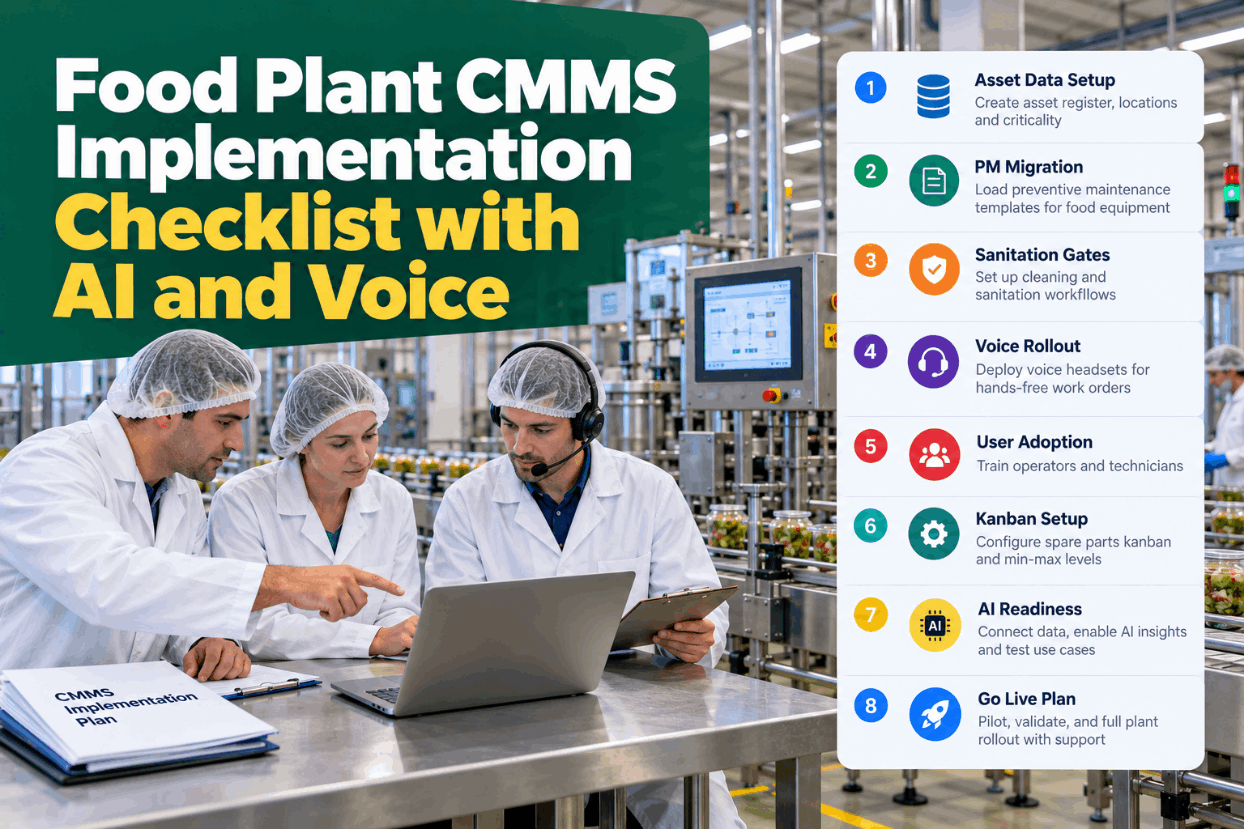
Live in 6–12 weeks
Wk 1–4
Load and Index
Manuals, alarm lists, work orders and procedures loaded and mapped to assets.
Wk 5–8
Test on Past Faults
Maintenance leads ask real past faults and check answers against what fixed them.
Wk 9–12
Go Live on One Line
Technicians start on one line, wrong answer flags reviewed weekly, then more lines.
HOW iFACTORY FITS
A Copilot Built for Food Plant Repairs
Factory Copilot is built for technicians who have gloves on, a line waiting and food safety rules to follow. See how it handles your own alarms in a short demo.
1
Answers from your documents. OEM manuals and plant procedures, cited by page.
2
Ranks by your history. Causes ordered by what actually fixed this machine before.
3
Adds the food safety line. Lubricant grade, allergen status and hygienic release with every repair.
4
Drafts the work order. The conversation becomes a complete record, confirmed by the technician.
1000+
Industrial clients running iFactory
99.9%
Platform uptime for round-the-clock plants
6-12 wks
From racked server to live copilot answers
FREQUENTLY ASKED QUESTIONS
What Plant Managers Ask About a Technician Copilot
What is an AI copilot for food plant technicians?
It is an assistant that technicians speak to while they work. It answers fault questions from your OEM manuals and work order history, ranks likely causes, gives first checks and parts, adds the food safety steps for the repair and drafts the work order. You can
hear it answer a fault on one of your own machines.
How does it avoid making things up?
It uses retrieval-augmented generation, so answers are written only from passages found in your own library, with the source shown. When nothing relevant is found, it says so instead of guessing. Technicians can flag a wrong answer by voice, and those flags are reviewed each week.
Can it look up fault codes from any OEM?
It can look up any code that appears in the manuals and alarm lists you load. Codes can differ between machine models and software versions, so the alarm list must match what your HMI shows. Our
support team can check your alarm lists during setup.
Will it ever tell a technician to skip lockout?
No. The energy control step is a fixed rule, not a model choice. Any answer that involves opening a guard or reaching into a machine starts with the lockout procedure for that asset, and the copilot will not suggest ways around guards or interlocks.
See the guardrails live before you decide.
Does it know which lubricants and parts are food grade?
It knows what your stores and parts data record. If items are marked H1, H2 or food-contact approved, the copilot names the right one for the repair. Where that data is missing, it says the grade must be checked before use.
How do we start?
Pick one line and its twenty most frequent alarms. Load the manuals, alarm lists and recent work orders for those assets, test answers against past faults, then let technicians use it. To plan that first line,
book a 30-minute session with our team.
Put the Manual, the History and the Next Step in Every Technician's Ear
Give technicians sourced answers to fault questions, food safety steps with every repair and a work order that writes itself from the conversation. Everything ships turnkey and is live within 6 to 12 weeks.
Example copilot session · Filler 3
QuestionAlarm 214, valve lift fault
Answer3 ranked causes, manual cited
Confirmed causeLift sensor, head 7
Work orderDrafted, read back, confirmed
Hygienic release recorded before restart