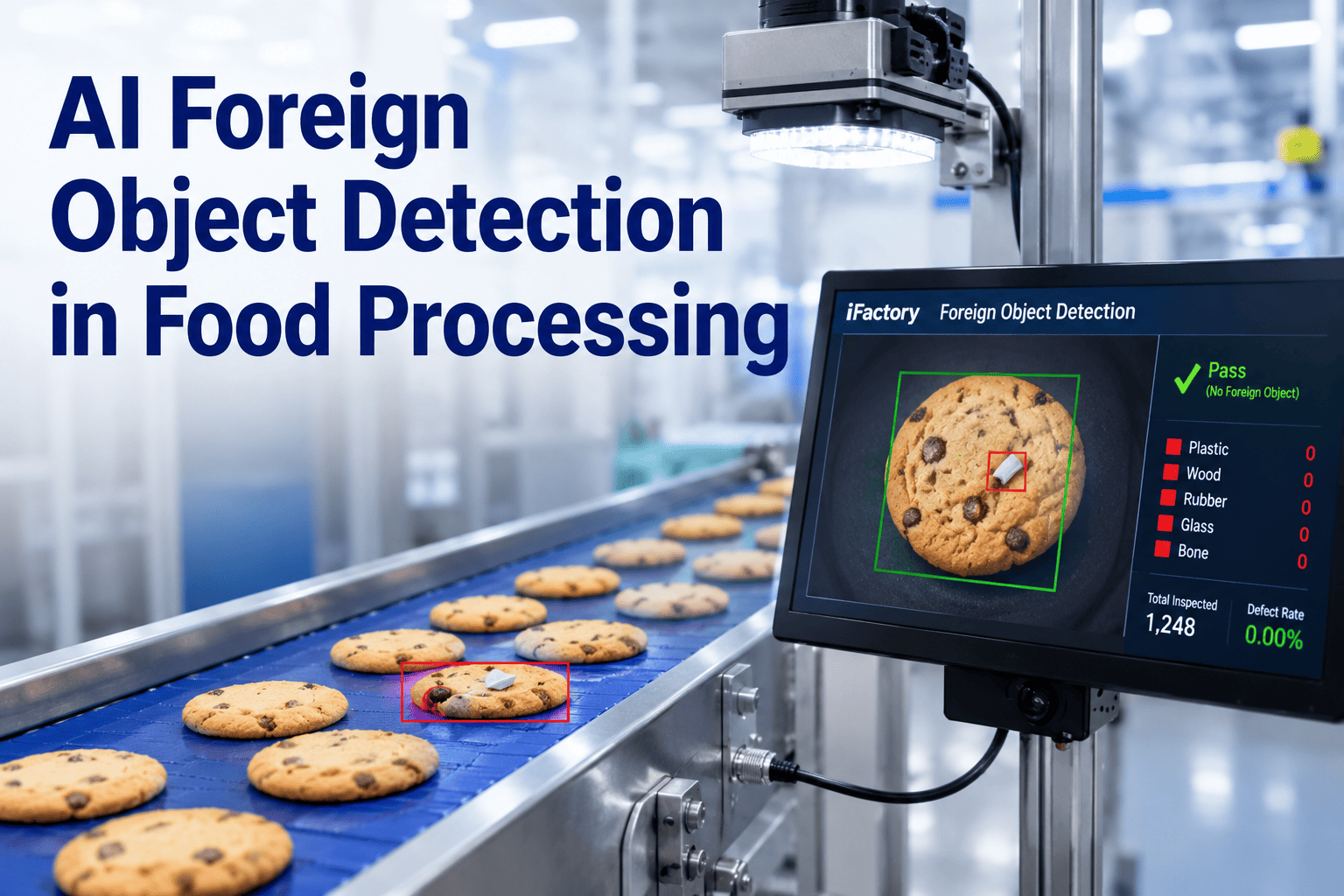
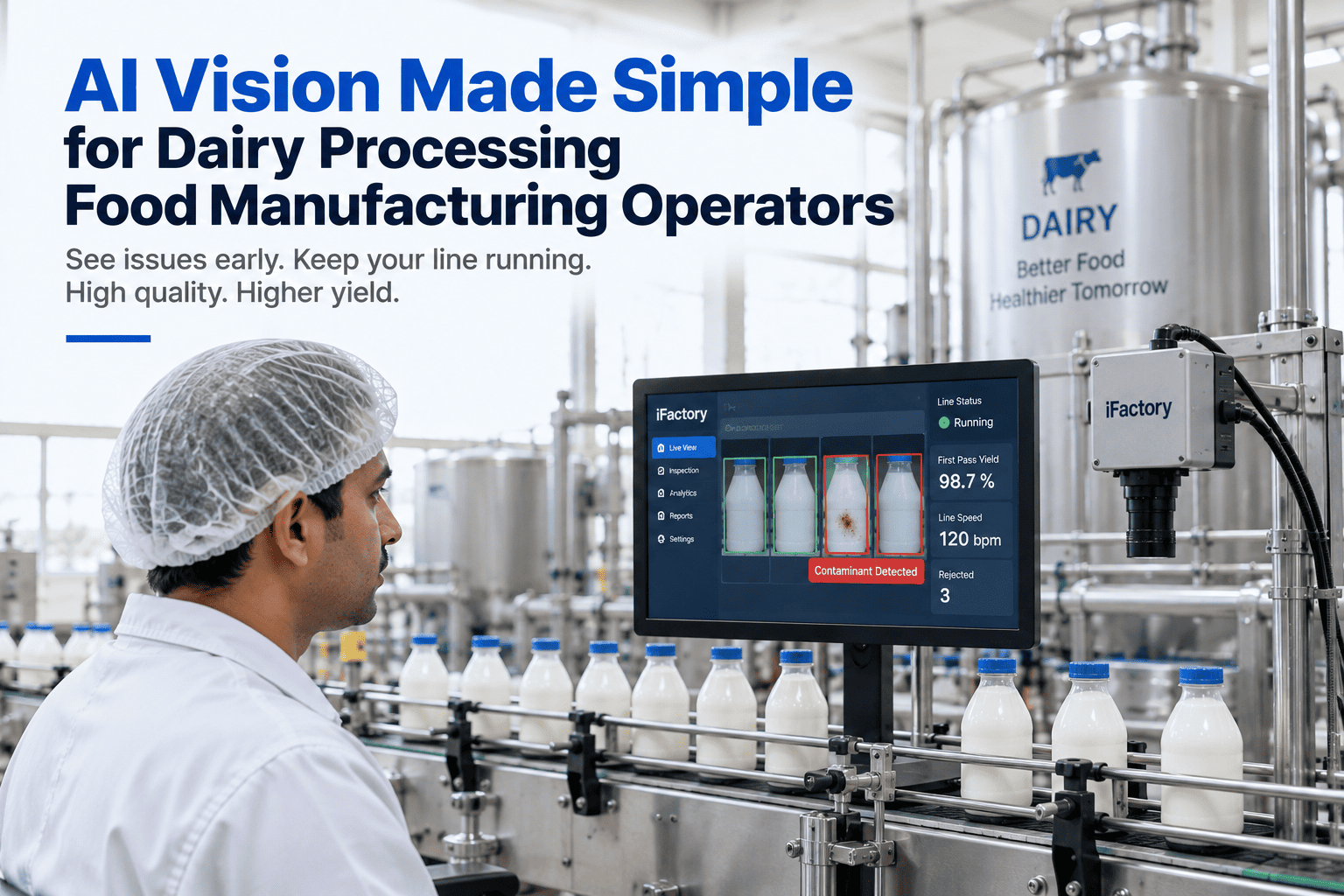
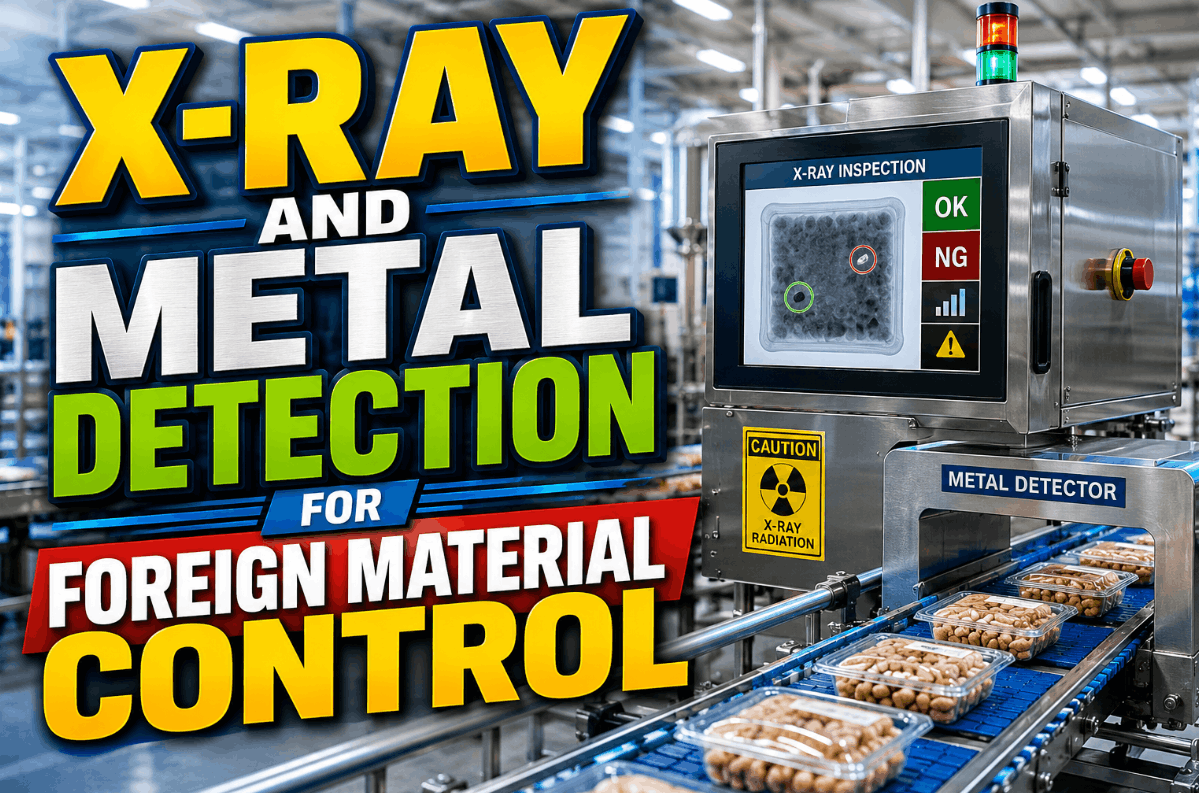
In 2025, foreign material was the #1 cause of USDA food recalls — 13 out of 42, over 71 million pounds of product pulled off shelves. A single Class I recall costs a mid-sized processor $10 million in direct expenses and can escalate past $100 million once brand damage, retailer delistings, and litigation are counted. And here's the uncomfortable truth every food safety director already knows: metal detectors miss glass, plastic, wood, and rubber. X-rays miss low-density plastics and organic contaminants at similar density to the product. Human inspectors on a line moving 100–400 items per minute miss almost everything at the visual threshold that matters. A UK beverage plant recalled 140,000 units after 2–4mm glass shards from a cracked CIP sight glass slipped past every checkpoint — the recall cost £2.3 million. AI vision with hyperspectral imaging changes the equation. Analyzing chemical composition across the 900–1700nm wavelength range, the same technology that dropped baby food quality issues by 90% at ELROILAB detects plastic, wood, bone, rubber, and cartilage that neither metal detectors nor X-ray can see — at line speed, per unit, with FSMA-compliant audit records. iFactory Vision Anomaly Detection for Food Processing catches what your current stack can't.
iFactory Vision Anomaly Detection
Stop the $10M–$100M Recall — Before Contamination Leaves Your Line
AI vision + hyperspectral imaging detects plastic, wood, rubber, glass, bone, and organic contaminants that metal detectors and X-ray miss. 0.8mm sensitivity. 40ms decision. FSMA, BRC 9, SQF 9, IFS 8 audit-ready.
#1
USDA recall cause 2025
$10-100M
avg recall cost range
0.8mm
detection sensitivity
The Real Recall Anatomy — Where the $10M Actually Goes
Food safety directors quote the recall number, but the full cost hides in the pieces around it. This is where the money actually leaks when a single contamination event escalates to a Class I recall.
Product destruction & logistics
$0.5–2.2M
Production stoppage & rework
$0.4–1.8M
FDA response & compliance
$0.3–1.5M
Legal & class-action exposure
$1–3.5M
Brand damage & retailer delisting
$7–90M+
The bottom line: direct costs are recoverable. Brand equity and shelf position frequently are not.
The Contaminant × Detection Technology Matrix
Every food processor already runs metal detection and X-ray. So why do plastic, glass, and bone still make it to the customer? Because each technology has a blind spot — and the contaminant that trips it up is exactly the one that ends up in a recall notice.
Contaminant
Metal Detector
X-Ray
AI Vision
Hyperspectral
Ferrous / non-ferrous metal
Detects
Detects
Surface only
Surface only
Glass fragments
Misses
Detects
Detects
Detects
Hard plastic
Misses
Density-limited
Detects
Detects
Soft plastic / film
Misses
Misses
Contrast-limited
Detects
Rubber gasket fragments
Misses
Misses
Surface only
Detects
Bone / cartilage
Misses
Density-similar
Surface only
Detects
Wood splinters
Misses
Misses
Surface only
Detects
Parasites / biological
Misses
Misses
Contrast-limited
Detects
Not sure which technologies your line actually needs? Book a demo — we'll map your product and contaminant risk to the right multi-modal stack.
How Hyperspectral Imaging Sees What Everyone Else Misses
Hyperspectral is not a fancy camera — it's a chemistry sensor. Each pixel captures a full spectrum across 900–1700nm, and the AI model learns the spectral fingerprint of your product versus every contaminant. A plastic shard the same color as the food, invisible to a normal camera, has a completely different NIR signature. The AI reads it in real time.
01
Spectral capture
Line-scan camera captures 900–1700nm across the full product width. Every pixel gets a chemical spectrum, not just RGB.
02
Fingerprint match
AI model compares each pixel spectrum to learned signatures. Plastic looks like plastic even when it looks like food.
03
Anomaly flag
Anything outside learned normal is flagged — including contaminant types not in training data. The pattern is what matters.
04
Reject & log
Pneumatic reject fires in 40ms. Detection image, spectrum, timestamp, line, batch — all archived for FSMA audit.
The Multi-Modal Stack — What Actually Sits on the Line
The strongest food safety programs don't pick one technology — they layer them at the right CCPs. Metal detection at intake and pre-pack. X-ray at final product for dense contaminants. AI vision on the conveyor for surface defects. Hyperspectral for organic and non-metallic contamination on high-risk lines. iFactory unifies the alert stream from all of them.
CCP 01
Raw material intake
Metal detection + hyperspectral
Metal shavings from upstream milling, plastic from supplier packaging, stone from field harvest
CCP 02
Post-grinding / cutting
AI vision + hyperspectral
Bone fragments, cartilage, wood splinters from crates, rubber from worn seals
CCP 03
Pre-packaging conveyor
AI vision anomaly detection
Surface contamination, packaging debris, gloves, hair nets, tools left on line
CCP 04
Final product / sealed pack
X-ray + AI classification
Glass, dense plastic, metal, bone — the last line before retail shelf
Real Recall Cases — What Each Would Have Cost to Prevent
The three recall patterns below have played out repeatedly across food manufacturing. Each one had a specific detection gap. Each one would have been caught by the multi-modal AI stack for a fraction of the recall cost.
Glass
UK beverage plant: 140,000 units recalled after 2–4mm glass shards from a cracked CIP sight glass slipped past a ferrous metal detector calibrated for 3mm+.
Recall cost £2.3M
X-ray at final pack + AI vision on the CIP inspection window would have caught the sight-glass crack before contamination.
Plastic
Bakery line: soft plastic fragments from a torn conveyor belt entered ambient product. X-ray density too close to dough. Metal detector blind. Class II recall issued.
Recall cost $4-8M
Hyperspectral on the conveyor after mixing catches soft plastic — different NIR signature from dough regardless of density.
Bone
Poultry processor: bone fragments in deboned chicken breast escaped X-ray inspection because density signature matched surrounding meat tissue.
Recall cost $12M+
Hyperspectral distinguishes bone spectra from muscle tissue chemically — even at similar density.
The iFactory Detection Loop — 40ms Per Unit
From product entering the inspection zone to reject actuation, the whole loop runs in under 40 milliseconds. That's what makes 100–400 items per minute inspection at 0.8mm sensitivity actually work in production.
01
Multi-spectrum capture
Visible light + NIR + hyperspectral captured simultaneously. Product-specific lighting for maximum contrast.
02
Edge AI classification
Deep learning + anomaly detection run on-premise. No cloud latency. Contaminant type, size, location tagged per unit.
03
Pneumatic reject
Air blast or diverter arm fires per SKU-configured threshold. Reject verified by downstream beam sensor.
04
Batch record + trend
Every event logged with image, spectrum, batch ID. Cluster detection alerts on 3+ events in configurable window.
05
FSMA audit trail
21 CFR Part 117 compliant records. BRC 9, SQF 9, IFS 8 audit exports on demand. Preventive controls evidence built-in.
What Processors See in the First 90 Days
Food processors deploying iFactory Vision Anomaly Detection typically report measurable outcomes inside a quarter. These are the numbers customers use to justify the investment upward — and the ones that make the ROI conversation short.
99%
Detection accuracy
multi-modal stack
$1.2M+
Annual cost avoidance
3-line mid-sized processor
6-10
Month ROI
full payback window
90%
Complaint reduction
ELROILAB baby food case
Ask the Vision AI on the Food Line
QA Supervisor
Line 2 flagged 6 rejects in the last hour — that's unusual. What's happening?
iFactory Vision AI
6 rejects all classified as soft plastic, 2-4mm fragments, all appearing on the right edge of the belt. Signature matches the outer sleeve of conveyor belt PVC. Recommend immediate belt inspection at the transfer point between mixer and depositor — cluster indicates belt wear, not upstream raw material.
QA Supervisor
Hold the batch or continue?
iFactory Vision AI
Recommend hold. Six rejects flagged means the belt is actively shedding — probability of missed fragments on already-packed units is elevated. Batch B24-1147 has 4,200 units at final pack; suggest quarantine pending inspection. Work order auto-generated for belt replacement.
Frequently Asked Questions
We already have X-ray and metal detection. Do we actually need AI vision on top?
Both technologies have documented blind spots — metal detection misses everything non-metallic, and X-ray struggles with soft plastic, low-density organic contaminants, and materials with similar density to the product itself (bone in meat, wood in bulk grain). AI vision and hyperspectral fill exactly those gaps. In 2025, foreign material was the #1 cause of USDA recalls despite most facilities running metal detection and X-ray. The gap isn't sensitivity — it's contaminant coverage.
Does hyperspectral work through packaging?
Only for transparent or specific film packaging. For sealed opaque packages, X-ray remains the primary technology at the final CCP. Hyperspectral is deployed before packaging — on conveyors, after grinding, at raw material intake — where product surface is visible. The typical stack uses hyperspectral upstream to catch what will otherwise disappear into sealed packs, and X-ray on the pack itself for anything that slipped through.
How do you avoid false rejects tanking our yield?
Two mechanisms. First, deep learning trained on your specific product learns the natural variation envelope — color, shape, texture — so cosmetic variance isn't flagged as contamination. Second, detection thresholds are configurable per SKU and contamination category. Glass in baby food runs at maximum sensitivity. Low-density plastic in ambient bakery product runs at a threshold calibrated for yield preservation. The system separates high-consequence and low-consequence contaminant policies rather than applying one setting everywhere.
Will this meet FSMA and GFSI audit requirements?
Yes. Every deployment is designed around FSMA preventive controls (21 CFR Part 117) and the current GFSI scheme requirements — BRC Global Standard Issue 9, SQF Edition 9, IFS Food Version 8. The audit trail captures per-unit inspection results, calibration history, sensitivity settings, reject actuation confirmation, and corrective actions. Retailer QSA and third-party auditor exports run in minutes, not days.
Can it integrate with our existing X-ray and metal detectors?
Yes — that's the standard deployment. AI vision and hyperspectral run on new or upgraded stations, and iFactory ingests alert streams from your existing X-ray and metal detectors into the same platform. The unified rejection event log surfaces cluster patterns across technologies — three or more events from any combination of systems within a configurable window triggers a maintenance alert before a pattern escalates.
How long from purchase order to live inspection?
Typical deployment runs 12–16 weeks in four phases. Weeks 1–3: risk assessment mapping product-specific contamination profile against HACCP CCPs. Weeks 4–7: technology selection and station design. Weeks 8–13: sample collection, AI model training, validation to 95–99% detection accuracy. Weeks 14–16: install, reject-system integration, operator training, and full FSMA documentation package. Most facilities see detection rate improvements within two weeks of model activation on the pilot line.
Every day without multi-modal detection is a day of exposure.
See AI Foreign Object Detection Running on Your Line
Bring your product samples — including your worst historical contamination cases. We'll show live detection on plastic, wood, rubber, glass, and bone at your line speed, walk through the FSMA and GFSI audit trail your compliance team would sign off on, and map your specific contaminant risk to the right multi-modal stack. 12-16 weeks from PO to live inspection.