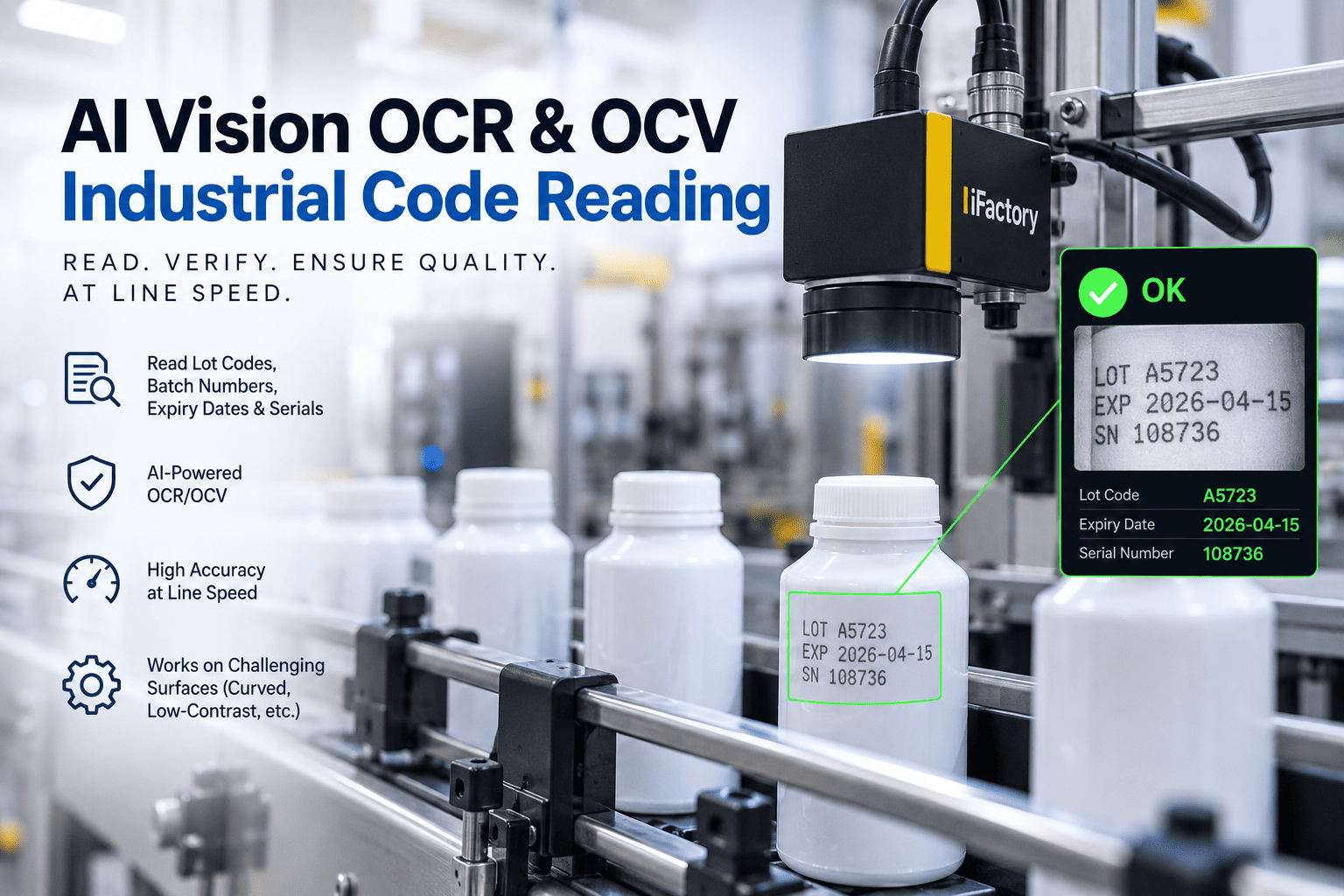
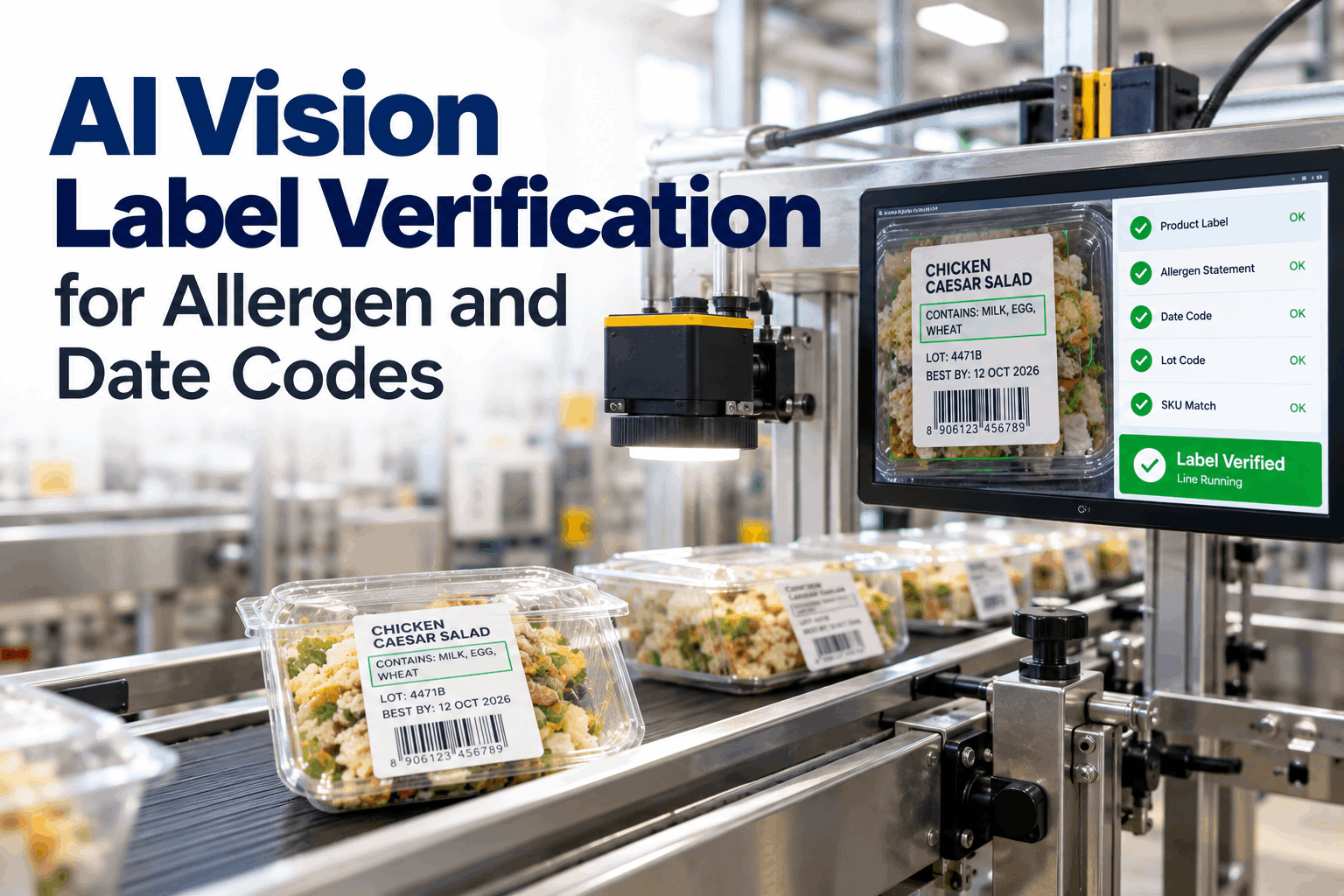
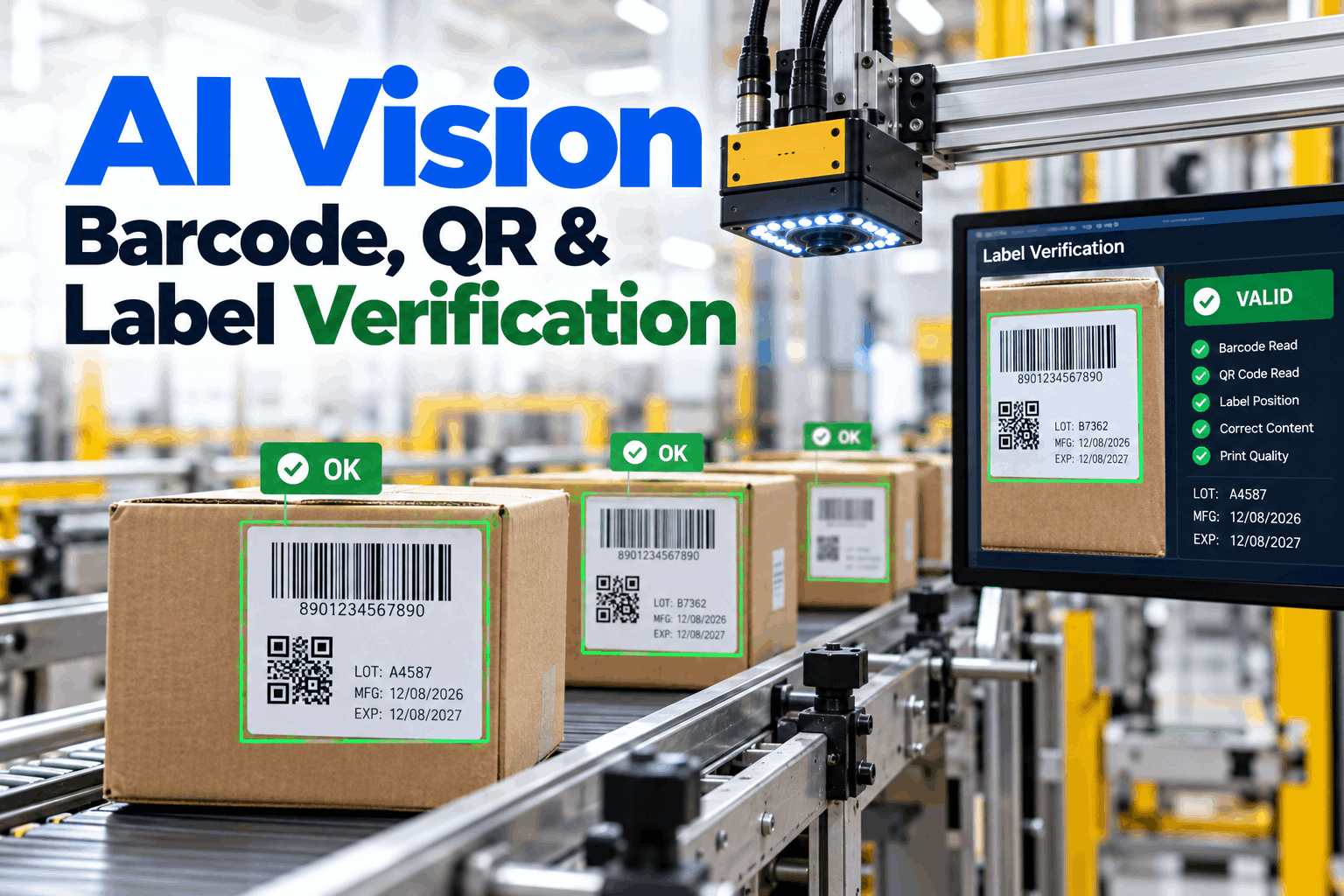
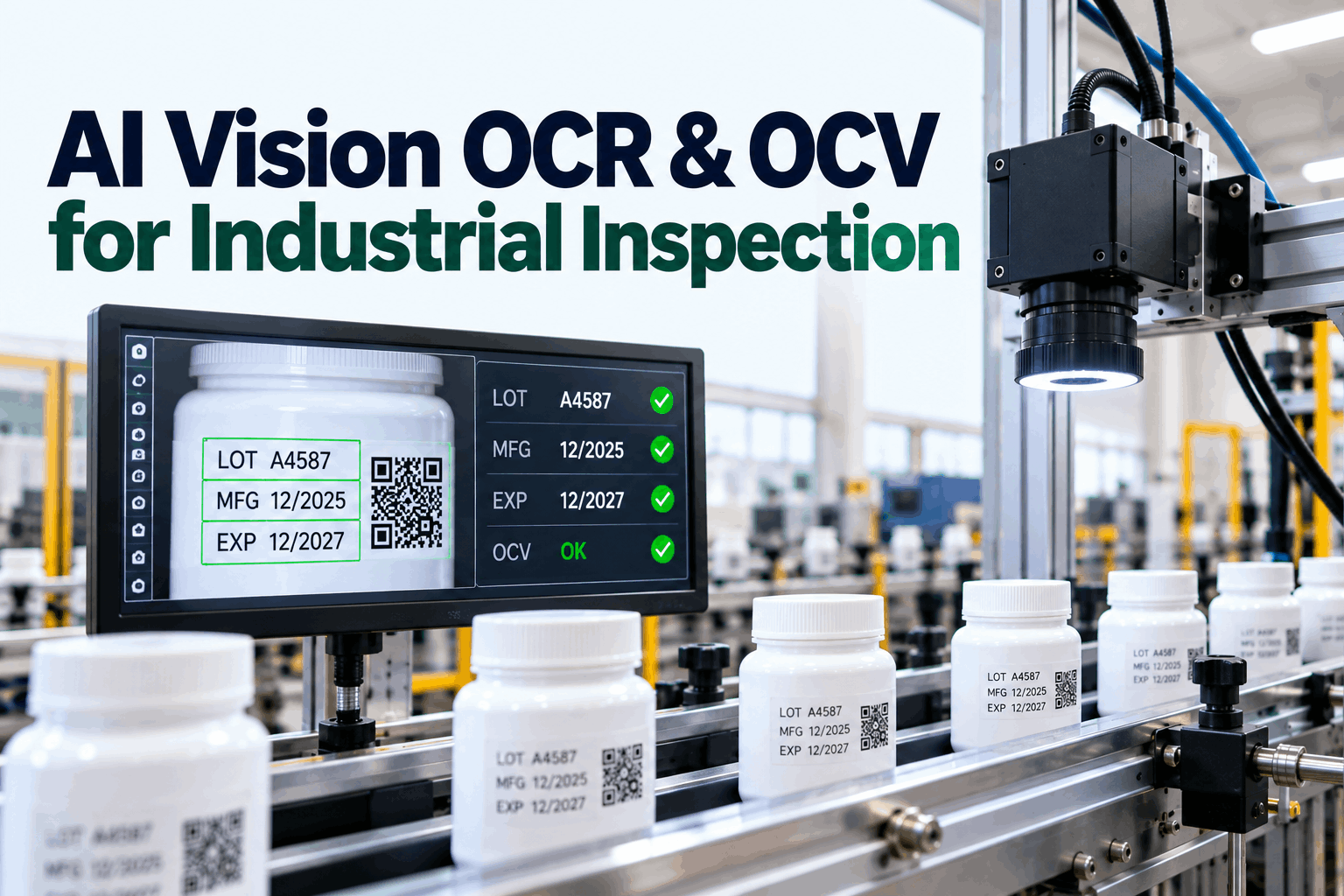
A lot code printed at an angle, a date stamp faded by heat, a serial embossed on a dark curved surface — traditional machine vision OCR fails on all three. Rule-based character recognition was built for clean, flat, high-contrast text under controlled lighting. The moment your packaging changes, your substrate changes, or your ink smears, the read rate drops and someone downstream catches the problem — in a customer complaint, a recall, or an audit finding. AI vision OCR is trained differently: it learns what your specific codes look like on your specific surfaces, under your specific line conditions, and it reads them at full line speed without a rules update every time the label changes. iFactory Vision OCR Inspection runs exactly that — every code, every surface, every line, live.
iFactory Vision OCR Inspection — Cross-Industry
AI Vision OCR & OCV — Read and Verify Every Code at Line Speed
Lot codes, batch numbers, expiry dates, and serials — read and verified in milliseconds, on curved, embossed, low-contrast, and variable-surface packaging, without manual rules updates.
<10 ms
read time per code — no line speed compromise
>99.5%
read rate on trained surfaces, including curved and embossed
Zero rules
no template updates needed when label or font changes
Full trace
every read linked to batch, line, shift, and timestamp
Where Traditional Rule-Based OCR Breaks Down
Rule-based OCR was designed for stable, predictable print on flat, high-contrast surfaces. Real manufacturing lines are none of those things. These are the six failure modes that send read rates below acceptable thresholds — and push verification back to manual inspection.
01
Curved & irregular surfaces
Bottles, cans, and pouches distort characters at the edges. Template-based OCR cannot compensate for the curvature — AI learns the distortion pattern and reads through it.
02
Low-contrast & embossed print
Ink-jet codes on dark substrates, embossed serials, and laser-etched marks on metal all fall below the contrast threshold rule-based systems require.
03
Variable font & label changes
Every font change, label redesign, or packaging format update requires a rules reconfiguration. Each reconfiguration is an engineer's day and a risk of mis-read until it's validated.
04
Ink smear & print degradation
Ink-jet heads drift. Characters smear, thin, or break at line speed. Rule-based systems reject the read — AI models trained on smear patterns continue reading accurately.
05
Lighting variation
Ambient light changes, reflective packaging, and inconsistent illumination degrade read quality across shifts. Deep learning OCR normalises for lighting variation without hardware changes.
06
No verification — only reading
Traditional OCR reads what's there. OCV (Optical Character Verification) checks it against what should be there — the expected lot code, date format, or serial range. Most legacy systems don't do this.
OCR and OCV — Two Different Jobs, Both Required
Most plants conflate OCR and OCV, but they solve different problems. Running one without the other leaves half the traceability and compliance value on the table.
OCR — Optical Character Recognition
"What does this code actually say?"
Reads the characters present on the package
Outputs a text string — lot code, date, serial, batch number
Works on any surface: flat, curved, embossed, etched
AI model trained on your specific code formats and surfaces
Primary use: capture and log what was printed for traceability
OCV — Optical Character Verification
"Does this code match what it should say?"
Compares the read string against the expected value
Flags wrong date, mismatched lot, out-of-range serial
Detects transposed digits, missing characters, truncated fields
Triggers reject signal or line stop on mismatch
Primary use: prevent wrong codes from leaving the line
The Live Code Inspection Dashboard — What Every Line Should Show
Plant-wide OCR/OCV visibility means every line reporting read rate, verification status, and rejection events live — with mismatches flagged before the product moves downstream. This is what a cross-line inspection dashboard looks like across a mixed packaging floor.
Line 1 — Filling
Beverage — lot & date code
All verified
Read rate99.8%last 1,000 units
OCV match100%no mismatches
Rejects0this shift
Expected lotLOT-2418confirmed
Line 2 — Labelling
Pharma — serial + expiry
Read degraded
Read rate97.1%−2.7% vs baseline
No-reads29last 1,000 units
OCV match100%verified reads only
Likely causePrint headdrift detected
Line 3 — Packaging
FMCG — batch + barcode
All verified
Read rate99.9%last 1,000 units
OCV match100%no mismatches
Rejects0this shift
Throughput420/minat full speed
Line 4 — Final Pack
Automotive — serial plate
OCV mismatch
OCV statusMismatchwrong serial range
Rejects14last 30 min
Read rate99.6%reads OK
Alert sent14:32operator & QA
Surface Types AI Vision OCR Handles — Where Legacy Systems Give Up
The read rate number that matters is not the read rate on ideal labels in a demo — it's the read rate on your worst-case packaging, on your line, at full speed. These are the surface conditions where AI-trained OCR consistently outperforms rule-based systems.
Handles well
Curved bottles & cans
AI model trained on the specific curvature and character distortion pattern for your container geometry. Read rate maintained at full rotation speed.
Handles well
Embossed & debossed marks
Moulded-in serial numbers, embossed batch codes, and die-stamped part marks — read by depth-sensitive lighting and a model trained on shadow-pattern characters.
Handles well
Laser-etched metal & plastic
Laser marks on stainless, aluminium, and dark polymers produce near-zero contrast. Deep learning OCR reads the texture change, not the grey-level difference.
Handles well
Reflective & glossy packaging
Foil laminates, gloss coatings, and metallised films cause specular reflections that saturate rule-based systems. Polarised lighting and AI normalisation eliminate the glare artifact.
Handles well
Ink-jet on porous substrates
Cardboard and kraft absorb ink unevenly — edges bleed, strokes thin. AI models trained on smear and bleed patterns read through the variation without a contrast threshold increase.
Handles well
Thermal transfer on flexible film
Flexible pouches wrinkle and distort under the camera. AI models compensate for surface deformation and read codes that geometric correction alone would reject.
Code Types Covered — Every Format on Your Line
AI vision OCR is not one model for one code type. Each format — variable data, fixed structure, human-readable or machine-readable — has its own model configuration. iFactory Vision OCR covers every code type your traceability and compliance stack requires.
Variable Data Codes
Lot / batch number
Expiry / best-before date
Manufacture date
Serial number
Production shift code
Fixed Identity Codes
SKU / product code
Part number
Country of origin
Weight / volume declaration
Regulatory approval numbers
Machine-Readable + OCR Combined
1D barcode + human-readable line
2D Data Matrix + adjacent text
QR code + lot code pairing
RFID number + printed serial match
GS1-128 + date field cross-check
Compliance-Specific Formats
DSCSA / UDI serialisation
EU FMD pack code
REACH / safety marking text
CE / UL certification marks
Country-specific date formats
Want to see read rates on your specific packaging? Start a pilot — send us sample images of your hardest-to-read codes and we'll run them through the model before the demo.
How AI Vision OCR/OCV Works — From Camera to Traceability Record
The gap between a camera on a line and a verified, logged, traceable code record has five steps. Each one is where AI OCR outperforms a rule-based system — and where a missed step turns a read rate number into a compliance gap.
01
Image Capture
Triggered by encoder or product sensor. Frame captured at line speed — no product stoppage. Multiple cameras per station for curved or multi-face codes.
02
AI Read
Deep learning OCR model localises the code region, corrects for distortion, and outputs the character string — trained on your specific font, surface, and lighting conditions.
03
OCV Verify
Read string compared against the expected value from the production order — lot, date format, serial range. Mismatch, no-read, or format violation triggers a reject signal in <10 ms.
04
Reject & Alert
Reject conveyor or air-blast activated on mismatch. Alert routed by severity — operator on-screen, supervisor push, QA email — with image and read string attached.
05
Trace & Log
Every read — pass or fail — stored with batch, line, shift, timestamp, and image. Full audit trail available on demand for DSCSA, FDA, BRC, and customer traceability requests.
What AI Vision OCR/OCV Delivers Across the Line
The value of AI OCR/OCV is not just a higher read rate number — it's what that read rate prevents: wrong codes reaching consumers, recall events driven by unverified lots, and audit findings from incomplete traceability records. These are the outcomes plants see after deploying AI-trained code inspection.
>99.5%
Read rate
on trained surfaces including curved, embossed, and low-contrast
<10 ms
Read + verify cycle
no line speed reduction on any current packaging format
Zero rules
Label change impact
model retrain replaces rules reconfiguration — faster, lower risk
Full trail
Audit traceability
every read logged with image, batch, line, shift, and timestamp
Curious what read rates look like on your packaging? Talk to our vision team — we'll benchmark your codes before committing to a deployment.
Frequently Asked Questions
How is AI OCR different from the OCR in our existing vision system?
Legacy vision OCR uses template matching and contrast thresholds — it's looking for characters that match a stored pattern under the lighting it was calibrated for. AI OCR uses a deep learning model trained on thousands of examples of your actual codes, on your actual surfaces, under your actual line conditions. The result is a read rate that holds up when ink fades, labels shift, or lighting changes — without a recalibration every time.
What does the model training process look like?
Training starts with image capture on your line — typically 500 to 2,000 images across the variation range you want the model to handle (good reads, degraded prints, curved surfaces, different lighting conditions). Those images are annotated and used to fine-tune the base model on your specific character set and surface. Deployment typically runs 2–4 weeks from first image capture to validated read rate on the line.
What happens when we change label design or add a new SKU?
A label change in a rule-based system means an engineer reconfigures the template, recalibrates thresholds, and revalidates the read rate — typically a half-day to a full day per SKU. With AI OCR, a new label means capturing a sample run of the new format and running a targeted model update — usually hours, not a day. If the change is a font size or colour variation on the same surface, the existing model often handles it without any retraining at all.
Does the system work with our existing cameras and lighting?
In most cases, yes — iFactory Vision OCR runs as a software layer on top of existing industrial cameras, including Cognex, Keyence, Basler, and Allied Vision hardware. If your current camera resolution and frame rate are adequate for the code size and line speed, we work with what's installed. For embossed or laser-etched codes, we sometimes recommend adding structured or polarised lighting — but we assess that in the pilot phase before recommending hardware changes.
Can we run a pilot on our packaging before committing to deployment?
Yes — and we recommend it. Send us sample images of your hardest-to-read codes: your worst-case curved surface, your most degraded ink-jet print, your lowest-contrast emboss. We'll run them through the base model and show you the read rate before any training on your data. If you then want to proceed to a line pilot, we deploy on one line, build the trained model, and show you the validated read rate on your live packaging. Book a demo and we'll start with your images.
Stop finding wrong codes downstream.
See AI Vision OCR Running on Your Own Packaging
Send us images of your hardest-to-read codes — curved, embossed, low-contrast, or degraded. We'll run them through the model and show you the read rate before any line installation. Pilot on one line, validated read rate before deployment.