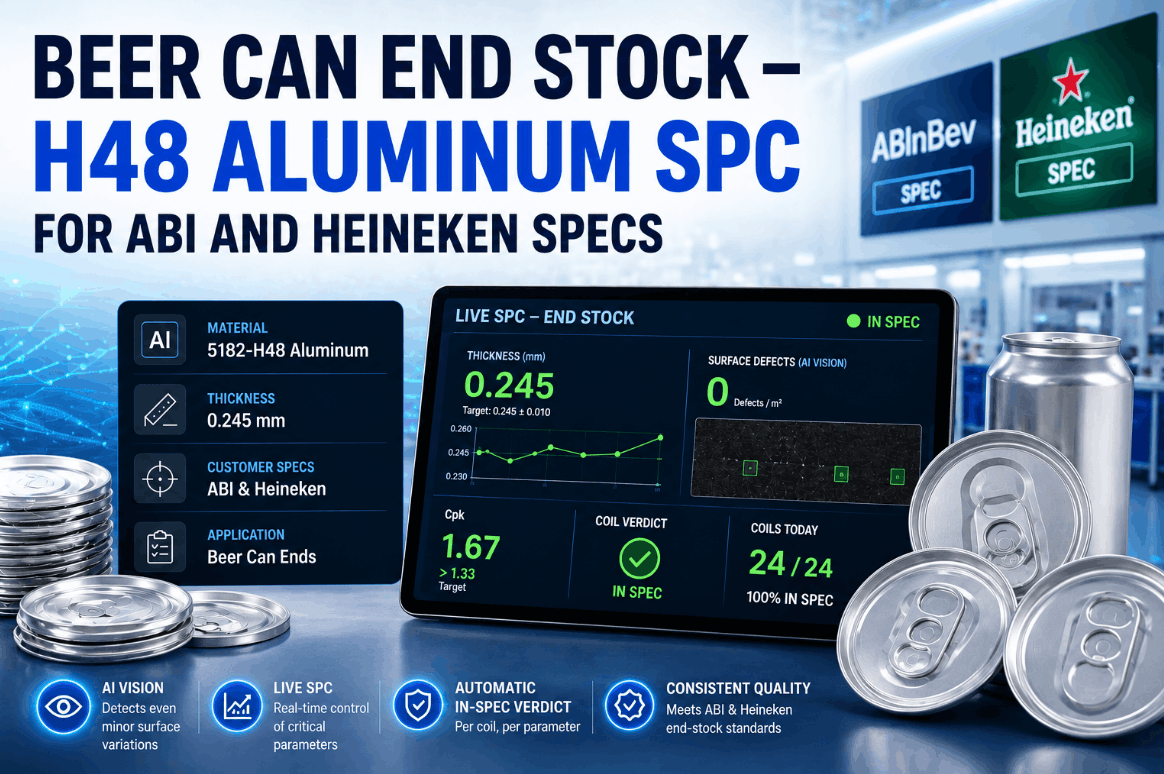
Eighteen months ago, a major beverage can body stock supplier was shipping 0.27 mm gauge 3104-H19 aluminum to two different fillers. Coca-Cola's spec required a 0.265–0.275 mm band with a Cpk of 1.67. PepsiCo's was 0.262–0.278 mm with a Cpk of 1.33. The plant ran a single recipe for both. Every shift, an operator manually overrode the mill's gauge target based on a clipboard note. One Friday night, the override was wrong. 84 coils — 420 tons of aluminum — were rolled to the wrong spec. The customer rejected the shipment. That single shift cost $680,000 in rework, scrap, and emergency freight. The problem wasn't the mill. It was the gap between what a customer spec says and what the control system does. This page is about closing that gap — permanently.
Hold Four Customer Specs on One 0.27 mm Gauge — Without Operator Override
iFactory's multi-customer recipe library encodes Coca-Cola, PepsiCo, Ball, and Crown gauge bands into your rolling mill's control loop. Live Cpk per customer. Zero clipboard overrides.
What One Can Stock Plant Achieved in 10 Weeks
A Midwest aluminum rolling mill running 3104-H19 body stock for three major fillers deployed iFactory's multi-customer recipe library in Q2 2025. The pilot covered two tandem mills and four gauge tolerances. These are the results after the first 10 weeks of live production.
How iFactory Encodes 3104-H19 v3.2 Body Stock Specs
Every customer spec — Coca-Cola's 0.265–0.275 mm band at Cpk 1.67, PepsiCo's 0.262–0.278 mm at Cpk 1.33, Ball's 0.268–0.280 mm at Cpk 1.50, Crown's 0.260–0.276 mm at Cpk 1.40 — becomes a digital recipe with live control limits, not a clipboard note.
Per-Customer Gauge Band
Each customer recipe stores the exact upper and lower spec limits for 0.27 mm body stock. iFactory maps these to the mill's AGC (automatic gauge control) setpoints. When a new order loads, the gauge target shifts to that customer's centerline automatically.
Live Cpk per Customer
iFactory calculates Cpk in real time against the active customer spec — not a generic target. If gauge drift moves Cpk below the filler's minimum, the system alerts the mill operator before a single coil falls outside the band.
Recipe Version Control
When Coca-Cola updates its body stock spec from v3.2 to v3.3 (narrowing the gauge band by 0.002 mm), the plant updates one recipe in iFactory. The change propagates to every mill that runs that customer's orders. No paper spec sheets. No shift-to-shift confusion.
Customer-Specific SPC Charts
iFactory generates SPC charts per customer, not per production run. Quality teams see gauge distribution, Cpk trend, and out-of-spec events filtered by filler. Audit-ready reports export in one click for any customer review.
Multi-Alloy Support
Beyond 3104-H19 body stock, the recipe library handles 5182 for ends, 5052 for tabs, and 3003 for fins. Each alloy has its own gauge, temper, and surface-finish parameters per customer. One platform for all can stock.
Order-to-Recipe Matching
iFactory ingests the production schedule from your ERP. When an order for Coca-Cola 0.27 mm body stock appears, the system loads the correct recipe — gauge band, Cpk target, and SPC limits — before the first coil enters the mill.
Three Ways Manual Gauge Management Drains Can Stock Margins
Every can stock plant running multiple customer specs on shared assets knows the pain. But the numbers tell a story that most plants don't quantify until after a rejection.
Operator Override Error — $680,000 Per Shift
A single override mistake at a Midwest plant rejected 420 tons of 0.27 mm body stock. The rework, scrap, and emergency freight cost $680,000. That's one shift. The root cause: the mill's control system had no way to know which customer's gauge band was active.
Customer-Specific Cpk Blind Spots — Hidden Rejection Risk
Most mills report Cpk against a single target gauge. But Coca-Cola's Cpk 1.67 at 0.270 mm centerline is different from PepsiCo's Cpk 1.33 at 0.270 mm. A coil that passes one spec fails the other. Without per-customer SPC, you don't know which coils are at risk until the customer measures them.
Spec Version Drift — 14 Days to Update Every Shift
When a filler tightens its gauge band by 0.002 mm, the plant must update every shift's reference sheet. In practice, it takes two weeks for the change to reach all operators. In those 14 days, the mill runs to the old spec. Every coil is at risk. iFactory updates the recipe once — every shift sees the new target immediately.
One recipe library. Four customer specs. Zero operator overrides. Book a 30-min walkthrough and we'll show you how a can stock plant cut rejected coils by 94% in 10 weeks.
Four Steps to Live SPC for 0.27 mm Body Stock
iFactory connects to your mill's existing control system — no new sensors, no PLC rewiring. The multi-customer recipe library sits between your production schedule and the AGC setpoints.
Ingest Customer Specs
Upload each filler's gauge band, Cpk minimum, and alloy spec (3104-H19 v3.2) into iFactory's recipe library. One-time setup per customer.
Connect to Production Schedule
iFactory reads your ERP order queue. When a Coca-Cola order loads, the system selects the correct recipe — gauge target, spec limits, and SPC rules — before the coil enters the mill.
Auto-Set Mill Parameters
The recipe pushes the gauge target and tolerance band to the AGC. The mill runs to that customer's centerline. No operator override needed. No clipboard.
Monitor Live Cpk per Customer
iFactory calculates Cpk every 10 seconds against the active customer spec. If drift approaches the filler's minimum, the system alerts the operator — before a single coil falls outside the band.
What a Can Stock Plant Gets with iFactory
No cloud dependency. No data leaving your plant network. No custom integration projects. iFactory arrives as an NVIDIA appliance on your mill floor and connects to your existing control systems in weeks.
Multi-Customer Recipe Library
Up to 50 customer-specific recipes per plant. Each recipe stores gauge band, Cpk target, alloy, temper, and surface-finish parameters. Add or update a recipe in minutes.
Live SPC with Per-Customer Cpk
Real-time gauge monitoring against each filler's spec. Cpk calculated per customer, not per production run. Audit-ready reports for any customer review.
On-Premise Appliance — Zero Cloud Dependency
iFactory runs on an NVIDIA appliance inside your plant network. No data egress. No cloud latency. No security review for data leaving the mill floor.
6–12 Week Pilot to Live Production
iFactory's end-to-end team handles the integration. Hand over data-source access. We deliver a working pilot on your mill in one quarter. From pilot to ROI in under 12 weeks.
Questions Can Stock Operations Leaders Ask
Stop Relying on Clipboard Overrides for 0.27 mm Body Stock
One recipe library. Four customer specs. Live Cpk per filler. 94% fewer rejected coils in 10 weeks. Book a 30-minute walkthrough and we'll show you how.


-—-live-spc-for-tier-1-oem-programs.png)