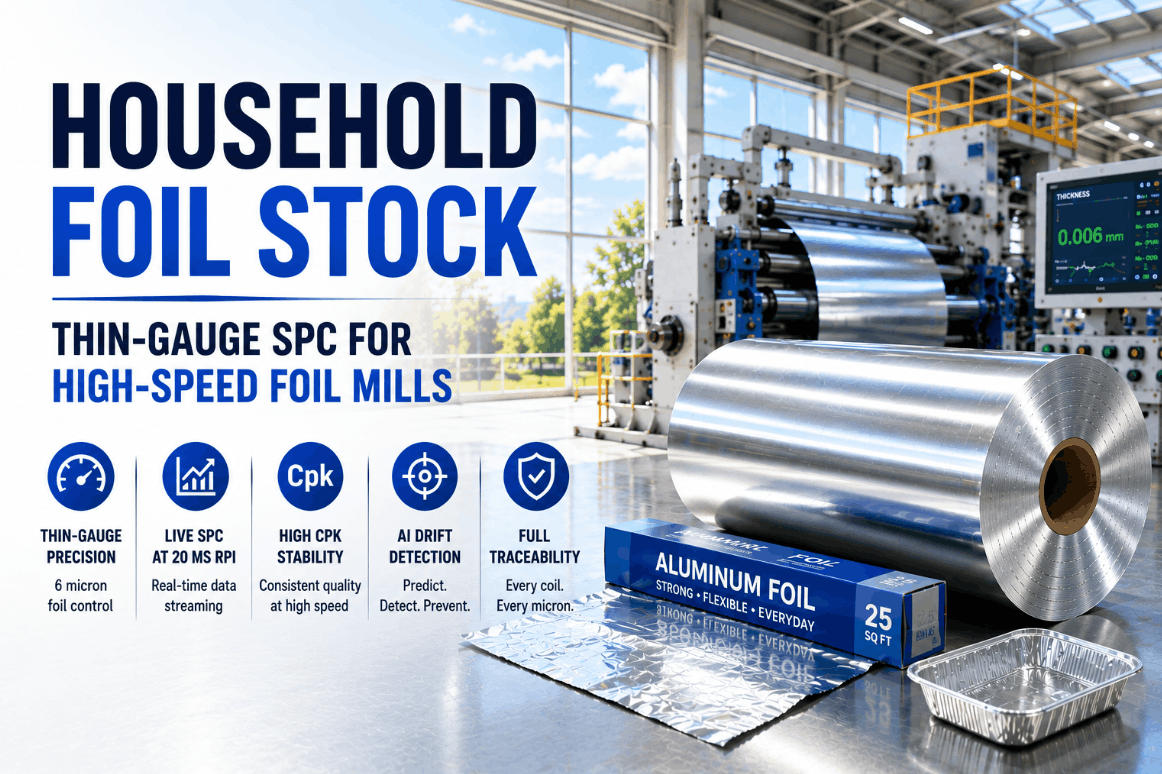
Household foil stock at 6 microns — 0.006 mm — is among the most demanding quality disciplines in aluminum rolling. At that gauge, the difference between a conforming coil and a rejected one is measured in fractions of a micron, drift that is completely invisible to any inspector on the mill floor and undetectable by sampling-interval SPC systems that were designed for plate or sheet applications. At rolling speeds exceeding 1,000 meters per minute, a gauge deviation that begins at the entry of a foil pass has propagated through hundreds of meters of finished product before a conventional quality system logs the first data point. The pinhole rate, the elongation uniformity, the flatness profile across a 1.5-meter-wide coil — every one of these critical quality attributes is determined in the milliseconds of contact between the work roll and the strip, and every one of them requires SPC sampling at a time resolution that matches the process physics rather than the convenience of the data collection interval. iFactory's thin-gauge foil mill connector streams mill data at 20-millisecond resolution directly into live capability charts — giving foil mill quality managers the first SPC platform that actually runs at foil speed. Book a Demo to see your foil mill's live gauge, elongation, and flatness data in iFactory's sub-100ms SPC dashboard.
Why Conventional SPC Fails at 6-Micron Foil — and What That Failure Costs Per Coil
The SPC systems deployed in most aluminum rolling facilities were architected for cold-rolled sheet: gauges in the 0.1–3.0 mm range, mill speeds in the 100–400 meters-per-minute range, and quality characteristics that respond slowly enough for a 30-second or 1-minute sampling interval to provide meaningful process control information. None of those assumptions hold at 6-micron household foil. A foil mill running at 900 meters per minute generates more than 54,000 meters of finished product per hour. A gauge deviation that starts at the 5% level — 0.3 microns off-target on 6-micron nominal — and is detected by a 30-second sampling interval has already propagated through 450 meters of product before the first alarm fires. At household foil coil weights of 300–600 kg, that is often a full coil of off-specification product, wound, labeled, and headed for the customer before the quality system identified the deviation.
The root cause of this failure is not instrumentation — modern X-ray and beta gauges on foil mills generate continuous thickness data at update rates well below 100 milliseconds. The failure is the SPC layer: the platform that receives that data stream, applies control chart logic, detects drift patterns, calculates Cpk, and alerts the mill operator. Most foil mills are either discarding 95%+ of their gauge data between sampling intervals or batching it into averages that smooth out exactly the high-frequency variation that causes pinholes and flatness defects. iFactory's thin-gauge foil mill connector retains and analyzes the full data stream at 20ms resolution — the first SPC architecture designed to match foil process physics rather than adapt a sheet-rolling platform to a fundamentally different quality problem.
The Four Critical Quality Dimensions of Household Foil Stock — and How iFactory Monitors Each
Household foil stock quality is not a single-parameter discipline. The four quality dimensions that determine whether a coil ships to a converter, gets downgraded to industrial grade, or goes straight to scrap are gauge profile, elongation uniformity, flatness (I-unit or cross-bow), and pinhole rate — and each one is driven by different process variables, requires different SPC chart types, and fails in different ways when the monitoring system is not calibrated to thin-gauge physics. iFactory's foil mill quality platform monitors all four simultaneously, with drift AI tuned to the variation patterns specific to 6-micron sheet.
Gauge Profile — Cross-Direction and Machine-Direction Thickness Control
Gauge is the primary quality characteristic of household foil stock, and it is the most technically demanding to control at 6-micron nominal. Cross-direction (CD) gauge variation — the thickness profile from edge to edge across the coil width — is driven by work roll crown, thermal crown, and mill deflection under rolling force. Machine-direction (MD) gauge variation — thickness oscillations along the rolling direction — is driven by entry material variation, AGC response speed, and work roll wear patterns. At 6 microns, a 5% MD gauge deviation of 0.3 microns represents a Cpk contribution that will fail most customer specifications, and it must be detected within meters of occurrence to be actionable before a full coil is affected.
Elongation Uniformity — Controlling Mechanical Property Consistency Across the Coil
Elongation in foil rolling refers to the percentage extension of the strip in the machine direction — the ratio of exit speed to entry speed across each rolling pass, controlled by the tension and rolling force balance. For household foil, elongation uniformity determines the mechanical property consistency that governs whether the foil tears cleanly at the serrated edge of a dispenser box or fractures erratically in use. Non-uniform elongation across the width produces differential residual stress that drives flatness defects — the same root cause that produces both edge wave and center buckle, the two flatness failure modes that cause the most converter downtime and customer complaints in household foil supply chains.
Flatness — I-Unit and Cross-Bow Monitoring Across the Full Coil Width
Flatness is the quality characteristic that most directly determines whether a foil coil runs successfully through a high-speed converter laminating or printing line. Household foil converters run at 200–600 meters per minute through narrow web paths with minimal tolerance for out-of-flat strip — edge wave or center buckle that is invisible on the recoiler at the foil mill becomes a converter shutdown event when the foil enters a laminating nip or a printing press. I-unit measurement — the standard flatness metric for cold-rolled and foil products — quantifies residual stress-induced elongation differences across the strip width, with most household foil customers specifying I-unit tolerances in the 5–15 I-unit range for finished coil.
Pinhole Rate — The Zero-Defect Quality Requirement That Drives Customer Rejection
Pinholes — through-thickness micro-defects in finished foil — are the quality failure that most directly drives customer rejection and chargebacks in household foil supply chains. A pinhole in household wrapping foil is a barrier failure: moisture, oxygen, and light can penetrate a foil wrap with even a single pinhole in the seal zone. The primary causes of pinhole formation in thin-gauge foil are gauge excursions that create localized under-thickness zones at hard inclusions in the aluminum alloy, elongation non-uniformity that concentrates strain at weak points in the strip, and lubricant distribution failures that cause localized friction spikes under rolling contact. All three root causes generate precursor signals in the gauge and elongation data streams that iFactory's drift AI detects before the pinhole count in the coil reaches customer threshold levels.
How iFactory's 20ms Foil Mill Connector Works — From Sensor Stream to Live Cpk
The technical barrier that has prevented conventional SPC platforms from delivering meaningful process control on thin-gauge foil mills is data architecture, not sensor capability. The gauge sensors, force transducers, speed tachometers, and tension load cells on a modern foil mill all generate data at update rates of 10–50 milliseconds — the physical information is available. The barrier is the SPC middleware: platforms designed around 30-second to 5-minute sampling intervals that cannot ingest, process, and visualize a 20ms data stream without discarding the data that makes thin-gauge control possible. iFactory's foil mill connector was built from the ground up for this data rate. Book a Demo to see how the connector integrates with your mill's existing gauge system and historian.
iFactory vs. Conventional SPC for Thin-Gauge Foil: What Changes at 20ms Resolution
The practical question for a foil mill quality manager evaluating a SPC platform upgrade is not whether high-frequency monitoring is theoretically better — it is whether the specific quality failures that are currently driving scrap, customer chargebacks, and converter downtime would have been detected earlier with 20ms SPC than with the current system. The table below answers that question directly for the five most common quality failure modes in household foil stock production. Book a Demo to map these failure modes against your plant's own scrap and chargeback history.
| Failure Mode | Detection with 30s SPC | Detection with iFactory 20ms | Product Saved Per Event | Customer Impact Prevented |
|---|---|---|---|---|
| MD Gauge Drift (+5% from nominal) | After 450m at 900 m/min — full coil section affected | Within 3–5 meters of onset — operator alert before 100m produced | 350–450m per event at typical coil weights | Below-gauge coil shipped to converter; laminate delamination and pinhole claim |
| Lubricant Starvation Spike | Rolling force spike visible but pinhole cause not identified; no SPC correlation | Force + temperature compound alert at 20ms; coil position flagged before pinhole confirmed | Targeted inspection vs. 100% coil rejection | Pinhole cluster in household wrap; retail consumer complaint and recall risk |
| Elongation Undershoot — Coil Head | Not detected; first 100–200m averaged into subgroup; Cpk appears normal | Real-time elongation ramp tracking; head scrap length precisely identified and trimmed | 80–150m reduction in coil head scrap | Flatness failure at converter on first 200m of coil causing web break and setup loss |
| Periodic Gauge Variation (Roll Eccentricity) | Averaged out in subgroup; Cpk appears normal despite repetitive peak-to-valley variation | Frequency-domain analysis identifies roll ID and rotational period; maintenance scheduled before roll failure | Full coil — defect is systematic, not isolated | Converter die wear from periodic gauge peak; warranty claim and roll replacement at customer |
| Flatness Drift (Thermal Crown Build) | I-unit measured at coil end; deviation found after winding; disposition retroactive | Real-time I-unit trending; thermal crown prediction from mill temperature model; AGC adjustment before I-unit limit reached | Prevents downgrade or scrap of full coil | Edge wave foil causing web tracking failure at converter laminating line; unplanned downtime |
Expert Review: Why Foil Mill SPC Requires a Different Platform — Not a Faster Version of the Same One
I spent eleven years as a quality manager at two household foil operations before moving into consulting, and the conversation I had with every SPC software vendor was the same: "we support configurable sampling intervals, you can set it to whatever you want." What they could not support was the underlying statistical architecture that makes sub-100-millisecond SPC valid for 6-micron foil — EWMA charts calibrated for the autocorrelation structure of a continuous rolling process, drift models that distinguish true process shift from the measurement noise that is unavoidable at this gauge, and Cpk calculations that reflect what the coil actually is rather than what a 30-second average suggests it might be. When you run a foil mill at 900 meters per minute and your SPC system is sampling every 30 seconds, you are not doing statistical process control. You are doing statistical process documentation — after the fact, for the quality certificate, not for the operator who needs to make an adjustment in the next ten seconds. The difference between those two things is the difference between a quality program that prevents scrap and one that accurately measures it. iFactory is the first platform I have seen that is actually designed for the former on thin-gauge foil.
Conclusion: The Gauge Data Is Already There. The SPC Platform That Can Use It Has Not Been — Until Now.
Every foil mill running X-ray or beta gauge systems today is generating thickness data at update rates of 10–50 milliseconds. That data stream contains the complete quality story of every coil: the gauge drifts, the elongation excursions, the flatness events, the precursor signatures that precede pinhole formation. The information is present. What has been missing is the SPC architecture capable of ingesting that stream at its native resolution, applying control chart logic and drift detection tuned to 6-micron foil physics, and delivering actionable operator alerts in the time frame that thin-gauge rolling actually requires.
iFactory's thin-gauge foil mill connector closes that gap: 20ms RPI from mill sensor to live Cpk chart, drift AI calibrated for the specific variation patterns of household foil stock, automated coil quality records for customer shipment documentation, and a platform that runs at foil speed rather than adapting foil data to a system designed for a completely different product class. The foil mill quality managers who Book a Demo are consistently surprised by how much actionable quality information was already in their sensor data — and how much scrap and chargeback exposure was hiding in the gap between 20ms sensor updates and 30-second SPC intervals.
Frequently Asked Questions
At 900 m/min rolling speed, a 30-second interval means 450 meters of product is produced between samples — an entire coil section passes through the mill before a gauge deviation is detected and an operator can respond; 20ms SPC detects the same deviation within 3–5 meters of onset, making corrective action practical before the affected length constitutes a scrap or downgrade event.
iFactory connects via OPC-UA, MQTT, or direct historian API to existing gauge systems, rolling mill SCADA, and tension/force instrumentation — no new mill hardware is required in most foil mill configurations, and commissioning typically completes within 2–4 weeks of data connection validation.
Western Electric Rules were designed for low-autocorrelation discrete manufacturing processes; iFactory's drift AI uses EWMA-based models calibrated for the high autocorrelation structure of a continuous rolling process, distinguishing genuine drift from measurement noise at 6-micron nominal and detecting frequency-domain patterns like roll eccentricity that are invisible to point-in-time rule monitoring.
Yes — iFactory automatically generates a coil quality record for every finished coil including gauge Cpk, elongation performance, flatness summary, and any detected drift events with coil position and resolution status — formatted for converter customer quality documentation requirements without manual data assembly.
Most foil mill deployments reach full live operation in 6–10 weeks; early scrap reductions from coil-head elongation tracking and MD gauge drift detection are typically visible within the first 30 days of live operation, with customers reporting 15–30% reductions in thin-gauge scrap rate within 90 days of commissioning. Book a Demo for a scoping assessment specific to your mill configuration.