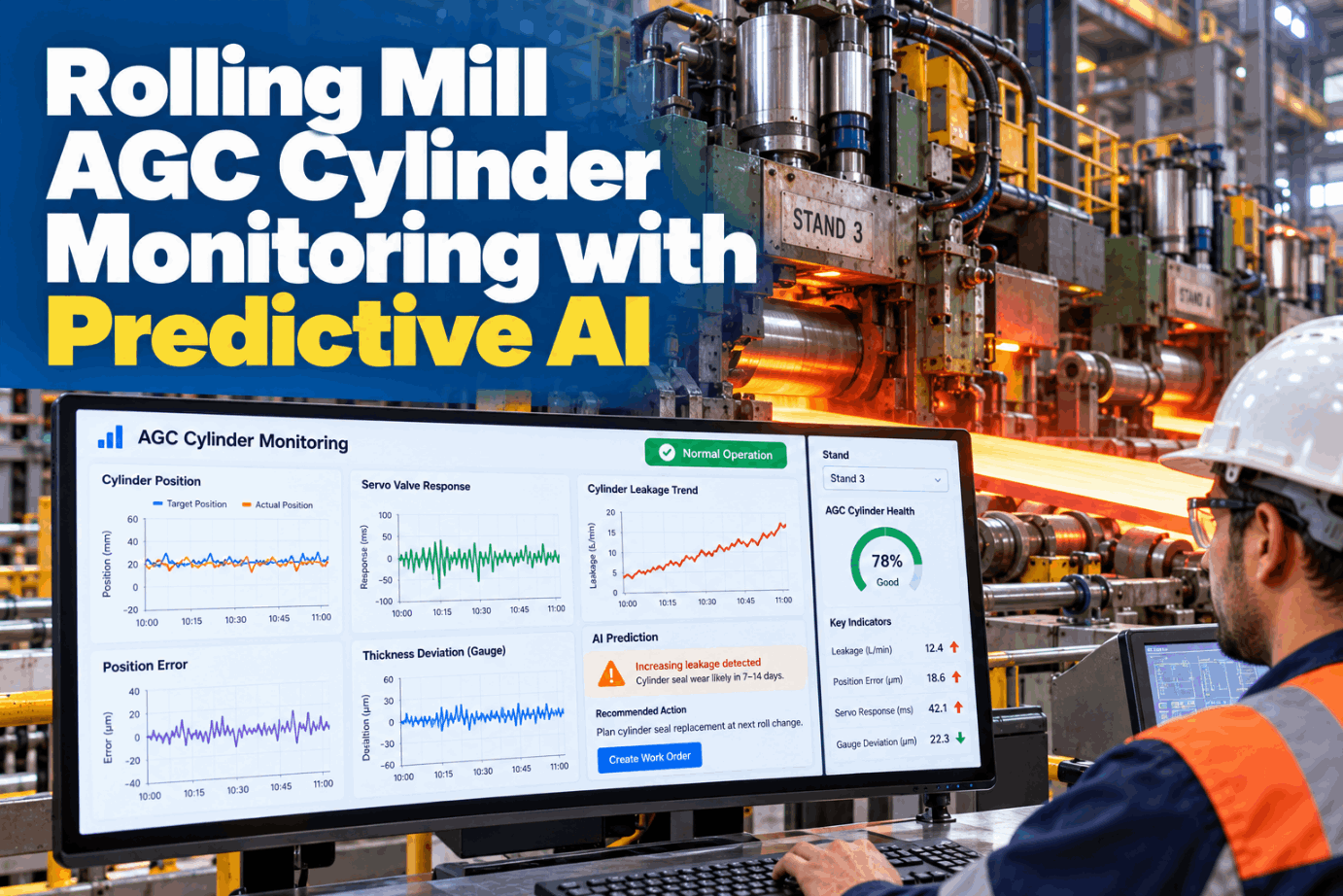
On a strip mill, gauge accuracy depends on hydraulic cylinders that move the roll gap by a few microns, many times a second. When a seal starts to bypass or a servo valve drifts off null, the gauge loops quietly work harder to hide it, until thickness wanders or a stand has to stop. AGC cylinder monitoring tracks servo response, leakage and position error per stand, so the weak cylinder or valve is found early and swapped at a roll change. See the stand-by-stand view in a short gauge analytics demo.
Catch the Weak AGC Cylinder Before It Costs You Gauge
iFactory Predictive AI builds servo response and leakage models for every stand and links them to strip gauge deviations. When a cylinder or servo valve starts to slip, the swap is planned into the next roll change.
Two Ways Mills Put a Cylinder Behind the Roll Gap
Hydraulic gap control places hydraulic pistons either in series with the mechanical screws or instead of them. Both designs use the same instruments: a servo valve that meters oil in and out, a position transducer inside or beside the cylinder and pressure transducers that let the control system work out rolling force. Magnetostrictive sensors of the Temposonics type are common for position; one maker quotes 1 micron resolution for its R-Series sensors. Check your own stand design with our rolling specialists.
- Sits between the screwdown and the top backup roll chock
- Screws set the coarse gap, the capsule makes fast, fine corrections
- Small stroke, so a little leakage shows up quickly as drift
- Usually reached when the backup rolls come out
- Replaces the mechanical screws entirely
- Handles gap opening, roll change travel and gauge control
- Longer seals and transducer, more oil volume to control
- Stroke and response tested across its whole working range
Every Gauge Loop Ends as a Command to the Cylinder
Automatic gauge control stacks several loops on top of the hydraulic position loop. The gaugemeter loop, first developed by BISRA, estimates exit thickness from roll gap and rolling force using the mill modulus. Feedforward uses entry thickness and speed, and the monitor loop trims using a gauge after the stand. Whatever loop is active, its output is a position or force command to the cylinder. If the cylinder cannot follow, gauge accuracy falls. See how loop data feeds the models in a loop walkthrough.
What Goes Wrong in Stand Hydraulics and How It Shows
Most AGC faults develop slowly. The position loop compensates, so the mill keeps rolling while the effort to hold gap creeps up. That is why the first signals live in control data, not in alarms. A typical servo valve datasheet, such as Moog's 760 series, lists null bias and null shift limits of under 2% and notes that metering edge wear, pressure gain loss and leakage depend on fluid cleanliness. Review your own failure history with our support team.
Gauge Deviations Traced to the Cylinder Behind Them
iFactory keeps a servo response and leakage model for each stand and side, then checks gauge deviations against them. When a deviation lines up with a weakening cylinder or valve, the swap is proposed for the next roll change.
Six Signals Worth Trending on Every Stand
None of these needs new hardware on most mills. They come from the position transducer, the pressure transducers, the valve command and the gauges that the AGC system already reads. What matters is recording them under the same conditions each time so trends mean something. Fast signals need fast capture: a gap step lasts only milliseconds, so slow historian sampling can hide the very change you are looking for. Map your available signals in a signal review.
One Outlier Stands Out When Every Cylinder Is Tested Alike
A single test result means little. The same test run at every roll change, on every stand and side, quickly shows which cylinder is drifting away from the rest. The chart below is illustrative and shows weekly hold drift results across a finishing mill. Ask our support team for a sample stand report.
Match Each Repair to the Window That Fits It
The cheapest time to fix an AGC problem is a stop that is already planned. Work roll changes are short and frequent; backup roll changes are longer and usually give access to the capsule or cylinder. Predictive models give planners enough warning to choose the right window instead of forcing an extra stop. They also give stores time to get the right valve or seal kit to the stand before the window opens. Plan your windows with our maintenance planners.
Send removed valves for bench testing to the ISO 10770-1 test methods before reuse, and record a new baseline for the fitted part.
A Health Record for Each Cylinder and Valve
Keep one record per stand and side. It holds the baseline that every later test is compared against and the history planners need when choosing a swap window. Ask our support team for a blank record.
Five Habits That Make the Data Trustworthy
Models are only as good as the tests and records behind them, and this is where most AGC cylinder monitoring implementation guides start. These practices keep results comparable from one roll change to the next and keep hydraulic faults from being blamed for mill setup problems. Talk them through in an implementation session.
Three Patterns and What Planners Did Next
These are illustrations of typical patterns, not case studies. Each shows how two or three signals together point to one part. Walk through your own stand data with our support team.
Gauge Analytics, Models and NVIDIA Server in One Package
iFactory delivers Predictive AI and gauge analytics as a turnkey bundle. Fast AGC signals are collected from your level 1 system, and a pre-configured NVIDIA AI server ships racked and ready with the servo response, leakage and gauge-link models pre-loaded. You rack it, plug in power and Ethernet, and the AI is live. To scope it for your mill, request a turnkey quote.
- Pre-configured NVIDIA AI server, racked and ready
- Fast data capture of position, pressure and valve signals
- Servo response and leakage models per stand and side
- Links to gauge and coil data for deviation tracing
- Roll change test routines and baseline records
- Swap work orders timed to roll change windows
- 24×7 remote monitoring of models and hardware
AGC signals and gauge data connected, test routines agreed with hydraulics and automation.
Baselines recorded per stand, models compared with known valve and seal history.
Alerts and swap proposals switched on, planners and engineers trained.
AGC Cylinder Monitoring Software Built Around the Stand
iFactory reads the signals your gauge control already uses and turns them into a health view for every cylinder and valve. Our support team can walk you through a pilot plan.
What Plant Managers Ask About AGC Cylinder Monitoring
Protect Gauge Accuracy One Stand at a Time
Trend servo response, leakage and position error on every cylinder, trace gauge deviations to the part behind them and swap it at a planned roll change. The full system is delivered turnkey and goes live in 6 to 12 weeks.