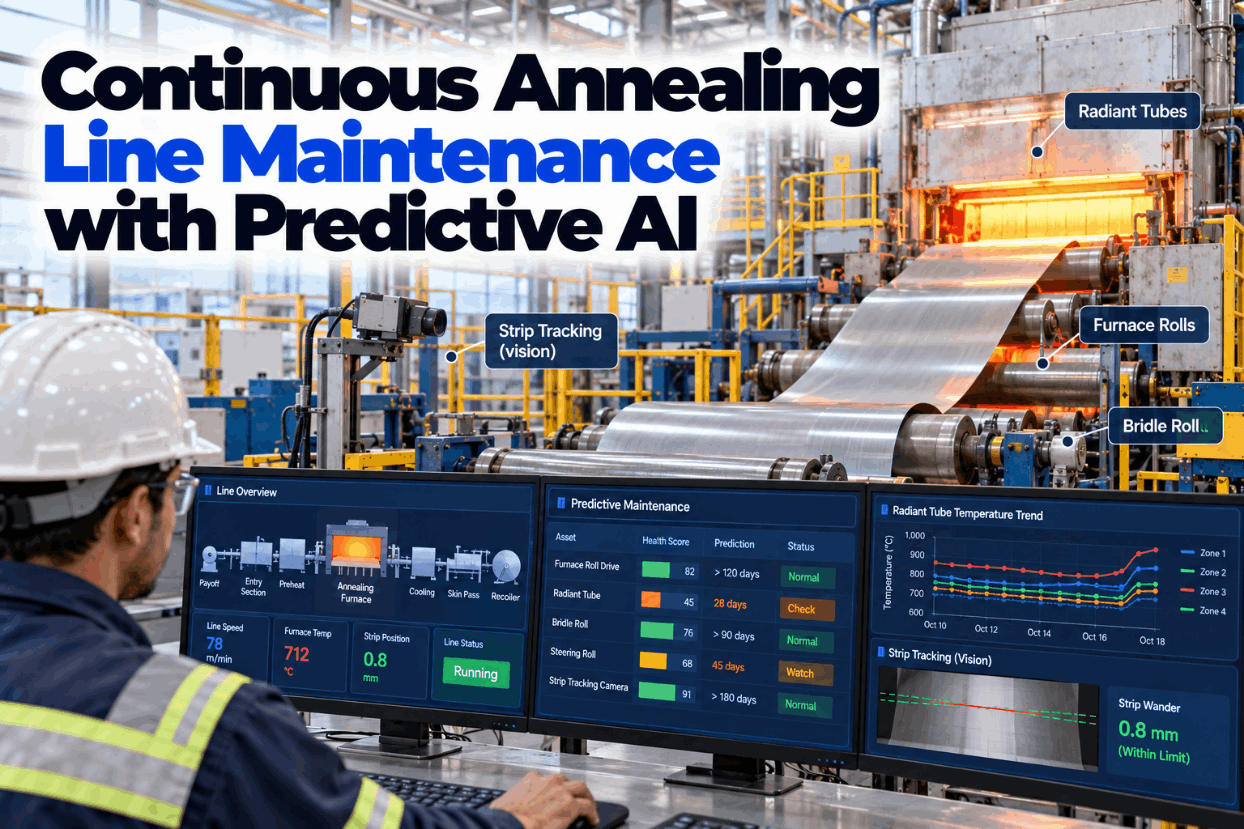
Continuous Annealing Line Maintenance with Predictive AI

By Josh Brook on October 23, 2026

continuous-annealing-line-maintenance-predictive-ai

On a continuous annealing line, the costliest stops rarely start with a big failure. They start with a hearth roll slowly picking up oxide, a radiant tube sagging in the hottest zone or a steering roll fighting harder to keep the strip centred. Each one leaves a signal in drive torque, tube temperature or strip position long before a wrap or a break. Predictive AI reads those signals across the whole furnace and tells maintenance which asset to check at the next stop. See it on furnace data in a short CAL demo.

PREDICTIVE AI · CONTINUOUS ANNEALING

Catch the Roll, Tube or Steering Fault Before the Strip Wraps

iFactory Predictive AI uses roll drive torque and radiant tube temperatures to predict failures in the furnace. Strip Tracking Vision follows strip wander and flags steering roll issues automatically, so the next stop fixes the right asset.

CAL 2 furnace · Live watch2 flags
Steady speed · all zones in temperature band
Hearth roll HR-22 torqueAbove baseline, rising
Radiant tube RT 3-07Cooler than zone neighbours
Strip edge at steering roll SR-4Within band · vision
Bridle 3 roll slipNormal
TorqueTube tempStrip vision
Work order drafted: check RT 3-07 burner at next stop
CONTINUOUS ANNEALING LINE MAINTENANCE

Seven Sections, One Strip, No Easy Stops

A continuous annealing line turns cold-rolled, work-hardened strip into soft, formable product. Loopers let the entry and exit stop for coil changes while the furnace keeps running, which also means a furnace fault stops everything. Most maintenance risk sits in the furnace, where you cannot reach the rolls and tubes until it is cooled and purged. Map your own line with our CAL specialists.

Entry
Payoff reels, welder
›
Cleaning
Alkaline wash, brushes
›
Entry looper
Strip stored for coil changes
›
Furnace
Heating, soaking, cooling, overaging
›
Exit looper
Buffer for the exit end
›
Skin pass
Temper rolling, shape
›
Exit
Inspection, shear, coiler
ANNEALING FURNACE RELIABILITY

What Fails in the Furnace and the Signal It Gives First

Every major furnace asset has a typical way of failing and a measurable signal that moves before the strip shows it. The matrix links the two, so each asset is watched by the signal that matters for it. Review your asset list in a furnace walkthrough.

Asset
Typical failure
What the line sees
Signal the AI watches
Hearth rolls
Oxide build-up, crown change, bearing or drive wear
Marks on strip, wander, heat buckles
Drive torque per roll
Radiant tubes
Creep sag, oxidation, cracks
Zone short of heat, furnace pressure loss
Tube temp vs neighbours
Burners
Wrong air-fuel ratio, ignition faults
Uneven heating within a zone
Flue O2 per burner
Bridle rolls
Coating wear, slip, bearing faults
Tension swings, scratches
Torque share and slip
Steering rolls
Sluggish actuators, sensor faults
Strip wander, edge contact
Vision edge position
Jet cooling fans
Bearing and imbalance faults
Uneven cooling, shape issues
Vibration, motor current
Looper cars
Rope, sheave and carriage wear
Looper faults at coil change
Position, rope tension
FURNACE ROLL MAINTENANCE

Hearth Roll Crown: Too Little Wanders, Too Much Buckles

Hearth rolls carry a small crown that pulls the strip to the centre. Heat changes that crown in service, and patents on furnace rolls describe the trade-off plainly: too little crown and the strip meanders, too much and hot strip heat-buckles. Build-up adds a third problem, as iron and manganese oxide stick to the roll surface and print onto the strip. Talk through roll care with our roll team.

Crown too small
Weak centringStrip drifts sideways and can touch the furnace wall
Working window
Stable trackingStrip centred without buckling at normal tension
Crown too large
Heat bucklingHot, soft strip folds into ridges along its length
What torque tells you

Each hearth roll has its own drive. A roll with build-up, a stiff bearing or a changed crown takes a different share of torque than its neighbours. iFactory trends that share per roll and ranks rolls for inspection at the next stop.

RADIANT TUBE FAILURE

How W, U and P Tubes Wear Out

Radiant tubes keep combustion gas apart from the protective atmosphere. Creep is the main life limit: a study of P-type tubes linked creep mainly to temperature cycling from on/off firing and local hot spots. In a Kanthal case study from a Swedish line with over 200 W-tubes, sagging of the burner leg was the main reason for changing tubes. See tube monitoring in a furnace demo.

Creep and sagTubes stretch and bow at high temperature under their own weight, worst in the hottest zones.
OxidationThe outer surface scales and thins, faster when a tube runs hotter than design.
Cracks and leaksFurnace gas leaks into the tube and furnace pressure falls, limiting heating.
Burner faultsA poor air-fuel ratio wastes fuel, makes soot and leaves tubes running hot or cold.
Finding the failed tube

Compare each tube's temperature with others in its zone, compare flue O2 between burners in the same control group, and watch furnace pressure and atmosphere make-up flow. Some mills also isolate tube groups with a helium tracer. Confirm at the stop before changing a tube.

One View of Rolls, Tubes and Strip Position

Torque, tube temperatures and strip tracking vision usually live in three different systems. iFactory brings them together, explains why an asset is flagged and drafts the work order. Your engineers decide when to act.

CAL 2 · Shift engineer and iFactory
Shift engineerVision shows the strip wandering after the soak zone. Is it the steering roll?
iFactorySR-3 is near its travel limit and still losing ground. HR-22 just upstream has taken a rising torque share for two days, which fits build-up changing its crown.
Shift engineerCan it wait for the weekend stop?
iFactoryWander is still inside your alarm band. I have drafted an HR-22 inspection for that stop and will alert you if the trend speeds up.
BRIDLE ROLL

Bridle Rolls Set the Tension, and Tension Has Two Limits

Bridle rolls at the furnace entry, between sections and at the exit set strip tension by small speed differences. Furnace patents describe the balance: high tension at the cold ends to stop slip and mistracking, lower tension where the strip is hot and soft. Worn bridle coatings and slipping rolls upset that balance. See bridle trending in a line review.

TENSION TOO LOW
  • Strip slips on rolls and can scratch
  • Weaker centring, so the strip wanders
  • Wander can bring the edge into the furnace wall
  • Watch: bridle slip and roll speed mismatch
TENSION TOO HIGH
  • Heat buckles in the heating and soaking zones
  • Strip narrows more than the width tolerance allows
  • Over-necking and, at worst, a strip break
  • Watch: tension spikes at speed and gauge changes
STRIP TRACKING AND STEERING ROLL

Strip Wander by Steering Roll, Hour by Hour

Steering rolls correct strip position, often with hydraulic actuators and edge sensors. A healthy roll corrects quickly and returns to centre. A sluggish actuator, a dirty sensor or a roll near its travel limit shows up as wander that grows from hour to hour. Vision tracks the edge at each point and flags the roll that is losing control. Set alarm bands with our tracking team.

Peak edge offset this shift, mmIllustration, not site data
SR-1 heating4
SR-2 soaking5
SR-3 cooling16
SR-4 overaging6
SR-5 exit4
FlaggedSR-3, near travel limit
Upstream suspectHR-22 torque share
ActionInspect at next stop
STRIP WRAP PREVENTION

Six Common Routes to a Break or Wrap in the Furnace

A strip break inside the furnace can mean cooling down, purging, clearing wrapped strip from rolls and rethreading. Most breaks follow a short list of causes, and most give a warning in torque, tension or tracking first. Thin, wide strip is the most sensitive. Review your break history in a break review.

01
Heat buckleA fold forms in hot strip and tears or wraps at the next roll
02
MistrackingStrip edge reaches the furnace wall or a roll end
03
Weld failureA weak entry weld parts under furnace tension
04
Tension upsetSpikes at speed, gauge or width changes
05
Stalled rollA seized bearing or drive fault drags the strip
06
Edge damageCracked or nicked edges that tear under load
PROTECTIVE ATMOSPHERE SAFETY

HNx Gas Changes How Maintenance Works

The furnace runs in nitrogen with hydrogen (HNx) to keep the strip bright. Mixes below about 5% hydrogen are often described as non-flammable, but high-hydrogen jet cooling sections can run far richer, and hydrogen becomes flammable in air at about 4%. No AI replaces the purge, gas test and permit your procedures and NFPA 86 require. Review safe-entry steps with our safety team.

H2
HydrogenFlammable in air from about 4%; check each zone's design level
N2
Nitrogen purgeBefore opening, before entry and before reheating; also an asphyxiation risk
O2
OxygenA rise in the furnace points to air getting in through seals or leaks
DP
Dew pointA rise points to water or air ingress and harms strip surface
CONTINUOUS ANNEALING LINE MAINTENANCE TEMPLATE

A Furnace Stop Work Pack, Ranked by Risk

Furnace stops are short and expensive, so the work list should be ranked by data, not habit. Use these fields to plan each stop. iFactory fills the ranked lists from torque, tube and tracking trends. Get an editable copy in a planning session.

Stop windowCool-down, work and reheat hours
Atmosphere releaseN2 purge, gas test, entry permit
Hearth rollsRanked by torque share trend
Radiant tubesRanked by temperature, O2, sag
Steering rollsActuators, travel, edge sensors
Bridle rollsCoating, slip, bearings
Spares stagedTubes, burners, roll sets
Restart checksPurge, heat-up rate, tracking
CONTINUOUS ANNEALING LINE MAINTENANCE EXAMPLES

Three Flags and What Followed

These illustrations show how a flag usually turns into a check. They are not case studies, and your own procedures decide the response. Walk through your scenarios with our support team.

Hearth roll torque share rising
Roll inspected at the planned stopBuild-up found and cleaned before marks reached the strip.
One tube cooler than its zone
Flue O2 points to the burnerThe burner was fixed and the tube kept in service, so no tube change was needed.
Wander after width change
Steering roll slow to respondA sticking actuator valve was found and changed during the next coil change window.
CONTINUOUS ANNEALING LINE MAINTENANCE COST AND ROI

Size What Furnace Breaks Cost Your Line

Use your own break log, throughput and margin. The worksheet uses assumed inputs and only shows the arithmetic; it is not a savings claim. Build the case with your data in a value session.

Strip breaks in the furnace per year3, assumed
Hours lost per break: cool, clear, rethread, reheat24, assumed
Line throughput100 t per hour, assumed
Output lost per break24 × 100 = 2,400 t
Output lost per year3 × 2,400 = 7,200 t

Multiply the tonnes you believe earlier warnings could protect by your own margin per tonne. Add roll repair, tube and labour costs from your records.

TURNKEY AI DEPLOYMENT

Furnace AI, Tracking Cameras and Edge Server in One Package

iFactory delivers Predictive AI and Strip Tracking Vision as one bundle. A pre-configured NVIDIA AI server ships racked and ready with torque, tube and tracking models pre-loaded, so furnace data and video are processed on site. You rack it, plug in power and Ethernet, and the AI is live. Ask our scoping team for a turnkey quote.

What's Included
  • Pre-configured NVIDIA AI server, racked and ready
  • Tracking cameras at key strip positions
  • Links to roll drive torque and tension signals
  • Links to radiant tube temperatures and flue O2
  • Models for hearth rolls, tubes, bridles and steering
  • Work orders drafted into your maintenance system
  • 24×7 remote monitoring of models and hardware
Live in 6–12 weeks
Wk 1–4
Connect and Install

Server and cameras installed, drive and furnace signals linked, history loaded.

Wk 5–8
Baseline and Shadow

Per-roll and per-tube baselines built, flags checked silently with your engineers.

Wk 9–12
Go-Live and Training

Alerts and work orders switched on, planners and shift teams trained.

HOW iFACTORY FITS

Continuous Annealing Line Maintenance Software That Watches the Furnace

iFactory turns signals your line already produces into ranked maintenance work for the next stop. See it on your own data in a short demo.

1
Watches roll drive torque. Each hearth and bridle roll is trended against its own baseline.
2
Tracks radiant tube temperatures. Tubes are compared with their zone to spot failing tubes and burners.
3
Sees strip wander. Vision follows the strip edge at key tracking points.
4
Flags steering roll issues. Rolls losing control are flagged automatically, with the likely upstream cause.
1000+
Industrial clients running iFactory
99.9%
Platform uptime for continuous lines
6-12 wks
From racked server to live furnace alerts
FREQUENTLY ASKED QUESTIONS

Continuous Annealing Line Maintenance for Plant Managers

What does continuous annealing line maintenance cover?
The entry and welder, cleaning section, loopers, furnace, skin pass mill and exit. The furnace carries most of the risk: hearth rolls, radiant tubes and burners, bridle rolls, steering rolls and jet cooling fans, all inside a protective atmosphere that must be purged before anyone works on them.
How does predictive AI spot a failing radiant tube?
It compares each tube's temperature with the other tubes in its zone and compares flue O2 between burners in the same control group. A tube running cooler or hotter than its neighbours, together with an odd O2 reading, points to a burner fault or a damaged tube to check at the next stop.
Why do hearth roll problems cause tracking and buckling?
The roll crown centres the strip. Heat and build-up change that crown in service. With too little crown the strip wanders, and with too much the hot strip can heat-buckle. Trending torque per roll shows which roll is behaving differently before the strip does.
Can cameras see the strip inside the furnace?
Cameras are placed where the strip can be viewed, such as entry, exit, loopers and sight ports where the furnace allows. Steering rolls inside the furnace usually have their own edge sensors, and iFactory reads those signals alongside the vision data.
How does this help prevent strip wraps?
Most wraps follow a heat buckle, mistracking, a tension upset or a stalled roll. Each one gives an early signal in torque, tension or strip position. Flagging those signals early gives the team time to slow down, adjust or plan the fix before a break.
How do we start?
Start with the furnace: link roll drive torque, tube temperatures and existing tracking sensors, add cameras at one or two key points and run the models in shadow mode for a few weeks. Our support team can plan that pilot with you.

Plan Every Furnace Stop Around the Assets That Need It

Trend every hearth and bridle roll, watch every radiant tube and follow the strip edge with vision. The full system is delivered turnkey and goes live in 6 to 12 weeks.
Example shift summary · CAL furnace
Hearth rollsTorque trended per roll
Radiant tubesCompared within each zone
Strip trackingEdge position by vision
FlagsWork orders drafted for approval
Every flag linked to an asset and a time

Share This Story, Choose Your Platform!