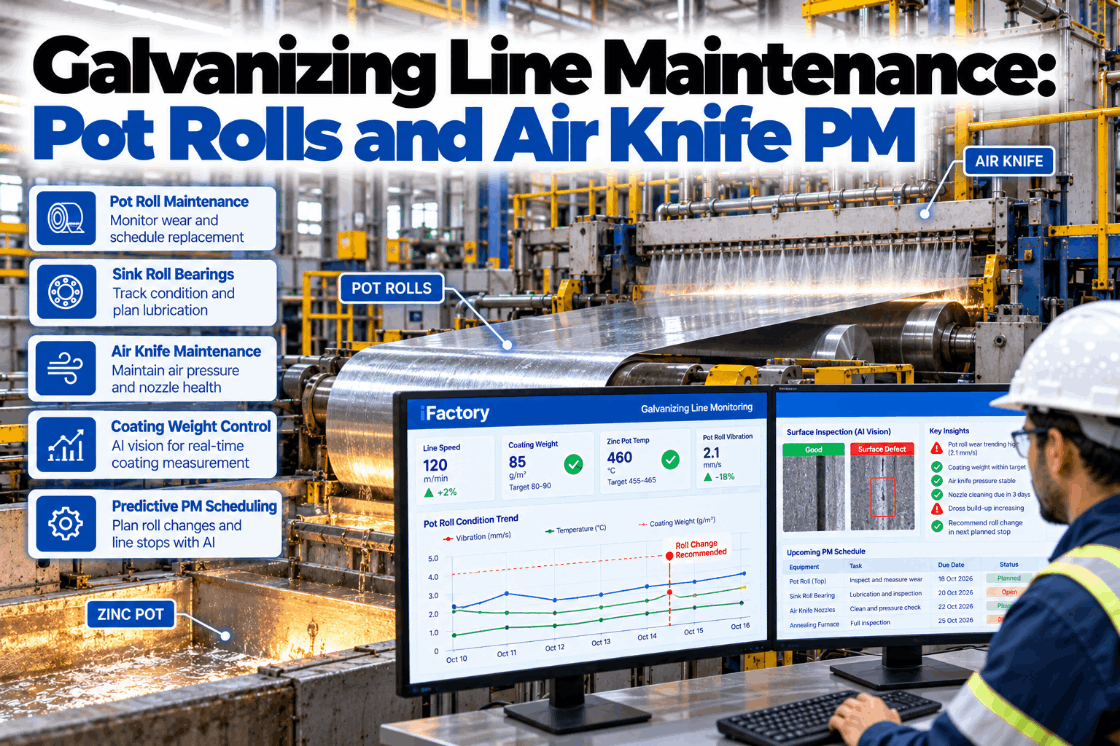
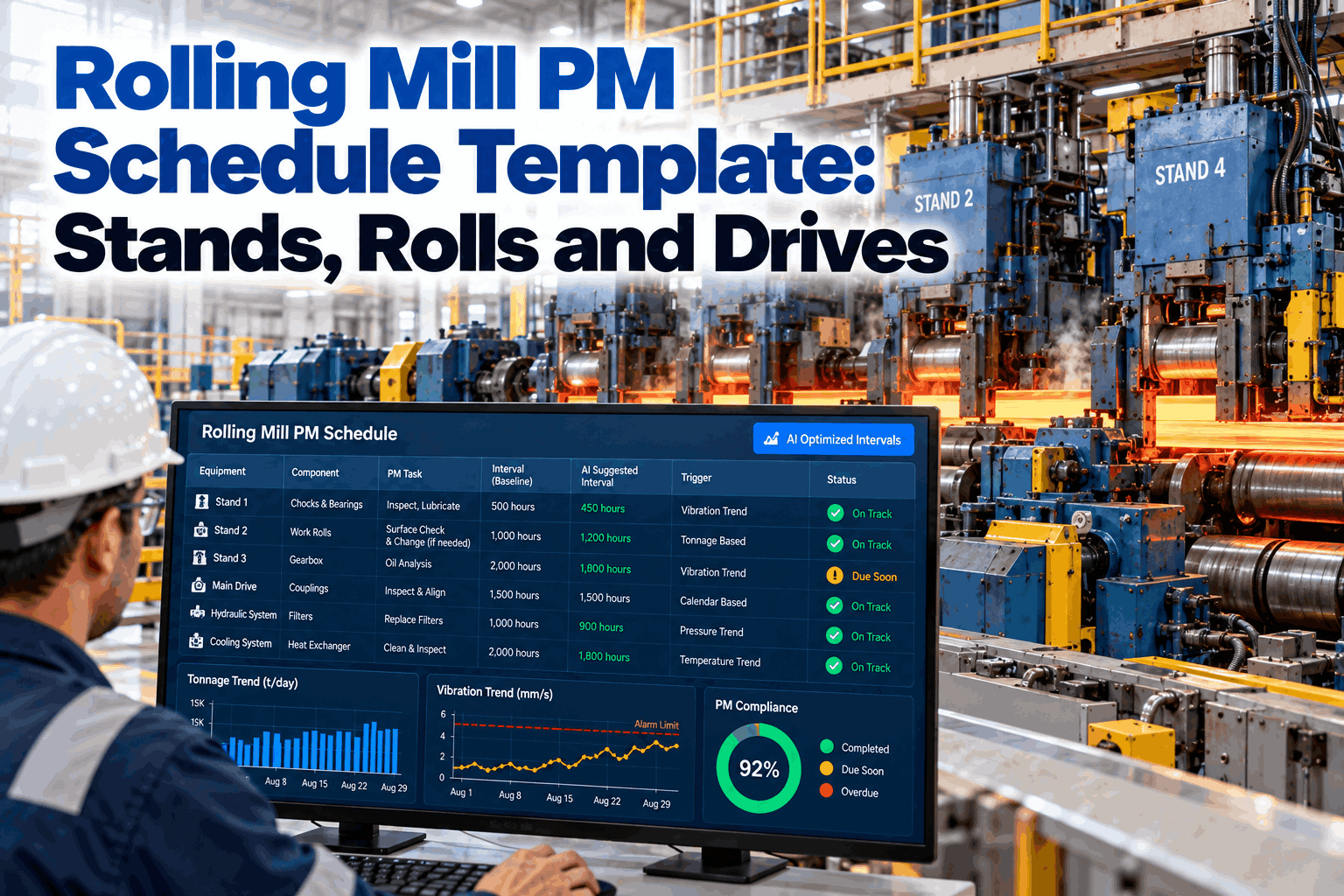
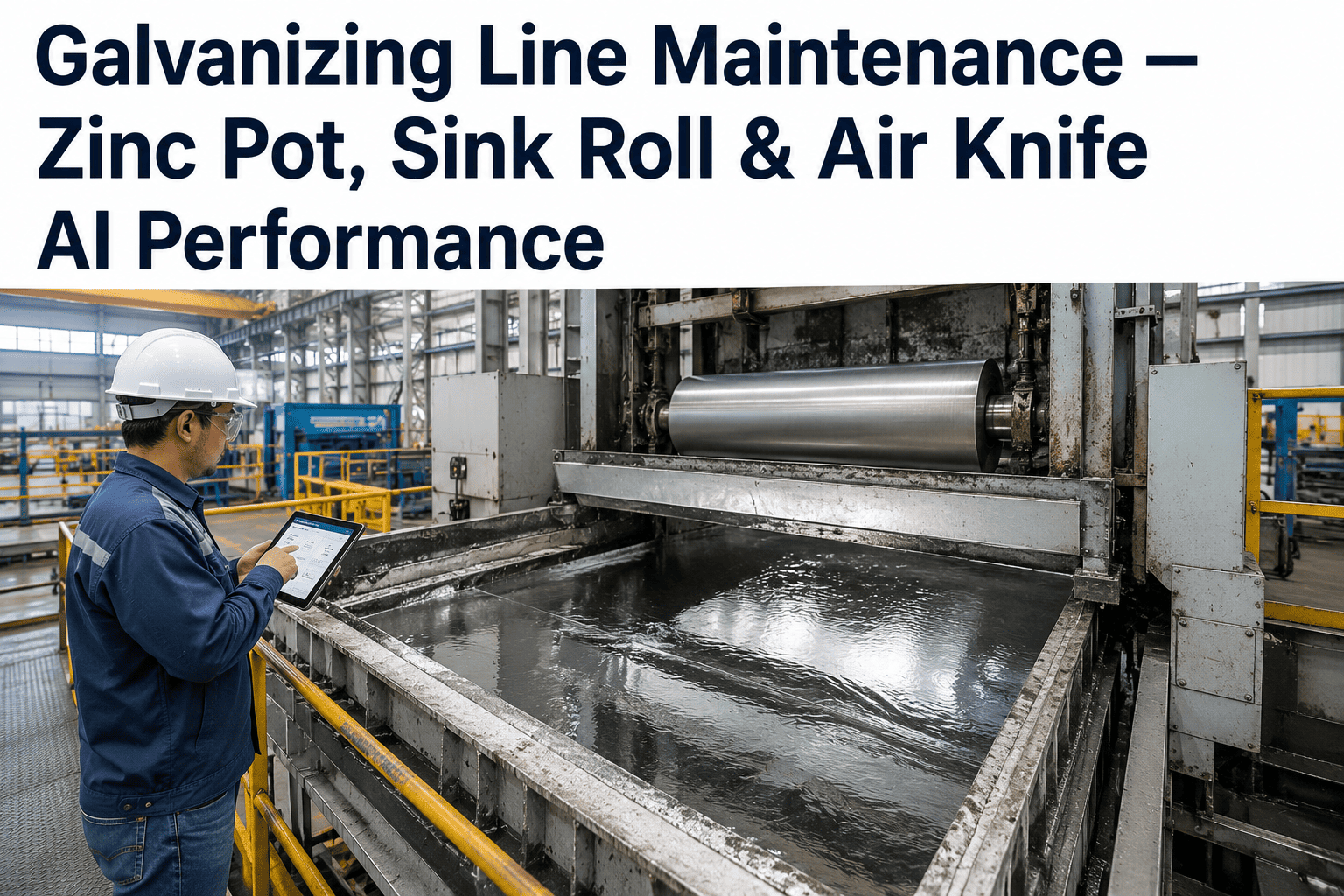
On a continuous hot-dip galvanizing line, the parts that decide coating quality sit inside a pot of molten zinc or a few centimetres from the strip. The sink roll, stabilizer and correcting rolls wear out in the bath, dross builds up around them and air knife lips collect zinc splash. When a pot roll fails between planned stops, the whole line stops with it. This guide sets out a practical PM plan for the pot, air knives and annealing furnace, and shows how coating data can time roll changes. See it on a coating line in a galvanizing line demo.
PREDICTIVE AI · COATING LINES
Plan Pot Roll Changes From Coating Data, Not the Calendar
iFactory Predictive AI and Coating Vision read coating weight and surface defect trends to predict pot roll wear. The PM agent books each roll change into a planned line stop and preps the roll shop kanban.
CGL 2 · pot roll watchCampaign day 11
Z275 order · coating weight per side, last 8 coils
Top143 g/m²
Bottom136 g/m²
Roll marks3 coils
Wear indexRising
Roll set BPreheating
HOT DIP GALVANIZING LINE
Inside the Zinc Pot: What Wears and Where
After cleaning and annealing, the strip runs down a snout into the zinc pot, wraps around the sink roll and rises past stabilizer and correcting rolls that keep it flat and steady. Above the bath, air knives wipe off excess zinc to set coating weight, and a gauge after the cooling tower measures it. Every part in the bath is fighting heat, molten zinc and dross. Ask our coating line team to map your own pot hardware.
1SnoutSeals the strip from air on its way in from the furnace
2Sink roll and bearingsTurns the strip in the bath, the most stressed part
3Stabilizer and correcting rollsHold the strip flat and steady for the knives
4Air knivesGas jets that wipe zinc to set coating weight
5Top drossFloats on the bath, skimmed off
6Bottom drossSettles on the pot floor
7To cooling tower and gaugeCoating weight measured per side
ZINC POT ROLL MAINTENANCE
Sink Roll Bearing and Pot Roll Wear
Pot rolls run fully submerged in a molten zinc and aluminium bath, so bearings and bushings wear and dross builds up on roll surfaces. That is why lines run pot hardware in campaigns. A US Department of Energy research report on pot hardware noted that the lines it studied stopped about every two weeks to change submerged rolls. Ceramic and cermet bearing materials and hard-faced sleeves are used to stretch that interval. Compare your own campaign lengths in a pot hardware review.
Sink roll
Wears byBearing and bushing wear, dross build-up on the shell
Shows on strip asRoll marks, pick-up, unsteady strip at the knives
Change triggerWear trend, marks on several coils
Stabilizer roll
Wears byShell grooving, bearing play
Shows on strip asStrip flutter, edge-to-edge coating spread
Change triggerCoating spread across width
Correcting roll
Wears byShell wear, dross pick-up
Shows on strip asCrossbow, uneven knife gap to strip
Change triggerPosition limits reached
Bearings and bushings
Wears bySliding wear in zinc, often ceramic or cermet pairs
Shows on strip asRoll chatter, slip marks
Change triggerMeasured wear in the roll shop
DROSS MANAGEMENT
Top Dross, Bottom Dross and the Aluminium Line
Dross is made of hard Fe-Al-Zn intermetallic particles. GalvInfo explains that above about 0.14% effective aluminium the stable particle is Fe2Al5-based top dross, which floats. Below it, delta FeZn7 bottom dross forms and sinks. Typical total aluminium is 0.16–0.20% for galvanize and 0.11–0.135% for galvanneal. A sudden fall in temperature can throw out zinc-iron particles, so steady bath and strip temperatures matter. Review your bath plan with our process team.
Bath aluminium, %Bands show total Al, the line shows effective Al
0.100.130.160.190.22
Galvanneal 0.11–0.135 totalGalvanize 0.16–0.20 totalAbout 0.14 effective
Below the line: bottom drossDelta FeZn7, heavier than zinc, settles on the pot floor and can be stirred up onto the strip.
Above the line: top drossFe2Al5-based, lighter than zinc, floats and is skimmed by hand or robot.
Keep the bath steady
GalvInfo advises against sudden aluminium swings, suggests strip entry at no more than about 2°C above bath temperature and stresses keeping iron fines off the strip.
AIR KNIFE MAINTENANCE AND COATING WEIGHT CONTROL
Six Settings That Decide Coating Weight
Coating is sold by mass. Under ASTM A653, G90 means at least 0.90 oz/ft² total on both sides in a triple-spot test, the same mass as Z275, which is 275 g/m² in A653M and EN 10346. GalvInfo names knife pressure as the main control, with distance, height, angle and slot gap also set. Lips crusted with zinc splash disturb the jet, which is why lip cleaning and gap checks belong in the PM plan. Walk through your knife set-up in a coating control session.
Pressure
Main controlMore pressure gives a thinner coatDistance
Knife to stripCloser gives a thinner coat. Too close or too much pressure can freeze zinc at the knifeLine speed
Drags out zincFaster strip needs more pressure for the same weightHeight
Above the bathSet with the other settings, kept steady per productAngle
Jet to stripChecked after knife work or roll changesSlot gap
Lip openingGauged and kept even, lips cleaned of zinc build-up
ASTM A653G900.90 oz/ft² both sides, triple spot
=
A653M · EN 10346Z275275 g/m² both sides, triple spot
ANNEALING FURNACE
Trace Strip Defects Back to the Furnace
Many coating defects start before the pot. Radiant tubes heat the strip in a protective atmosphere, hearth rolls carry it through and the snout brings it into the bath without air contact. When a tube fails, a hearth roll builds up or the atmosphere drifts, the strip shows it. The map below links common symptoms to furnace checks. Ask our furnace specialists about your own defect history.
Marks or dents at a regular pitch
›
Hearth roll build-upInspect and clean rolls at the next planned stop
Uneven strip temperature across zones
›
Radiant tube fault or leakThermography and combustion checks on the zone
Bare spots or poor adhesion
›
Atmosphere or cleaning problemDew point trend, seals and the cleaning section
Oxide or dull patches before the pot
›
Air reaching the stripSnout and furnace seal checks
GALVANIZING LINE MAINTENANCE TEMPLATE
A PM Schedule for the Pot, Knives and Furnace
Use this template as a starting point. The frequencies are common practice to adapt with your OEM guidance, bath chemistry plan and your own failure history. Tasks tied to roll changes move with the campaign, not the calendar. Get an editable copy from our PM planning team.
Roll Changes Timed by the Coating, Booked by the PM Agent
iFactory reads coating weight and Coating Vision defect trends to predict pot roll wear. The PM agent fits each roll change into a planned stop and preps the roll shop kanban, so the next set is ready.
Line engineer and iFactory · CGL 2
EngineerWill the sink roll last to next week's stop?
iFactoryUnlikely. Roll marks on three coils and bottom-side coating drift point to the limit within about five days.
EngineerThen use Thursday's stop.
iFactoryBooked. Set B is on the roll shop kanban for preheat by Wednesday night, with knife checks added to the stop.
COATING LINE DOWNTIME
Predicting Roll Change Timing From the Strip
The pot can't be inspected while it runs, but the strip carries the evidence out. Bottom-side coating drift, wider spread across the width, roll marks found by Coating Vision and rising knife pressure to hold target all point to pot roll wear. iFactory combines them into a wear trend and compares it with the next planned stop. Our reliability team can show which signals your line already has.
Bottom-side coating driftRising
Coating spread across widthRising
Roll marks from Coating Vision3 coils
Knife pressure to hold targetSteady
Campaign runway · illustration
Today
Planned stop, Thu
Predicted limit
Limit after the next stopChange at that stop
Limit before the next stopPull a stop forward or slow the line
No clear trendKeep running, watch daily
ROLL SHOP KANBAN
The Next Roll Set Ready Before the Stop
A planned roll change only saves time if the replacement set is rebuilt, measured and preheated before the line stops. The roll shop kanban tracks every set through the same stages, and the PM agent raises the next card as soon as a change is booked. See the board in a roll shop walkthrough.
GALVANIZING LINE MAINTENANCE COST AND ROI
Size the Value of Planned Roll Changes
An unplanned pot roll failure usually costs more line time than the same change done at a planned stop, because nothing is ready. Use your own stop records to size the gap. The worksheet uses assumed inputs to show the arithmetic only. Our team can help you build it with your data.
Unplanned pot roll stops per year4assumed
Extra hours lost vs a planned change× 6 hassumed
Extra line hours per year= 24 h4 × 6
Line output per hour× 50 tassumed
Capacity at stake per year= 1,200 t24 × 50
GALVANIZING LINE MAINTENANCE BEST PRACTICES
Six Rules for a Steady Coating Line
These rules come up again and again on well-run coating lines. Each one protects the pot, the knives or the planned stop. Talk them through with an engineer in a best practice review.
01Never shock the bathSmall, steady aluminium additions and stable temperatures
02Always have the next set readyA rebuilt, preheated roll set before every planned stop
03Record wear per roll setBearing and bushing readings tied to campaign length
04Check knives after roll changesGap, angle and distance to the new strip line
05Trust the gauge, verify with the labDaily lab checks keep coating weight honest
06Read defects as maintenance signalsRoll marks and streaks point to the part that needs work
TURNKEY AI DEPLOYMENT
Implementation Guide: Coating Vision and Pot Roll AI, Turnkey
A pre-configured NVIDIA AI server ships racked and ready, with Coating Vision, predictive models and the PM agent pre-loaded. You rack it, plug in power and Ethernet, and the AI is live. Confirm the scope with our integration team.
What's Included
- Pre-configured NVIDIA AI server, racked and ready
- Coating Vision cameras after the cooling tower
- Links to coating gauge, knife and pot data
- Pot roll wear models tuned to your campaigns
- PM agent and roll shop kanban set up
- Training for line, roll shop and planners
- 24x7 remote monitoring of server and models
Live in 6–12 weeks
Wk 1–4
Connect and Install
Server racked, gauge and PLC data linked, cameras fitted.
Wk 5–8
Learn the Campaigns
Models tuned on past roll changes and run in shadow mode.
Wk 9–12
Go-Live and Training
Roll change booking and kanban live, teams trained.
HOW iFACTORY FITS
Built for the Pot, the Knives and the Roll Shop
iFactory connects what the strip shows to what the maintenance team does next. See it on your line data in a coating line demo.
1
Reads the coating. Coating weight per side and spread across the width are trended for every coil.
2
Sees surface defects. Coating Vision flags roll marks, streaks and pick-up as they appear.
3
Predicts pot roll wear. Trends combine into a wear outlook against the next planned stop.
4
Schedules and preps. The PM agent books roll changes into planned stops and preps the roll shop kanban.
1000+
Industrial clients running iFactory
99.9%
Platform uptime for continuous coating lines
6-12 wks
From racked server to live roll predictions
FREQUENTLY ASKED QUESTIONS
Galvanizing Line Maintenance Questions From Plant Managers
How often should pot rolls be changed?
There is no single interval. It depends on bearing materials, bath chemistry, strip mix and line speed. Many lines run fixed campaigns. Tracking coating and defect trends lets you change rolls when wear shows, at the nearest planned stop.
What causes sink roll bearings to wear?
They run in molten zinc with dross particles, under load from strip tension, with no normal lubricant. Sliding wear, corrosion and dross between the surfaces all take their toll, which is why ceramic and cermet bearing materials are common.
How do air knives control coating weight?
Gas jets wipe excess zinc back into the pot as the strip rises. Pressure is the main control, with distance to the strip, height above the bath, angle and slot gap also set. Line speed changes how much zinc the strip drags out.
Is G90 the same as Z275?
They describe the same coating mass in different units. G90 under ASTM A653 is 0.90 oz/ft² total both sides in a triple-spot test, and Z275 is 275 g/m² total both sides in A653M and EN 10346.
How does AI predict roll change timing?
It trends signals the line already produces: coating weight per side, spread across the width, knife pressure and roll marks found by Coating Vision. The combined trend is compared with the next planned stop so the change can be booked there.
Do we need new sensors on the pot?
Usually not to start. Most signals come from the coating gauge, the line PLC and cameras after the cooling tower. The site survey confirms what your line already has. Our
support team can review your data sources.
Fewer Surprise Pot Stops, Better-Prepared Roll Changes
Trend coating weight and surface defects, predict pot roll wear and book every change into a planned stop with the next set ready. Delivered turnkey, live in 6 to 12 weeks.
Example stop plan · CGL 2, Thursday
Pot rollsSet A out, Set B in
Air knivesLip clean, gap and angle check
FurnaceHearth roll inspection
Roll shopSet A to strip and measure
Kanban cards raised for every task