Flammability Sample from Shipped Lot Audit with AI Vision

By David Cook on October 29, 2026

flammability-sample-shipped-lot-audit-ai

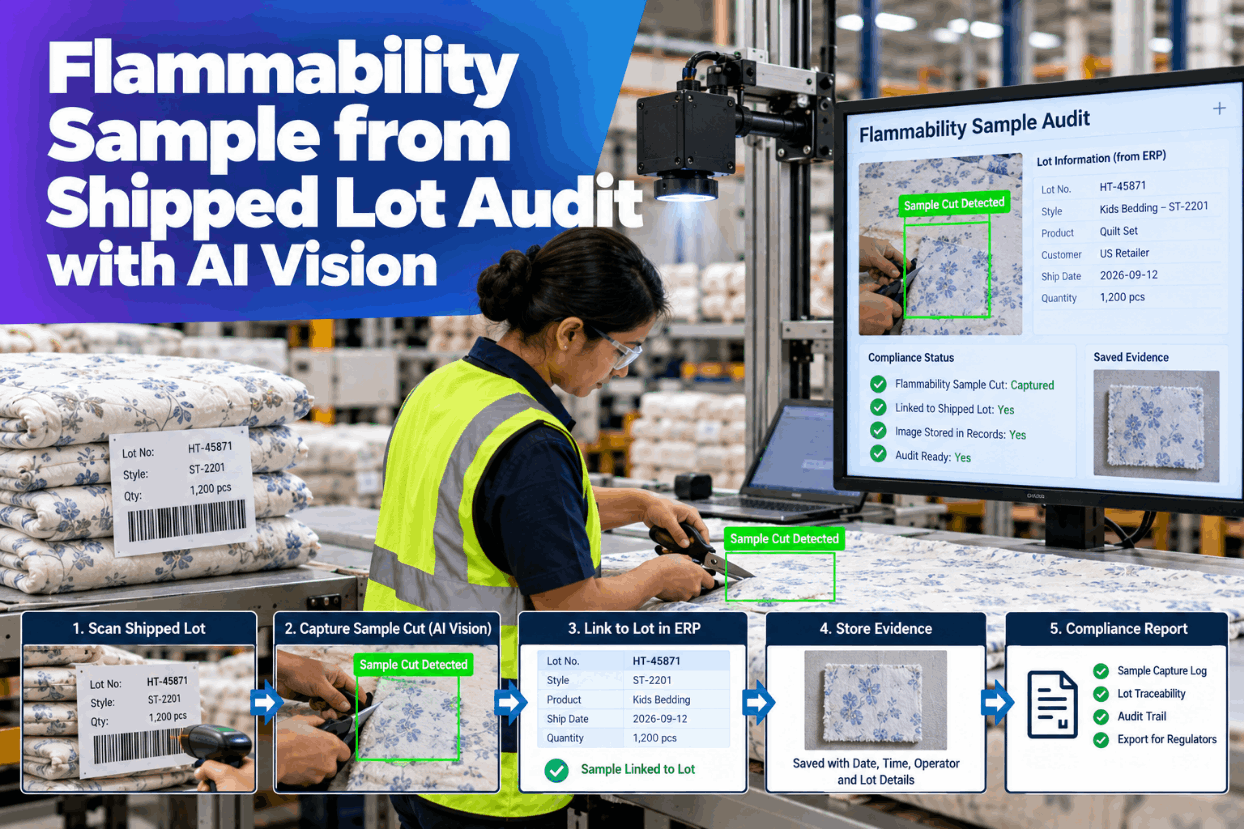
A flammability report is only as good as the fabric it describes. If the swatch the lab burned came from a strike-off, an early roll or a lot that was later re-dyed, the report says little about the goods on the truck. When CPSC or a retailer asks for proof, legal teams need to show the sample came from the production that shipped. AI vision records each sample cut, ties it to the ERP lot and the lab report, and holds any shipment whose evidence does not match. See the full chain on real roll goods in a sample traceability demo.

FLAMMABILITY EVIDENCE · SAMPLE TO SHIPMENT

Prove the Burn-Test Swatch Came From the Lot You Shipped

iFactory Sample-Cut Vision Capture photographs every flammability sample at the cutting bench with its roll, lot, position, time and operator. The Shipped-Lot Compliance Link then checks each ASN against that record and the lab report, and holds the shipment when they disagree.

Sample S-31 · Lot 2408-B

ASN 7712match ✓
Lot2408-B
Cartons14 · rug rolls
Sample cutRoll 04 · head end
Lab report FR-0931 linked16 CFR 1630 pill test · PDF
US FLAMMABILITY LAW

Which Products a Federal Flammability Rule Actually Covers

The Flammable Fabrics Act is enforced through product-specific standards in 16 CFR, and each one has its own scope. Clothing, children's sleepwear, carpets and rugs, mattresses and upholstered furniture are covered. Many other home textiles are not. Before building any sample program, confirm which rule, if any, applies to each line. Map your product lines to these parts with our compliance support team.

Rule
What it covers
Scope notes
How samples tie to production
16 CFR 1610
Textiles for clothing, adult and children's
Certain hats, gloves and footwear and interlining fabrics are excepted. Bedding is not clothing.
Guaranties rest on reasonable and representative tests, with records and a sample of the tested fabric kept
16 CFR 1615 and 1616
Children's sleepwear, sizes above 9 months through 14
Infant garments and tight-fitting garments are exempt from these tests. Tight-fitting items must still meet Part 1610.
Prescribed sampling per fabric production unit and garment production unit
16 CFR 1630 and 1631
Carpets and rugs, large and small
Surface ignition by the methenamine pill test. Part 1631 adds labeling provisions for small rugs.
Specimens cut from the carpet or rug being certified
16 CFR 1632
Mattresses and mattress pads
Smoldering cigarette ignition
Prototype tests for each mix of materials and construction
16 CFR 1633
Mattress sets
Open-flame ignition
Prototype testing plus a quality assurance program and production lot records
16 CFR 1640
Upholstered seating, by adopting California TB 117-2013
Excludes mattresses, foundations and bedding products. In effect since June 25, 2021.
Smolder tests of cover fabric, barrier, filling and decking. A permanent label certifies compliance
Not every home textile has a federal rule

No CPSC flammability standard currently applies to sheets, blankets, comforters, pillows, towels or curtains. Retailer specifications, voluntary standards and state laws may still ask for tests, so treat those as contract or state duties, not federal ones.

WHERE THE CHAIN BREAKS

Four Ways a Passing Report Ends Up Describing the Wrong Fabric

Most gaps are not fraud. They come from normal mill habits: testing early to save time, reusing a report across lots, or finishing a lot again after the test. Each one leaves a valid-looking report that no longer matches the goods. Walk through your own sampling habits in a sample program review.

01
Strike-off or lab dip sampleTested before bulk production, so it shows the design, not the run
02
One report, many lotsA report from lot A is filed against lots B and C with no link back
03
Re-dye or re-finishThe lot is dyed or finished again after the sample was cut
04
Wrong roll at the benchA roll from a neighbouring lot is cut because the tags look alike
SAMPLE CUT TRACEABILITY

What the Camera Records at the Cutting Bench

An overhead camera watches the sample bench. When the operator scans the roll and cuts, the system saves a photo of the cut with the roll tag in frame and attaches the facts a reviewer would ask for later. Nothing is typed from memory. Our support team can show where it meets your current lab request form.

PhotoCut in progress, roll tag readable
Lot IDFrom the roll barcode, checked in ERP
Roll IDWhich roll in the lot was cut
Cut positionHead end, tail end or metres from head
TimestampDate and time from the camera clock
OperatorBadge scan at the bench
Sample IDPrinted on the bag sent to the lab
Production unitFPU or production lot the roll belongs to

Answer a Records Request in Minutes, Not Days

When counsel asks which sample supports a shipment, the answer comes back with the photo, the roll, the report and the ASN in one place. No digging through lab folders.

Legal compliance head and iFactory
Compliance headShow me the sample behind ASN 7712.
iFactoryS-31, cut from roll 04 of lot 2408-B at the head end, 14 Oct, 09:42, operator 117. Report FR-0931 is linked and the lot matches.
Compliance headAnything on this order without a matching sample?
iFactoryLot 2408-C was re-dyed after its sample was cut. It is held at the dock until a new sample is tested.
FLAMMABILITY VISION SYSTEM LIMITS

Vision Documents the Cut. The Lab Proves the Result.

The camera never tests flammability. It records where and when a sample was cut and links it to the lot. Whether the fabric passes is decided by the test, run to the CFR method by the lab you use. For children's products, that means a CPSC-accepted third-party lab. The workflow joins the two records so neither stands alone. Review the hand-off with our vision engineers.

THE CAMERA DOES NOT
  • Burn, measure or grade any specimen
  • Judge whether a fabric is Class 1 under Part 1610
  • Know whether a finish changed the burn behaviour
  • Replace the lab report or the certificate
VISION AND THE WORKFLOW DO
  • Prove which roll and lot the sample came from
  • Time-stamp the cut against the production unit
  • Match the lab report's sample ID to the cut record
  • Hold any ASN whose lot has no valid match
SHIPPED LOT AUDIT

Five Links From Swatch to Shipment

Each link is a record that already exists somewhere in the plant. The gap is that nobody joins them until an inquiry arrives. iFactory joins them as the goods move, so the chain is complete before the truck leaves. Connect your ERP and lab data with our integration team.

Cut
Photo, roll, position, time
›
Lot
ERP lot and production unit
›
Report
Lab result matched by sample ID
›
Release
Lot released only with a match
›
ASN
Shipment checked at the dock
FLAMMABILITY SAMPLE AUDIT FLAGS

Five Mismatches That Hold a Shipment

Each flag is a rule your legal and quality teams agree before go-live. A flag holds the ASN, names the gap and sends it to the person who can close it. Some need a new sample. Others need only a corrected record. Agree your flag rules in a rules session.

LOT
Sample lot is not the shipped lotThe ASN lot has no cut record of its own
AGE
Sample older than the production unitCut before the unit's first roll was made, such as a strike-off
DYE
Re-dye or re-finish after the cutReworked sleepwear fabric must be tested again. Set your own rule for other lines
RPT
Report missing or IDs disagreeNo lab report yet, or its sample ID does not match the cut
FPU
Sleepwear unit too large for its samplesMore yardage than the unit limit with only one sample set
SLEEPWEAR PRODUCTION UNITS

Worked Example: How Many Samples a Sleepwear Order Needs

Children's sleepwear is where the CFR is most specific about sampling. Under normal sampling a fabric production unit can be up to 5,000 linear yards and is tested with one sample from each end. A garment production unit can be up to 500 dozen garments. The order sizes below are assumed, and the unit limits come from CPSC's sleepwear test manual. Check your own plan with our support team.

Sleepwear fabric ordered13,200 linear yards, assumed
Fabric production units at 5,000 yards max5,000 + 5,000 + 3,200 = 3 units
Fabric samples, 2 per unit3 × 2 = 6 samples, 30 specimens
Garments of one style9,000, assumed
Garment units at 500 dozen (6,000) max9,000 ÷ 6,000 = 1.5, so 2 units
Cut records the system expects6 fabric + 6 garment samples = 12

Garment units use 3 samples each under normal sampling, so 2 units need 6. After a rejected fabric unit, tightened sampling adds a third sample from a middle piece of each unit, and the expected count rises with it.

RECORD RETENTION

How Long Each Rule Says to Keep the Evidence

Retention differs by part, and the clock does not always start on the test date. The system keeps each cut record, photo and report for the longest period that applies to the product line, plus any margin your counsel adds. Set retention per line in a records planning call.

3 yrs
Part 1610 guarantiesFrom the date of the tests, including a sample of the fabric tested
3 yrs
Parts 1615 and 1616Per CPSC's test manual, with prototype records kept longer
3 yrs
Part 1632Records and test results for mattresses and pads
+3 yrs
Part 1633While the prototype is in production, then 3 more years
FLAMMABILITY EVIDENCE EXAMPLES

Three Shipments the Link Would Have Stopped

These are illustrations, not customer case studies. They show how a flag appears and what closes it. Send us a past shipment's records and our support team will show where the chain holds or breaks.

Area rug, lot re-finished
DYE flag at the dockThe lot went back for a latex backing touch-up after the cut. A new pill-test sample is cut before release.
Children's nightgown fabric
FPU flag before cuttingA 6,400-yard dye lot was booked as one unit. It is split into two units and sampled at each end.
Mattress pad ticking
LOT flag on the ASNThe report named a neighbouring lot. The record is traced to the right prototype test and corrected.
TURNKEY AI DEPLOYMENT

Bench Cameras, Lot Links and an Edge Server, Delivered Together

iFactory ships the sample evidence system as a turnkey bundle. A camera goes over each sample bench, and a pre-configured NVIDIA AI server ships racked and ready with the capture and matching models preloaded, so cut photos never leave the plant. You rack it, plug in power and Ethernet, and the AI is live. Scope your benches and docks in a bench and dock planning call.

What's Included
  • Pre-configured NVIDIA AI edge server, racked and ready
  • Overhead cameras for sample cutting benches
  • Roll tag and barcode reading at the bench
  • Link to ERP lots, production units and ASNs
  • Lab report intake matched by sample ID
  • Ship hold signal to the dock and WMS
  • Evidence store with retention set per CFR part
Live in 6–12 weeks
Wk 1–4
Map Rules and Benches

Each line mapped to its CFR part, cameras and server installed, ERP lots linked.

Wk 5–8
Capture in Shadow

Every cut recorded and matched while legal reviews flags without holding goods.

Wk 9–12
Dock Holds Live

ASN holds switched on, bench operators trained, retention rules active.

HOW iFACTORY FITS

Flammability Evidence AI for US Textile Legal Teams

Legal teams need a chain they can defend, not another folder of PDFs. iFactory builds that chain from the bench to the dock as part of normal work. Ask our support team for a pilot outline.

1
Sample-Cut Vision Capture. Every sample photographed with roll, lot, position, time and operator.
2
Shipped-Lot Compliance Link. Each ASN checked against its cut record and lab report.
3
Mismatch holds. LOT, AGE, DYE, RPT and FPU flags stop the shipment, not the paperwork.
4
Retention by rule. Evidence kept for the period each CFR part sets, ready for a records request.
1000+
Industrial clients running iFactory
99.9%
Platform uptime for bench and dock checks
6-12 wks
From racked server to live shipment holds
FREQUENTLY ASKED QUESTIONS

What Textile Legal Teams Ask About Flammability Sample Audits

Does iFactory test fabric flammability?
No. The test is run by a laboratory to the method in the relevant CFR part. For children's products it must be a CPSC-accepted third-party lab. iFactory records where the sample came from and links it to the lot and the shipment, so the lab result can be shown to describe the goods that shipped.
Which home textiles have a federal flammability rule?
Carpets and rugs (Parts 1630 and 1631), mattresses and mattress pads (Part 1632), mattress sets (Part 1633) and upholstered seating (Part 1640). Sheets, blankets, comforters, pillows, towels and curtains have no CPSC flammability standard today. To see how the system handles a mixed product range, book a 30-minute walkthrough.
Does 16 CFR 1610 apply to bedding?
No. Part 1610 covers textiles used in clothing. Bedding is not clothing, and Part 1640 also excludes bedding products. Children's sleepwear falls under Parts 1615 and 1616, with tight-fitting sleepwear tested under Part 1610 instead.
How long do we keep sample and test records?
It depends on the part. Part 1610 guaranty records run 3 years from the tests, Part 1632 records 3 years, and Part 1633 records last while the prototype is in production plus 3 years. Our support team can set retention for each of your lines.
What counts as a mismatch?
The default flags are a sample from a different lot, a sample older than its production unit, a re-dye or re-finish after the cut, a missing or mismatched lab report and an oversized sleepwear unit. Your legal team signs off each rule. You can see each flag raised on a live dock before go-live.
How should a textile legal team start?
Pick the product line with the most specific rule, often children's sleepwear or rugs. Put one camera over its sample bench, link its ERP lots and run in shadow mode for a few weeks while legal reviews every flag. Then switch on dock holds. Plan that first line with our team.

Every Shipment Backed by a Sample You Can Show

Record each flammability sample at the bench, tie it to the lot and the lab report, and hold any shipment that does not match. Shipped turnkey and running within 6 to 12 weeks.
Example week · Rug and sleepwear lines
Samples cut and recordedEvery cut, with photo
Lab reports matchedBy sample ID, not by hand
ASNs held1, lot re-dyed after its cut
Records keptPer CFR part for each line
Sample-to-shipment chain ready for review

Share This Story, Choose Your Platform!