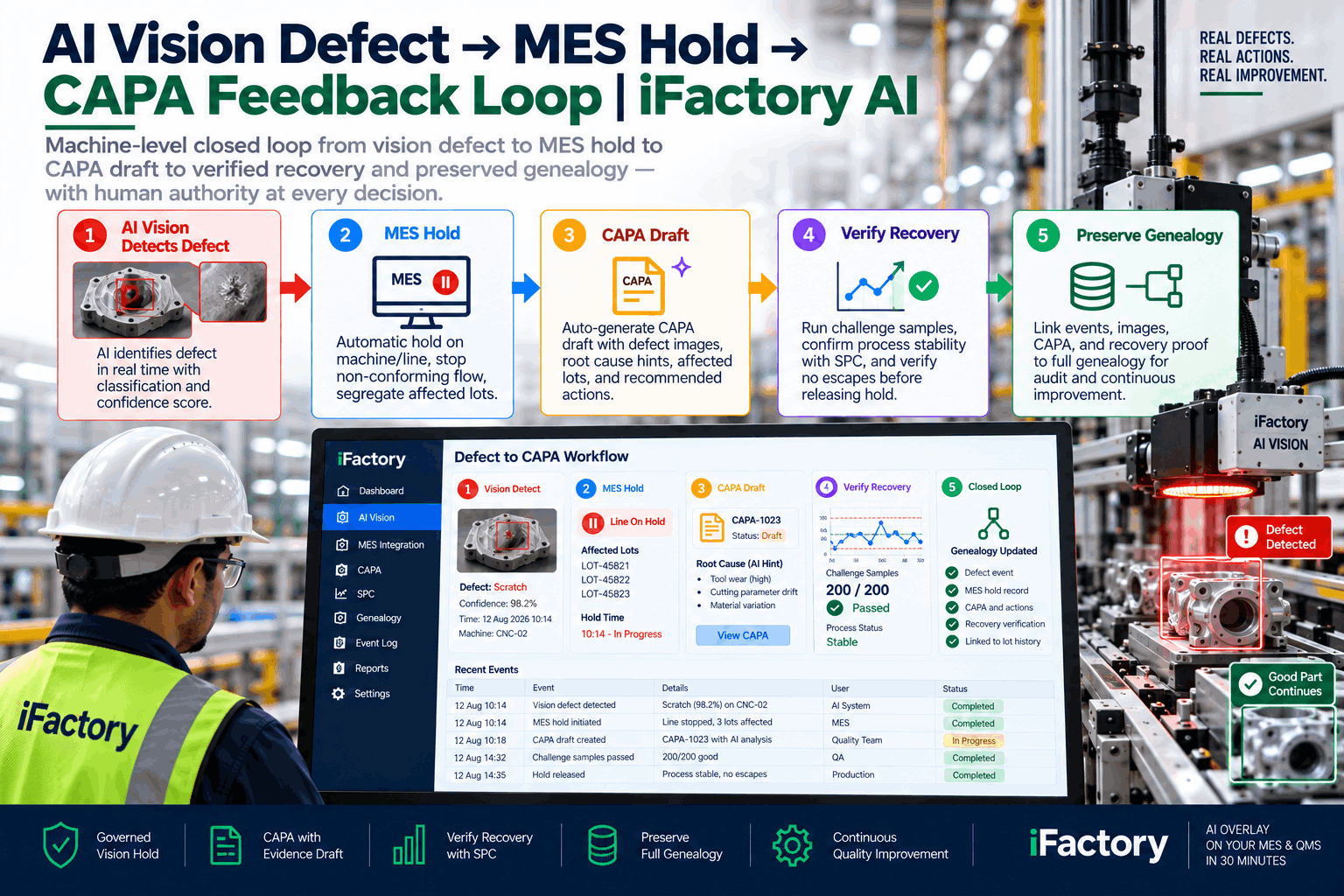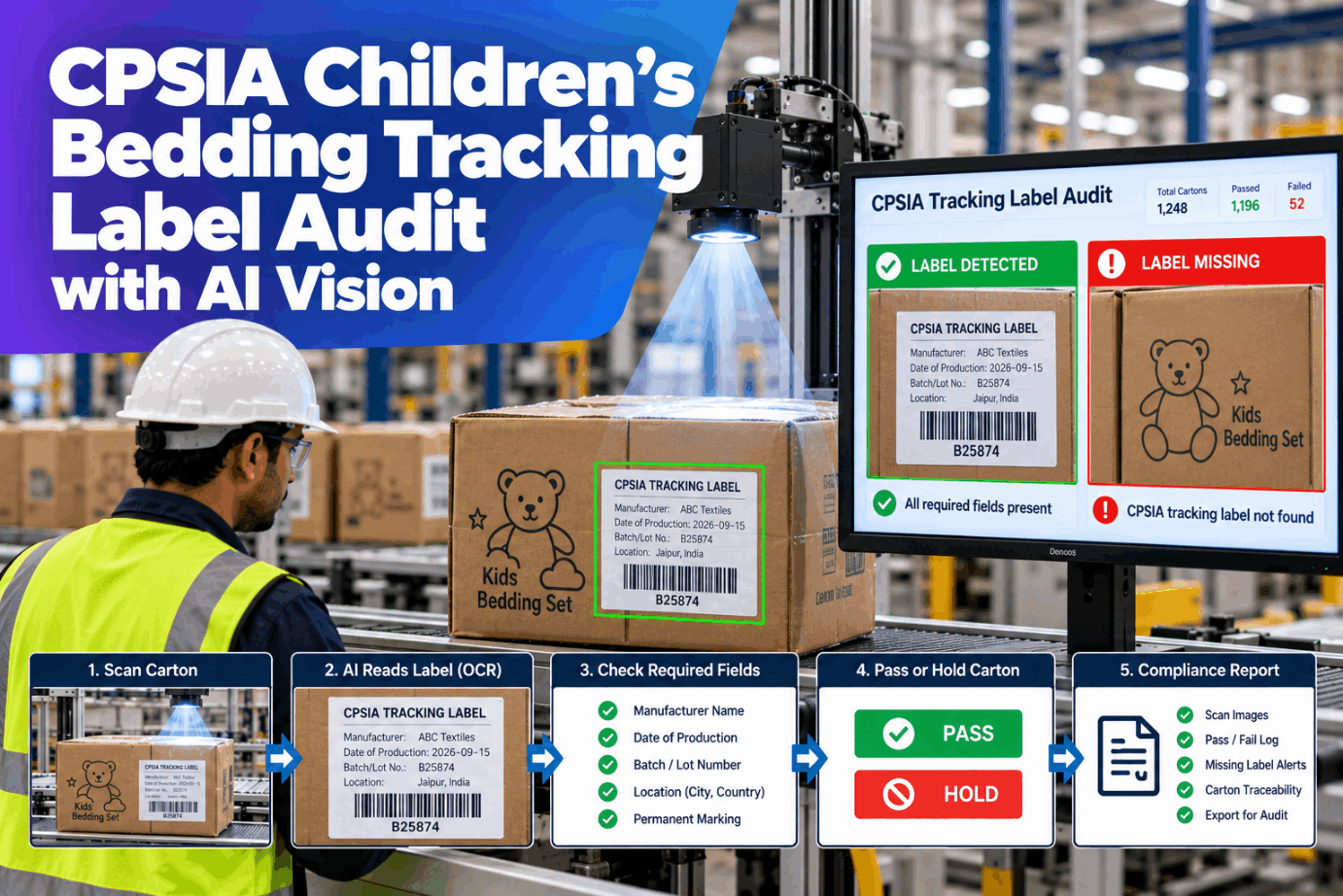
A children's comforter can pass every lab test and still cause trouble when a recall comes, because nobody can tell which units came from the bad batch. CPSIA Section 103(a) exists for that moment. It requires permanent tracking marks on the product and its packaging that show who made it, where, when and in which batch. On a busy pack line, one blank batch field on a sewn-in label is easy to miss by eye. Vision label OCR reads every label, checks each field against the production record and holds the carton when something is missing. See it read a real bedding label in a short label OCR demo.
Catch the Missing Batch Code Before the Carton Is Sealed
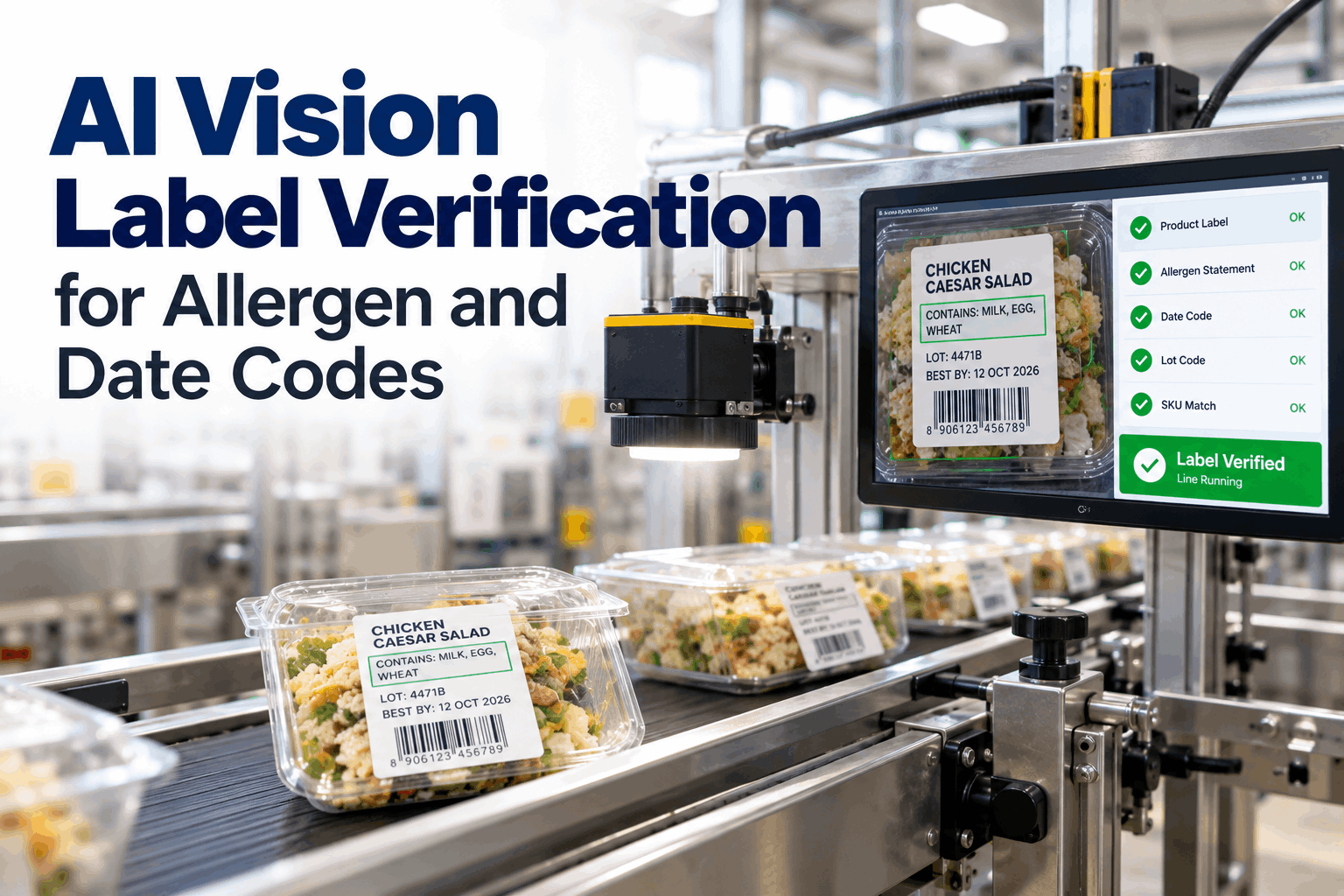
iFactory Vision Label OCR reads the sewn-in tracking label on every piece of children's bedding, checks each CPSIA field against the production order and holds the carton when one is blank or wrong. The camera confirms the mark is there and correct, while your testing and Children's Product Certificate confirm the product is safe.
Four Things the Marks Must Let Someone Work Out
Section 103(a) of the CPSIA added section 14(a)(5) to the Consumer Product Safety Act. It applies to children's products made on or after August 14, 2009. The marks must be visible, legible and permanently affixed to the product and its packaging, to the extent practicable. From those marks, a consumer or investigator must be able to work out four things. The law sets no fixed format, so each manufacturer designs its own label and must be able to explain it. Check how your current label scheme maps to these four items with our compliance support team.
CPSC's guidance accepts coded information as long as a consumer knows whom to contact to decode it. A code such as "F-07 / 26W38 / B3" works if your records turn it back into plant, week and batch on request.
Is This Bedding a Children's Product?
A children's product is one designed or intended primarily for children 12 or younger. Under 16 CFR 1200, that call weighs your own statement of intended use, how the item is packaged and marketed, whether consumers see it as a children's item and CPSC's age determination guidelines. Crib and toddler bedding is clearly in scope. A plain twin sheet set sold for any bedroom usually is not. Write the decision down for each style, because the label rules follow it. Walk through your style list in a scoping session.
Where a Bedding Tracking Mark Can Live
The mark belongs on the product and on its packaging, to the extent practicable. For bedding, the product mark is almost always a sewn-in label. CPSC's 2009 policy statement says permanent marks already required by other rules, such as Textile Act fibre labels, can form part of the distinguishing marks. The shipping carton is not consumer packaging, but it is where your hold takes effect. Ask our support team which camera views your line needs.
Ask the Line Which Cartons Are Held, and Why
Every read, every miss and every hold sits in one record. Compliance leads can ask in plain words and get the carton, the field and the image back in seconds.
What Label OCR Can Prove, and What Only Testing Can
Be clear about what the camera does. It checks that the tracking label is present and readable and that its fields agree with the production record. It cannot tell whether the fabric, prints or trims meet CPSC requirements. Third-party testing and the Children's Product Certificate do that. The rule layer bridges the two by refusing to pass a label whose batch has no released test record behind it. Review that link with our vision engineers.
- Certify that the product meets any CPSC rule
- Measure lead in a screen print or zipper pull
- Prove the printed date is the true sewing date
- Read a label hidden inside a closed duvet cover
- Confirm all tracking fields are present and legible
- Match labeler, plant, date window and batch to the order
- Check that the batch has a released CPC on file
- Hold the carton and keep the image as evidence
From a Folded Duvet to a Field-by-Field Verdict
The check runs where the label is easiest to see: at the fold station, before the item goes into its bag. A second view reads the package label after bagging. Both reads are tied to the carton barcode, so a miss on one unit points to one carton. Plan camera positions with our line setup team.
Four Outcomes at the Pack Station
Not every miss is a compliance failure. A label folded over its own edge needs a second look, not a quarantine. The rules separate a poor read from a real gap, and only a real gap stops the carton. Thresholds are set with your compliance team during the shadow period. Agree your hold rules in a rules workshop.
Where the Children's Product Certificate Fits
The tracking label is not a safety rule that needs certifying, and the CPC does not have to mention it. A CPC is still needed when a children's product safety rule applies. For bedding, that is often the lead content limit for prints, buttons or zipper pulls. CPSC has found that dyed or undyed textile fibres do not exceed the lead limits, but that finding does not cover after-treatments such as screen prints. Ask our support team how test records link to batches.
One Audit Record per Carton
When an auditor or retailer asks how you know every unit was marked, you need a record per carton rather than a sign-off per shift. The fields below show what each record holds. Compare them with your current pack-out log in a record review call.
Three Label Problems on a Bedding Line
The three cases below are illustrations, not customer stories. They show the field check and the hold working as a pair. Bring your own label samples to our support team for a test read.
Why a Readable Cohort Code Narrows a Recall
The value of a good cohort mark shows up in a recall, when it limits how many units are in scope. The worksheet uses assumed inputs to show the arithmetic only. Real recall scope is agreed with CPSC and depends on the facts. Run your own numbers with our compliance specialists.
This only works if every unit carries a readable batch. One blank field puts that unit back into the wide group, which is why the check runs on every piece.
Fold-Station Cameras, Label Models and an Edge Server, Shipped as One
iFactory delivers the label check as a turnkey bundle. Cameras go over the fold stations and baggers, and a pre-configured NVIDIA AI server ships racked and ready with the OCR and field rules preloaded, keeping every label read inside the plant. You rack it, plug in power and Ethernet, and the AI is live. Scope your pack-out lines with our deployment team.
- Pre-configured NVIDIA AI edge server, racked and ready
- Cameras for fold stations and bagger exits
- OCR models tuned to your label stock and fonts
- CPSIA field rules mapped to your cohort code scheme
- Link to production orders in your ERP or MES
- Carton hold signal to pack-out and the WMS
- Carton audit records and a weekly label report
Label formats and cohort codes documented, cameras and server installed, order data linked.
OCR runs without holding cartons while compliance reviews every miss and sets thresholds.
Carton holds go live, operators are trained on re-reads, audit records start.
A CPSIA Label Vision System Built for Soft Goods
Bedding labels are soft, folded and often printed on satin or nylon tape. iFactory is tuned for that, and it ties each read to the order, the carton and the test record. Scope a one-line pilot in a pilot planning call.
What Children's Textile Compliance Teams Ask About Tracking Label Checks
Every Unit Marked, Every Carton Accounted For
Put label OCR on your fold stations, check every CPSIA field against the order and hold cartons that fall short. The whole kit arrives turnkey and runs live within 6 to 12 weeks.