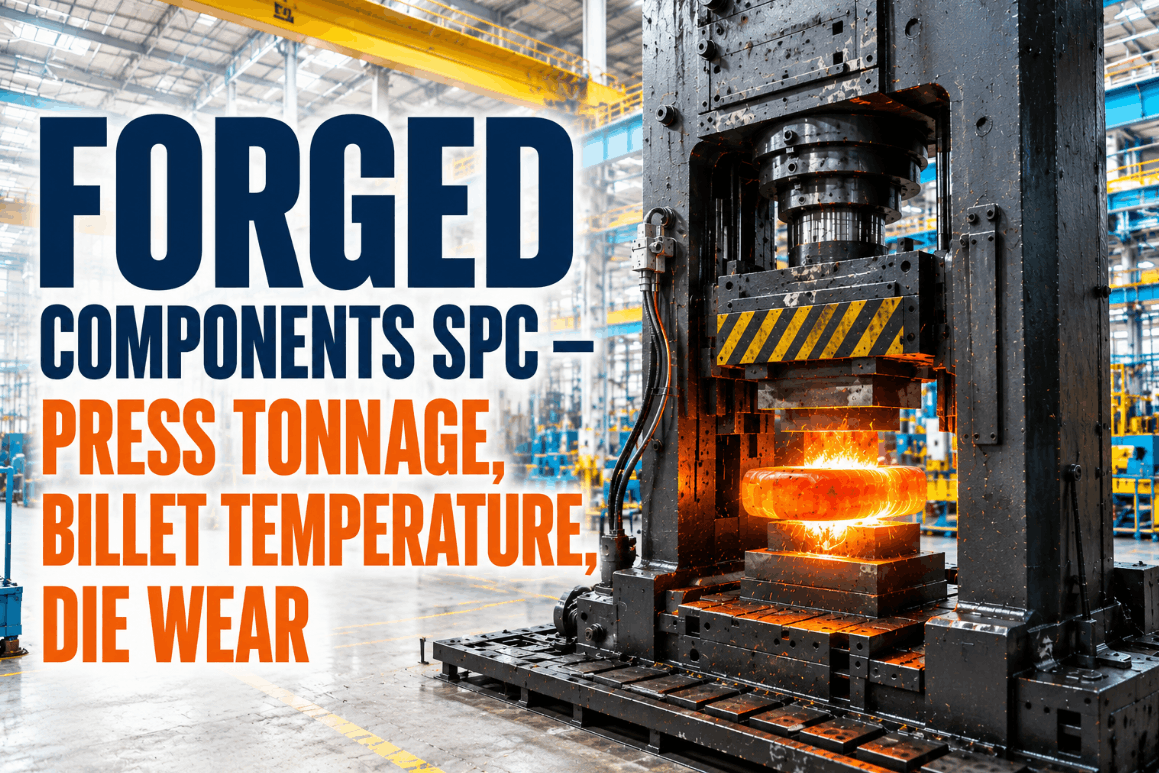
Forged components are the structural backbone of mission-critical industries—aerospace landing gear, automotive powertrains, energy transmission systems, and heavy equipment. Yet the hot forging process that delivers this strength also introduces complex variability across every stroke of the press. Press tonnage oscillates with billet volume and temperature. Billet temperature gradients shift as dies heat and cool across a production run. Die wear accumulates gradually, distorting cavity geometry until a part fails CMM inspection. In most forge shops, these variables are monitored in isolation—a tonnage chart here, a pyrometer reading there—with no unified view of per-part quality. iFactory's forge shop connector changes this by bringing AI-powered SPC directly to the press floor, unifying real-time tonnage curves, billet temperature trends, and die wear progression into a single per-part, per-die intelligence layer. For quality leads looking to finally connect process data to part outcomes, Book a Demo to see how AI SPC transforms the forge floor.
Unify Your Forging SPC with AI-Powered Process Control
iFactory's forge shop connector delivers AI-driven SPC for press tonnage, billet temperature, and die wear — purpose-built for hot forging environments where every stroke matters.
The Hidden Variability in Hot Forging — Tonnage, Temperature, and Die Wear
Every forged component carries the fingerprint of three interacting process variables. Press tonnage determines whether material fills the die cavity completely. Billet temperature dictates flow stress and final grain structure. Die wear governs dimensional consistency across the die lifecycle. In traditional forge shops, these variables are tracked in separate systems or paper logs, making it impossible to correlate a tonnage spike to a subsequent Cpk shift. iFactory's AI SPC unifies these signals into a single per-part, per-die quality model. Quality engineers who Book a Demo consistently report that this unified view is the missing link between process data and part quality.
Press Tonnage Variability
Tonnage fluctuates with billet volume tolerance, furnace temperature uniformity, and die lubrication consistency. A single out-of-range stroke can produce a cold shut or incomplete fill that passes visual inspection but fails under load. AI SPC detects tonnage drift per stroke, per part number.
Billet Temperature Drift
Induction or gas furnace temperature gradients produce billets with core-to-surface deltas exceeding 100°F. This thermal inconsistency alters flow stress mid-stroke, creating unpredictable die fill patterns and variable mechanical properties. Real-time thermal SPC catches drift before scrap occurs.
Die Wear Progression
Every stroke erodes die cavity surfaces, particularly at radii and flash lands. Wear accelerates non-linearly after a threshold number of hits, shifting part dimensions outside tolerance. AI SPC tracks wear per die across its full lifecycle and forecasts end-of-life to prevent unplanned cavity rework.
Why Traditional SPC Falls Short in the Forge Shop
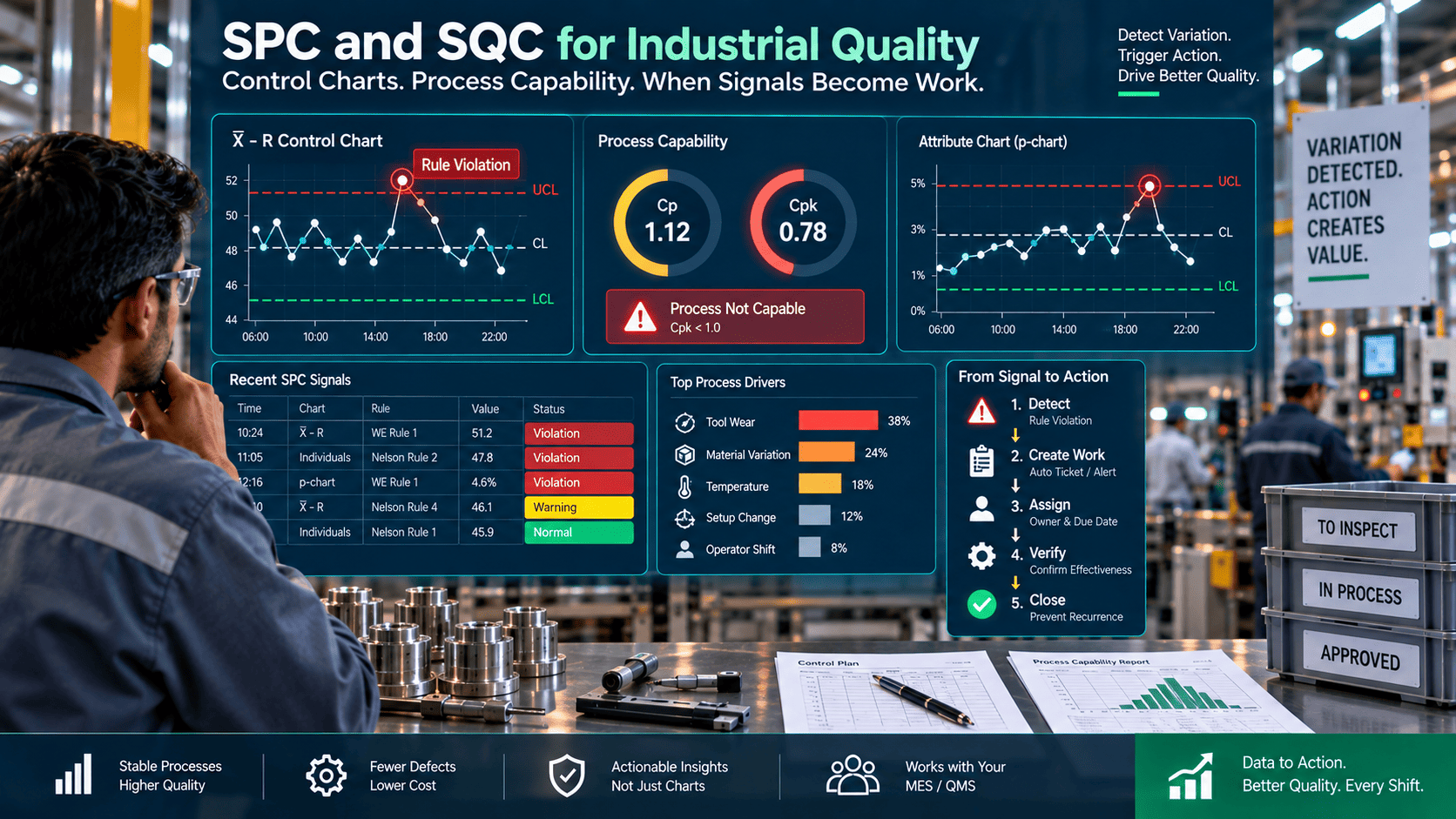
Conventional SPC was designed for stable, high-volume machining processes with slow tool wear and consistent material inputs. Hot forging is the opposite: every billet is unique, die wear is non-linear, and press dynamics shift across a production day. Traditional control charts treat each measurement as independent, ignoring the causal relationships between tonnage, temperature, and die condition. The table below highlights where legacy SPC breaks down and how iFactory's AI-driven approach fills the gap.
| Capability | Traditional SPC | iFactory AI SPC for Forging |
|---|---|---|
| Data Source | Post-process CMM / caliper | Live IoT press sensors + thermal cameras + die counters |
| Granularity | Sample-based (n=5 per shift) | Per-stroke, per-billet, per-die analysis |
| Variable Correlation | Univariate control charts | Multivariate causal AI linking tonnage, temp, and wear |
| Die Wear Tracking | Calendar-based die changes | Condition-based die life prediction with stroke count + tonnage trends |
| Alert Speed | After parts are produced and measured | Real-time during the stroke sequence |
| Cpk Visibility | End-of-batch reporting | Per-part Cpk with early warning at first sign of drift |
Bridge the Gap Between Process Data and Part Quality
Move beyond sample-based SPC. iFactory delivers per-stroke, per-die quality intelligence for press tonnage, billet temperature, and die wear in a single unified platform.
AI-Powered SPC for Press Tonnage, Billet Temp, and Die Wear
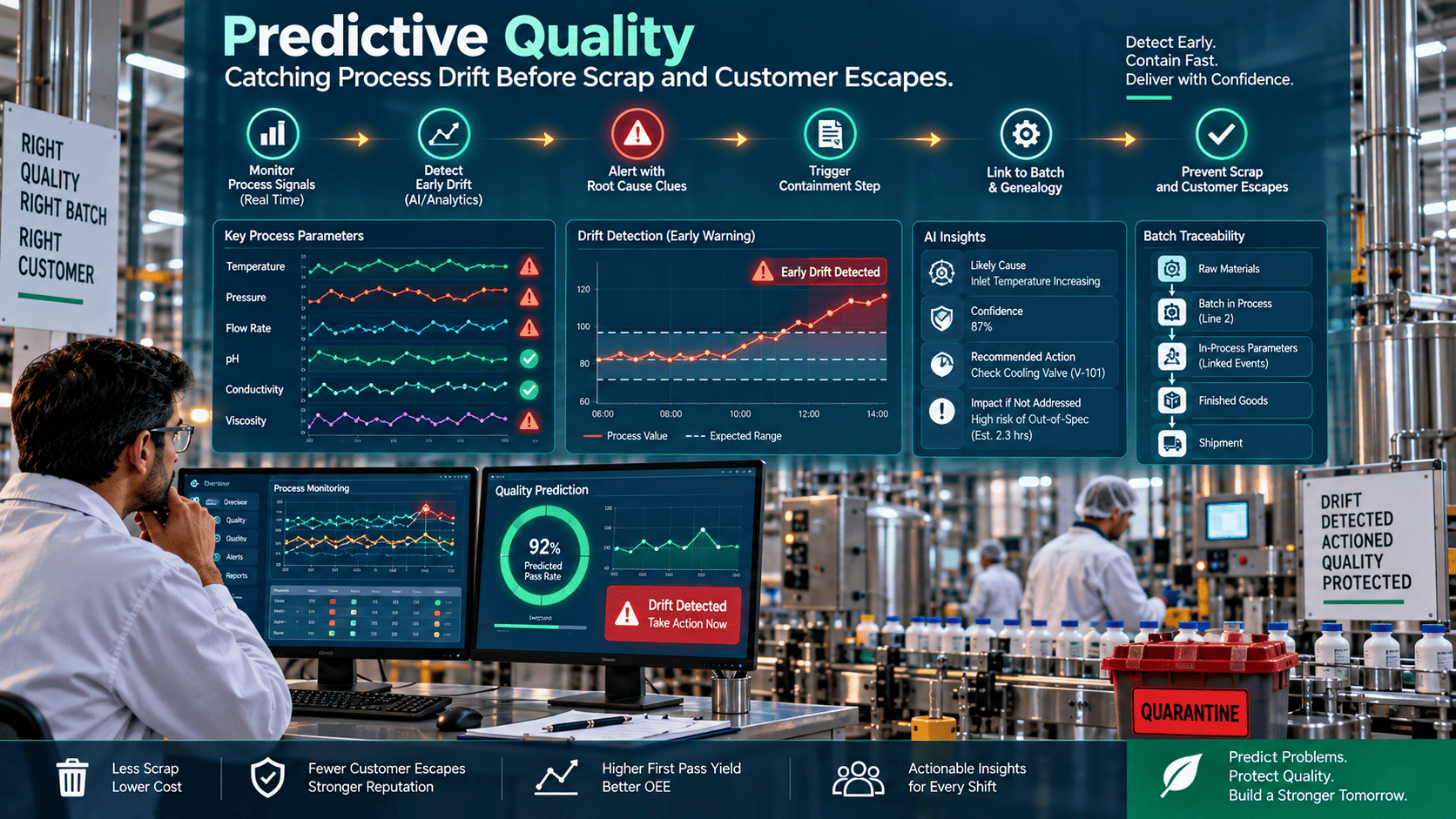
iFactory's forge shop connector ingests data from press load cells, billet pyrometers, infrared die thermal cameras, and stroke counters to build a per-part digital fingerprint. The Causal AI engine then correlates these signals against known failure modes—cold shuts, underfills, dimensional drift—and surfaces actionable SPC alerts before non-conforming parts are produced. The workflow below shows how raw press data becomes per-part quality intelligence. Forge quality teams that Book a Demo typically see their first causal SPC alert within two weeks of connector installation.
Multi-Modal Data Ingestion
Press tonnage curves at 100Hz, billet surface and core temperature at furnace exit, die cavity temperature per stroke, and cumulative stroke count per die insert. All streams time-stamped and aligned to each individual part serial number.
Causal AI Pattern Recognition
The engine learns the normal operating envelope per part number and per die set. When a tonnage-temperature-wear combination deviates from the expected multivariate distribution, the system flags the specific stroke and predicts the likely defect mode before it materializes.
Real-Time SPC Alerting & Root Cause ID
Alerts are pushed to the quality lead's dashboard and the operator's mobile interface with the specific variable in drift—tonnage peak, billet delta, or die wear index—along with the recommended corrective action derived from thousands of similar patterns across the fleet.
"We were running SPC on paper charts pulled once per shift. By the time we spotted a Cpk shift, we had already produced 200 non-conforming parts. iFactory's AI SPC alerted us on stroke 47 of a 500-part run that a billet temperature gradient was pushing die fill out of spec. We adjusted the furnace zone temperature on the next billet and saved the remaining 453 parts. That is the difference between reactive quality and predictive quality."
Phased Roadmap to Forge Shop Quality Excellence
Transitioning from sample-based SPC to per-part AI-driven quality intelligence requires a structured approach that respects the realities of a production forge shop. iFactory's implementation team follows a proven three-phase roadmap that builds data infrastructure first, then intelligence, then full optimization. Forge quality leaders who Book a Demo receive a personalized deployment plan aligned to their specific press types, part families, and quality maturity level.
Connect & Baseline
Install IoT connectors on press load cells, billet pyrometers, and die counters. Establish per-part data alignment and build baseline SPC models for each part number. Digitize existing quality logs and create the single-source-of-truth data lake. Timeline: 6–10 weeks.
Predict & Prevent
Deploy Causal AI models that correlate tonnage curves, billet temperature profiles, and die wear metrics to specific defect modes. Activate real-time SPC alerting and root cause identification per stroke. Transition from calendar-based to condition-based die changes. Timeline: 10–14 weeks.
Optimize & Scale
Extend AI SPC models across all press lines and part families. Integrate quality data with ERP for automated part disposition. Enable cross-plant benchmarking and fleet-wide model transfer learning. Achieve sustained Cpk improvement and scrap reduction at scale. Timeline: Ongoing.
Stop Chasing Cpk. Start Predicting It.
The difference between a world-class forge shop and one that struggles with scrap is not the press or the die material. It is the ability to see quality-relevant variability before it produces a non-conforming part. iFactory's AI-powered SPC transforms press tonnage curves, billet temperature profiles, and die wear progression from isolated data points into a unified, per-part quality intelligence system. For quality leads who are ready to move from reactive inspection to predictive process control, Book a Demo to see the forge shop connector in action on your press lines.
Forged Component SPC — Frequently Asked Questions
How is AI SPC different from traditional SPC in a forge shop?
Traditional SPC samples finished parts and treats measurements as independent. AI SPC analyzes every stroke in real time, correlating tonnage, temperature, and die wear to predict defects before they occur.
Can iFactory integrate with existing press load cells and pyrometers?
Yes. The forge shop connector supports Modbus, OPC-UA, and analog signal interfaces, connecting to virtually any press controller, thermal sensor, or die counter without replacing existing hardware.
How long does it take to see results from AI SPC deployment?
Most forge shops receive their first causal AI alert within two weeks of connector installation, with measurable Cpk improvement within the first production month.
Does AI SPC require a data science team to operate?
No. iFactory's models are pre-trained on forging process data and self-calibrate to each press and part number. Quality engineers interact through dashboards and alerts, not algorithms.
What is the typical ROI for AI SPC in a hot forging operation?
Customers typically see a payback period under 9 months through combined scrap reduction, die life extension, and reduced post-forge inspection costs.
Stop Sampling. Start Predicting. with iFactory AI.
iFactory's forge shop connector delivers per-stroke, per-die AI-powered SPC for press tonnage, billet temperature, and die wear — purpose-built for hot forging quality excellence.