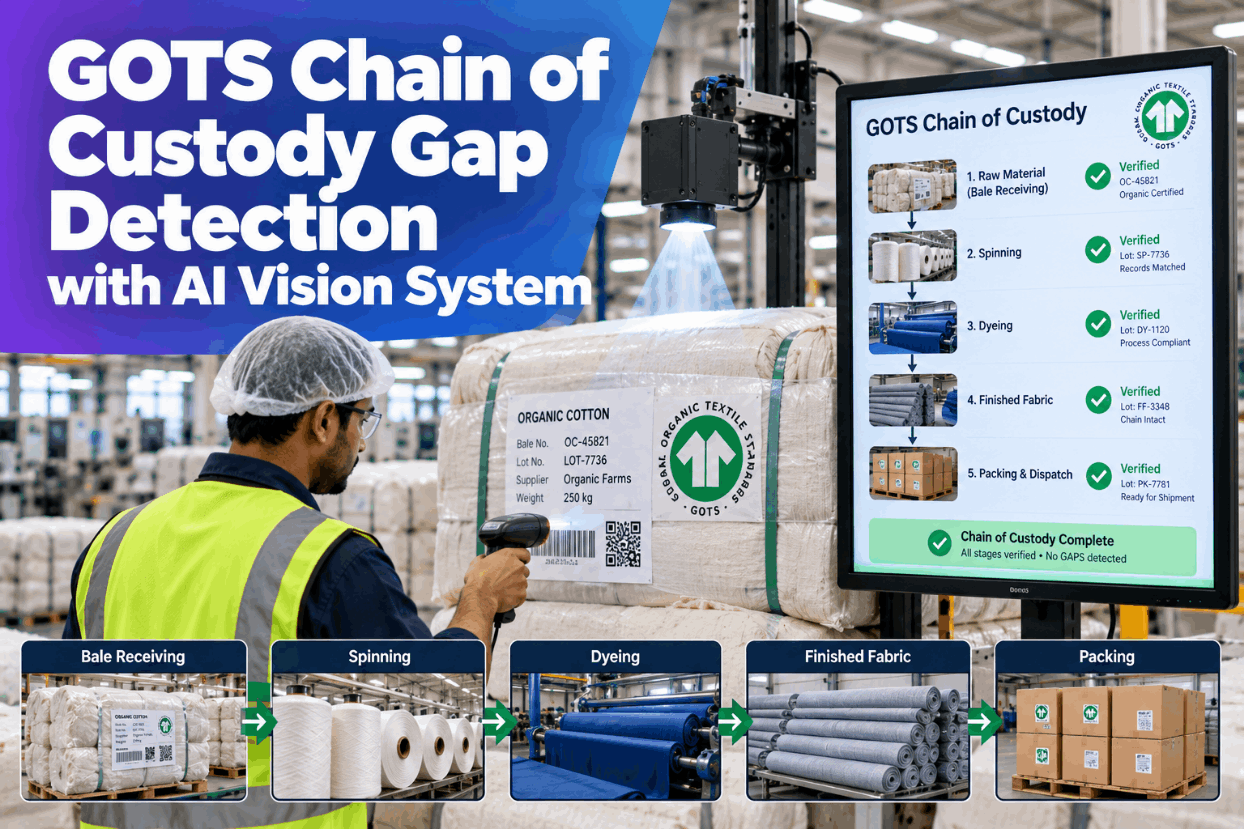
An organic claim on a finished garment is only as strong as the weakest hand-off behind it. The bale can be certified, the mill can be certified and the dye house can be certified, and the claim still fails if one lot sat beside conventional yarn or one transaction certificate never reached the next site. GOTS chain of custody gap detection watches each hand-off on the floor and checks the paperwork behind it, so gaps surface before the certifier finds them. Follow a full custody trail in a short GOTS evidence demo.
Find the Broken Link in Your Organic Chain Before the Certifier Does
iFactory reads bale tags, lot IDs and bay labels at every hand-off, matches them to scope and transaction certificates in the workflow, and files each check in a compliance evidence log. A missing reference holds the lot, not the whole inspection.
Version 7.0 Governs Inspections Today, Version 8.0 Takes Over in March 2027
GOTS 7.0 was released in March 2023 and became fully effective on 1 March 2024. GOTS 8.0 was released in March 2026 and applies to all certified entities from 1 March 2027, after a one-year transition, with early adoption allowed. For custody control, 8.0 keeps the core tools of scope certificates, transaction certificates, segregation and volume reconciliation, and adds a dedicated manufacturing restricted substances section and revised GMO testing references. Check how your certifier is handling the switch with our compliance support team.
Where GOTS Starts and What Each Stage Must Prove
GOTS doesn't certify farming. Raw fibre must be certified to a recognised organic farming standard, and GOTS certification begins with the first processor after the farm. For cotton, the standard names ginning as that first step. From there, every processor, manufacturer and trader that handles the goods needs its own scope certificate, and the goods need clear identification at each step. Map your own stages with our custody specialists.
One Certificate Covers the Site, the Other Covers the Shipment
Teams often treat these as one document, and that is where many gaps start. A scope certificate says a facility is certified for named product categories and processes, and it lists any subcontractors. A transaction certificate is issued by the approved certifier for a specific sale of certified goods, and it shows that this lot passed through certified hands. Under GOTS 8.0, buyers must obtain and keep the scope and transaction certificates covering the whole quantity bought, with invoices and delivery notes. Ask our support team how the two records link in iFactory.
- Issued to a company or facility after inspection
- Lists product categories, processes and subcontractors
- Answers: is this site allowed to do this process?
- Checked once per supplier, then again before it expires
- Issued by the approved certifier for a sale of certified goods
- Names seller, buyer, products and quantities
- Answers: did this lot come through certified hands?
- Checked against every receipt and its quantity
GOTS treats volume reconciliation as a complementary check. If a site ships more certified output than its certified input can support, the gap shows in the numbers even when every tag on the floor looks right.
Two Label Grades, One Hard Floor at 70 Percent
The label grade depends on the share of certified organic fibre, not counting accessories. A product with at least 95% may carry the "organic" grade. One with at least 70% carries "made with x% organic materials". Below 70%, the product isn't eligible for the GOTS label. Conventional cotton can't be blended into any GOTS product, and organic and conventional fibre of the same type can't be blended together. Confirm your blend rules in a label grade review.
A Camera Can't Tell Organic Cotton From Conventional
This is the honest core of the system. Organic and conventional fibre look the same to any camera, and no image shows whether a bale is free of GMO cotton. GOTS integrity rests on certificates, identification and segregation, and lab testing such as GMO screening of organic cotton before it enters the chain. Vision verifies the physical evidence at each hand-off, and the workflow layer then checks that evidence against the documents. Walk through this split of duties with our support engineers.
Ask Where the Custody Trail Breaks
Compliance heads rarely need another report. They need to know which lot is exposed and why. iFactory answers from the evidence log in plain language and points to the hand-off, the document and the photo.
Six Places a Custody Gap Usually Opens
Most gaps aren't fraud. They come from ordinary floor habits that break the paper trail: a lot parked in the wrong bay, a fresh tag after rework, a reference keyed into the wrong field. Each gap below maps to a check that iFactory runs at the hand-off. Review your own weak points in a gap mapping session.
Five Checks Between One Stage and the Next
A hand-off is the moment goods change site, process or owner. That is where iFactory places a fixed camera or a handheld capture point. The vision read and the document match happen together, and the lot is released only when both agree. Plan your capture points with our support team.
One Evidence Record per Hand-Off
When the certifier's inspector asks how a carton traces back to a bale, the answer should be a chain of records, not a week of email. Each hand-off writes one record like this, and the records link end to end from pack back to ginning. See a complete trail in a live evidence walkthrough.
Three Gaps and How They Were Closed
These are illustrations of typical situations, not customer case studies. The right response always follows your certifier's instructions and your own procedures. Talk through scenarios from your own sites with our support engineers.
Price the Hours Spent Building Evidence Packs
The value that matters most, keeping the certificate and the customer, is hard to price and shouldn't be inflated. The hours your team spends tracing lots for inspections and brand requests can be counted. Every figure below is an assumed input, and the result is arithmetic only. Build your own version with our compliance team.
Leave out penalties, lost orders or decertification costs unless your own data backs a number.
Custody Workflow, Hand-Off Cameras and an Edge AI Server, Delivered Together
iFactory delivers hand-off vision and the custody workflow as one turnkey package. A pre-configured NVIDIA AI server ships racked and ready with the tag, lot ID and bay models loaded, so hand-off photos are processed on site. You rack it, plug in power and Ethernet, and the AI is live. Size the bundle for each of your sites with our support team.
- Pre-configured NVIDIA AI server, racked and ready
- Fixed cameras or handheld capture points at each hand-off
- Reading models for tags, lot IDs and bay labels
- Workflow links to scope and transaction certificate records
- Volume balance per order and per site
- Compliance evidence log with a photo trail
- Remote monitoring of models and hardware
Stages, hand-off points and ID formats mapped, capture points and server installed.
Reads and document matches run silently while compliance checks every result.
Holds switched on, teams trained and a first evidence pack run through a mock inspection.
Custody Control Built for Organic Textile Supply Chains
iFactory pairs what a camera can confirm with what only documents and labs can prove, and keeps both in one record. Sketch a two-stage pilot on a call with our team.
What Organic Compliance Heads Ask About GOTS Custody Checks
Every Hand-Off Recorded, Every Gap Held
Put vision at each GOTS hand-off, match every read to scope and transaction certificates, and keep an evidence log your certifier can follow from carton back to bale. Delivered turnkey, live in 6 to 12 weeks.