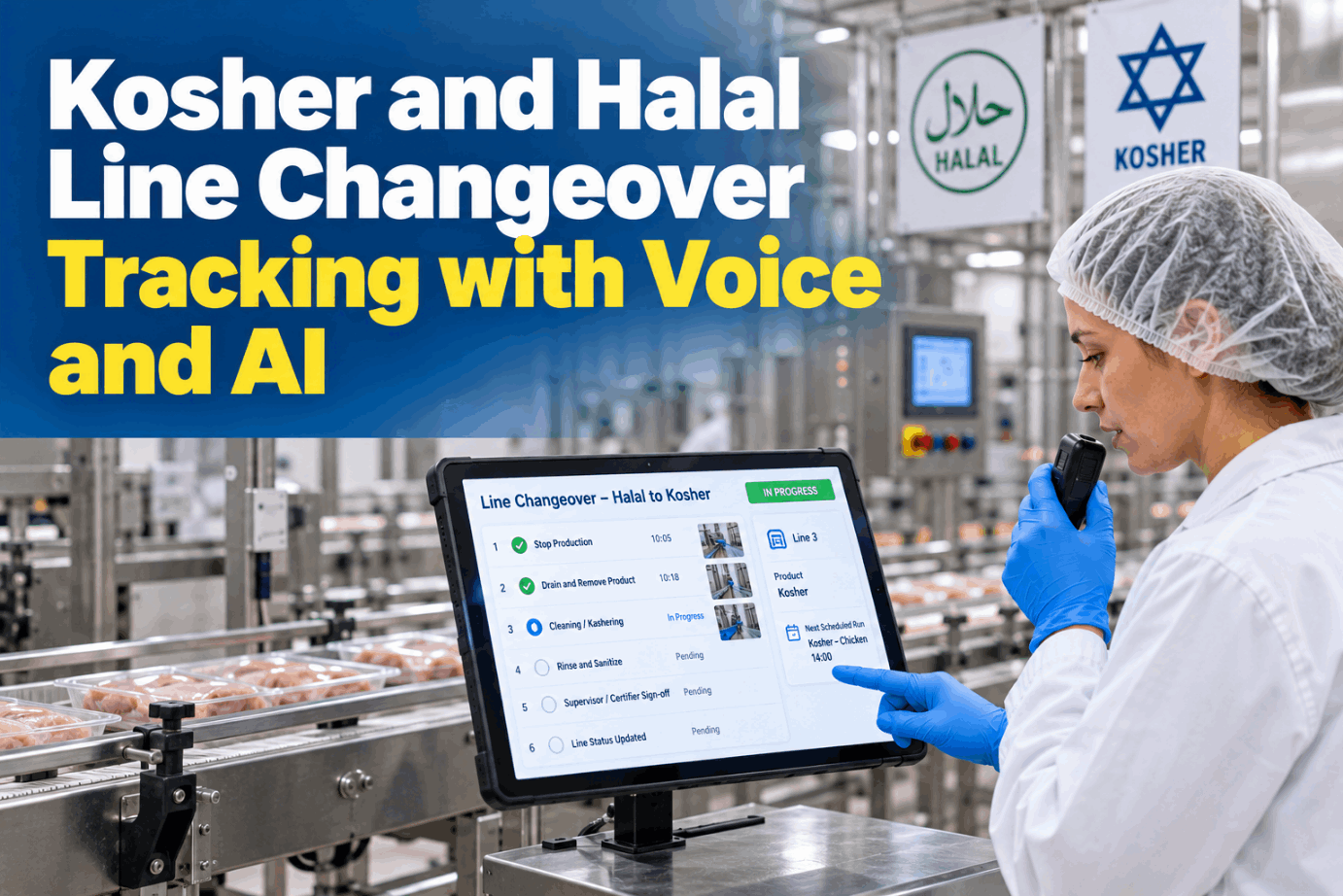
A shared line that ran a hot dairy product on Monday and is booked for a pareve product on Tuesday is only ready once every changeover step is done, the idle period has passed and the person your certifier requires has signed off. Many plants still track that on paper travellers and shift memory, which is how the right product ends up on a line with the wrong status. Kosher and halal changeover tracking keeps every step, sign-off and line status in one record and holds the start until they match. See it in a short certification workflow demo.
Every Changeover Confirmed, Every Sign-Off Captured, No Start on the Wrong Status
iFactory Certification Workflow lets crews confirm each changeover step by voice and captures the certifier's sign-off. Production stays blocked until the line status matches the scheduled product, and your agency's rules decide what each changeover needs.
The Status a Line Carries Into the Next Run
Under kosher rules, foods fall into three groups: meat, dairy and pareve, which is neither. The OK explains that a pareve product cannot be produced on meat or dairy equipment unless the line is kosherized first. Equipment takes on the status of what last ran through it hot, so the line carries a status, not just the recipe. Halal asks a parallel question: has anything non-halal, or any najs (impurity), touched this line since it was last cleaned to the certifier's standard? Map your own status list with our certification support team.
Kashering Methods and When Agencies Typically Use Them
Kashering, or kosherization, returns equipment to kosher use. The principle is that equipment purges the way it absorbed, so the method follows how the item was used. OU guidance calls for hagalah water at a rolling boil, ideally 212°F, and lists libun kal times measured on the equipment itself. For hot production, agencies commonly require the item to stand idle for 24 hours first, known as eino ben yomo. The OK notes that kosherizing is done by the rabbi assigned to the plant, after staff clean the equipment and he inspects it. Your hechsher decides the method for every item. Review your equipment list in a changeover planning session.
OU guidance runs the 24 hours from the last hot use. If the item is then cleaned with hot water, the clock may need to restart. Record the last product time and the last hot cleaning time, and let your rabbinic coordinator decide.
Halal Changeovers: Najs, Cleaning and Sertu
Halal changeovers centre on keeping najs and non-halal materials away from halal product. American Halal Foundation guidance, for example, prefers dedicated equipment where possible and asks for halal runs before non-halal ones on shared lines. For the most severe impurity, Malaysia's MS 1500:2019 includes a sertu method in Annex A: seven washes, one of them with water mixed with soil. Standards differ, though. One Malaysian state guideline applies sertu only to dog licking and treats pig contact with plain washing. In the US, certifiers such as IFANCA and ISA review ingredients, lines and plant practices before approval. Check how your certifier's rules map to each line with our support team.
Know the Line Status Before Anyone Presses Start
iFactory compares each line's live status with the next scheduled product. If a dairy line is booked for pareve, or a halal run follows a non-halal one without its cleaning record, the start is held and the reason is spoken to the production lead.
Dedicated, Shared or Single-Status: Classify Every Item
The easiest changeover is the one that never happens. Dedicated equipment keeps one status for life, so it needs normal cleaning only, with no idle clock, kashering or sertu. Shared equipment needs a changeover every time its status changes. Some parts may not be kasherable in your agency's view and must stay on one status or be replaced. Classify each item once, agree it with your certifier, and every changeover then pulls the right steps from that list. Book an equipment classification review.
How the Production Block Works, Step by Step
The software does three things people find hard to do reliably on a busy shift. It remembers each line's last status, it keeps the idle clock, and it refuses to release the line until the record is complete. Crews confirm each step by voice with a read-back, so nobody stops to write. The certifier's sign-off is the only step that changes a line's status. Talk through the logic with our implementation team.
Records Certifiers Ask For, in One Changeover Record
Agencies differ in what they check, but the questions are familiar. OU guidance asks plants to clear every raw material change against Schedule A, keep a current file of ingredient certification letters, hold a live set of product labels and give ready access to temperature data where it is part of the kosher program. ISA asks for a full raw material listing for each product. A changeover record ties all of this to the line and the run. See a sample record in a short walkthrough.
A Changeover Checklist Crews Can Tick
Use this as a starting point and adjust it to your certifier's written requirements. Each item can be ticked here or confirmed by voice during the changeover. Label control matters as much as cleaning: a pareve product packed in a dairy label, or the reverse, is a status error even when the line is right. For a version built around your own lines, ask our support team.
Three Changeovers and How the Workflow Handles Them
These are illustrations, not case studies, and the right response always follows your certifier's rules. Walk through your own scenarios in a scenario review.
Size the Admin Time With Your Own Numbers
The biggest value is a status error that never reaches a pack, which is hard to price and should not be inflated. The measurable part is time spent writing, chasing and filing changeover paperwork. Every input below is assumed, to show the arithmetic only. Our team can help you build the case with your own figures.
Add audit preparation time and fewer schedule surprises, but only with your own data. Leave recall or lost-certification costs out of the sum unless your history supports a figure.
Voice Workflow, Line Interlock and AI Server in One Package
iFactory delivers the Certification Workflow turnkey. A pre-configured NVIDIA AI server ships racked and ready, with speech models on site so voice confirmations work on the floor and certification records stay in your plant. You rack it, plug in power and Ethernet, and the AI is live. To scope it for your lines, request a turnkey quote.
- Pre-configured NVIDIA AI server, racked and ready
- On-site speech models for changeover steps
- Equipment list with status and classification
- Changeover rules set from your agency's requirements
- Line start interlock linked to the schedule
- Certifier sign-off capture and audit records
- 24×7 remote monitoring of models and hardware
Equipment classified with your certifier, rules agreed, server installed and linked to the schedule.
Voice steps and sign-offs run on one shared line, with the interlock in warning mode.
Start blocking switched on, crews trained, then extended to every shared line.
Changeover Tracking Built Around Your Certifier
iFactory does not interpret religious law. It records what your agency requires, keeps the clock and holds the line until the record is complete. Plan a single-line pilot with our support team.
Kosher and Halal Changeover Questions From Plant Managers
Put Every Changeover on the Record
Confirm steps by voice, capture the certifier's sign-off and block production until the line status matches the scheduled product. The full system is delivered turnkey and goes live in 6 to 12 weeks.