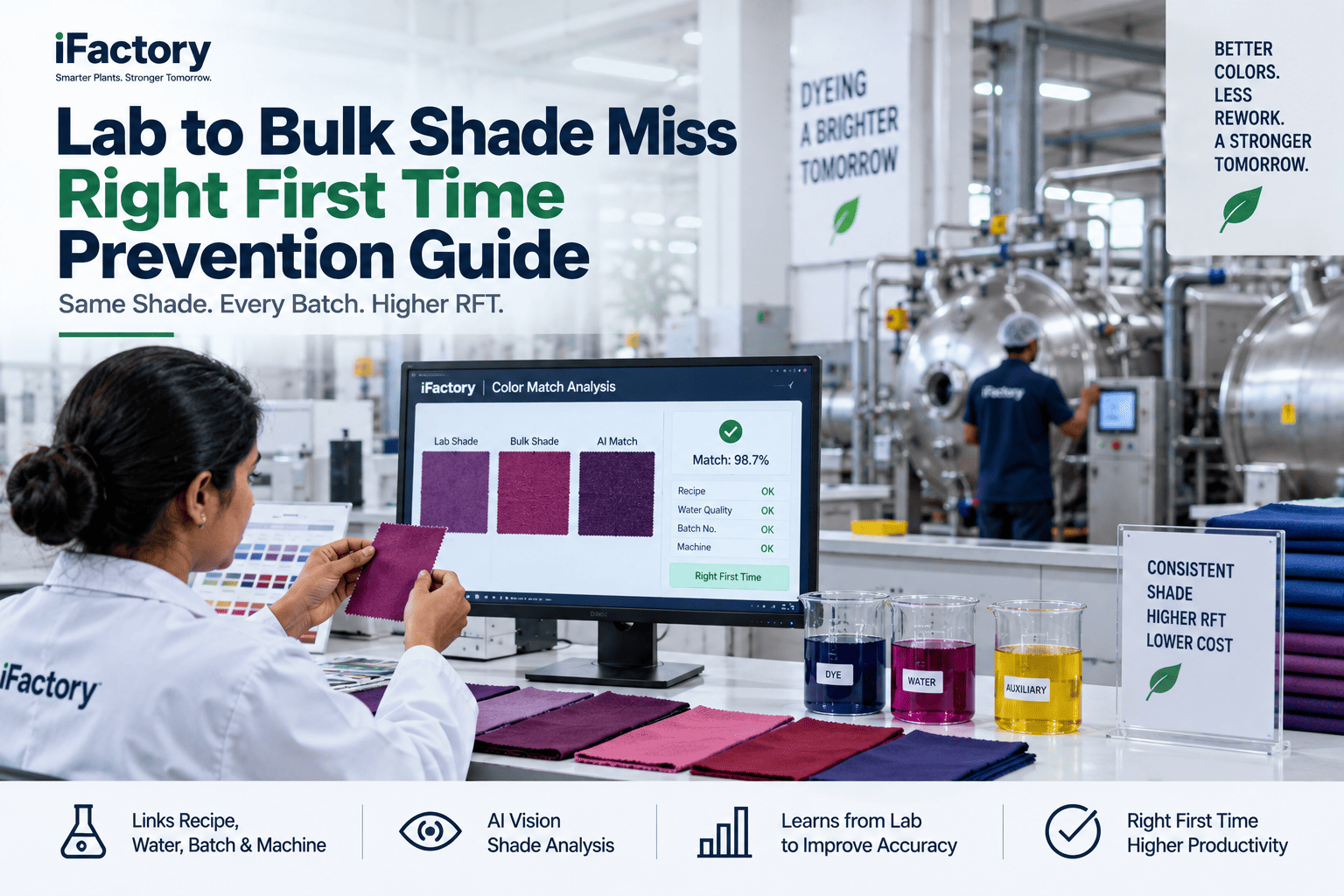
Lab to Bulk Shade Miss Right First Time Prevention Guide
By Jackson T on September 19, 2026
The lab dip was approved. The recipe was transferred exactly. The bulk came out off shade. Every dyehouse knows this sequence, and every dyehouse has the same conversation afterwards about whether it was the water, the substrate, the machine or the dyestuff lot — a conversation held from memory, because the lab record holds the recipe and almost nothing about the conditions the bulk actually ran in. Right First Time stalls in the seventies not because the lab is inaccurate, but because the lab is matching in a world that the bulk machine does not live in. iFactory's dyehouse AI ties recipe, water, substrate batch and machine to the shade that came out, and writes what it learns back into the lab record.
AI Quality Control for the Dyehouse
Lab to Bulk Shade Miss Right First Time Prevention Guide
Predict how a lab-approved recipe will actually come out in bulk. The model ties water, substrate batch, machine and dosing to measured shade, flags the lots at risk before they run, and feeds the correction back to the colour lab.
When a bulk lot misses shade, the visible cost is an addition or a strip and re-dye. The real cost is the machine hour that produced nothing sellable, the water and steam consumed twice, the delivery date that has now moved, and the fibre that has been through another thermal cycle and will never be quite as strong or as bright. On top of that sits the quiet cost: because misses are expected, planners build slack into every dyeing schedule, and that slack is capacity you own and do not use. Right First Time is not a quality metric with a quality benefit. It is the single number that governs how much your dyehouse can actually produce.
The Recipe Transfers. The Conditions Do Not.
A lab dip and a bulk lot are the same chemistry in profoundly different circumstances. Every one of these differences shifts dye uptake, and because they shift it together, the error is never a simple constant you can correct once and forget.
The same recipe, two different worlds
Experienced colourists correct for this from memory, machine by machine. That knowledge works until the person is on leave, the water changes with the season, or a new spinning lot behaves differently. The model does the same job from the record, every time.
Know the Risk Before the Machine Is Loaded
The prediction runs on the lot you are about to dye, using the recipe as issued and the conditions that lot will actually meet. Where the risk is high it names the reason, which is what makes the recommendation usable rather than merely alarming.
Bulk shade risk — before the batch runs
Lotapproved lab dip · package dye machine 6
Substratespinning lot 4471, first use
Predicted shade against standardoutside tolerancewatch
Water hardness this weekabove the usual bandwatch
Substrate dye uptakeunknown lot, no historywatch
Machine 6 correction factorappliedOK
Dosing profileas specifiedOK
Run a fast lab check on the new spinning lot before loading, and apply the recommended recipe scaling for this week's water. The alternative is finding both problems at the end of a four-hour cycle.
Right First Time Is Won Lot by Lot
No single change fixes RFT. What moves it is closing the loop repeatedly: predict, run, measure, and feed the difference back so the next prediction on that machine with that substrate is better. The distribution of shade differences tightens, and the lots that would have needed an addition stop appearing.
Shade difference at first check, lot by lot
The points that matter are the ones above the line. Each is a machine cycle spent producing something that has to be corrected, and each one removed is capacity returned without any capital spend.
What the Model Ties Together
Four inputs explain most lab-to-bulk misses, and the model holds all four against the shade that actually came out.
Recipe and scaling
How the approved lab recipe should be scaled for the liquor ratio, batch size and dosing profile of the machine that will run it.
Water quality
Hardness, pH, iron and residual chlorine tracked as live conditions rather than as an annual assumption about the supply.
Substrate batch
Dye uptake by spinning lot and supplier, so a substrate that has never been dyed before is treated as the risk it is.
Machine fingerprint
Each vessel's own bias, learned from its history and updated after every lot, then written back into the lab record.
What Shade Miss Prevention Delivers
Higher Right First Time pays out in machine hours, in utilities and in delivery reliability at the same time.
Higher
Right First Time
fewer lots needing correction
Fewer
Additions and re-dyes
machine hours back in the schedule
Lower
Water and steam
no second cycle on the same yarn
Better
Delivery reliability
dates that hold without slack
Frequently Asked Questions
Why do lab dips fail in bulk even when the recipe is followed exactly?
Because the recipe is only one of the variables. Liquor ratio changes dye exhaustion, batch size changes heat-up and flow behaviour, plant water carries hardness and metals that lab water does not, dosing is profiled in bulk and manual in the lab, and the substrate is a real spinning lot rather than a reference yarn. Each shifts uptake a little, and they interact, which is why the correction that worked last month does not reliably work this month.
What Right First Time improvement is realistic?
It depends entirely on where you are starting and why you are missing. A dyehouse at a high RFT with occasional misses on new substrates has less to gain than one sitting in the seventies with a different correction factor in every colourist's notebook. The reliable first step is diagnostic: tie your last several hundred lots to their conditions and see how much of the variation is explained by water, substrate and machine. That analysis tells you the size of the prize before you commit to anything.
Do we need a spectrophotometer and a digital lab system?
A spectrophotometer with recorded readings is important, because the model has to be trained against measured shade rather than visual assessment. Most dyehouses already have one and a colour management system holding the lab dips and standards. Beyond that we need the process record: recipes as dosed, machine and cycle data, water analysis and the substrate lot. Where water is only tested occasionally, increasing that frequency is usually the single highest-value change.
Does it replace our colourists?
No. It captures what the experienced ones already know and makes it available to everyone on every shift. A senior colourist who knows that machine 6 runs slightly deep on turquoise and that the borewell gets harder after the monsoon is carrying a model in their head. The system writes that model down, keeps it current and applies it consistently, which matters most when that person is not at work.
How does the learning loop reach the lab?
Each completed lot contributes its measured shade back against the conditions it ran in, and the updated correction for that machine and substrate is written into the lab record used for the next dip. That is what keeps the lab matching for the bulk that exists today rather than for the bulk of two years ago, and it is the part that makes the improvement hold instead of decaying after the project ends.
Find the Miss Before the Machine Is Loaded.
See Your Own Lab-to-Bulk Misses Explained
Bring your lab records, spectro readings and machine data for the last few hundred lots. We'll show how much of your shade variation is water, substrate, machine or recipe scaling, and what the prediction would have flagged.