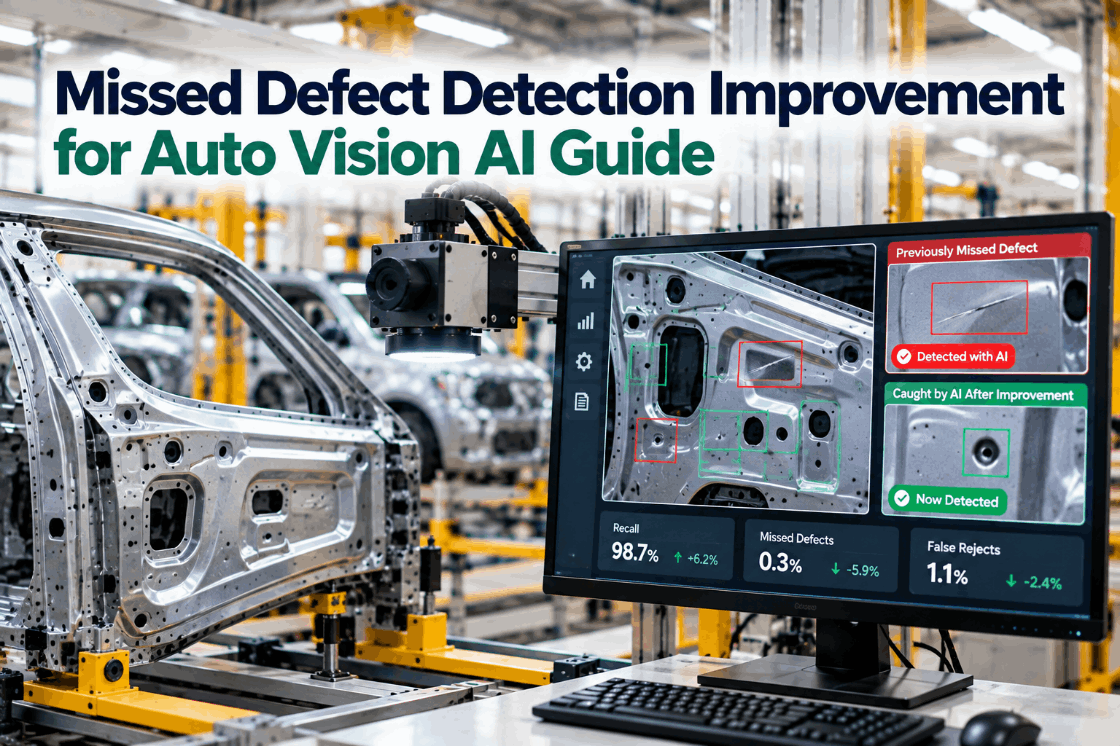
A false reject is annoying and visible. A missed defect is silent. It passes the station, travels down the line and surfaces later at audit, at the dealer or in the field, when it is far more expensive to fix. For automotive plants, improving recall, the share of real defects a vision system catches, is the part of AI inspection that protects customers and brands. This guide explains how to measure misses honestly, why vision models miss defects, and the three main ways to close the gap: recall tuning by defect class, a disciplined edge-case retraining loop and ensembles that give hard calls a second opinion. To see recall tracking on your own stations, book a short walkthrough.
Missed Defect Detection Improvement for Automotive Vision AI: Raise Recall Where It Counts
Recall targets set by defect class, escapes turned into training data and hard calls checked by a second model, so fewer defects leave the station unseen.
Why Missed Defects Are the Costliest Failure
Every inspection system makes two kinds of error: it rejects good parts, and it passes bad ones. The first is visible at the station. The second is not. A missed defect is found, if at all, somewhere downstream: at end-of-line audit, in a customer audit, at the dealer or in warranty data. The later it is found, the more it costs and the harder it is to trace back.
People miss defects too. In a Sandia National Laboratories study, trained inspectors caught 85% of defective parts, meaning roughly one in seven was missed. At industry scale, the consequences of escapes show up in recall data: NHTSA reports 997 vehicle safety recalls in the US in 2025, covering more than 31 million vehicles. Not all of those relate to visual defects, but they show what is at stake when problems reach the field.
AI vision can raise recall well above human levels, but only if misses are measured and managed deliberately. We can review how your current stations track escapes on a call.
How to Measure Recall and Escapes Honestly
Misses are hard to measure because, by definition, the system did not see them. Three sources of evidence fill the gap.
Illustrative numbers. The same study also scores false alarms on the good parts in the master set.
Downstream escapes are the most valuable evidence of all, because they show real misses under real conditions. Linking them back to the station is part of every integration.
Why Vision Models Miss Defects
Understanding the cause of a miss decides the fix. These are the most common causes on automotive lines.
Defects that occur rarely have few training examples, so the model has little to learn from.
If a pinhole is smaller than a few pixels, no model will find it reliably; the camera or lens must change.
Thresholds raised to cut false alarms can quietly push recall below target.
A new colour, supplier finish or lighting change produces defects that look different from training.
Defects on surfaces the camera cannot see, or hidden by later assembly, cannot be caught at that station.
A model can be consistently weak on one pattern, such as faint dents on light colours.
Two of these causes, optics and coverage, cannot be fixed by retraining. That is why every miss investigation starts with the image: was the defect visible at all? Our engineers check this first in every review.
Setting Recall Targets by Defect Class
A single threshold for all defect classes forces a bad compromise. Recall targets set per class let the system be most sensitive where misses matter most.
- Same sensitivity for every defect type
- Rare, serious defects treated like cosmetic ones
- Tuning for false alarms lowers recall everywhere
- Average recall looks fine, weak classes hidden
- No link to defect consequences
- Hard to explain to customers
- Sensitivity set by defect consequence
- Safety and function defects get the highest recall
- Cosmetic classes balanced against false alarms
- Weak classes visible in per-class reporting
- Targets tied to the control plan
- Easy to show in audits
A practical way to set targets is to start from the control plan and the PFMEA. Defects with high severity get the strictest recall targets and the lowest thresholds, even at the cost of more false alarms. Minor cosmetic defects can accept slightly lower recall if that keeps false alarms under control.
Targets should be reviewed whenever the PFMEA changes or a customer complaint reveals a new risk. Target tracking is built into our quality reports.
The Edge-Case Retraining Loop
Most misses come from edge cases: defects that look different from anything in training. The fix is a loop that turns every escape and near miss into a lesson.
Collect escapes, near misses and low-confidence calls with their images.
Quality engineers confirm each case and label it consistently.
Find similar cases in stored images and add controlled variations.
Train a new version with the enriched edge-case set.
Check recall on a held-out golden set and false alarms on good parts.
Approve under change control and watch the class closely.
Stored images are a major asset here. When one pinhole escapes, the system can search weeks of stored images for similar seams, often finding more examples than anyone expected. Those examples make the retraining far more effective than a single new image would.
The golden set must stay untouched by training. If edge cases leak into it, validation scores rise without real improvement. Keeping it separate is basic discipline, but it is often skipped under time pressure.
Each loop is recorded with the escape that triggered it, so auditors can see what was learned and when. See the loop in a demo.
Ensembles and Second Opinions for Hard Calls
Some defects are hard enough that one model is not enough. Ensembles combine several views or models so that one catches what another misses.
Anomaly detection deserves special mention. Because it learns what good looks like rather than what each defect looks like, it can flag a new defect type the first time it appears. That makes it a useful safety net beside class-based models, especially after launches and supplier changes.
Ensembles fit best at stations with severe defect consequences, such as welds, seals and safety-related fasteners. Our team can suggest where they pay off.
Validation Checklist for Recall
Use this checklist to validate recall before each release and at regular intervals afterward.
Seeded defect runs are the simplest way to prove a live station still performs. We can help design a seeding plan that fits your line rate.
How iFactory Improves Missed Defect Detection
Sensitivity set by defect severity and consequence.
Downstream finds linked back to the station and image.
Stored images searched for cases similar to each escape.
Confirmed cases added and versions validated before release.
Second models, views and anomaly checks on hard stations.
Validation data kept separate and versioned.
It works with your existing stations, audits and warranty data. Share a recent escape and we will show how it would be traced and learned from in a session.
Find the Defects Your Stations Are Missing
Pick a station with known escapes. We run a master set study, seed defects on the live line and set up the edge-case loop, reporting recall by class for the pilot period.
Downstream audit found a pinhole the model scored at 0.41. Escape added to the edge-case set and flagged for review.
An Escape Turned Into a Lesson
This exchange shows how a body shop quality engineer might work through an escape with iFactory.
iFactory ships as a pre-configured NVIDIA AI server, racked and ready with the defect detection and recall monitoring models loaded. Rack it, plug in power and Ethernet, and the AI is live on your network. Our scope covers cameras and lighting at inspection stations and cells, PLC/SCADA and MES integration, cabling and network setup, operator and quality team training, and 24×7 remote monitoring.
Server installed, cameras and lighting mounted, PLC and MES links live, existing defect images and records loaded.
Models trained on your own parts, paint and variants, then run in shadow on one line with your quality team reviewing every call.
Rollout to the agreed stations under your change control, team training and 24×7 remote monitoring in place.
Hardware, software and integration come as one package. For pricing on your stations, contact our sales team.
Frequently Asked Questions
Recall is the share of truly defective parts the system flags. Its complement is the miss rate, which the AIAG MSA manual treats as acceptable below 2% in attribute studies.
Use master set studies with known defective parts, seeded defects on the live line, and downstream escapes traced back to the station. Report recall per defect class, not only as an average.
Common causes are rare defect classes with little training data, defects too small for the optics, thresholds raised to cut false alarms, new conditions such as colours or suppliers, and systematic blind spots.
It is a loop that captures escapes and low-confidence calls, labels them, finds similar cases, retrains the model and validates it on a separate golden set before release.
Where the consequence of a miss is severe, such as welds, seals and safety-related fasteners. Two models, multiple views, rules beside learning and anomaly detection all reduce blind spots.
Studies and escape tracing can start within days. Retraining and validation typically fit within a 6–12 week rollout. Plan it with our engineers.
Catch the Defects That Used to Get Away
iFactory sets recall targets by defect class, learns from every escape and adds second opinions where misses matter most, so fewer defects ever leave the station.
Weld pinholes are below the recall target and have a retraining action open.