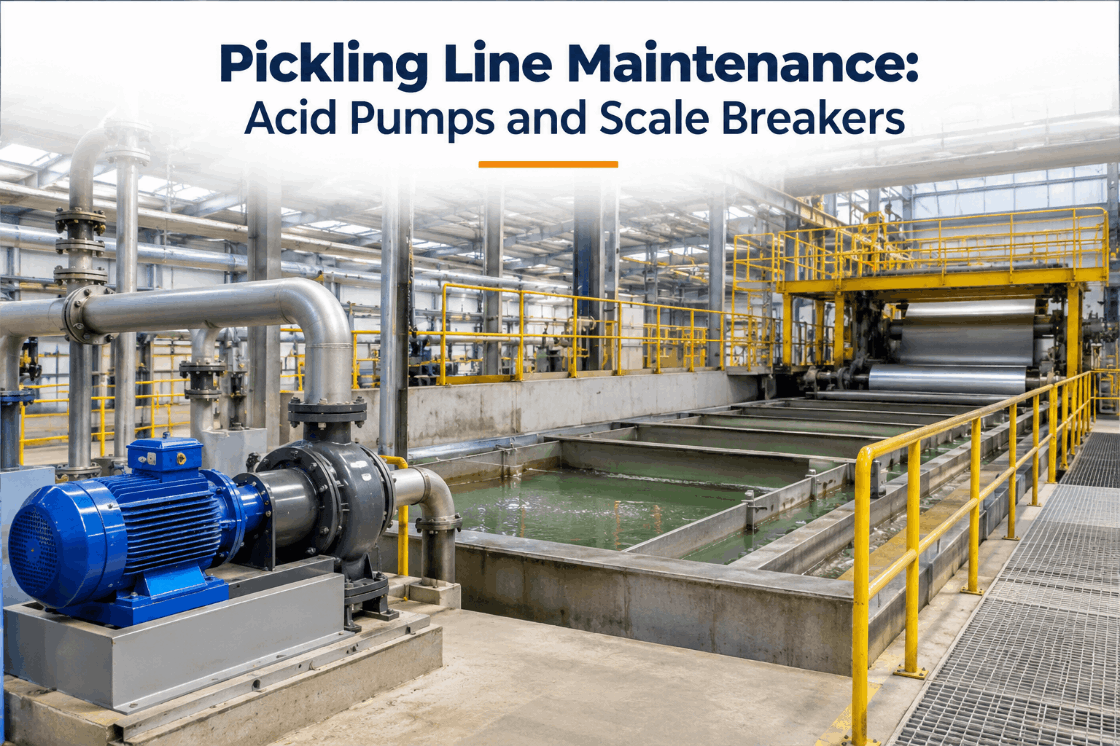
Pickling Line Maintenance: Acid Pumps and Scale Breakers

By David Cook on November 20, 2026

pickling-line-maintenance-acid-pumps-scale-breakers

A pickling line wears out its own equipment. Hot hydrochloric acid, chloride fume and scale fines work on pumps, linings, rolls and ducts every hour the strip runs, so most failures arrive as slow drifts in vibration, temperature, differential pressure and bath chemistry. This guide goes through the line asset group by asset group, with a PM template, a scrubber trend and a permit tied to every job. Bring your own line data to a short walkthrough.

PREDICTIVE AI + PM SCHEDULER

Pickling Line Maintenance for Acid Pumps, Tanks, Scale Breakers and Scrubbers

iFactory trends pump vibration, bath chemistry and scrubber differential pressure, schedules lining and roll PMs, and sends each job to a pickling line kanban with its safety permit attached.

Pickling section · Line 1Illustrative
Tank 1
HCl55 g/L
Fe125 g/L
Tank 2
HCl95 g/L
Fe90 g/L
Tank 3
HCl150 g/L
Fe50 g/L
P-2 circulation pumpvibration rising
Scrubber ΔP 1.9 kPa ↑ · packing check
PUSH PULL PICKLING LINE VS CONTINUOUS

Push-Pull or Continuous Changes Where the Wear Lands

Most carbon steel strip lines pickle in hydrochloric acid, and some older lines still run sulfuric. NZ Steel lists faster pickling, a brighter surface and less spent liquor among the reasons for HCl. Line type matters too: Tenova quotes continuous lines at up to 350 m/min and 2.2 Mt a year, and push-pull lines at up to 180 m/min, 750,000 t a year and strip up to 12 mm. Our support engineers can map your layout.

PUSH-PULL LINE
  • Each coil threads on its own, so tank floors and entry guides meet every head end; Tenova builds flat granite tanks to ease threading
  • Thicker strip, up to 12 mm, bends harder through the scale breaker
  • Gaps between coils give short windows for walk-round checks
  • Pumps and scrubber fans follow a stop-start rhythm
CONTINUOUS LINE
  • Welder and loopers keep the process section moving between coils
  • Higher speed means more acid circulated and more fume per hour
  • Few natural stops, so most PM waits for a planned outage
  • Condition trends matter more because there is less time to look
PICKLING LINE ASSET GROUPS

Seven Asset Groups and How Each One Fails

Splitting the line into groups gives every PM an owner and every alarm a home. Each group fails its own way: rolls wear, linings crack, pumps lose flow, exchangers foul and scrubbers load up. Walk through the grouping in a live demo.

1 · Scale breaker and leveler
Rolls that crack the scaleFlexing and stretching the strip cracks the scale so acid reaches the steel, per NZ Steel. Watch roll bearings, elongation against set-point and roll marks.
2 · Acid tanks and linings
Rubber plus acid brick, or PP/FRPWatch shell temperature, weeps at nozzles and flanges, and the age of each lining repair.
3 · Circulation pumps
Lined, mag-drive or mechanical sealSundyne sells ETFE-lined sealless magnetic drive pumps for pickling acid. Trend vibration, power and flow.
4 · Graphite heat exchangers
Heating the bath with steamSGL Carbon notes graphite's high resistance to hydrochloric acid, in block, shell-and-tube or plate form. Watch approach and condensate.
5 · Squeeze rolls and rinse
Stopping acid carry-overWorn roll covers let more acid through to the rinse, where it shows as rising rinse conductivity.
6 · Fume scrubber
Packed tower and its pumpDifferential pressure, makeup water and recirculation flow describe its state between inspections.
7 · Acid regeneration plant
Spray roaster, kept briefAndritz says its roaster recovers acid at up to 18% HCl and yields iron oxide. Burners, roaster and absorber carry their own PMs.
One board
Every group, one kanbanEach job lands on the pickling line board with its permit, isolation list and parts.
CORROSION MONITORING SIGNALS

Corrosion and Wear Signals Worth Trending

Acid attacks slowly and mostly out of sight, so the useful signals are indirect: heat where there should be none, conductivity in water that should be clean, power that no longer matches flow. iFactory reads them against each other before it raises a job. Ask our support team which tags you already have.

Signal
Asset group
What a change can mean
First response
Vibration, bearing temperature
Pumps, scale breaker
Bearing wear, misalignment, cavitation
Plan swap to standby
Motor power against flow
Sealless pumps
Flow loss or running dry with no outside leak
Check suction and level
Shell temperature or thermal scan
Tanks, ducts
Lining breach letting acid reach the steel
Inspect at next outage
Condensate conductivity
Graphite exchangers
Acid crossing into the steam side
Isolate and test
Rinse conductivity
Squeeze rolls, rinse
More acid carried out of the last tank
Roll cover check
Differential pressure
Fume scrubber
Packing or mist eliminator loading
Packing check
Free acid and iron
Tanks 1 to 3
Bath off target, sometimes from a pump or heating fault
Chemistry review
How acid strength is actually measured

Bath strength is two numbers: free HCl and dissolved iron, mostly as FeCl2. They come either from titrating a sample, as Metrohm's process note describes for HCl, Fe2+ and Fe3+, or from inline density and conductivity, which infer both through a calibrated model. iFactory labels which source each value came from, and inline meters still get regular titration checks.

Tell a Worn Pump From a Starved One

When a circulation pump starts to shake, iFactory checks its power, flow and tank level before anyone writes it up, and the job reaches the kanban with its permit already attached.

Line 1 pickling · Mechanical tech and iFactory · illustrative
Mechanical techP-2 sounds rougher than last week. Bearing, or is it sucking air?
iFactoryP-2 bearing vibration is up 40% over nine days. Power, flow and Tank 2 level are steady, so starved suction is unlikely. Bearing wear fits better.
Mechanical techSwap to P-2B at the next coil gap and raise the bearing job.
iFactoryJob on the pickling kanban with the line-break permit and isolation list attached. P-2B start logged.
HCL PICKLING NESHAP

Where 40 CFR 63 Subpart CCC Meets the PM Plan

In the US, subpart CCC covers major-source plants that pickle carbon steel in a solution of 6% or more HCl by weight at 100 °F or higher, plus HCl regeneration plants. Existing lines must hold HCl to 18 ppmv or 97% collection efficiency; existing regeneration plants, to 25 ppmv HCl and 6 ppmv chlorine. Several of its items are maintenance tasks in all but name. Check your scope in a compliance walkthrough.

§63.1160(b)(1)(i)
Scrubber differential pressure, once per shiftBecomes a shift log reading with a trend line, so a slow climb is visible.
§63.1162(a)(2)
Makeup water flow, monitored continuouslyRecorded at least once per shift; a flow under the performance-test minimum triggers an alert.
§63.1160(b)(1)(iii)–(iv)
Clean internals, inspect the scrubberNozzles, baffles, droplet eliminators, exchanger elements and dampers; the rule says "at intervals of no less than 3 months".
§63.1160(b)(1)(vi)–(vii)
Act within 1 working day, sign the recordJob timestamps and a sign-off by the responsible maintenance official.
Your permit may say more

State rules and your air permit can add to the federal text, and this page is not legal advice. Confirm applicability, limits and intervals with your environmental team before you build PMs on them.

FUME SCRUBBER MAINTENANCE EXAMPLE

Worked Example: Scrubber ΔP Climbing Over Six Weeks

Every number here is assumed. The packed tower's clean baseline is 1.2 kPa at normal fan load. Over six weeks the shift readings climb while makeup water holds steady, which points at the packing or the mist eliminator rather than the water supply. Our support engineers can rerun this on your tags.

1.2Wk 1
1.3Wk 2
1.4Wk 3
1.6Wk 4
1.7Wk 5
1.9Wk 6
Weekly average differential pressure, kPa · assumed values
Rise from baseline1.9 − 1.2 = 0.7 kPa
As a share of baseline0.7 ÷ 1.2 = 58%
Alert band, assumed 1.5 × baseline1.5 × 1.2 = 1.8 kPa, crossed in Wk 6
Makeup water, assumed minimum 3.5 m³/h4.0 m³/h, above minimum
What the crew does with it

A packing and mist eliminator inspection goes on the next outage, the recirculation pump discharge pressure is checked, and fan current is compared with its own baseline. If ΔP rises with falling recirculation flow instead, the pump comes first.

PICKLING LINE KANBAN AND PERMITS

Every Acid-Side Job Carries Its Permit

Going inside an acid tank is a confined-space entry with acid-gas and oxygen hazards, done under a written permit with gas testing, isolation and an attendant; in the US that is OSHA's permit-required confined space rule. AI does not change any of that. It keeps the permit, isolation list and gas test tied to the job so work cannot start without them. See the board in a short demo.

Planned
Tank 2 lining inspectionOutage wk 14 · contractor booked
Confined spaceGas testLOTO
Permit check
Scrubber packing checkΔP trend attached
Permit to workFan isolation
In work
P-2 bearing swapRunning on P-2B
Line-break6 isolation points
Closed
Squeeze roll 3 coverRinse conductivity back to baseline
Permit closedSigned off
PICKLING LINE MAINTENANCE TEMPLATE

A PM Template by Asset Group

The frequencies below are illustrative. Your OEM manuals, lining contractor, air permit and failure history set the real intervals. Our support team can load your version.

Asset group
Each shift
Weekly
Monthly
Quarterly or outage
Owner
Scale breaker and leveler
Elongation against set-point
Bearing vibration route
Roll surface check
Roll change, bearing renewal
Mechanical
Acid tanks and linings
Level, temperature, leak walk
Shell temperature scan
Nozzle and flange check
Entry inspection under permit
Mechanical, contractor
Circulation pumps
Flow and power
Vibration route
Standby test start
Bearings, seal or containment shell
Mechanical
Graphite exchangers
Bath temperature against steam
Condensate conductivity
Approach trend review
Clean and pressure test
Utilities
Squeeze rolls and rinse
Rinse conductivity
Roll loading check
Cover inspection
Regrind or recover rolls
Mechanical
Fume scrubber
ΔP and makeup water log
Recirculation pump vibration
Spray nozzle flow
Internals and mist eliminator
Environmental
Regeneration plant
Burner and roaster temperatures
Absorber flows
Oxide handling check
Roaster and absorber inspection
ARP crew
Bath chemistry
Free acid and iron
Titration check of inline meters
Consumption trend review
Meter calibration
Process
PICKLING LINE MAINTENANCE COST AND ROI

What Unplanned Acid-Side Stops Cost You

No saving is promised here. Each input is marked assumed so the arithmetic can be checked; replace them with your own stop log, line rate and labour rate. Fill in real inputs during a costing call.

Unplanned stops from acid-side equipment a year4, assumed
Hours per stop, including re-threading6, assumed
Line throughput180 t per hour, assumed
Tonnes not pickled a year4 × 6 × 180 = 4,320 t
Emergency pump rebuilds5 a year × 2 fitters × 10 h = 100 h, assumed
Yearly exposure4,320 t × your margin + 100 h × your labour rate
TURNKEY AI DEPLOYMENT

Pump Models, Chemistry Trends and the Server in One Delivery

The server and the software are sold as one bundle: a pre-configured NVIDIA AI server, shipped racked and ready with the pump, scrubber and bath chemistry models already loaded, keeps line data on your site. You rack it, plug in power and Ethernet, and the AI is live. Our scope runs from cabling and the network through PLC/SCADA integration to operator training and 24×7 remote monitoring. Size the job in a scoping session.

What's Included
  • NVIDIA AI server, pre-configured and delivered in its rack
  • Connectors for line PLCs, pump drives and bath analysers
  • Wear models for each circulation pump and its spare
  • Scrubber ΔP and makeup water logs with trend alerts
  • PM scheduler loaded with your asset groups
  • Pickling line kanban with permits and isolation lists
  • Cabling, network, PLC/SCADA hookup, crew training and 24×7 remote monitoring
Live in 6–12 weeks
Wk 1–4
Rack and Connect

Server installed, pump, tank and scrubber tags linked, PM history and permits imported.

Wk 5–8
Learn the Line

Baselines built per pump and per tank; alerts checked by the crew before release.

Wk 9–12
Run the Board

Kanban and alerts live, then the regeneration plant and rinse added.

HOW iFACTORY FITS

Pickling Line Maintenance Software Beside Your CMMS

iFactory works alongside your line automation, bath analysers and existing CMMS rather than replacing them. Questions about your own systems can go to our support desk.

1
Trends wear and corrosion. Pump vibration, power, shell temperature and conductivity read together.
2
Labels bath data honestly. Titration and inline values kept apart, with the source on every point.
3
Schedules by asset group. Lining, roll, pump and scrubber PMs with owners and intervals.
4
Puts permits on the job. Every card on the kanban carries its permit, isolation list and sign-off.
1000+
Industrial sites already on iFactory
99.9%
Uptime for lines that run around the clock
6-12 wks
From racked server to a live pickling board
FREQUENTLY ASKED QUESTIONS

Questions Pickling Line Managers Ask

What does pickling line maintenance cover?
The scale breaker and leveler, acid tanks and linings, circulation pumps, graphite exchangers, squeeze rolls and rinse, the fume scrubber and the regeneration plant. Each group needs its own checks and owner, and you can walk through a sample plan built that way.
Does iFactory measure acid strength itself?
No. It reads free acid and iron from your lab titrations or from inline density and conductivity meters, keeps the two sources labelled, and trends them alongside pump and heating data.
Does AI change how we inspect tanks?
It changes when you look, not how you go in. Tank entry stays a permit-required confined-space job with gas testing, isolation and an attendant. Trends only help pick which tank and which zone to look at first.
Does 40 CFR 63 subpart CCC apply to our line?
It covers major-source plants pickling carbon steel in 6% or stronger HCl at 100 °F or more, and HCl regeneration plants. Your environmental team should confirm it, and our support team can map its scrubber items to PMs.
Should we trend mag-drive pumps differently from sealed ones?
Yes. A sealless pump can lose flow without leaking, so power and flow matter as much as vibration. Sealed pumps add seal flush and leak checks. See both in a pump trend demo.
Where should we start?
Start with the circulation pumps and the scrubber on one line, since both already have tags. Add tank shell scans and the PM board next, then the regeneration plant. To shape that first step, book a pilot planning call.

Keep Pumps, Linings and the Scrubber Ahead of the Acid

Trend wear and corrosion by asset group, schedule PMs with owners, and send every job to the kanban with its permit. Server, software and site work come as one package that goes live within 6 to 12 weeks.

Example shift view · Line 1
P-2 circulation pumpRunning on P-2B
Scrubber ΔP1.9 kPa · packing check set
Tank 2 free acid95 g/L · titration due
Squeeze roll 3Cover change closed
Every job on the board, every permit on the job

Share This Story, Choose Your Platform!