Predictive Maintenance for Bucket Elevators & Air Slides
By David Cook on August 26, 2026
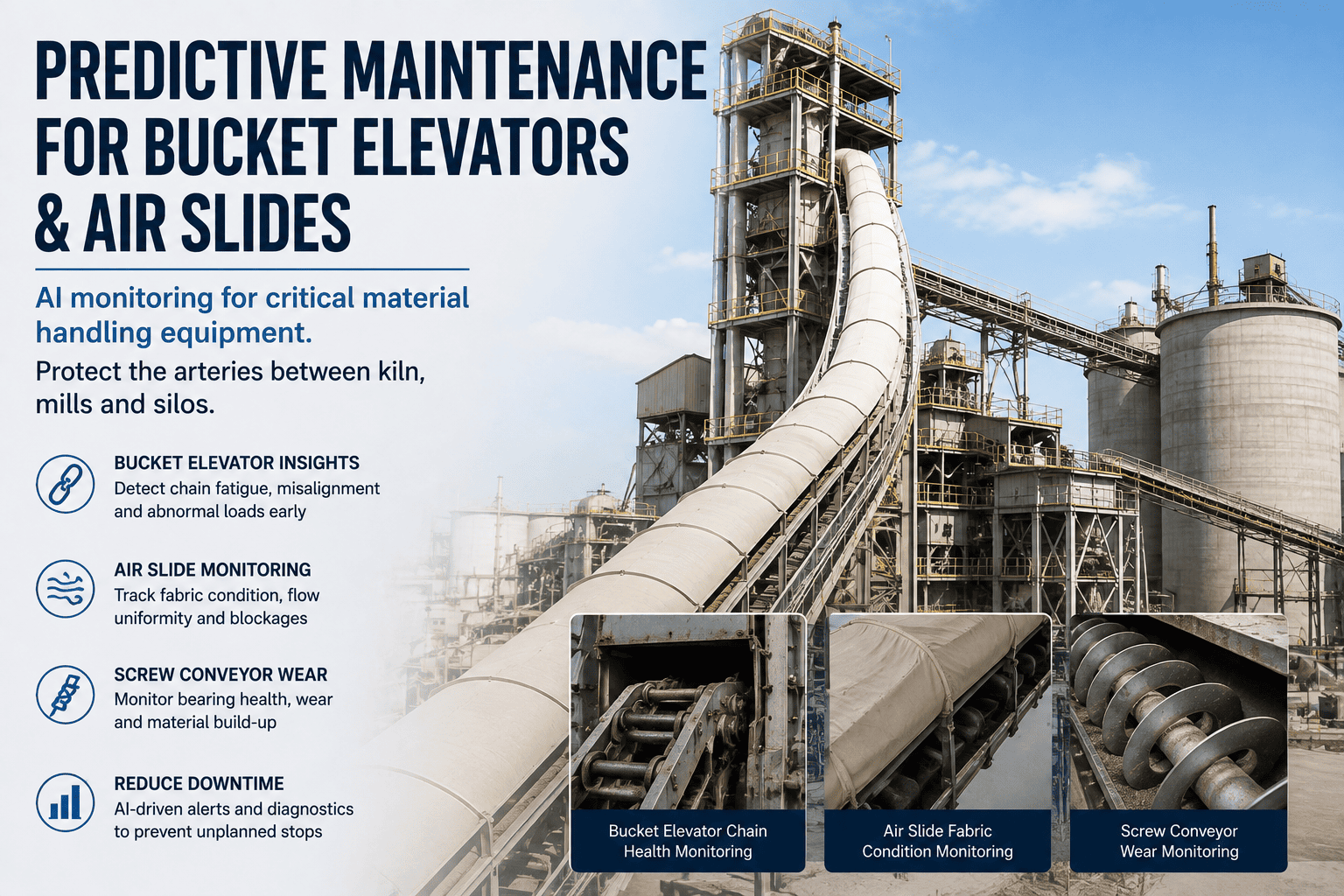
Every cement plant obsesses over its kiln and its mills, and forgets the machines that connect them. Bucket elevators, air slides, screw conveyors, and drag chains are the arteries of the plant — they move raw meal, clinker, and cement between every stage, and they do it in series. That is the quiet danger. A vertical roller mill going down slows one circuit; a bucket elevator chain snapping between the kiln and the silo stops everything upstream and downstream of it at once, buckets piled in the boot, a repair that is hot, confined, and slow. These arteries are the least-monitored assets in the plant and a large share of the unplanned stops. iFactory's Predictive Maintenance Engine watches them — chain fatigue, air-slide fabric, and screw wear — before the flow stops.
Material Handling Reliability for Cement Plants
Predictive Maintenance for Bucket Elevators and Air Slides
Track bucket elevator chain fatigue, air-slide fabric degradation, and screw-conveyor wear with AI — and protect the transport arteries between kiln, mills, and silos before a single failure stops the line.
Material handling gets overlooked precisely because it is simple. An elevator lifts, a slide flows, a screw turns — until it doesn't. The attention and the sensors go to the glamorous process machines, while the transport that ties them together runs to failure. And because the flow is serial, that failure is expensive out of all proportion to the machine: a torn air-slide fabric or a stretched elevator chain does not slow production, it halts it, and often at the worst place to reach. Watching the arteries is some of the highest-leverage predictive maintenance a plant can do.
The Arteries Between Every Stage
Draw the plant as its flow and the material-handling links are the lines between the boxes. Every one is a single point through which everything must pass — which is exactly why each deserves to be watched.
Material handling links the whole line
Raw mill
elevator
Preheater / Kiln
drag chain
Cooler
elevator
Clinker silo
conveyor
Cement mill
air slide
Cement silo
elevator
Packing
Every link is in series with the whole plant. One artery blocked and the material stops — which is why a cheap conveyor can cost more downtime than an expensive mill.
Two Ways an Artery Fails
Material-handling failures come in two shapes, and they need catching in different ways. Some fail suddenly — a fatigued elevator chain runs fine until it breaks. Others fail creeping — an air-slide fabric clogs slowly until flow chokes off. The predictive engine reads both: the fatigue trend before the break, and the gentle decline before the blockage.
Sudden
Chain fatigue to break
Runs healthy until the chain lets go. The engine reads elongation and load trends and flags the fatigue while there is still time to plan the change.
Creeping
Fabric clog to blockage
Flow fades as the fabric clogs and fluidization is lost. The engine sees the decline in differential pressure and throughput long before the slide chokes.
What We Watch on Each Machine
Each artery has its own failure modes and its own tell-tale signals. The engine is configured per machine class, so the diagnostics match how that machine actually wears.
Bucket elevators
Chain fatigue and elongation, sprocket and bearing wear, bucket loss
Signals: motor load, vibration, chain elongation, speed
A broken chain piles buckets in the boot — the longest stop on the list.
Air slides
Fabric wear, clogging and tearing, loss of fluidizing air
Signals: differential pressure, fluidizing air flow, throughput vs power
Lose fluidization and fine powder stops flowing — a blockage, not a slowdown.
Screw conveyors
Flight wear, hanger bearing wear, shaft and coupling faults
Signals: motor load, vibration, bearing temperature
Worn flights lose capacity first, then risk seizing the screw entirely.
Belt and drag chain
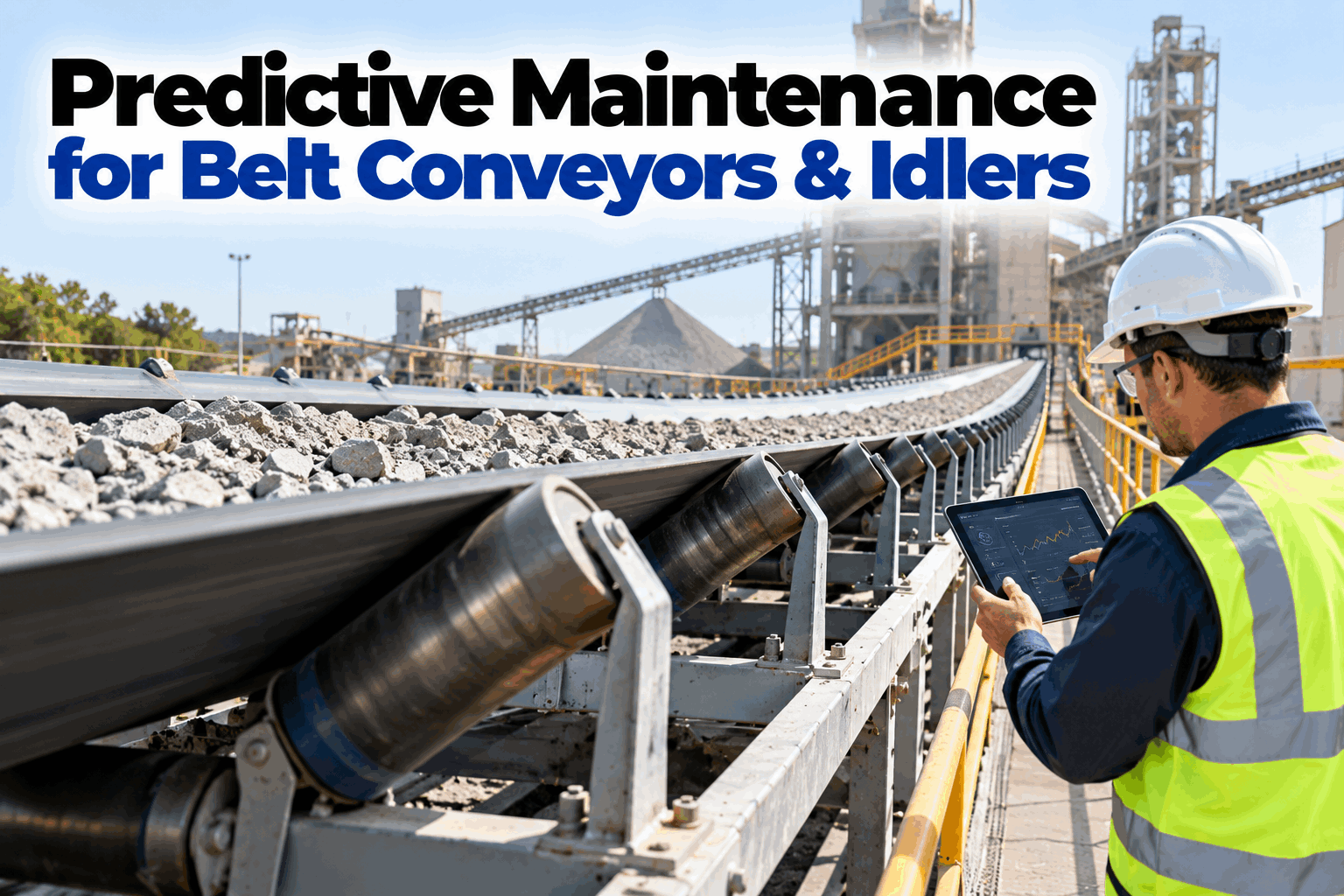
Belt and chain wear, mistracking, idler and roller failure
Signals: load, speed and slip, vibration
Mistracking and wear build quietly toward a tear or a jam.
Which of your arteries would take the whole line down tomorrow? Book a 30-minute demo and we'll show the engine reading your elevators and slides.
What Material Handling PdM Delivers
Watching the transport the plant takes for granted turns its most disruptive failures into planned work.
Caught
Chain fatigue
the break planned, not suffered
Seen
Fabric clogging
the slide cleaned before it chokes
Fewer
Line stops
serial arteries kept flowing
Ranked
By impact
the arteries that stop everything come first
Frequently Asked Questions
Can you predict a chain break, which seems to happen without warning?
A chain break looks sudden but the fatigue behind it is not. Chain elongation, changes in drive load, and vibration signatures develop over time as links and pins wear, and the engine trends those to flag the fatigue well before the break. The failure event is abrupt; the degradation that causes it is gradual and detectable, which is exactly what makes it predictable.
How does it monitor an air slide, which has no rotating parts?
By watching the flow rather than the mechanism. As the fabric membrane wears, clogs, or loses fluidizing air, the differential pressure across it and the throughput for a given input drift measurably. The engine tracks those signals to see the fabric degrading and to distinguish a developing blockage from normal variation, giving warning before flow chokes off.
Do we need to instrument every conveyor in the plant?
No. The engine often works from signals you already have, especially motor current and drive data, which reveal a surprising amount about load, wear, and blockage. Where a critical artery justifies it, adding a vibration or pressure point sharpens the picture. The right approach is to start with the machines whose failure stops the most and use the data already available on them.
How do we decide which arteries to watch first?
By consequence. Because material handling is serial, the machines to prioritize are the ones whose failure stops the largest span of the plant or sits in the hardest place to repair. The engine ranks assets by both condition and that impact, so effort goes to the arteries that would hurt most, not simply the ones that are noisiest.
How do we start?
The best next step is a demo on a few of your own arteries. We take the drive and any condition data from a critical elevator and air slide and show the fatigue and clogging trends the engine reads, along with how it would have flagged them ahead of a stop. That makes the leverage of watching the overlooked machines clear.
Protect the Machines That Stop Everything.
See the Engine Read Your Elevators and Slides
Bring the drive and condition data from a critical bucket elevator and air slide. We'll show the chain-fatigue and fabric-clogging trends the engine tracks, and how it flags them before the artery stops the line.